
2026 Rivian R2 vs. Tesla Model Y: The Midsize EV SUV Showdown
The newly launched Rivian R2 and the refreshed Tesla Model Y offer identically priced but philosophically opposite takes on the modern electric SUV.
By Factlen Editorial Team
- Efficiency & Tech Purists
- Buyers and analysts who prioritize aerodynamic range, software integration, and proven charging speeds.
- Utility & Adventure Advocates
- Drivers who value ground clearance, boxy cargo space, and rugged off-road capability over on-road handling.
- Value & Availability Shoppers
- Consumers focused on immediate availability and lower entry-level pricing.
What's not represented
- · Budget-conscious buyers waiting for sub-$40k EVs
- · Legacy automakers losing market share to these two dominant EV brands
Why this matters
For the first time in years, the world's best-selling electric vehicle faces a genuine, identically-priced competitor. Choosing between the Tesla Model Y and the Rivian R2 dictates not just what you drive, but whether your vehicle is optimized for urban efficiency or outdoor utility.
Key points
- The 2026 Rivian R2 Performance and Tesla Model Y Performance are priced identically at $57,990.
- Tesla's Model Y is quicker to 60 mph and more aerodynamically efficient for highway driving.
- Rivian's R2 offers significantly more cargo space (90.1 cu ft) and genuine off-road capability.
- Both vehicles use the NACS charging port, allowing the R2 to use Tesla Superchargers without an adapter.
- The Model Y Juniper refresh features a quieter cabin and improved suspension over previous years.
- Lower-priced trims of the Rivian R2 will not be available until 2027.
The midsize electric SUV segment is the most competitive automotive market in the world, and for years, the Tesla Model Y has been its undisputed benchmark. But 2026 brings a genuine showdown. Tesla has rolled out its highly anticipated "Juniper" refresh for the Model Y, significantly refining its ride quality and interior acoustics. Meanwhile, Rivian has finally launched the R2, a smaller, more affordable sibling to its flagship R1S that aims to disrupt Tesla's dominance with a rugged, outdoor-focused alternative.[4][5]
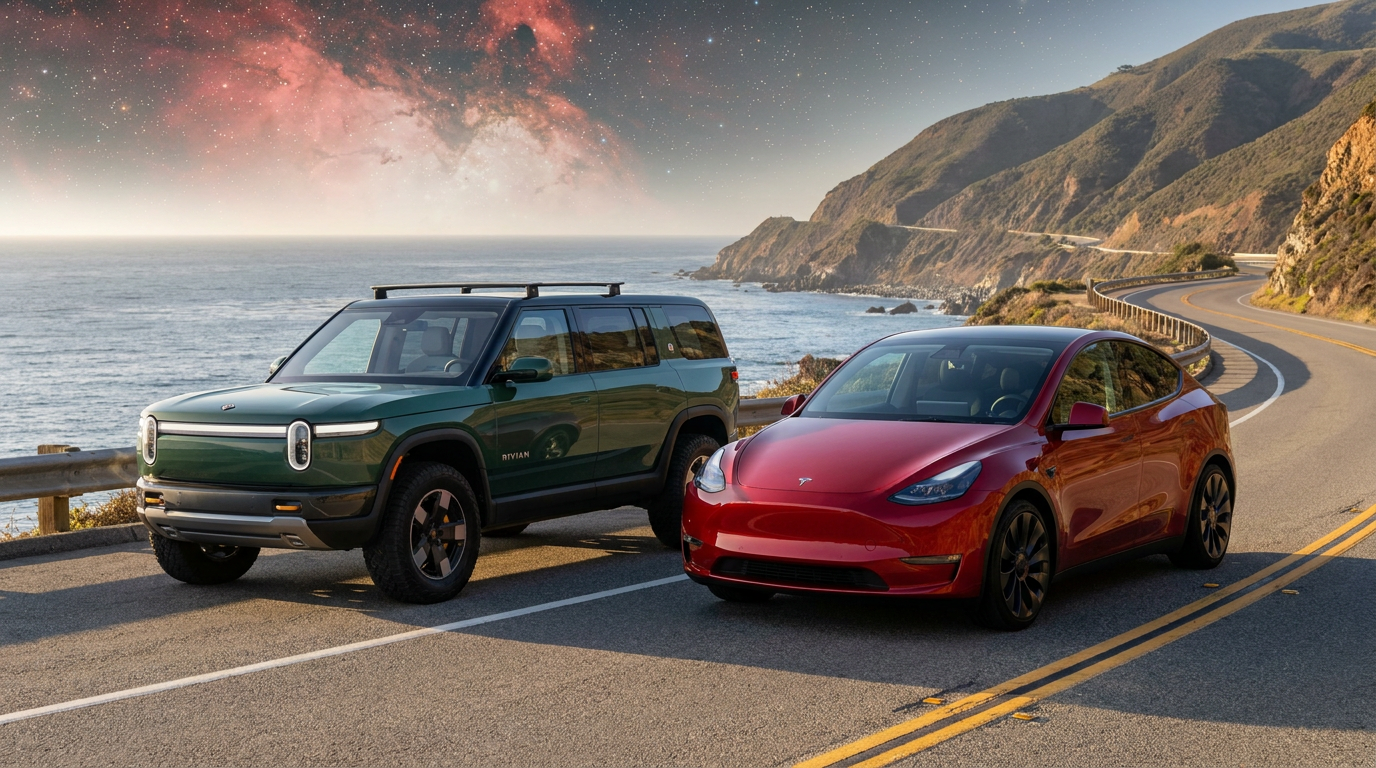
At the top of the range, these two vehicles are priced identically, with both the Rivian R2 Performance and the Tesla Model Y Performance ringing in at exactly $57,990. Yet, they represent entirely different design philosophies. The Model Y is a sleek, aerodynamic crossover tuned for on-road efficiency and tech-forward minimalism. The R2 is a boxy, traditional SUV built for outdoor versatility, cargo capacity, and genuine off-road capability.[1][2]
For buyers prioritizing straight-line speed and aerodynamic efficiency, the case for the Tesla Model Y is incredibly strong. Despite the Rivian R2 Performance boasting a massive 656 horsepower, the lighter Model Y is quicker off the line. The Tesla hits 60 mph in just 3.3 seconds, edging out the R2's 3.6-second sprint. Furthermore, the Model Y's teardrop shape allows it to cut through the air with minimal resistance, making it highly efficient for high-speed highway commuting.[1][3][7]

However, the case against the Model Y centers on its ultimate utility. While it offers a respectable 76 cubic feet of cargo space, its sloping roofline severely limits the ability to haul bulky, square items. Additionally, its ground clearance and suspension are strictly tuned for pavement; taking a Model Y on anything rougher than a well-graded dirt road risks damaging its undercarriage or getting stuck.[2][3]
The evidence for Tesla's on-road dominance is clear in the 2026 Juniper refresh. Reviewers note that Tesla dramatically improved the Model Y's suspension, transforming it from a notoriously stiff ride into a soft, composed, and quiet cruiser. With acoustic glass and new sound-dampening materials, the cabin is near-silent at highway speeds. Tesla also maintains a slight edge in charging speed, completing a 10-to-80 percent fast charge in roughly 24 to 26 minutes.[1][5]
Conversely, the case for the Rivian R2 is built entirely around utility and off-road capability. Where the Tesla prioritizes aerodynamics, the Rivian prioritizes sheer volume. Its boxy, upright design yields a massive 90.1 cubic feet of total storage, including a spacious front trunk. The seats fold completely flat, effectively turning the cabin into a cargo van or a level sleeping platform for camping.[2][6][7]

Conversely, the case for the Rivian R2 is built entirely around utility and off-road capability.
The primary case against the Rivian R2 in 2026 is its availability and aerodynamic drag. While the $57,990 Performance trim is available now, buyers looking for the promised $45,000 base model will have to wait until 2027. Furthermore, pushing a boxy shape through the air requires a massive 87.9-kilowatt-hour battery to achieve its 330-mile range, making it less efficient per kilowatt-hour than the Tesla.[1][6]
The evidence for Rivian's ruggedness is found in its physical dimensions. The R2 is built for the trail, featuring 9.6 inches of ground clearance, 32-inch tires, and impressive approach and departure angles of 25 and 26 degrees, respectively. Reviewers highlight that the R2 feels like a true SUV, capable of tackling rocky inclines and rutted trails that would leave the Model Y stranded.[2][3][7]
Inside the cabin, the two vehicles take divergent paths. Tesla's Juniper refresh leans heavily into futuristic minimalism, removing the steering wheel stalks entirely and adding wraparound RGB ambient lighting. All information is routed through a single 15.4-inch central screen. Rivian, conversely, offers a more traditional luxury feel with open-pore wood trim and, crucially, a dedicated 12.3-inch digital gauge cluster directly in front of the driver, alongside its 15.6-inch main display.[2][5]

Both automakers treat their vehicles as software-defined platforms, offering frequent over-the-air updates, and notably, neither supports Apple CarPlay or Android Auto. Tesla's Full Self-Driving software remains the industry benchmark for advanced driver assistance on city streets. Rivian is countering with its new Autonomy+ system, which utilizes a robust suite of cameras and radar, though it is still building the billions of miles of real-world training data that Tesla already possesses.[2][5]
Historically, Tesla held a massive advantage due to its proprietary Supercharger network, but in 2026, that moat has evaporated. The Rivian R2 is built natively with the North American Charging Standard (NACS) port, meaning it can pull up to any compatible Tesla Supercharger and plug in without an adapter. This levels the playing field for road trips, making the choice purely about the vehicle rather than the charging infrastructure.[1][7]
Ultimately, the trade-off comes down to how the vehicle will actually be used. The Model Y is the pragmatic choice for the urban commuter. It is slightly cheaper to run, faster to charge, and offers a more refined, sedan-like driving experience on paved roads. It is designed for buyers who want seamless technology and maximum on-road efficiency.[1][5]

The Rivian R2 is the emotional and versatile choice. It offers a distinct, characterful design in a segment dominated by aerodynamic blobs. It is engineered for buyers who genuinely spend their weekends outdoors, need maximum cargo flexibility, or simply prefer the commanding driving position and rugged aesthetics of a traditional SUV.[1][2]
How we got here
March 2024
Rivian officially unveils the R2 and R3 midsize SUVs.
Late 2025
Tesla begins rolling out the 'Juniper' refresh for the Model Y.
Spring 2026
First deliveries of the Rivian R2 Performance trim begin.
2027
Lower-priced Rivian R2 Standard trims are scheduled to arrive.
Viewpoints in depth
Fits well when: The Tesla Model Y
The ideal use case for Tesla's refined crossover.
The Model Y fits well when your primary driving consists of highway commuting, city navigation, and paved road trips. It is the superior choice if you prioritize aerodynamic efficiency, straight-line acceleration, and a whisper-quiet, sedan-like ride. It does not fit well if you frequently haul bulky, square cargo, regularly drive on rutted off-road trails, or prefer physical controls and a dedicated driver display.
Fits well when: The Rivian R2
The ideal use case for Rivian's rugged SUV.
The Rivian R2 fits well when you need maximum cargo versatility, genuine off-road ground clearance, and a vehicle that can double as a basecamp for outdoor adventures. Its boxy shape and flat-folding seats make it a utilitarian powerhouse. It does not fit well if you are shopping strictly on a budget in 2026 (as only the $57,990 Performance trim is currently available), or if you prioritize maximum aerodynamic efficiency for high-speed, long-distance highway cruising.
What we don't know
- The exact battery capacity and real-world range of the upcoming $45,000 base model Rivian R2.
- How Rivian's Autonomy+ system will perform in real-world urban environments compared to Tesla's mature Full Self-Driving software.
- Whether Tesla will introduce an off-road focused trim of the Model Y to directly compete with the R2.
Key terms
- NACS
- North American Charging Standard, the plug design originally developed by Tesla and now adopted by Rivian and most other automakers.
- Over-the-air (OTA) updates
- Software updates delivered wirelessly to the vehicle, allowing automakers to add features or improve performance after purchase.
- Approach and departure angles
- The maximum angle of a ramp or obstacle a vehicle can climb or descend without the bumpers hitting the ground.
- Frunk
- A front trunk, utilizing the space where a traditional gas engine would normally sit.
Frequently asked
Which EV has more cargo space?
The Rivian R2 offers significantly more space, with 90.1 cubic feet of total storage compared to the Model Y's 76 cubic feet.
Can the Rivian R2 use Tesla Superchargers?
Yes, the 2026 Rivian R2 is built with a native NACS port, allowing it to plug directly into compatible Tesla Superchargers without an adapter.
Which vehicle is faster?
While the Rivian R2 Performance has more horsepower (656 hp), the lighter Tesla Model Y Performance is quicker, reaching 60 mph in 3.3 seconds versus the R2's 3.6 seconds.
Are cheaper versions of the Rivian R2 available?
Not yet. While Rivian plans to release a $45,000 base model, only the $57,990 Performance trim is available in 2026. The cheaper trims arrive in 2027.
Sources
Source coverage
7 outlets
3 viewpoints surfaced







[1]RoadEthosValue & Availability Shoppers
Tesla Model Y vs Rivian R2: An Honest Comparison For 2026 Buyers
Read on RoadEthos →[2]Car ConfectionsValue & Availability Shoppers
Who is best within 2027 Rivian R2 vs. 2026 Tesla Model Y?
Read on Car Confections →[3]CarBuzzUtility & Adventure Advocates
Here's every way the new Rivian R2 is ready to beat the Model Y at its own game
Read on CarBuzz →[4]InsideEVsValue & Availability Shoppers
2026 Rivian R2: Everything We Know
Read on InsideEVs →[5]Everyday ChrisEfficiency & Tech Purists
2026 Tesla Model Y Juniper Review: The Good, The Bad
Read on Everyday Chris →[6]TFL CarUtility & Adventure Advocates
2026 Rivian R2 Specs & Details
Read on TFL Car →[7]RivianUtility & Adventure Advocates
Rivian R2: Explore the lineup
Read on Rivian →
Every angle. Every day.
Get automotive stories with full source coverage and perspective breakdowns delivered to your inbox.