
2026 Kia EV9 vs. Rivian R1S: The Three-Row Electric SUV Showdown
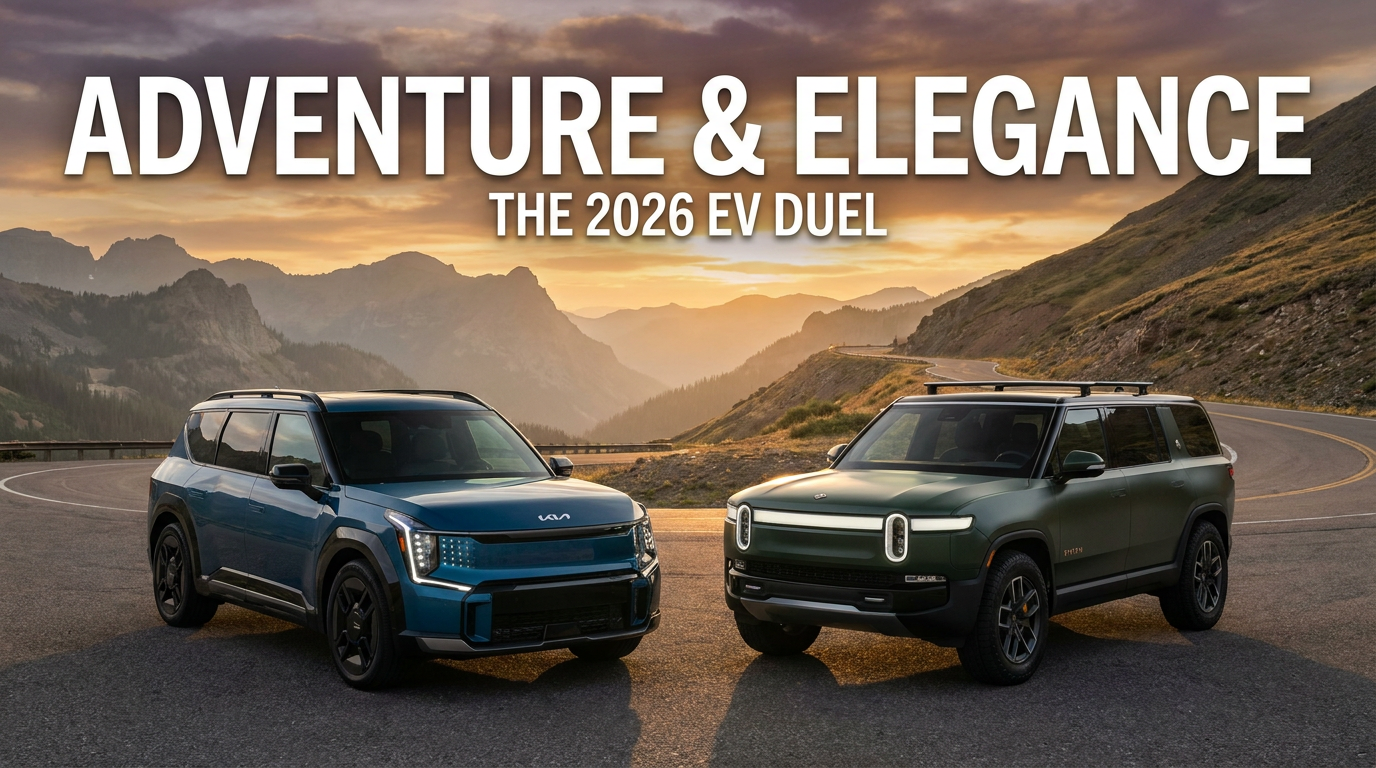
The 2026 Kia EV9 and Rivian R1S offer distinct approaches to the three-row electric SUV, pitting Korean luxury and value against American off-road performance.
By Factlen Editorial Team
- Value-Conscious Families
- Prioritizes affordability, comfort, and practical daily features over extreme performance.
- Adventure & Capability Seekers
- Values off-road prowess, maximum range, and rugged utility for outdoor lifestyles.
- Tech & Performance Enthusiasts
- Focuses on cutting-edge software, blistering acceleration, and premium EV specifications.
What's not represented
- · Traditional Minivan Buyers
- · Budget EV Shoppers
Why this matters
As families increasingly transition to electric vehicles, choosing the right three-row SUV means balancing daily comfort and budget against extreme range and off-road capability. This comparison clarifies which electric hauler aligns with your specific lifestyle and driving needs.
Key points
- The Kia EV9 starts at $56,545, offering exceptional value, a plush ride, and standard Apple CarPlay.
- The Rivian R1S starts at $76,990, delivering extreme off-road capability, massive cargo space, and up to 410 miles of range.
- Kia's 800-volt architecture allows for faster peak charging, going from 10% to 80% in roughly 24 minutes.
- Rivian's new Quad-Motor variant produces 1,025 horsepower, achieving 0-60 mph in a staggering 2.6 seconds.
- The EV9 excels as a comfortable daily family hauler, while the R1S dominates in outdoor adventure and performance.
The three-row family SUV has officially entered the electric era, and two distinct champions have emerged for the 2026 model year. On one side is the Kia EV9, a refined, tech-forward lounge on wheels that democratizes electric family hauling. On the other is the Rivian R1S, an American-made, off-road-capable powerhouse that blends utilitarian ruggedness with luxury performance. Both vehicles offer seating for seven, ample cargo space, and zero emissions, but they approach the assignment from entirely different philosophical continents. Choosing between them is less about finding the objectively superior vehicle and more about matching a machine to a specific lifestyle.[1][2][3][4][5][7]
The Kia EV9 enters 2026 continuing its mission to provide an accessible, feature-rich electric alternative to the traditional minivan or midsize crossover. Starting at a highly competitive $56,545, the EV9 undercuts much of the luxury electric market while offering a cabin that feels distinctly premium. The mid-tier all-wheel-drive models, which most buyers opt for, deliver 379 horsepower and 516 pound-feet of torque, yielding a 0-60 mph time of around 4.9 seconds. For those seeking more thrill, the new-for-2026 GT model pushes output to 501 horsepower. But the EV9’s true party trick is its 800-volt charging architecture, allowing it to pull up to 230 kilowatts and charge from 10 to 80 percent in roughly 24 minutes on a compatible DC fast charger.[1][2][6]
For the Kia EV9, the primary argument centers on unmatched value, everyday comfort, and seamless technology integration. Against the EV9, critics point to a lack of genuine off-road capability, a softer suspension that struggles with repeated surface variations, and a range that drops significantly when towing. The evidence supporting the EV9’s case is found in its standard inclusion of wireless Apple CarPlay and Android Auto, second-row captain’s chairs with heating and ventilation, and a remarkably quiet cabin that isolates passengers from road noise. It is a vehicle designed explicitly for the suburban commute, the school run, and the paved road trip, prioritizing passenger isolation over driver engagement.[1][4][6][7]

In stark contrast stands the 2026 Rivian R1S, a vehicle born from an adventurous startup ethos and built in a former Mitsubishi plant in Normal, Illinois. The R1S commands a significantly higher entry price, starting at $76,990 for the base model and climbing well past $120,000 for the top-tier trims. However, that premium buys a staggering amount of performance and capability. Even the Dual-Motor Performance model generates 665 horsepower, rocketing the 7,000-pound SUV to 60 mph in 3.7 seconds. The newly introduced 2026 Quad-Motor variant produces a hypercar-rivaling 1,025 horsepower, dropping the sprint to an astonishing 2.6 seconds. Paired with an adjustable air suspension that can provide nearly 15 inches of ground clearance, the R1S is as capable of rock crawling as it is of drag racing.[1][3][7]
In stark contrast stands the 2026 Rivian R1S, a vehicle born from an adventurous startup ethos and built in a former Mitsubishi plant in Normal, Illinois.
For the Rivian R1S, the core argument is its unparalleled blend of extreme performance, massive range, and go-anywhere utility. Against the R1S, buyers must weigh the steep price tag, a stiffer ride quality on paved roads, and the stubborn omission of Apple CarPlay and Android Auto. The evidence for Rivian’s dominance lies in its Max battery pack, which delivers an Environmental Protection Agency-estimated 410 miles of range, effectively eliminating range anxiety even in remote areas. Furthermore, the R1S boasts a cavernous front trunk and a split tailgate, offering a total of 90.7 cubic feet of cargo space, making it a superior tool for camping, overlanding, and hauling heavy gear.[1][3][5][7]
When comparing the interiors, the two SUVs reveal their distinct priorities. The Kia EV9 feels like a modern, upscale living room. Its seats are universally praised for their comfort, featuring relaxation modes with pop-up footrests that make waiting at a charging station a genuinely pleasant experience. The inclusion of physical buttons for climate control and well-designed mesh headrests further enhance its user-friendly nature. The Rivian R1S, meanwhile, adopts a minimalist, tech-forward aesthetic heavily reliant on its central touchscreen. While the cabin features beautiful open-pore wood and premium vegan leather, the necessity of using the screen to adjust air vents or access basic climate functions can frustrate drivers accustomed to tactile controls.[1][3][4][6]

The software and charging experiences also present a fascinating dichotomy. Rivian operates as a software-defined vehicle, receiving frequent over-the-air updates that continuously refine its performance and add new features. Its native navigation system is highly praised for its accurate range estimation and seamless integration with charging networks, including the Tesla Supercharger network. Kia, conversely, relies on a more traditional automotive software model but wins points for offering the smartphone mirroring systems that many drivers refuse to live without. While the EV9 charges faster on an 800-volt station, the Rivian’s larger battery and superior route planning often make it the more confident choice for venturing into areas with sparse charging infrastructure.[1][5][7]
Ultimately, the decision requires an honest assessment of how the vehicle will be used. The Kia EV9 fits perfectly when a buyer needs a luxurious, quiet, and highly comfortable daily driver for a family of six or seven. It is the ideal choice for those who prioritize value, rely heavily on smartphone integration, and spend 99 percent of their time on paved roads. It does not fit well when the owner intends to frequently tow heavy loads over long distances, requires maximum cargo volume for outdoor gear, or desires the prestige and blistering acceleration of a high-dollar performance EV.[4][6][7]

Conversely, the Rivian R1S fits exceptionally well when the buyer wants a single vehicle that can serve as a luxury commuter, a weekend off-roader, and a high-performance sports car. It is the right choice for outdoor enthusiasts who need massive range, a huge front trunk, and the ability to clear serious obstacles on a trail. It does not fit well when the budget is strictly capped under $75,000, when the driver demands the plush, isolated ride of a traditional luxury cruiser, or when the absence of Apple CarPlay is considered an absolute dealbreaker. Both vehicles represent the pinnacle of their respective design philosophies, ensuring that the electric family SUV segment has never been richer.[1][3][5][7]
How we got here
Late 2021
Rivian begins initial deliveries of the R1S, establishing itself as a premier electric adventure vehicle.
Late 2023
Kia launches the EV9, bringing a more affordable, family-focused three-row electric SUV to the mainstream market.
Mid 2024
Rivian introduces its second-generation R1S, featuring streamlined manufacturing, improved ride quality, and updated technology.
Early 2026
Kia introduces the high-performance EV9 GT model, while Rivian debuts a 1,025-horsepower Quad-Motor variant.
Viewpoints in depth
Value-Focused Families
Buyers prioritizing daily comfort, budget, and seamless tech integration.
For this demographic, the Kia EV9 is the undisputed champion. These drivers value the $20,000 price advantage, the plush ride quality, and the inclusion of familiar interfaces like Apple CarPlay. They view extreme off-road capability and hypercar acceleration as unnecessary expenses for a vehicle primarily used for school drop-offs and highway road trips.
Outdoor Adventurers
Drivers who need maximum range, cargo space, and off-road capability.
This camp gravitates entirely toward the Rivian R1S. The ability to raise the air suspension to 15 inches of ground clearance, combined with over 400 miles of range and a massive front trunk, makes the R1S a formidable tool for overlanding. They are willing to pay a premium for a vehicle that can confidently leave the pavement and handle rugged terrain without range anxiety.
Performance Enthusiasts
Buyers seeking sports-car acceleration in a family-sized package.
Performance-oriented buyers are drawn to the sheer physics-defying power of the Rivian R1S. With the Quad-Motor variant delivering 1,025 horsepower and a 0-60 mph time of 2.6 seconds, the R1S offers a driving experience that the softer, more comfort-oriented Kia EV9 simply cannot match. For these drivers, the R1S is both a practical hauler and a weekend thrill ride.
What we don't know
- How long-term reliability and battery degradation will compare between the legacy automaker (Kia) and the younger startup (Rivian) over a decade of ownership.
- Whether Rivian will eventually cave to consumer demand and integrate Apple CarPlay and Android Auto via a future software update.
Key terms
- 800-volt architecture
- An advanced electrical system in an EV that allows for significantly faster charging times and better thermal management compared to standard 400-volt systems.
- Air suspension
- A vehicle suspension system powered by an electric air pump or compressor, allowing the driver to raise or lower the vehicle's ride height on demand.
- Front trunk (Frunk)
- An enclosed storage compartment located at the front of an electric vehicle, occupying the space where a traditional gas engine would normally sit.
- Over-the-air (OTA) updates
- Software updates delivered wirelessly to a vehicle, allowing the manufacturer to add new features, improve performance, or fix bugs without a dealership visit.
Frequently asked
Does the Rivian R1S have Apple CarPlay?
No, Rivian uses its own proprietary software and navigation system, and does not currently support Apple CarPlay or Android Auto.
Which SUV has more cargo space?
The Rivian R1S offers more total cargo space, with 90.7 cubic feet behind the first row plus a large front trunk, compared to the Kia EV9's 81.7 cubic feet.
How fast does the Kia EV9 charge?
Thanks to its 800-volt architecture, the Kia EV9 can charge from 10% to 80% in approximately 24 minutes when using a 350kW DC fast charger.
Can the Kia EV9 go off-road?
While the EV9 offers all-wheel drive and is capable on dirt roads or in snow, it lacks the high ground clearance, air suspension, and dedicated off-road modes found in the Rivian R1S.
Sources
Source coverage
7 outlets
3 viewpoints surfaced






[1]EdmundsTech & Performance Enthusiasts
Kia EV9 vs. Rivian R1S: Which 3-Row Electric SUV Is Best?
Read on Edmunds →[2]Car and DriverTech & Performance Enthusiasts
2026 Kia EV9 Review, Pricing, and Specs
Read on Car and Driver →2026 Rivian R1S Review, Pricing, and Specs
Read on Car and Driver →[4]AutoblogValue-Conscious Families
I Drove the 2026 Kia EV9, and This is My Honest Review
Read on Autoblog →[5]Top GearAdventure & Capability Seekers
Rivian R1S Review 2025
Read on Top Gear →[6]Motor IllustratedValue-Conscious Families
2025 Kia EV9 Long Term Review First Update: Six Months In, No Regrets
Read on Motor Illustrated →[7]Torque NewsAdventure & Capability Seekers
The Kia EV9 promised luxury, but the Rivian R1S actually delivered confidence
Read on Torque News →
Every angle. Every day.
Get automotive stories with full source coverage and perspective breakdowns delivered to your inbox.