
2026 EV Showdown: Rivian R2 vs. Tesla Model Y
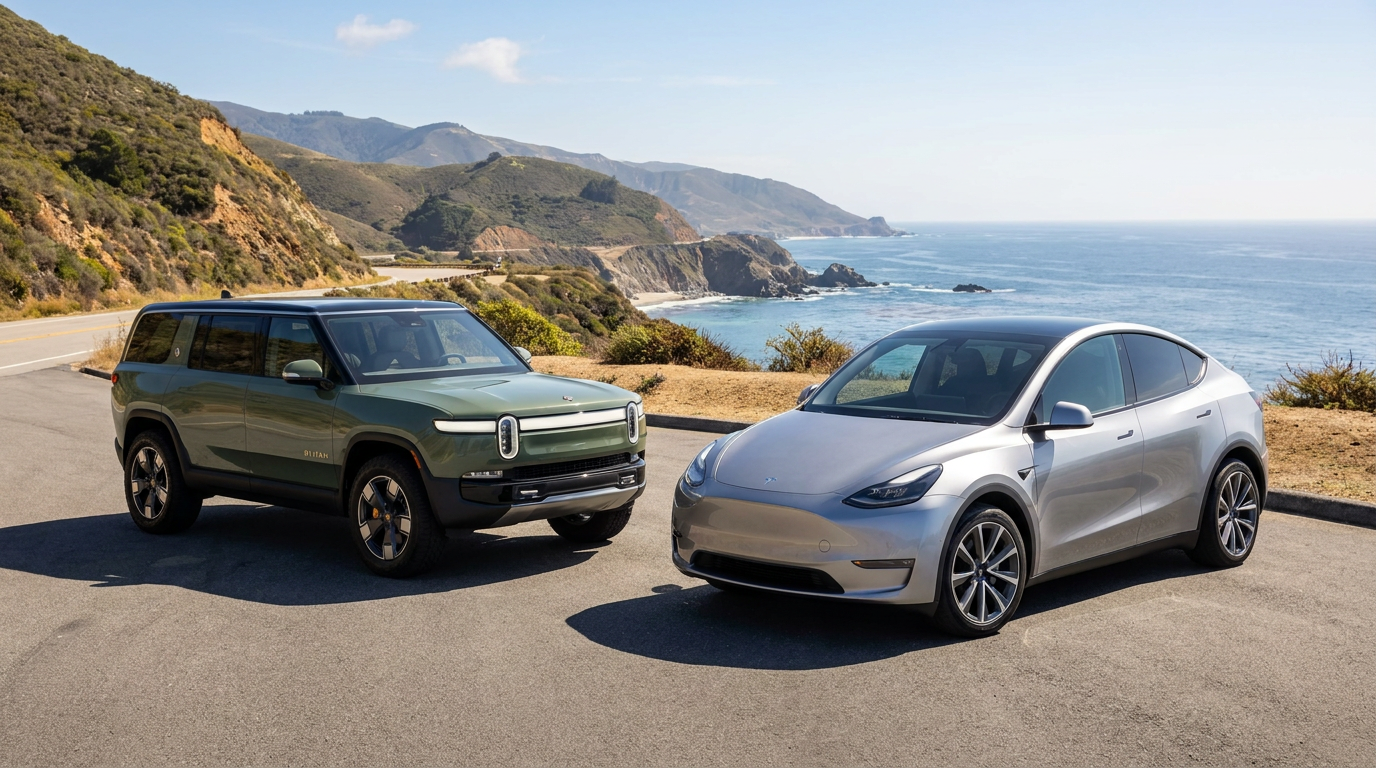
The highly anticipated Rivian R2 goes head-to-head with Tesla's refreshed 'Juniper' Model Y, offering buyers a stark choice between rugged utility and sleek on-road performance.
By Factlen Editorial Team
- Rivian R2 Advocates
- Values maximum utility, off-road capability, and traditional SUV design.
- Tesla Model Y Loyalists
- Values proven software, on-road driving dynamics, and immediate affordability.
What's not represented
- · Legacy Automakers
- · Budget-Constrained EV Shoppers
Why this matters
For buyers shopping for a family vehicle in 2026, the electric crossover segment has finally matured into a genuine two-horse race. Choosing between the Rivian R2 and the refreshed Tesla Model Y dictates not just your budget, but whether your daily drive prioritizes rugged outdoor utility or sleek, street-oriented performance.
Key points
- The 2026 Rivian R2 and refreshed Tesla Model Y 'Juniper' offer two distinct approaches to the electric crossover segment.
- Tesla holds a massive affordability advantage in 2026, with the Model Y starting at $39,990 compared to the R2's $57,990 launch price.
- At the top end, the R2 Performance matches the Model Y Performance in efficiency while offering 24 more miles of range.
- The Rivian R2 provides superior cargo space and off-road capability, while the Model Y excels in on-road handling and sporty dynamics.
- Both vehicles now utilize the NACS charging port, granting the Rivian adapter-free access to Tesla's Supercharger network.
For years, the Tesla Model Y has dominated the electric crossover segment, serving as the default choice for buyers seeking a practical, high-tech family vehicle. But the landscape has fundamentally shifted in 2026. Tesla has introduced its highly anticipated "Juniper" refresh, addressing long-standing critiques by adding a quieter cabin, improved suspension, and ventilated seats. Simultaneously, Rivian has officially entered the mass market with the R2, a midsize SUV that distills the brand's rugged, go-anywhere ethos into a more accessible package. The arrival of the R2 sets up the most significant head-to-head comparison in the electric vehicle market to date. Shoppers are no longer choosing between a Tesla and a compromised legacy alternative; they are choosing between two distinct philosophies of what a modern electric utility vehicle should be.[1][5][6]
When evaluating the financial trade-offs, the Tesla Model Y maintains a distinct advantage for budget-conscious buyers shopping in 2026. Tesla's entry-level rear-wheel-drive Model Y starts at an approachable $39,990, making it immediately available for those seeking an affordable transition to electric driving. In contrast, Rivian's rollout strategy prioritizes its highest-margin vehicles first. The only R2 available at launch is the flagship Performance trim, which commands a starting price of $57,990. While Rivian plans to introduce a standard rear-wheel-drive R2 priced around $45,000, those more affordable configurations will not reach customers until 2027. Consequently, for buyers who need a vehicle immediately and have a strict budget under $50,000, the Model Y wins by default.[1][2][6]
However, when comparing the top-tier configurations side-by-side, the price gap vanishes, setting the stage for a fierce feature-for-feature battle. The Rivian R2 Performance at $57,990 aligns almost perfectly with the Tesla Model Y Performance, which sits at roughly $57,490. At this premium price point, buyers are forced to weigh the evidence of what each automaker prioritizes. The R2 Performance delivers a staggering 656 horsepower and 609 pound-feet of torque from its dual-motor setup, providing immense raw power. The Model Y Performance, while slightly less powerful on paper, leverages its lighter weight to achieve a faster zero-to-sixty sprint of 3.3 seconds, edging out the Rivian's 3.6-second mark. The evidence suggests that while Rivian offers more horsepower per dollar, Tesla's engineering translates that power into slightly quicker straight-line acceleration.[1][3][4][6][7]

The most surprising evidence in this comparison emerges from the Environmental Protection Agency's efficiency ratings. Traditionally, boxy off-road vehicles suffer massive aerodynamic penalties, but Rivian's engineers have achieved a remarkable feat. On standard 21-inch all-season tires, the 5,250-pound Rivian R2 Performance matches the much lighter, teardrop-shaped Model Y Performance with an identical efficiency rating of 105 MPGe combined, consuming 32 kilowatt-hours per 100 miles. This parity is highly unusual given that the R2 weighs nearly 800 pounds more than the Tesla and features a taller, more upright windshield. The data proves that buyers do not have to sacrifice daily driving efficiency to obtain the Rivian's traditional SUV aesthetics, provided they stick to the standard road tires rather than the optional knobby all-terrain rubber.[4][6]
The most surprising evidence in this comparison emerges from the Environmental Protection Agency's efficiency ratings.
Because the Rivian matches the Tesla's efficiency while carrying a slightly larger 86.8-kilowatt-hour battery pack, it actually wins the range comparison. The R2 Performance boasts an EPA-estimated range of 330 miles, outlasting the Model Y Performance's 306-mile rating. This 24-mile advantage provides a tangible benefit for road-trippers, offering an extra buffer between charging stops. However, the charging experience itself has become a dead heat. Historically, Tesla held an insurmountable lead thanks to its exclusive Supercharger network. But the 2026 Rivian R2 is equipped with a native North American Charging Standard (NACS) port, granting it seamless, adapter-free access to the exact same Tesla Superchargers. The Model Y still charges slightly faster—reaching an 80 percent charge in about 24 minutes compared to the R2's 29 minutes—but the infrastructure advantage has effectively been neutralized.[1][3][4][6]

The starkest contrast between the two vehicles lies in their packaging and interior practicality. The Rivian R2 is designed for maximum utility, offering a cavernous 90.1 cubic feet of total storage space, significantly overshadowing the Model Y's maximum capacity of roughly 76 cubic feet. Rivian also includes clever lifestyle features, such as a rear window that rolls down into the tailgate and fold-flat front seats, allowing owners to easily haul long items like surfboards or camp comfortably inside the cabin. The R2 even features a larger front trunk, providing 5.2 cubic feet of space compared to the Tesla's 4.1 cubic feet. For families with extensive gear, dogs, or outdoor hobbies, the evidence heavily favors the Rivian's versatile, boxy design.[3][5][7]
Inside the cabin, both automakers embrace minimalism, but they execute it with entirely different aesthetics. The refreshed Model Y Juniper interior is ultra-sleek and clinical, featuring a single, massive central touchscreen that controls nearly every vehicle function, supplemented by a new 8-inch screen for rear passengers. The Rivian R2, by contrast, feels more like a modern designer loft, utilizing multi-layered dashboard materials and retaining a dedicated digital driver's display behind the steering wheel. This secondary screen is a major selling point for buyers who dislike glancing to the center of the dashboard to check their speed or remaining range. While Tesla's infotainment processor remains the industry benchmark for speed and fluidity, Rivian's software is highly responsive and visually intuitive, making the interior choice a matter of personal taste rather than technological compromise.[2][6]

When the pavement ends, the driving dynamics dictate which vehicle fits a buyer's lifestyle best. The Rivian R2 is a genuine off-roader, boasting 9.6 inches of ground clearance, 32-inch tires, and a sophisticated torque-vectoring system designed to conquer muddy trails and rocky inclines. It absorbs bumps with ease, providing a plush, insulated ride even on rough terrain. The Tesla Model Y, conversely, is tuned for the street. It sits lower to the ground and features a firmer suspension setup that, while vastly improved for 2026, still prioritizes sporty, car-like handling. The Tesla's steering is more direct, making it genuinely fun to drive on a twisty mountain road, whereas the Rivian feels more relaxed and commanding. Ultimately, the Model Y fits the urban commuter who enjoys agile handling, while the R2 fits the weekend adventurer who needs true all-terrain capability.[1][2][3][5]
Ultimately, the 2026 EV crossover market offers two exceptional but divergent paths. The side-by-side analysis reveals that neither vehicle is universally superior; rather, they serve different masters. The Tesla Model Y remains the undisputed king of accessible, on-road electric performance, offering a lower barrier to entry, a proven software ecosystem, and sports-sedan handling in a practical shape. The Rivian R2 successfully challenges that dominance by proving that a rugged, highly capable off-roader can match the efficiency of a teardrop crossover while offering superior cargo space and range. As buyers weigh the trade-offs, the decision hinges entirely on whether their daily life demands the sleek, street-oriented refinement of the Model Y or the boxy, go-anywhere versatility of the R2.[1][2][4][5]
How we got here
2020
Tesla Model Y first launches, quickly becoming the world's best-selling electric vehicle.
March 2024
Rivian officially unveils the R2 midsize SUV, promising a more affordable entry into the brand.
Early 2026
Tesla releases the 'Juniper' refresh for the Model Y, updating its suspension, interior, and exterior styling.
Spring 2026
Rivian begins customer deliveries of the flagship R2 Performance Launch Edition.
2027
Rivian is scheduled to release the lower-priced Standard and Premium trims of the R2.
Viewpoints in depth
The Case for the Rivian R2
Prioritizes outdoor versatility, maximum cargo space, and a traditional SUV aesthetic.
The R2 excels for drivers who need genuine off-road capability, boasting 9.6 inches of ground clearance and a boxy frame that swallows 90.1 cubic feet of cargo. It fits well when buyers want a rugged vehicle without sacrificing electric efficiency or range, offering 330 miles on a single charge. However, it does not fit when budget is the primary constraint in 2026, as the lower-priced trims will not arrive until 2027, leaving only the $57,990 Performance model available at launch.
The Case for the Tesla Model Y
Prioritizes on-road handling, immediate affordability, and a proven software ecosystem.
The refreshed 'Juniper' Model Y is the definitive choice for those seeking a sporty, car-like driving experience with a quieter cabin and refined suspension. It fits well when buyers want an entry-level price point today, starting under $40,000, and value Tesla's seamless software integration and slightly faster charging curve. It does not fit when buyers need to navigate rough trails, require massive cargo volume, or prefer physical driver displays over a centralized touchscreen.
What we don't know
- Whether Rivian will be able to scale production fast enough to meet the massive pre-order demand for the R2 without delays.
- The exact real-world highway range penalty of the R2's boxy shape at speeds over 75 mph, where aerodynamics matter most.
- How the eventual $45,000 base Rivian R2 will compare in features and range to the entry-level Model Y once it arrives in 2027.
Key terms
- NACS
- North American Charging Standard, the charging plug design developed by Tesla that is now being adopted by other automakers like Rivian.
- MPGe
- Miles Per Gallon Equivalent, a metric used by the EPA to compare the energy efficiency of electric vehicles to traditional gas-powered cars.
- Torque-vectoring
- A technology that allows a vehicle to vary the power sent to each wheel, improving grip and handling, especially in off-road conditions.
- Frunk
- A portmanteau of 'front trunk,' referring to the enclosed storage space found under the hood of many electric vehicles where an engine would traditionally sit.
Frequently asked
Can the Rivian R2 use Tesla Superchargers?
Yes, the 2026 Rivian R2 comes with a native NACS charging port, allowing it to plug directly into Tesla Superchargers without an adapter.
Which vehicle has more cargo space?
The Rivian R2 offers significantly more storage, with 90.1 cubic feet of total space (including the front trunk) compared to the Model Y's roughly 76 cubic feet.
Is the Rivian R2 cheaper than the Tesla Model Y?
Not in 2026. While Rivian plans to release a $45,000 base model in 2027, the only R2 available at launch is the $57,990 Performance trim. The Model Y currently starts at $39,990.
Which SUV is faster?
The Tesla Model Y Performance is slightly quicker, reaching 60 mph in 3.3 seconds, while the more powerful but heavier Rivian R2 Performance takes 3.6 seconds.
Sources
Source coverage
7 outlets
2 viewpoints surfaced







[1]RoadEthosTesla Model Y Loyalists
Rivian R2 Vs. Tesla Model Y: An Honest Comparison For 2026 Buyers
Read on RoadEthos →[2]CarwowTesla Model Y Loyalists
Rivian R2 vs Tesla Model Y: prices and standard equipment
Read on Carwow →[3]CarBuzzRivian R2 Advocates
Here's every way the new SUV is ready to beat the Model Y at its own game
Read on CarBuzz →[4]ElectrekRivian R2 Advocates
The Rivian R2 Performance's final EPA ratings are now published
Read on Electrek →[5]CarConfectionsTesla Model Y Loyalists
Who is best within 2027 Rivian R2 vs. 2026 Tesla Model Y?
Read on CarConfections →[6]EdmundsTesla Model Y Loyalists
The Rivian R2 hits the heart of the EV market
Read on Edmunds →[7]Kelley Blue BookRivian R2 Advocates
Rivian R2 Pricing
Read on Kelley Blue Book →
Every angle. Every day.
Get automotive stories with full source coverage and perspective breakdowns delivered to your inbox.