
Young Gut Bacteria Restores Juvenile Brain Plasticity in Older Mice
Researchers have discovered that transplanting the gut microbiome of young mice into older rodents reopens critical periods of neuroplasticity, reversing cognitive decline and allowing the brain to heal developmental impairments.
By Factlen Editorial Team
- Neuroplasticity Researchers
- Argue that the brain's critical periods are not permanently closed by age, but actively suppressed by systemic biological factors that can be reversed.
- Microbiome Scientists
- Emphasize that cognitive decline is largely a symptom of a degraded digestive ecosystem, focusing on the neuroprotective role of short-chain fatty acids.
- Translational Medicine Skeptics
- Warn against premature hype, noting that the chaotic human microbiome is vastly more complex to treat than controlled laboratory mouse models.
What's not represented
- · Human Clinical Trial Participants
- · Bioethicists
Why this matters
This breakthrough proves that the brain's aging process is not a one-way street. By targeting the gut microbiome, scientists are paving the way for non-invasive therapies that could one day stave off human cognitive decline and restore the brain's ability to learn and heal.
Key points
- Fecal transplants from young mice restored juvenile levels of brain plasticity in older mice.
- The treatment allowed aged mice to overcome an amblyopia-like visual impairment typically only treatable in childhood.
- Young gut microbiomes produce short-chain fatty acids that reduce neuroinflammation and protect synaptic connections.
- Researchers hope to isolate specific bacterial strains to create targeted therapies, avoiding the risks of whole-fecal transplants in humans.
The mammalian brain’s ability to rewire itself—known as neuroplasticity—peaks during early development and steadily declines with age. For decades, neuroscientists have searched for a biological mechanism to reopen these "critical periods" of plasticity in adults, hoping to treat neurological conditions, accelerate stroke recovery, or stave off age-related cognitive decline.[5]
A growing body of evidence now points to an unexpected control center for brain aging: the gut microbiome. A landmark June 2026 report highlights that transferring gut bacteria from young mice into older mice can literally make the aged brain act young again, restoring its fundamental ability to adapt and rewire neural circuits.[1]
The latest findings center on a neurological condition similar to amblyopia, commonly known as "lazy eye." In humans and mice alike, this visual impairment is typically only treatable during a brief developmental window in childhood. Once the brain's visual cortex matures, the neural pathways lock into place, making the condition largely permanent.[1]
However, researchers discovered that after older mice received a fecal microbiota transplant from younger donors, their brains regained juvenile levels of plasticity. The aged mice were suddenly able to overcome the amblyopia-like condition, demonstrating that the brain's rigid aging process is not entirely fixed, but dynamically linked to the bacteria residing in the digestive tract.[1][5]

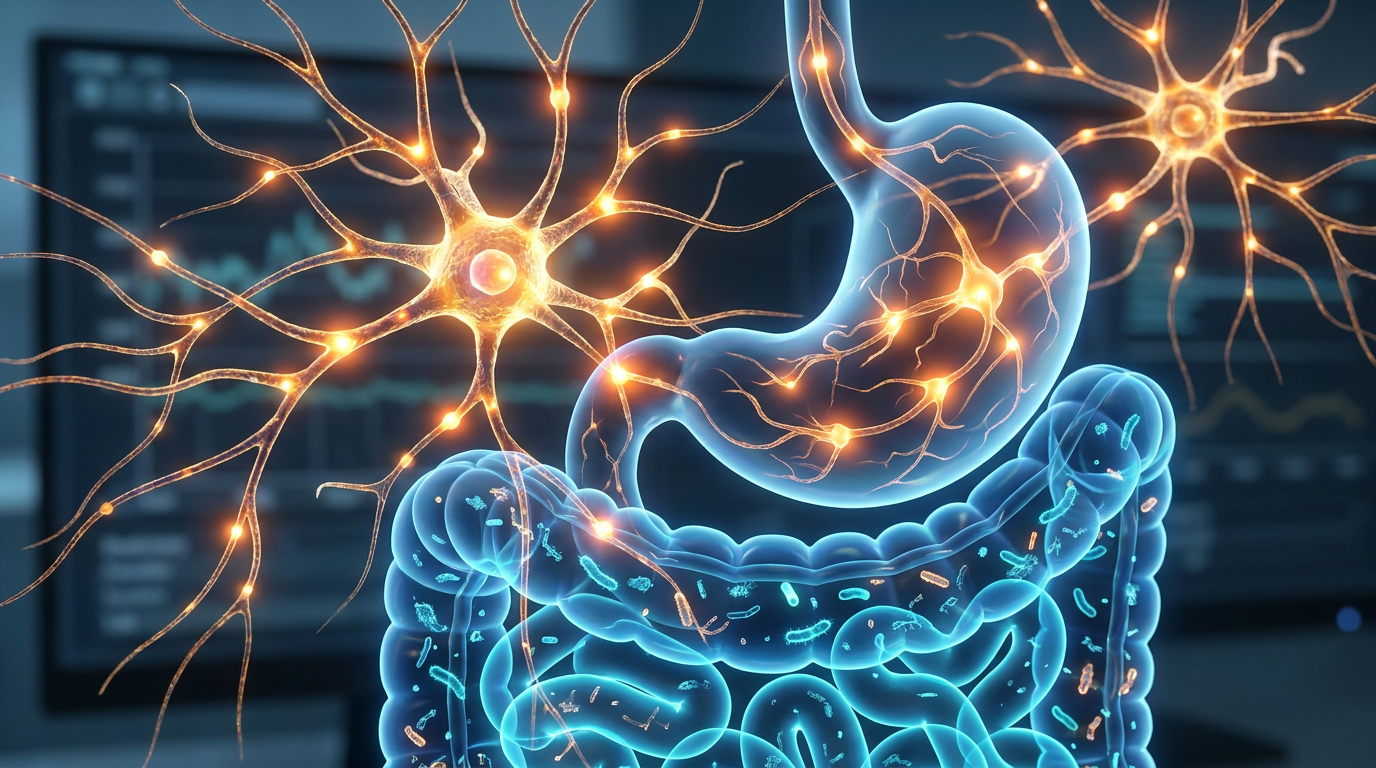
The mechanism driving this reversal lies in the gut-brain axis, a bidirectional communication superhighway involving the vagus nerve, the immune system, and biochemical messengers. As mammals age, the diversity of their gut microbiome plummets, allowing pro-inflammatory microbes to flourish while beneficial bacteria die off.[4][5]
This age-related microbial shift triggers systemic inflammation that crosses the blood-brain barrier, degrading synaptic connections and slowing down cognitive processing. By introducing a young microbiome into an older host, researchers effectively reboot this system, flooding the gut with bacteria that produce high levels of short-chain fatty acids like butyrate and valerate.[3][5]
These short-chain fatty acids act as powerful anti-inflammatory agents and neuroprotectants. The 2026 visual cortex discovery builds on a foundational 2021 study published in the journal Nature Aging, where geriatric mice—19 to 20 months old, the equivalent of 70-year-old humans—received fecal transplants from young adult mice over an eight-week period.[2][6]
These short-chain fatty acids act as powerful anti-inflammatory agents and neuroprotectants.
The results of that earlier study were staggering. The physical and chemical structure of the older mice's hippocampi, the brain region responsible for learning and memory, began to physically resemble those of young mice. The older rodents navigated mazes faster and showed significantly improved memory retention, proving that cognitive decline could be partially reversed by gut flora alone.[2][6]

The quality and lifestyle of the donor microbiome also play a critical role in the efficacy of the transplant. A comprehensive 2024 study demonstrated that fecal transplants from young mice that exercised regularly provided even greater cognitive benefits to older mice than transplants from sedentary young mice.[3]
The active donors possessed higher abundances of specific beneficial bacteria, such as Akkermansia. When transferred to older mice, this optimized microbiome not only reduced neuroinflammation but actively upregulated synaptic plasticity modulators in the brain, proving that lifestyle factors are encoded into our gut bacteria and can be transferred to a new host.[3]
While the mouse models provide compelling evidence for the gut-brain connection, the leap to human therapies remains fraught with scientific uncertainty. Mice live in highly controlled environments, eat identical diets, and possess defined genetics, whereas the human microbiome is wildly chaotic, shaped by decades of varied diets, antibiotic use, and environmental exposures.[4][6]
Furthermore, fecal microbiota transplants in humans are currently approved primarily for severe, life-threatening bacterial infections. The procedure carries inherent risks, including the accidental transfer of drug-resistant pathogens or unforeseen metabolic traits from the donor, making it unsuitable as a general anti-aging treatment.[4][5]

Because of these risks, researchers are not advocating for whole-fecal transplants to rejuvenate the human brain. Instead, the ultimate goal is to identify the specific bacterial strains and the exact metabolites responsible for restoring neuroplasticity, isolating the exact chemical signals that tell the brain to remain flexible.[2][5]
Once isolated, these compounds could be packaged into targeted postbiotics or precision probiotic supplements. If successfully translated to humans, these therapies could one day offer a safe, non-invasive way to keep the aging brain resilient, adaptable, and capable of learning new tricks well into our twilight years.[1][5]
How we got here
2012
Researchers establish a clear link between the diversity of the gut microbiome and physical frailty in aging populations.
August 2021
A landmark study in Nature Aging demonstrates that fecal transplants from young mice can reverse memory and learning impairments in older mice.
December 2024
Scientists discover that microbiomes from exercising mice provide even stronger cognitive benefits and synaptic plasticity to aged recipients.
June 2026
New research reveals that young microbiomes can restore juvenile levels of brain plasticity, allowing older mice to overcome early-development visual impairments.
Viewpoints in depth
Neuroplasticity Researchers' view
Argue that the brain's critical periods are not permanently closed by age, but actively suppressed by systemic biological factors.
This camp views the gut microbiome as a master switch that can lift molecular brakes on the brain. They argue that the visual cortex and hippocampus retain a latent capacity to rewire as if they were still developing, provided the right biochemical signals are present to suppress age-related inflammation.
Microbiome Scientists' view
Emphasize that the brain is downstream of the gut, focusing on the production of short-chain fatty acids.
These researchers argue that cognitive decline is largely a symptom of a degraded, aging digestive ecosystem rather than an isolated brain disease. By focusing on the production of metabolites like butyrate and valerate, they believe that restoring the gut flora is the most effective way to protect synaptic connections from systemic inflammation.
Translational Skeptics' view
Warn against premature hype, noting that curing mice is notoriously easier than curing humans.
This perspective emphasizes that human microbiomes are shaped by decades of complex diets, antibiotics, and environments, making it highly unlikely that a simple "young transplant" will yield the same miraculous cognitive reversal in human patients. They stress the severe risks of transferring pathogens and advocate strictly for targeted, isolated bacterial therapies rather than whole-fecal transplants.
What we don't know
- Whether the human brain retains the same latent capacity for plasticity as the mouse visual cortex.
- Which specific bacterial strains or combinations are primarily responsible for the cognitive rejuvenation effect.
- How long the neuroplasticity benefits of a young microbiome transplant last before the gut flora reverts to an aged state.
Key terms
- Gut-Brain Axis
- The two-way biochemical communication network connecting the gastrointestinal tract and the central nervous system.
- Neuroplasticity
- The brain's ability to reorganize itself by forming new neural connections throughout life, which typically declines with age.
- Amblyopia
- A vision development disorder, commonly called lazy eye, where the brain fails to fully process visual input from one eye.
- Short-Chain Fatty Acids (SCFAs)
- Beneficial compounds, such as butyrate, produced by gut bacteria during the fermentation of fiber, known to reduce systemic inflammation.
- Hippocampus
- A complex brain structure embedded deep into the temporal lobe that plays a major role in learning and memory.
Frequently asked
What is a fecal microbiota transplant (FMT)?
It is a medical procedure that transfers gut bacteria from a healthy donor into the gastrointestinal tract of a recipient to restore a healthy microbial balance.
Did the older mice actually get smarter?
Yes. Older mice that received young microbiomes navigated mazes faster and showed significantly improved memory retention compared to their untreated peers.
Can this cure lazy eye in human adults?
Not yet. While the mouse study showed the brain's visual cortex could reopen its plasticity to overcome an amblyopia-like condition, human trials have not yet replicated this effect.
Are doctors prescribing this for human aging?
No. In humans, FMT is currently only approved for severe, life-threatening bacterial infections like C. difficile, due to the risks of accidentally transferring pathogens.
Sources
Source coverage
6 outlets
3 viewpoints surfaced






[1]New ScientistNeuroplasticity Researchers
Faecal transplant makes the brains of old mice act young again
Read on New Scientist →[2]Nature AgingNeuroplasticity Researchers
Microbiota from young mice reverses aging-associated impairments in cognitive function and immune responses
Read on Nature Aging →[3]Aging and DiseaseMicrobiome Scientists
Fecal Microbiota Transplantation from Young-Trained Donors Improves Cognitive Function in Old Mice Through Modulation of the Gut-Brain Axis
Read on Aging and Disease →[4]National Institute on AgingTranslational Medicine Skeptics
Understanding the Gut-Brain Axis in Older Adults
Read on National Institute on Aging →[5]Factlen Editorial TeamTranslational Medicine Skeptics
Synthesis by Factlen editorial team
Read on Factlen Editorial Team →[6]Smithsonian MagazineMicrobiome Scientists
Scientists Reverse Aging in Mice With Fecal Transplants
Read on Smithsonian Magazine →


Every angle. Every day.
Get science stories with full source coverage and perspective breakdowns delivered to your inbox.