
World's Oldest Cave Art Found in Indonesia, Pushing Back Human Creativity by 5,000 Years
Scientists using a novel laser-dating technique have identified a 51,200-year-old cave painting in Indonesia as the oldest known narrative art. The discovery of the pig-hunting scene pushes back the timeline of human storytelling and challenges the view that complex art originated in Europe.
By Factlen Editorial Team
- Evolutionary Anthropologists
- Focus on what the art reveals about human cognitive development and the origins of storytelling.
- Geochronologists
- Focus on the precision of the new laser ablation technique and its potential to re-date other global sites.
- Heritage Advocates
- Emphasize the region's central role in early human history and the need to protect the Maros-Pangkep karst caves.
What's not represented
- · Local Indigenous Communities
Why this matters
This discovery fundamentally rewrites the timeline of human cognitive evolution, proving that our ancestors were capable of complex, abstract storytelling thousands of years earlier than previously proven. It also shifts the geographic center of early human creativity away from Europe, suggesting that narrative art either originated in Africa before global migration or developed independently in Asia.
Key points
- A cave painting in Indonesia has been dated to at least 51,200 years ago, making it the oldest known narrative art.
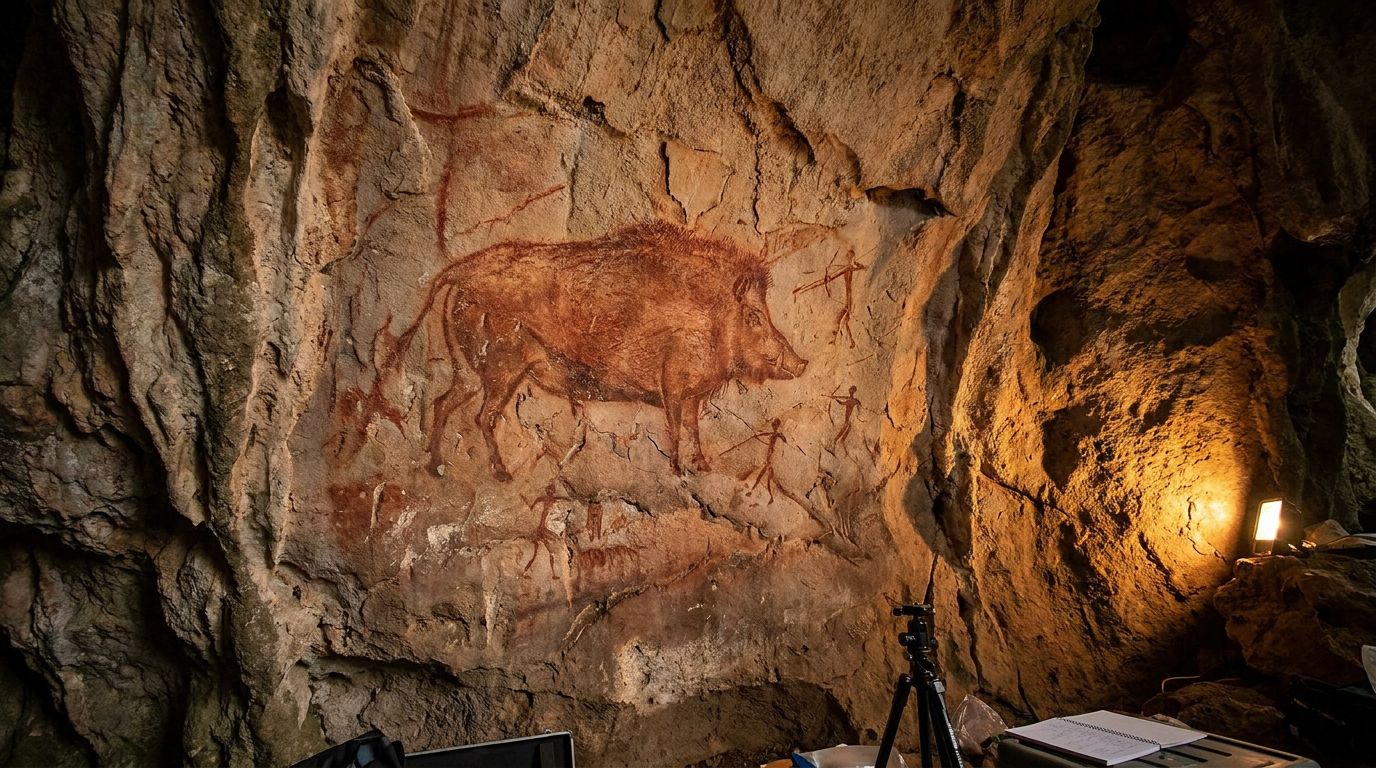
- The artwork depicts three human-animal hybrid figures interacting with a wild Sulawesi warty pig.
- Researchers used a novel laser-ablation dating technique to analyze mineral deposits over the pigment.
- The discovery pushes back the timeline of human storytelling by more than 5,000 years.
- The findings challenge the long-held belief that complex, figurative art originated in Europe.
Deep in the lush, mountainous karst landscape of South Sulawesi, Indonesia, a faded red painting on a limestone cave wall has quietly rewritten the timeline of human creativity. Discovered in the Leang Karampuang cave, the artwork depicts a large wild pig interacting with three smaller, human-like figures. While the image itself is striking, its true significance lies in its newly confirmed age: at least 51,200 years old. This makes it the oldest known reliably dated cave art image in the world, and more importantly, the earliest surviving evidence of visual storytelling.[1][2]
The discovery, published in the journal Nature by an international team of researchers, pushes back the origins of narrative art by more than 5,000 years. Previously, the record for the oldest narrative scene belonged to another Sulawesi cave painting, located just a few kilometers away at Leang Bulu' Sipong 4, which had been dated to roughly 44,000 years ago. The Leang Karampuang find not only shatters that record but also fundamentally challenges long-held assumptions about where and when the human mind first became capable of complex, abstract communication.[1][3]
To understand why this painting is so revolutionary, one must distinguish between isolated art and narrative art. Early humans left behind many single hand stencils or isolated depictions of animals, which are profound in their own right. However, the Leang Karampuang painting is a composed scene. The arrangement of the figures implies a deliberate interaction—a story being told. The three smaller figures are not merely standing near the pig; they are engaged with it in a dynamic sequence that requires the viewer to interpret an unfolding event.[4][7]

Adding to the complexity of the scene is the nature of the figures themselves. The researchers identified them as therianthropes—mythical beings that possess both human and animal characteristics. The depiction of therianthropes is a critical milestone in cognitive evolution. It demonstrates that the artists were not just painting what they saw in the physical world, but were capable of imagining things that did not exist in nature. This capacity for abstract, imaginative thought is the foundation of religion, mythology, and complex social structures.[2][5]
Determining the age of such ancient art is a notoriously difficult scientific puzzle. Traditional radiocarbon dating is largely useless for these paintings because the red ochre pigment used by early artists lacks the organic material necessary for the test. Instead, geochronologists must rely on dating the natural mineral deposits that form over the artwork over tens of thousands of years. As water seeps through the limestone cave walls, it leaves behind tiny layers of calcium carbonate, often referred to as 'cave popcorn,' which slowly encase the pigment.[3][6]
For years, scientists used a method called solution-based uranium-series analysis to date these mineral crusts. This technique measures the radioactive decay of uranium into thorium within the calcium carbonate. Because the mineral layer formed after the painting was completed, dating the crust provides a reliable minimum age for the art beneath it. However, the traditional method required scraping off relatively large chunks of the mineral deposit. This bulk sampling often inadvertently mixed older layers closest to the pigment with younger layers closer to the surface, resulting in an average age that underestimated how old the painting truly was.[1][5]
For years, scientists used a method called solution-based uranium-series analysis to date these mineral crusts.
To solve this problem, researchers from Southern Cross University and Griffith University pioneered a groundbreaking new technique: Laser Ablation U-series (LA-U-series) analysis. Instead of physically scraping the rock, scientists extract microscopic samples and use a high-precision laser beam—roughly four times smaller than the width of a human hair—to vaporize tiny, specific layers of the calcium carbonate. This allows them to create highly detailed geochemical maps of the mineral crust and isolate the exact layer that is in direct contact with the ancient pigment.[1][6]

The precision of the laser ablation method is what allowed the team to uncover the true age of the Leang Karampuang painting. By targeting the oldest possible layer of calcium carbonate without contamination from younger deposits, they confirmed the 51,200-year minimum age. The researchers also applied this new technique to the previous record-holder at Leang Bulu' Sipong 4. The laser analysis revealed that the older painting was actually at least 48,000 years old—more than 4,000 years older than the original bulk-sampling method had suggested.[1][3][5]
The implications of these dates ripple far beyond the field of geochronology. For decades, the academic consensus held that the 'creative explosion' of human art occurred in Europe, pointing to the breathtaking, 30,000-to-40,000-year-old animal murals in France's Chauvet and Lascaux caves as the birthplace of complex artistic expression. The discoveries in Sulawesi dismantle this Eurocentric narrative entirely. They prove that early humans in Southeast Asia were producing sophisticated, narrative-driven art thousands of years before the European cave painters picked up their ochre.[2][4][7]
This geographic shift raises profound questions about the evolutionary trajectory of our species. Did the cognitive capacity for storytelling and abstract art evolve independently in different populations around the world? Or, more likely, did these abilities develop in Africa long before modern humans began their great global migration? If the latter is true, it suggests that the first humans to walk out of Africa and across the Asian continent already carried the fundamental building blocks of art, mythology, and narrative culture with them.[4][5]

Humans have probably been telling stories for much longer than 51,200 years, but as words do not fossilize we can only go by indirect proxies like depictions of scenes in art, noted Adhi Agus Oktaviana, the Indonesian rock art specialist who led the study. The Sulawesi paintings serve as the oldest surviving proxy for that oral tradition, capturing a moment when early humans used the walls of the earth to record their myths, their hunts, and their understanding of the world.[1][2]
Despite the triumph of the discovery, the future of these ancient masterpieces is highly uncertain. The limestone karst caves of the Maros-Pangkep region are increasingly vulnerable to environmental degradation. Climate change, characterized by extreme temperature fluctuations and severe wet-dry cycles in the tropics, is accelerating the physical weathering of the cave walls. The very mineral crusts that have preserved and dated the art for 50,000 years are now flaking off at an alarming rate, threatening to erase humanity's oldest stories before they can all be found.[2][3]

The success of the laser ablation technique offers a glimmer of hope for the broader archaeological community. Because the method requires significantly smaller samples and causes less damage to the art, it can be deployed at sites around the world where traditional dating was deemed too destructive. Researchers anticipate that applying LA-U-series analysis to other known cave art sites in Asia, Australia, and Europe will likely push the timeline of human creativity back even further, revealing a prehistoric world far richer and more complex than previously imagined.[1][6]
How we got here
1950s
Prehistoric rock art is first reported in the limestone caves of Sulawesi, initially believed to be only 4,000 years old.
2014
Researchers date Sulawesi cave art to 40,000 years ago, proving it is as old as European cave paintings.
2019
A hunting scene in Leang Bulu' Sipong 4 is dated to 43,900 years ago, becoming the oldest known narrative art at the time.
2021
A painting of a Sulawesi warty pig in Leang Tedongnge is dated to 45,500 years ago.
July 2024
Using a new laser technique, the Leang Karampuang painting is dated to 51,200 years ago, setting a new record for narrative art.
Viewpoints in depth
Geochronologists
Focus on the precision of the new laser ablation technique and its potential to re-date other global sites.
For dating experts, the true breakthrough is methodological. Traditional bulk-sampling often averaged the ages of multiple mineral layers, artificially depressing the calculated age of the art. By using a laser to map and isolate the exact calcium carbonate layer touching the pigment, geochronologists argue they have unlocked a new standard of accuracy. They anticipate that applying this technique to existing sites worldwide will systematically push back the accepted timelines of human history.
Evolutionary Anthropologists
Focus on what the art reveals about human cognitive development and the origins of storytelling.
Anthropologists view the Leang Karampuang painting as a fossilized proxy for the human mind. The presence of therianthropes—figures that blend human and animal traits—proves that these early populations possessed advanced abstract imagination and spiritual frameworks. Because this level of cognitive sophistication appears in Southeast Asia over 50,000 years ago, theorists argue that the capacity for complex narrative must have evolved in Africa before modern humans dispersed globally, rather than developing independently in Europe.
Southeast Asian Archaeologists
Emphasize the region's central role in early human history and the urgent need to protect the Maros-Pangkep karst caves.
Local researchers and heritage advocates stress that Southeast Asia is no longer a peripheral stepping stone in human migration, but a primary theater of early cultural innovation. However, they warn that the Maros-Pangkep caves are in critical danger. Climate change and extreme weather cycles are causing the limestone surfaces to exfoliate, destroying the art. They argue that international funding and conservation efforts must immediately pivot to Indonesia to preserve these sites before humanity's oldest stories flake away entirely.
What we don't know
- Whether the capacity for narrative art evolved before modern humans left Africa or independently in Southeast Asia.
- The specific cultural or spiritual meaning behind the human-animal hybrid figures depicted in the scene.
- If even older narrative paintings exist in the region, as many caves in the Maros-Pangkep karst remain unexplored or undated.
Key terms
- Therianthrope
- A mythical figure that combines both human and animal characteristics, often indicating advanced abstract or spiritual thought.
- Laser Ablation U-series (LA-U-series)
- A high-precision dating method that uses a microscopic laser to analyze radioactive decay in tiny mineral layers without destroying the underlying sample.
- Calcium Carbonate
- A natural mineral deposit that forms on cave walls over time, which scientists date to determine the minimum age of the art beneath it.
- Karst
- A landscape formed from the dissolution of soluble rocks like limestone, characterized by underground drainage systems and extensive cave networks.
Frequently asked
Why couldn't scientists use radiocarbon dating?
Radiocarbon dating requires organic material. Because the red ochre pigment used by the early artists lacks organic matter, scientists must instead date the natural mineral crusts that form on top of the art.
What exactly is happening in the painting?
The faded red pigment depicts a large Sulawesi warty pig interacting with three smaller figures. These figures are therianthropes, meaning they possess both human and animal characteristics.
Does this mean complex art didn't start in Europe?
Yes. While Europe is home to famous ancient cave art like Lascaux and Chauvet, this discovery proves that complex, narrative art was being created in Southeast Asia thousands of years earlier.
Sources
Source coverage
7 outlets
3 viewpoints surfaced







[1]NatureGeochronologists
Narrative cave art in Indonesia by 51,200 years ago
Read on Nature →[2]Griffith UniversityEvolutionary Anthropologists
Sulawesi artwork painted at least 51,200 years ago, making it oldest known cave art image in the world
Read on Griffith University →[3]The GuardianHeritage Advocates
Oldest known picture story is a 51,000-year-old Indonesian cave painting
Read on The Guardian →[4]BBC NewsEvolutionary Anthropologists
World's oldest cave art found in Indonesia
Read on BBC News →[5]Mental FlossHeritage Advocates
The drawing of three human figures with a pig was discovered in an Indonesian cave—and might be the world's oldest art that tells a story
Read on Mental Floss →[6]Southern Cross UniversityGeochronologists
Southern Cross Uni's laser precision has dated oldest known evidence of storytelling in art, found in an Indonesian cave, at 51,200 years
Read on Southern Cross University →[7]The Leakey FoundationEvolutionary Anthropologists
Origin Stories: The First Story
Read on The Leakey Foundation →

Every angle. Every day.
Get culture stories with full source coverage and perspective breakdowns delivered to your inbox.