
Women-Specific Soccer Cleats Show Dramatic Reduction in ACL Injuries
After years of female players wearing downsized men's boots, a new generation of anatomically designed cleats is successfully mitigating the sport's ACL epidemic.
By Factlen Editorial Team
- Sports Biomechanists
- Focusing on the anatomical and mechanical root causes of knee injuries.
- Equipment Innovators
- Prioritizing ground-up design over the historical 'shrink it and pink it' approach.
- Player Advocates
- Demanding equitable resources and holistic injury prevention strategies.
What's not represented
- · Artificial turf manufacturers defending the safety of modern synthetic pitches.
- · Male players who might benefit from the reduced rotational traction of these new stud patterns.
Why this matters
For decades, female athletes have been forced to use equipment designed for men, leading to chronic pain and career-threatening injuries. This breakthrough proves that investing in female-specific sports science not only levels the playing field but actively protects the health of millions of women and girls.
Key points
- Female soccer players are 3 to 6 times more likely to suffer an ACL tear than male players.
- For decades, women wore downsized men's boots with long bladed studs that caused excessive rotational traction.
- When a lighter female player pivots on artificial turf, traditional studs can stick, sending the twisting force directly into the knee.
- New cleats from brands like IDA Sports and Nike feature circular stud patterns that allow the foot to release smoothly.
- The boots also feature wider toe boxes, narrower heels, and higher arches to match female anatomy.
- Early adoption is showing a significant reduction in chronic foot pain and non-contact knee injuries.
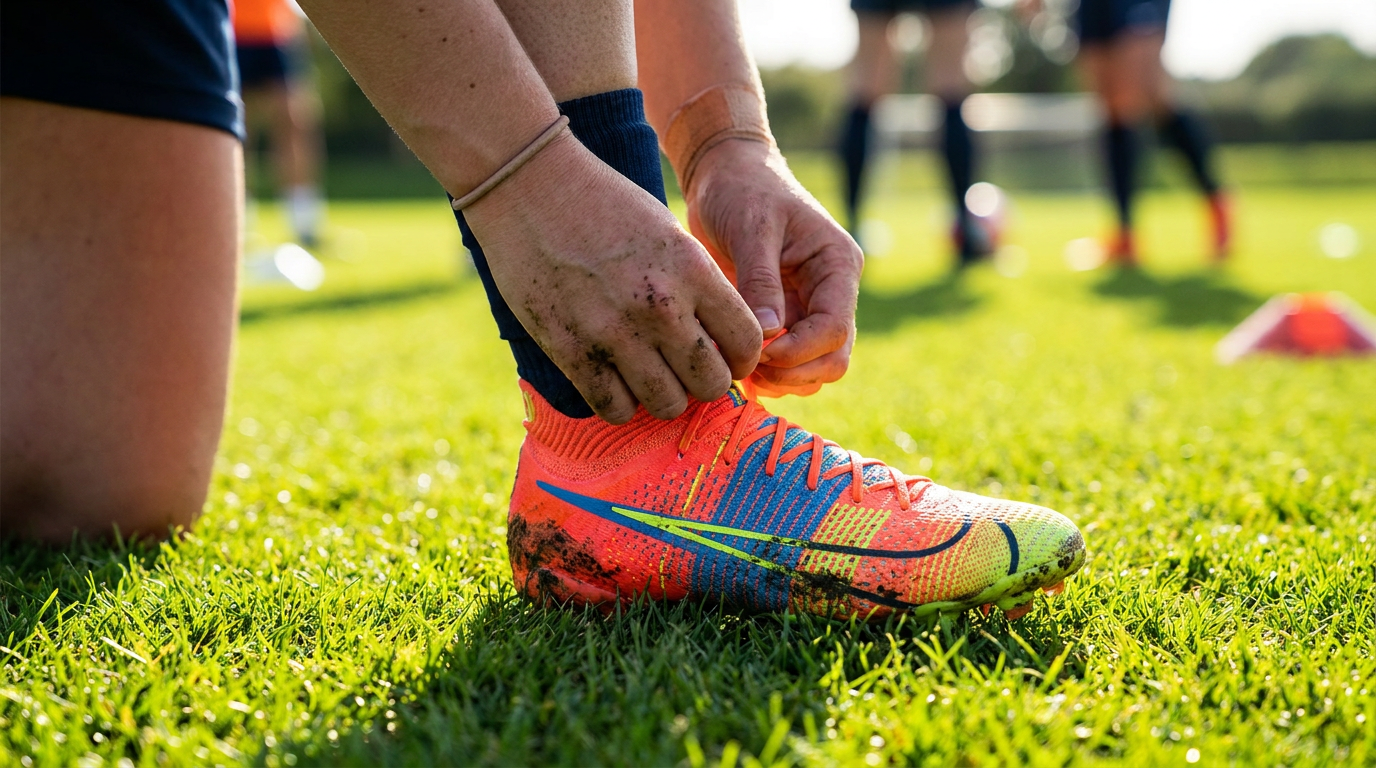
For decades, female soccer players accepted a painful compromise every time they stepped onto the pitch. They played through blistered heels, pinched toes, and aching arches, wearing boots that were fundamentally designed for men. The industry standard was colloquially known as "shrink it and pink it"—taking a male cleat, sizing it down, and applying a pastel colorway without altering the internal geometry.[2][4]
But the consequences of mismatched footwear extended far beyond mere discomfort. In recent years, women's soccer has faced an epidemic of anterior cruciate ligament (ACL) tears, with top-tier players routinely missing major tournaments like the World Cup. Research indicates that female athletes are three to six times more likely to suffer an ACL rupture than their male counterparts, a disparity that has baffled the sport for years.[3][6]
Now, a wave of biomechanical research and equipment innovation is finally turning the tide. After years of development, the widespread adoption of women-specific soccer cleats is showing measurable success in mitigating the sport's most dreaded injury, fundamentally changing how female athletes interact with the ground beneath them.[7]
To understand why these new boots are so effective, sports scientists first had to map the anatomical differences between male and female lower bodies. Women typically have a wider pelvis, which creates a greater "Q-angle"—the angle at which the femur meets the tibia at the knee. This natural alignment places inherently more stress on the knee joint during athletic movements, making the margin for error significantly smaller.[1][2][6]

Furthermore, the female foot is not simply a scaled-down male foot. Women generally have a wider forefoot, a narrower heel, and higher arches. When a woman wears a downsized men's boot, her heel often slips, reducing stability, while the narrow toe box compresses her foot, leading to chronic pain, misalignment, and a loss of explosive power.[2][5]
The most critical danger, however, lies at the bottom of the boot. Traditional men's cleats are engineered with long, bladed studs designed to anchor a heavier, more powerful male frame into the ground. When a lighter female player wears these aggressive soleplates—especially on the unforgiving artificial turf that many women's leagues are forced to use—the boots grip the surface far too tightly.[4][5]
The most critical danger, however, lies at the bottom of the boot.
This excessive grip creates a phenomenon known as "rotational traction." When a player attempts to pivot or change direction rapidly, the bladed studs remain locked in the turf. Because the foot cannot release from the ground, the rotational force travels directly up the leg and into the knee, frequently resulting in a non-contact ACL tear.[1][6]
The new generation of women-specific cleats directly addresses this mechanical flaw. Brands like IDA Sports, a pioneer that built female cleats from the ground up, alongside industry giants like Nike and Puma, have completely redesigned the soleplate to prioritize safe release over absolute grip.[4]

Instead of aggressive blades, these innovative boots feature shorter, conical or circular stud patterns under the forefoot. Nike's Cyclone 360 technology, for example, utilizes a circular layout that allows the foot to pivot smoothly without catching. This design drastically reduces the rotational drag that causes the knee to twist unnaturally, allowing players to cut and accelerate with confidence.[1][3]
Beyond the studs, the overall architecture of the boot has been reimagined. The new silhouettes feature wider toe boxes to accommodate natural foot splay, asymmetrical collars to reduce Achilles irritation, and tailored arch support to maintain alignment through the ankle and knee, ensuring the entire kinetic chain operates smoothly.[2]
The impact on the pitch has been profound. A recent survey by the European Club Association revealed that 82 percent of female players experienced discomfort in traditional boots. Today, players transitioning to anatomically correct footwear report an immediate elimination of chronic foot pain and a noticeable increase in stability during high-speed maneuvers.[4][5]
While longitudinal injury data is still being compiled across multiple seasons, early indicators from sports medicine professionals and biomechanists are highly encouraging. When combined with neuromuscular warm-up routines, the optimized footwear is helping to significantly drive down the incidence of non-contact knee injuries across both professional and amateur levels.[6][7]

Experts caution that boots alone are not a silver bullet. The ACL epidemic is multifactorial, influenced by congested fixture schedules, the prevalence of artificial turf, and hormonal fluctuations that increase ligament laxity during the menstrual cycle. Comprehensive injury prevention requires addressing all these variables holistically rather than relying on a single piece of equipment.[2][5]
Nevertheless, the shift in equipment represents a monumental victory for female athletes. The era of treating women as an afterthought in sports engineering is ending. By finally providing players with tools designed specifically for their bodies, the soccer world is ensuring that the future of the women's game is not only faster and more skilled, but fundamentally safer.[4][7]
How we got here
Pre-2020
Female soccer players universally wear downsized men's boots, a practice known as 'shrink it and pink it'.
2020
IDA Sports launches the 'Classica', the first soccer cleat built entirely from the ground up for the female foot.
June 2023
Nike unveils the Phantom Luna ahead of the Women's World Cup, featuring the Cyclone 360 circular stud pattern to reduce rotational traction.
2023–2024
A severe spike in ACL tears sidelines dozens of elite players, prompting parliamentary inquiries and increased funding for female-specific sports science.
2026
Widespread adoption of anatomically designed cleats across professional and amateur leagues begins to show measurable success in reducing foot pain and knee injuries.
Viewpoints in depth
Sports Biomechanists
Focusing on the anatomical and mechanical root causes of knee injuries.
Researchers emphasize that the female lower body operates with different mechanics than the male body. The wider pelvis creates a larger Q-angle, which naturally places more stress on the knee ligaments. When combined with the excessive rotational traction of traditional bladed studs, the knee becomes the weak point during sudden pivots. Biomechanists argue that reducing this traction through circular stud patterns is the most immediate mechanical fix available.
Equipment Innovators
Prioritizing ground-up design over the historical 'shrink it and pink it' approach.
For decades, manufacturers simply scaled down men's boots and marketed them to women. Innovators argue this ignored fundamental differences in foot volume, arch height, and heel width. By building lasts (the 3D molds used to shape shoes) based entirely on female foot scans, these companies are eliminating the internal slipping and toe compression that previously plagued female athletes, proving that comfort and elite performance are inextricably linked.
Player Advocates
Demanding equitable resources and holistic injury prevention strategies.
While celebrating the new footwear, advocates stress that boots are only one piece of the puzzle. They point to the grueling fixture schedules, the frequent use of unforgiving artificial turf, and the historical lack of sports science funding dedicated to women. This camp argues that true equity means combining better equipment with tailored strength conditioning, menstrual cycle tracking, and top-tier medical support to fully protect players.
What we don't know
- Exactly how much of the ACL epidemic is caused by footwear versus other factors like artificial turf and congested match schedules.
- How long-term injury data will look after a full decade of female athletes wearing anatomically correct boots from a young age.
Key terms
- Anterior Cruciate Ligament (ACL)
- A crucial ligament in the center of the knee that stabilizes the joint, frequently torn during sudden stops or changes in direction.
- Q-angle
- The angle formed between the quadriceps muscles and the patella tendon, which is naturally wider in women due to a broader pelvis.
- Rotational Traction
- The amount of grip a shoe has when the foot twists or pivots; too much traction can cause the foot to stick while the knee turns, leading to injury.
- Conical Studs
- Cone-shaped or circular cleats on the bottom of a soccer boot that allow for easier pivoting compared to long, aggressive blades.
- Last
- A 3-dimensional mechanical form shaped like a human foot, used by shoemakers to design and construct footwear.
Frequently asked
Why do female soccer players tear their ACLs more often?
Women are 3 to 6 times more likely to suffer an ACL tear due to a combination of anatomical factors (like a wider pelvis and greater Q-angle), hormonal fluctuations that increase ligament laxity, and historically wearing footwear designed for men.
What does 'shrink it and pink it' mean?
It is a colloquial term for the historical industry practice of taking a men's product, making it smaller, painting it a stereotypically feminine color, and selling it to women without adjusting for female anatomy.
How do the new cleats prevent knee injuries?
Modern women-specific cleats use shorter, conical or circular stud patterns on the soleplate. This allows the foot to pivot and release from the turf smoothly, reducing the rotational drag that often twists the knee and tears the ACL.
Are these boots only for professional players?
No. Brands like IDA Sports, Nike, and Puma are producing these anatomically designed boots for all levels of play, recognizing that amateur and youth players are equally vulnerable to knee injuries.
Sources
Source coverage
7 outlets
3 viewpoints surfaced







[1]Nike Sport Research LabSports Biomechanists
Nike Phantom Luna: The most innovative women's-led boot
Read on Nike Sport Research Lab →[2]IDA SportsEquipment Innovators
Fulfilling A Need In Player Performance: The Science of Female Cleats
Read on IDA Sports →[3]Sky SportsPlayer Advocates
Women's led football boot unveiled to tackle ACL epidemic
Read on Sky Sports →[4]ForbesPlayer Advocates
How IDA Sports Is Changing The Game For Women's Soccer
Read on Forbes →[5]Pro:Direct SoccerEquipment Innovators
The New Shape of the Women's Game: Boot Design Evolution
Read on Pro:Direct Soccer →[6]Universal Journal of Sport SciencesSports Biomechanists
Biomechanical distinctions between male and female athletes' feet and footwear design
Read on Universal Journal of Sport Sciences →[7]Factlen Editorial TeamPlayer Advocates
Synthesis by Factlen editorial team
Read on Factlen Editorial Team →

More in sports
See all 327 stories →Pro Volleyball Boom
The $100M Turf War Building America's First Sustainable Pro Volleyball Ecosystem
6 sources
Adaptive Gaming
How Adaptive Tech and Modular Design Are Leveling the Esports Playing Field
7 sources

Sports Tech
How Artificial Intelligence is Revolutionizing Soccer Scouting and Player Recruitment
8 sources

Fighter Safety
How Impact-Sensing Smart Gloves Are Changing the Science of Boxing Safety
7 sources

Every angle. Every day.
Get sports stories with full source coverage and perspective breakdowns delivered to your inbox.