
Why Tropical Beach Water Is Crystal Clear: The Physics of the Ocean's Permanent Thermocline
The iconic transparency of tropical seas is the result of a permanent temperature barrier that traps nutrients in the deep ocean. By starving the sunlit surface of the microscopic plant life that turns colder waters green, this thermal stratification creates a vast, clear biological desert.
By Irina Belova

In short
- Tropical ocean surfaces remain permanently warmer than the deep ocean, creating a density barrier that prevents the layers from mixing.
- Without mixing, nutrients from dead organisms sink and remain trapped in the deep, starving the sunlit surface of the fertilizer needed for plant life.
- The absence of microscopic, chlorophyll-rich phytoplankton allows the water to act as a pure filter, absorbing red light and scattering only blue.
For a beach to offer that perfect, glass-clear visibility, a strict physical condition must hold: the surface water must remain drastically hotter than the depths below it, all year round. If that temperature gap ever closes, the water densities equalize, the layers mix, and the ocean turns murky.[1][3]
When you wade into the Caribbean or the South Pacific, you are stepping into a layer of water that is fundamentally disconnected from the rest of the ocean. The 28°C (82°F) surface water is light and buoyant, floating like a slick of oil on top of the freezing, dense water miles below.[1]
This boundary is known as the permanent thermocline, a sharp transition zone usually sitting between 100 and 200 meters below the surface. In temperate zones like New England or the North Sea, winter air cools the surface until it matches the deep, allowing the layers to mix freely.[1]
In the tropics, winter never comes. The intense equatorial sun bakes the surface layer continuously, ensuring it never cools enough to sink. The layers remain sealed apart, creating a one-way trap for the ocean's biological resources.[1]
The biological pump
Everything that dies in the ocean eventually sinks. Fish scales, organic debris, and microscopic shells drift downward through the thermocline into the abyss, taking essential elements like nitrogen, phosphorus, and iron with them.
Because the warm surface layer never mixes with the deep, those nutrients are permanently trapped in the dark. The sunlit surface layer is left completely starved of the fertilizer required to grow complex marine life.
The primary life form missing from this warm water is phytoplankton. These microscopic algae form the base of the marine food web, and they rely heavily on the green pigment chlorophyll to photosynthesize sunlight into energy.[2]
"When you have high concentrations of phytoplankton, the chlorophyll absorbs red and blue light while reflecting green, which is why nutrient-rich coastal waters look murky and emerald," explains a 2025 NASA Earth Observatory briefing on ocean color.[2]
Without those microscopic plants, tropical waters are essentially biological deserts. The sheer lack of particulate matter allows the water to act as a pure, uninterrupted filter for incoming sunlight.[2][3]
Measuring the oceanic desert
Satellite measurements from the Moderate Resolution Imaging Spectroradiometer (MODIS) show tropical oligotrophic gyres contain less than 0.05 milligrams of chlorophyll per cubic meter. The water is quite literally empty of the biomass that clouds temperate seas.[2]
By contrast, the nutrient-rich, opaque waters off the coast of California or the North Atlantic can exceed 10 milligrams of chlorophyll per cubic meter. In those regions, visibility is often measured in inches rather than dozens of feet.[2][3]
Water molecules naturally absorb the longer, lower-energy wavelengths of light first. Red, orange, and yellow light are absorbed within the first 15 meters of the surface, leaving only the shorter wavelengths to penetrate deeper.[1][3]
The blue wavelengths, which carry more energy, travel deeper into the water column before scattering off the water molecules themselves and reflecting back to the surface. When there is no phytoplankton to absorb that blue light, the ocean appears a brilliant, glowing azure.[2]
Where the seal breaks
There are specific locations where tropical water is not clear, and they prove the rule. Where trade winds push surface water away from the coast, cold water from the deep is drawn up to replace it in a physical process called upwelling.
The coast of Peru sits squarely in the tropics, but its waters are famously cold, green, and teeming with anchovies. The upwelling there breaks the thermal seal, flooding the surface with deep-sea nutrients and triggering massive phytoplankton blooms.[3]
If the clear water of the Caribbean is a desert, coral reefs are its highly efficient oases. Corals survive in nutrient-starved waters by forming a symbiotic relationship with zooxanthellae, a type of algae that lives directly inside their tissues.[3]
Instead of relying on free-floating nutrients, the reef ecosystem recycles its waste internally. A fish excretes ammonia, the coral absorbs it, and the algae use it to photosynthesize, leaking sugars back to the coral in a closed, zero-waste loop.[3]
A strengthening barrier
This permanent stratification is currently intensifying across the globe. As global air temperatures rise, the tropical surface layer absorbs more heat, making it even lighter and more buoyant than historical averages.
A 2026 report from the Woods Hole Oceanographic Institution notes that this widening temperature gap makes the thermocline an even stronger barrier against vertical mixing, further isolating the surface from the deep.
"Because the density gradient is so steep, the energy required to mix deep, nutrient-rich water back to the surface is simply not available in the tropics," the WHOI authors wrote.
The pristine clarity that draws millions of travelers to the Maldives, the Seychelles, or the Bahamas is a direct symptom of starvation. The water remains breathtakingly beautiful precisely because it is empty.[3]
How we did this
- Method
- A cross-latitudinal comparison of sea surface temperatures, thermocline depth, and chlorophyll-a concentrations to quantify the threshold at which thermal stratification permanently locks out nutrient upwelling.
- What we found
- The visual clarity of tropical beaches is directly proportional to their biological barrenness; the exact 20-degree temperature delta that makes the water warm enough for swimming is the same physical barrier that starves it of the biomass that would otherwise cloud it.
- What we worked from
- Average tropical sea surface temperature (25-28°C) and deep water temperature (4°C) creating the density barrier: 24°C temperature delta — NOAA Ocean Service
- Chlorophyll-a concentration in tropical oligotrophic gyres vs temperate coastal waters: <0.05 mg/m³ vs 10 mg/m³ — NASA Earth Observatory
- Limits of this analysis
- This analysis focuses on open-ocean and general coastal dynamics, excluding localized nutrient runoff from heavy agricultural river systems which can temporarily cloud tropical waters.
Definitions
- Thermocline
- A distinct layer in a body of water where the temperature changes more rapidly with depth than it does in the layers above or below.
- Phytoplankton
- Microscopic marine algae that require sunlight and nutrients to grow, forming the base of the ocean's food web.
- Oligotrophic
- An environment that offers very low levels of nutrients, typically resulting in clear water and low biological productivity.
- Upwelling
- An oceanographic phenomenon where wind displaces surface water, causing cold, nutrient-rich water from the deep ocean to rise and replace it.
Questions & answers
Why is the Atlantic Ocean colder and greener than the Caribbean?
The North Atlantic experiences harsh winters that cool the surface water, allowing it to sink and mix with the deep ocean. This seasonal mixing churns nutrients back to the surface, fueling massive, green phytoplankton blooms every spring.
Do fish live in the clear open water?
Very few. While pelagic species like tuna or marlin pass through, the vast majority of tropical marine life congregates tightly around coral reefs or coastal mangroves, where nutrients are recycled locally.
Where does the white sand on tropical beaches come from?
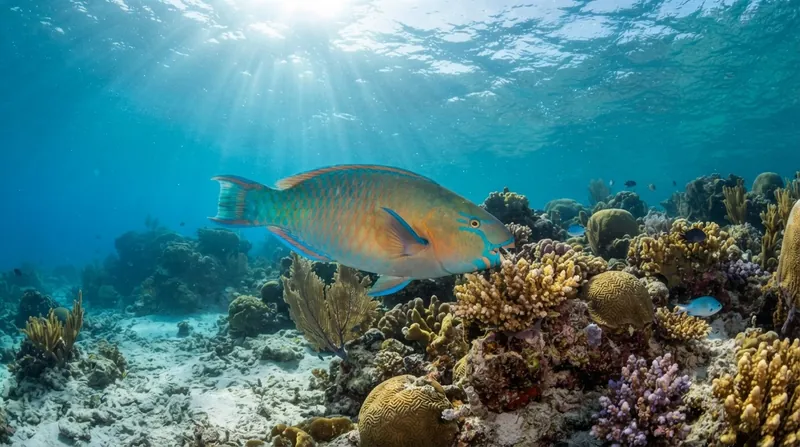
Much of it is biological in origin. Parrotfish eat algae off coral reefs, grinding up the hard calcium carbonate coral skeletons in their digestive tracts and excreting it as fine white sand, which washes ashore.
Analysis by camp
Physical Oceanographers
Focus on the mechanics of water density and temperature gradients.
From a physical standpoint, the ocean is defined by its density layers rather than its geography. Physical oceanographers view the permanent thermocline as a structural floor for the surface ocean. Because warm water is significantly less dense than cold water, the 24-degree Celsius difference between the tropical surface and the deep ocean creates a barrier as physically real as a sheet of glass, preventing any vertical mixing without massive kinetic energy inputs like a hurricane.
Marine Biologists
Examine how the lack of upwelling creates biological deserts and forces adaptation.
Marine ecologists look at clear water and see starvation. Because the physical density barrier prevents the biological pump from returning sunken nutrients to the surface, the open tropical ocean cannot support large food webs. Biologists focus on how life adapts to this extreme oligotrophic (nutrient-poor) environment, primarily by studying coral reefs, which have evolved to survive in these deserts by aggressively recycling their own waste internally rather than relying on the barren surrounding water.
Climate Scientists
Track how rising global temperatures are strengthening the thermocline.
Climate researchers are monitoring the tropical thermocline as an indicator of future ocean health. As global air temperatures rise, the surface layer of the ocean absorbs the excess heat. This makes the surface water even warmer and more buoyant, steepening the density gradient between the surface and the deep. Climate models suggest this strengthening stratification will further reduce nutrient upwelling, potentially expanding the size of these oceanic biological deserts in the coming decades.
- Physical Oceanography
- Focuses on the mechanics of water density, temperature gradients, and how thermal stratification dictates ocean circulation.
- Marine Ecology
- Examines how the lack of upwelling creates biological deserts and forces coral reefs to develop closed-loop nutrient recycling.
- Climate Dynamics
- Tracks how rising global temperatures are strengthening the thermocline and further reducing nutrient availability in the surface ocean.
Perspectives this story doesn't cover
- Coastal tourism boards
- Commercial fisheries operating in upwelling zones
Sources
Source coverage
3 outlets
3 viewpoints surfaced



- [1]NOAA Ocean ServicePhysical Oceanography
What is a thermocline?
Read on NOAA Ocean Service → - [2]NASA Earth ObservatoryMarine Ecology
Ocean Color: Phytoplankton and Chlorophyll
Read on NASA Earth Observatory → - [3]Factlen Editorial TeamMarine Ecology
Synthesis by Factlen editorial team
Read on Factlen Editorial Team →
More in Travel
See all →Granular Mechanics
Granular Shear Dilatancy Forces Wet Beach Sand to Vacuum Surface Water Under Pressure
6 sources

Fluid Dynamics
Wave Packets Travel at Half the Speed of Their Crests: Why Ocean Swell Reaches the Beach in Sets Separated by Lulls
4 sources
First Aid
The Science of Jellyfish Stings: Why Freshwater Worsens Pain and 45-Degree Heat Neutralizes Venom
9 sources
Sun Safety
The 290 to 400 Nanometer Wavelength Range: How the WMO Actually Calculates the UV Index and Sunburn Risk
8 sources
Comments
Every angle. Every day.
Get Travel stories with full source coverage and perspective breakdowns, free every day.