
Venice Expands Day-Tripper Tourist Fee to 60 Days for 2026 Amid Debate Over Effectiveness
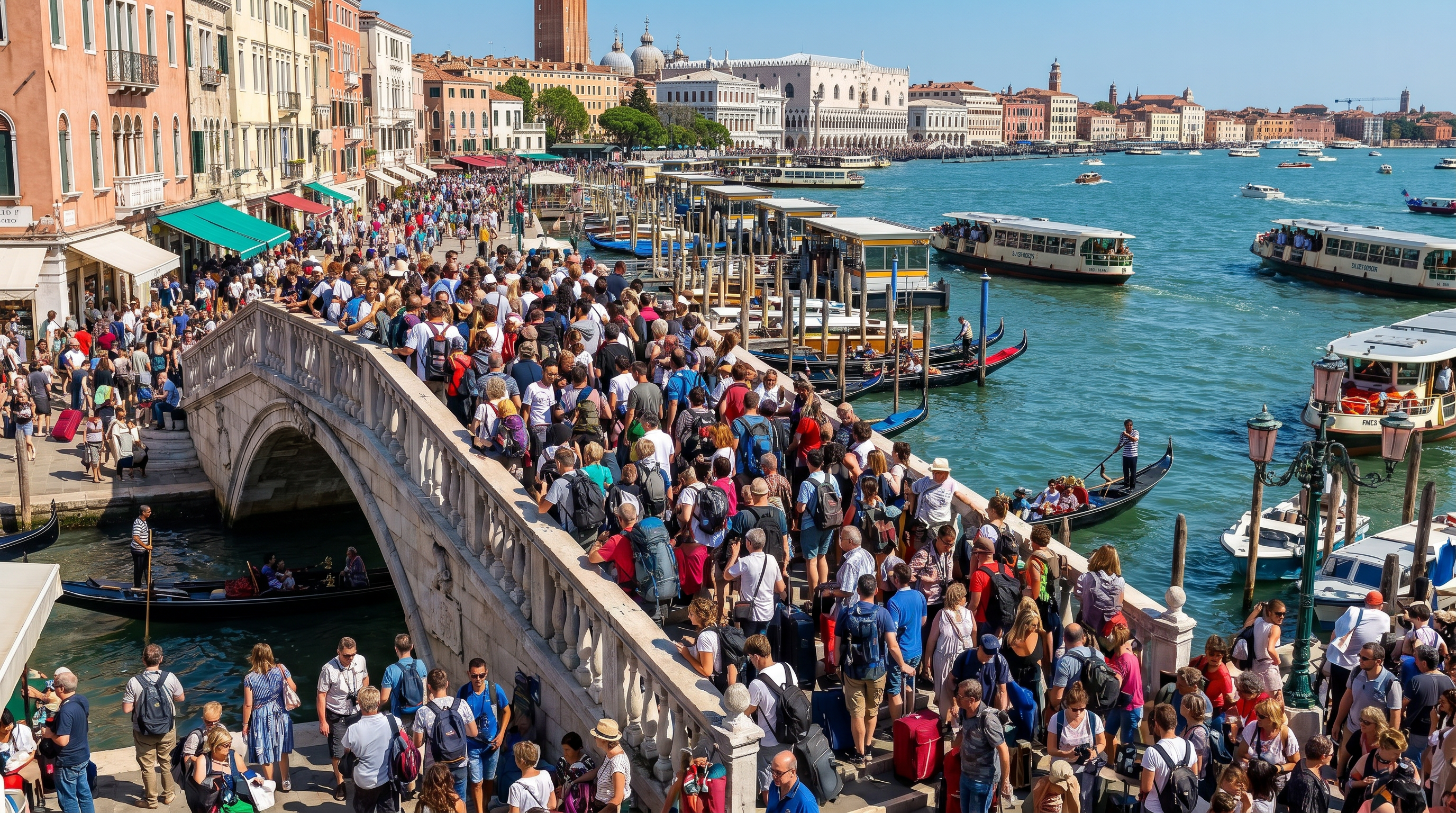
Venice has expanded its day-tripper access fee to 60 peak days for the 2026 tourist season. While the tax has generated millions for city maintenance, critics argue it has failed to reduce crowd sizes and risks turning the historic city into a theme park.
By Factlen Editorial Team
- Displaced Locals
- Furious that the city is monetizing overtourism rather than restricting short-term rentals.
- City Officials
- Argue the fee is a necessary first step in managing crowds and funding city maintenance.
- Heritage Conservationists
- Support regulatory measures to protect the city's fragile architecture from physical wear.
What's not represented
- · Budget-conscious travelers who may be priced out of visiting cultural heritage sites.
- · Cruise line operators who bring massive influxes of day-trippers to the region.
Why this matters
Venice is serving as the world's primary test case for managing overtourism through taxation. Its decision to expand the day-tripper fee despite evidence that it fails to reduce crowd sizes raises critical questions about whether such policies are genuine conservation tools or simply new municipal revenue streams.
Key points
- Venice will charge day-trippers €5 to €10 on 60 peak days between April and July 2026.
- The fee applies from 8:30 a.m. to 4:00 p.m., with fines up to €300 for non-compliance.
- Overnight guests, residents, students, and children under 14 are exempt but must still register for a QR code.
- Critics point to data showing the fee has failed to reduce daily visitor numbers, which still average around 75,000 on peak days.
- The city's permanent resident population has dwindled to fewer than 50,000, outnumbered by tourist beds.
- The tax generated €2.4 million during its initial 29-day pilot, far exceeding the projected €700,000.
Venice is doubling down on its controversial experiment to tax day-trippers, signaling a long-term shift in how the world's most fragile destinations manage mass tourism. After two years of testing and tweaking, the city will expand its access fee to 60 peak days for the 2026 tourist season, running primarily on weekends from early April through late July. The measure is explicitly designed to curb the crushing waves of "hit-and-run" tourists who clog the historic canal city's narrow alleyways and strain its municipal services, but leave before dinner without spending significantly in the local economy. By expanding the calendar, municipal authorities hope to force a change in traveler behavior, pushing visitors toward quieter weekdays or encouraging them to stay overnight.[1][2][3][4]
Visitors arriving between 8:30 a.m. and 4:00 p.m. on designated days must register on a dedicated online platform and download a digital QR code before entering the historic center. The pricing structure is tiered to reward planning: those who book their slots at least four days in advance will pay €5 (about $5.50), while last-minute arrivals face a doubled fee of €10. Enforcement relies on a network of inspectors who monitor key entry points, including the bustling Santa Lucia train station, the Piazzale Roma bus depot, and the Tronchetto parking garage. Tourists caught wandering the city's labyrinthine streets without a valid QR code risk steep administrative fines ranging from €50 to €300, plus the cost of the original entry fee.[1][4][5][6]
The system is carefully calibrated to target only transient day-trippers, leaving several major loopholes and exemptions. Tourists staying overnight in registered Venetian accommodations are entirely exempt from the entry fee, as their hotel or short-term rental bills already include a separate, nightly tourist tax. Other broad exemptions apply to children under 14, university students, commuters working in the historic center, residents of the wider Veneto region, and individuals visiting the city for medical care or to see family members. However, even exempt visitors—including overnight tourists who have already paid their hotel tax—must navigate the city's digital portal to secure a specific exemption QR code. This dual-layered bureaucratic hurdle has frustrated both international travelers and locals, leading to confusion at checkpoints.[2][3][4][5][7]

When Venice first launched the pilot program in 2024 for a limited run of 29 days, city officials projected a modest €700,000 in revenue, framing the initiative strictly as a crowd-control measure rather than a money-making scheme. Instead, the tax generated a staggering €2.4 million, with nearly half a million day-trippers paying the fee during the trial period. While municipal leaders celebrated the influx of funds—which they say is desperately needed to maintain the city's sinking infrastructure, dredge canals, and manage the massive waste generated by millions of visitors—critics immediately seized on the windfall. For opponents, the millions of euros collected were not a sign of success, but undeniable proof of the policy's fundamental failure to deter arrivals.[1][3][5][6]
The primary stated goal of the access fee was to reduce the sheer volume of human traffic on peak days, but municipal data suggests the tax has done the exact opposite. During the initial trial periods, Venice recorded an average of 75,000 daily visitors, sometimes exceeding the previous year's equivalent, tax-free days by up to 10,000 people. Tourism economists and urban planners argue that a €5 or even €10 fee is simply too low to alter the behavior of international travelers who have already spent thousands of dollars on flights and regional rail passes to reach Italy. For a tourist traveling from the United States or Asia, a €10 surcharge is viewed as a negligible rounding error rather than a genuine deterrent.[2][4][6][7]
The primary stated goal of the access fee was to reduce the sheer volume of human traffic on peak days, but municipal data suggests the tax has done the exact opposite.
For many of Venice's remaining permanent residents, the implementation of the fee represents a dark psychological turning point in the city's long history. Opposition councillors and local activist groups argue that charging admission effectively reduces a living, breathing, centuries-old municipality to the status of a gated museum or a theme park. "The ticket is a grand bluff," one opposition leader noted during a recent press conference, arguing the scheme was artfully created to generate international media buzz rather than solve the root causes of overtourism. Activists have staged protests at the train station, holding banners that declare Venice is a city, not a reservation, and demanding policies that prioritize civic life over tourist logistics.[1][2][3][7]
The fierce debate over the entry fee masks a much deeper existential crisis: Venice is suffering from severe, perhaps irreversible, social desertification. The permanent population of the historic center has dwindled to fewer than 50,000 residents, hollowed out by a lack of affordable housing, the disappearance of neighborhood businesses, and the unchecked explosion of short-term rentals. Today, tourist beds in Venice officially outnumber beds for actual residents, transforming residential neighborhoods into transient hotel zones. Activists argue that until the municipal government is willing to regulate the proliferation of vacation apartments and cap daily arrivals, taxing day-trippers is akin to bailing out a sinking gondola with a teaspoon.[2][4][5][6]

The implementation of the QR code system has also sparked intense civil liberties debates among the local population. Residents and local university students deeply resent being forced to log their movements and justify their presence in their own city to avoid being fined by inspectors. Furthermore, the city's increasing reliance on a high-tech "Smart Control Room"—which tracks anonymized cellphone data and uses optical sensors to monitor crowd density in real-time—has prompted widespread unease. Locals have raised serious concerns about creeping surveillance and data privacy violations, arguing that the infrastructure built to monitor tourists is simultaneously turning residents into tracked subjects within their own hometown.[1][3][5][7]
Despite its domestic unpopularity and questionable efficacy at crowd reduction, the tax has achieved one major geopolitical victory for the city administration. In late 2023, the mere announcement of the impending day-tripper fee convinced a UNESCO committee not to place Venice on its dreaded list of World Heritage sites in danger. International heritage bodies have praised the city for taking proactive, if imperfect, steps to manage its carrying capacity, buying local politicians valuable time and political cover. By demonstrating to the United Nations that they are willing to take unprecedented regulatory steps, Venetian officials have successfully protected the city's prestigious international standing, even as local conditions continue to deteriorate.[1][2][5][6]
As the 2026 season approaches, destinations worldwide are watching Venice closely, treating the lagoon city as a real-time laboratory for the economics of crowd control. From Barcelona increasing its nightly tourist taxes and banning short-term rentals, to Mount Fuji and the Galápagos Islands capping daily visitor numbers, the global travel industry is grappling with the absolute limits of sustainable tourism. Venice remains entirely unique as the first major global city to charge an outright admission fee for day-trippers. If the expanded 60-day calendar proves successful at shifting visitor patterns, it could provide a blueprint for other overwhelmed heritage sites; if it fails, it may prove that pricing strategies alone cannot solve overtourism.[2][3][4][7]

Whether the expanded 60-day calendar and the stricter €10 penalty for late bookings will finally reach the price elasticity threshold needed to deter visitors remains the central question for 2026. City officials maintain that the policy is a long-term cultural shift, arguing that it will take years to train global tourists to respect the city's carrying capacity. But for now, Venice remains locked in a tragic paradox: it is successfully monetizing its own overcrowding, generating millions in new revenue, but it has yet to prove it can save its soul or stem the exodus of the very Venetians who keep the city alive.[3][5][6]
How we got here
2020
Venice begins tracking crowd data via a high-tech Smart Control Room using anonymized cellphone data.
Sep 2023
UNESCO decides against putting Venice on its 'in danger' list after the city announces the impending day-tripper fee.
Apr 2024
Venice launches the initial 29-day pilot program, charging a flat €5 for day-trippers.
2025
The program expands to 54 days, introducing a €10 tier for last-minute bookings.
Apr 2026
The fee expands to 60 days, covering most spring and summer weekends.
Viewpoints in depth
Municipal Administration
City officials view the fee as a pioneering, necessary tool to manage crowds and fund infrastructure.
For the mayor's office and tourism councillors, the access fee is a groundbreaking attempt to manage an unprecedented global problem. They argue that while the fee may not immediately empty the streets, it establishes a crucial principle: visiting a fragile heritage site comes with a cost. The millions of euros generated are ring-fenced for essential city services, including waste management, canal dredging, and maintaining the crumbling architecture that makes Venice unique. Officials insist the policy is a long-term cultural shift that will eventually train tourists to avoid peak weekends.
Local Residents & Activists
Locals argue the fee turns the city into a theme park and ignores the real issue of short-term rentals.
Resident associations and opposition politicians view the fee as a catastrophic misstep that commodifies their hometown. They argue that charging an entry ticket psychologically transforms a living civic space into a museum or an amusement park. Furthermore, activists point out that the fee completely ignores the primary driver of the city's demographic collapse: the unregulated explosion of short-term vacation rentals like Airbnb. They demand policies that cap daily visitor numbers and restrict tourist apartments to bring permanent residents back to the historic center.
Tourism Economists
Experts believe the fee is too low to deter travel and functions merely as a municipal cash grab.
Economists studying travel behavior argue that a €5 to €10 fee lacks the price elasticity required to change the plans of international tourists. Because visitors often spend thousands of dollars on flights and accommodations to reach Italy, a minor surcharge at the train station is viewed as a negligible inconvenience rather than a deterrent. Consequently, these experts argue the policy fails as a crowd-control measure and functions instead as a highly successful, if cynical, revenue-generation scheme for the local government.
What we don't know
- Whether the increased €10 penalty for late bookings will finally reach the price threshold needed to deter visitors.
- How the municipal government plans to allocate the millions of euros in surplus revenue generated by the tax.
- If UNESCO will eventually intervene and place Venice on the 'in danger' list if visitor numbers continue to climb despite the fee.
Key terms
- Hit-and-run tourism
- A term for day-trippers who visit a destination for only a few hours, contributing to crowding without spending significantly in the local economy.
- Overtourism
- The phenomenon where the volume of visitors negatively impacts the local environment, infrastructure, and quality of life for residents.
- Social desertification
- The hollowing out of a city's permanent population as housing is converted into tourist accommodations and local services disappear.
- Smart Control Room
- A high-tech surveillance center in Venice that uses anonymized cellphone data and optical sensors to monitor crowd density in real-time.
Frequently asked
Do I have to pay if I'm staying overnight in Venice?
No. Overnight guests are exempt because they already pay a nightly hotel tax. However, you must still register on the city's portal to download an exemption QR code.
How much is the fine for not paying?
Tourists caught without a valid QR code during enforcement hours face administrative fines ranging from €50 to €300, plus the cost of the original entry fee.
Does the fee apply every day of the year?
No. In 2026, the fee only applies on 60 specific peak days between April and July, primarily on weekends and major spring holidays.
Does the fee apply if I am only visiting islands like Murano?
No. The access fee specifically targets the historic center of Venice. Visitors who bypass the main city and only travel to islands like Murano or the Lido are exempt.
How do authorities check if I paid?
Inspectors conduct random checks at key entry points, including the Santa Lucia train station, the Piazzale Roma bus depot, and the Tronchetto parking garage.
Sources
Source coverage
7 outlets
3 viewpoints surfaced







[1]The Independent
Venice's day-tripper fee returns this week, here's what you need to know
Read on The Independent →[2]Wanted in Milan
Venice is expanding its day-tripper entry fee again in 2026
Read on Wanted in Milan →[3]FTN News
Venice will extend and expand its tourist entry fee in 2026
Read on FTN News →[4]Travel Tomorrow
Venice's controversial entry fee for day visitors is back this year
Read on Travel Tomorrow →[5]Outlook Traveller
Venice expands its day-tripper fee in 2026 to 60 days between April and July
Read on Outlook Traveller →[6]The Economic Times
Venice will reintroduce its daytripper fee from April 3 to July 26, 2026
Read on The Economic Times →[7]Tempo
Venice Enforces Weekend Tourist Fee From April to July 2026
Read on Tempo →

Every angle. Every day.
Get travel stories with full source coverage and perspective breakdowns delivered to your inbox.