
US Community Solar Surpasses 10-Gigawatt Milestone, Expanding Clean Energy Access
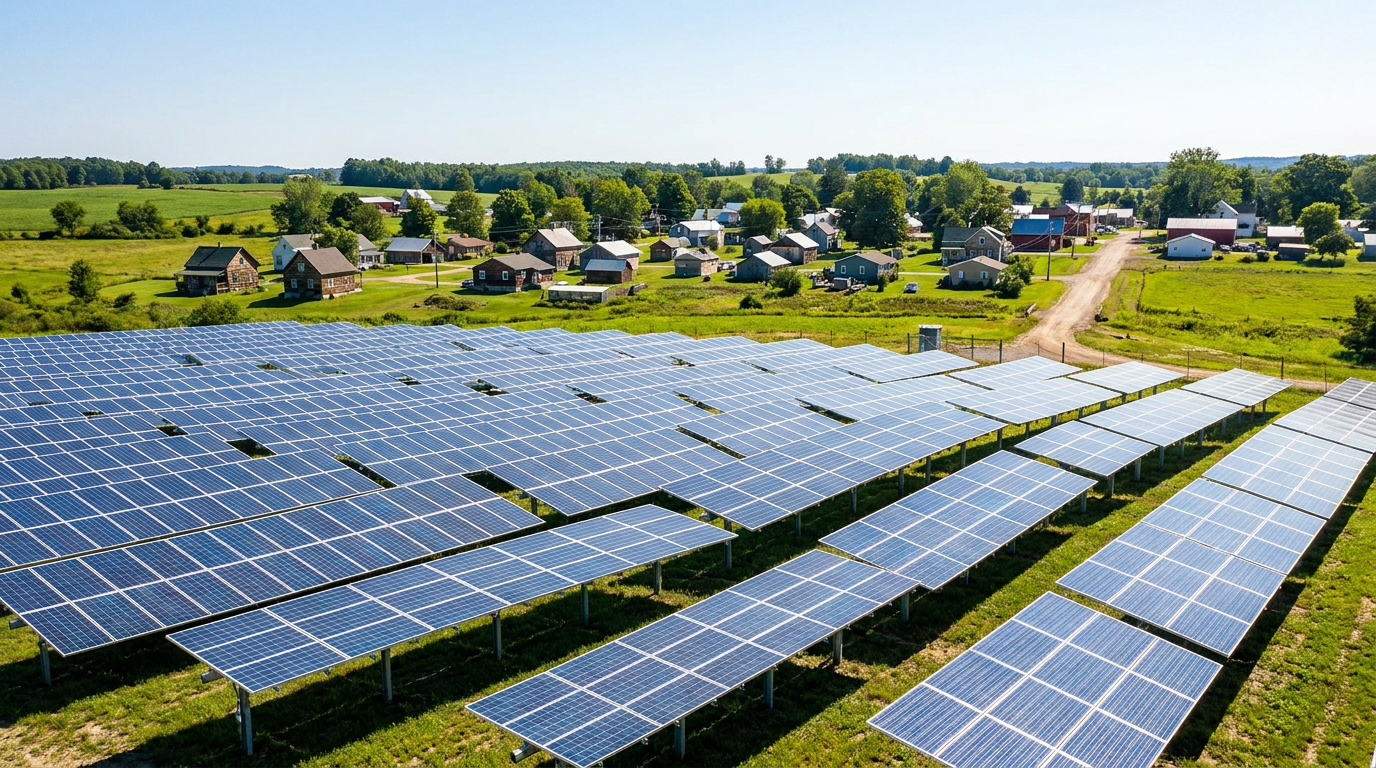
The United States has officially crossed 10 gigawatts of installed community solar capacity, a historic milestone that brings renewable energy and bill savings to renters and households unable to install rooftop panels.
By Factlen Editorial Team
- Clean Energy Advocates
- View the 10 GW milestone as a massive victory for energy equity that democratizes access to solar power for renters and low-income households.
- Energy Market Analysts
- Focus on the market data, noting that while the milestone is historic, the sector must overcome a recent 25% contraction and severe grid interconnection delays.
- Global Observers
- See the US community solar model as a successful blueprint that other nations can replicate to solve their own clean energy access problems.
What's not represented
- · Traditional utility companies managing the grid interconnection queues
- · Local municipalities zoning the new community-scale projects
Why this matters
For the roughly 80% of Americans who cannot install rooftop solar—whether because they rent, live in apartments, or have shaded roofs—community solar offers a direct path to lower electricity bills and participation in the clean energy transition.
Key points
- The US has officially surpassed 10 gigawatts of installed community solar capacity.
- The milestone proves the viability of shared solar models for renters and low-income households.
- Despite a 25% market contraction in 2025, analysts project a 12% growth rebound in 2026.
- Developers are managing an 8 GW pipeline, with 29% of projects already under construction.
- Future growth depends heavily on new state-level legislation and resolving grid interconnection delays.
The United States has officially crossed a historic threshold in its renewable energy transition, surpassing 10 gigawatts (GW) of cumulative community solar capacity. The milestone, confirmed in a joint report by energy analytics firm Wood Mackenzie and the Coalition for Community Solar Access (CCSA), represents a major victory for energy equity. Unlike traditional rooftop solar, which requires homeownership and significant upfront capital, community solar allows multiple participants to subscribe to a shared local solar array and receive direct credits on their utility bills.[1][4]
Reaching 10 GW—enough to power millions of homes—proves that distributed clean energy can successfully reach ordinary people. Industry advocates note that the sector has already delivered meaningful electricity bill savings to hundreds of thousands of households and businesses, particularly benefiting low-income families and renters who have historically been locked out of the green energy boom.[4][5]
Despite the celebratory milestone, the data reveals a market in transition. The sector actually experienced a 25% contraction in 2025, installing 1,435 megawatts (MW) for the year. Analysts attribute this dip to a natural slowdown in mature, early-adopter markets like New York and Maine, where the most accessible projects have already been built and grid capacity is tightening.[1][3]

However, the industry is poised for a rapid recovery. Wood Mackenzie forecasts a 12% rebound in growth for 2026, driven by a surge of new installations in Illinois and several Mid-Atlantic states. Developers are currently sitting on a massive project pipeline exceeding 8 GW, with nearly 29% of that capacity already under construction and racing toward completion.[1][4]
Wood Mackenzie forecasts a 12% rebound in growth for 2026, driven by a surge of new installations in Illinois and several Mid-Atlantic states.
To sustain this momentum, developers are shifting their strategies toward "community-scale" resources. These projects, typically ranging up to 20 MW, are smaller than massive utility-scale solar farms but large enough to make a significant dent in local power needs. Because they connect directly to the distribution grid, they can be deployed much faster than larger projects, offering utilities a nimble tool to enhance grid flexibility and reliability in the face of rising electricity demand.[1][6]

The long-term expansion of community solar now hinges heavily on state-level politics. The US did not build its first 10 GW through a single federal mandate; rather, it relied on a patchwork of state policies that gradually created a national market. Developers have already established strong pre-development pipelines in states like Ohio, Iowa, Pennsylvania, and Michigan, hoping that new legislative frameworks will unlock up to 1.5 GW of additional capacity through the end of the decade.[4][5]
Navigating the road ahead will require overcoming significant logistical hurdles. Solar developers are actively battling severe interconnection queue backlogs, waiting months or years for utility approval to plug their finished arrays into the grid. Furthermore, shifting federal policy—particularly the planned phaseout of the federal investment tax credit (ITC) in 2030—is forcing companies to accelerate their construction timelines to secure critical funding.[1][2]

The success of the American community solar model is increasingly drawing international attention. Global energy observers point out that the US stands largely alone among developed nations in scaling this specific shared-ownership model. Countries with massive solar potential but highly fractured energy access, such as India, are now looking to the US state-by-state approach as a blueprint for democratizing their own grids.[5]
As the industry pushes past the 10 GW mark, the focus is shifting from simply building capacity to refining the consumer experience. With subscriber acquisition costs dropping and management platforms consolidating, the barrier to entry for the average household continues to fall. For communities across the country, the milestone signals that the future of the electric grid can be both clean and locally owned.[1][4]
How we got here
Late 2025
The US community solar sector officially surpasses 10 gigawatts of cumulative installed capacity.
End of 2025
Annual data reveals a 25% contraction in new installations compared to the previous year, driven by slowdowns in mature state markets.
Early 2026
Wood Mackenzie and the CCSA release their joint report confirming the 10 GW milestone and forecasting a 12% market rebound.
2030
The scheduled phaseout of the federal investment tax credit (ITC), which is currently accelerating developer construction timelines.
Viewpoints in depth
Clean Energy Advocates
Celebrating the democratization of the electric grid.
For clean energy advocates and industry groups like the Coalition for Community Solar Access, the 10 GW milestone is proof of concept for a more equitable grid. They argue that the traditional energy transition has heavily favored wealthy homeowners who can afford the upfront costs of rooftop panels. Community solar breaks down that barrier, allowing anyone with an electric bill to participate. Advocates are now pushing aggressively for new state-level legislation in places like Ohio and Pennsylvania to open up fresh markets and maintain the industry's momentum.
Energy Market Analysts
Balancing historic milestones with near-term market realities.
Market analysts acknowledge the significance of the 10 GW achievement but caution that the sector is facing growing pains. The 25% contraction in 2025 highlights the fragility of relying on a few early-adopter states like New York and Maine. Analysts point out that developers are currently bottlenecked by severe interconnection delays, waiting for utilities to upgrade local grids to handle the new power. Furthermore, the looming 2030 phaseout of federal tax credits is forcing developers to rush their 8 GW pipelines, creating a complex, high-pressure environment for the next four years.
What we don't know
- Whether pending legislation in states like Ohio, Iowa, and Pennsylvania will pass in time to offset the slowdown in mature markets.
- How quickly utility companies will be able to resolve the interconnection queue backlogs that are currently delaying finished projects.
- What impact the planned 2030 phaseout of the federal investment tax credit will ultimately have on long-term project financing.
Key terms
- Community Solar
- A shared solar array with multiple subscribers who receive credit on their electricity bills for their share of the power produced.
- Gigawatt (GW)
- A unit of power equal to one billion watts, often used to measure the capacity of large-scale power plants or national energy grids.
- Interconnection Queue
- The waiting list and approval process that new power generation projects must go through before they are allowed to connect to the regional electricity grid.
- Investment Tax Credit (ITC)
- A federal policy that allows individuals or businesses to deduct a percentage of the cost of a solar energy system from their federal taxes.
Frequently asked
What is community solar?
Community solar is a model where multiple customers subscribe to a shared, local solar power project. Subscribers receive credits on their utility bills for the energy their portion of the array produces, allowing them to benefit from solar without installing panels on their own roofs.
Why did the community solar market shrink in 2025?
The market contracted by 25% in 2025 primarily due to a slowdown in mature, early-adopter states like New York and Maine, where the most accessible projects have already been completed and grid capacity is becoming constrained.
Who benefits the most from community solar?
Renters, residents of multi-family buildings, low-income households, and homeowners with heavily shaded roofs benefit the most, as they are typically excluded from the traditional rooftop solar market.
Sources
Source coverage
7 outlets
3 viewpoints surfaced







[1]Wood MackenzieEnergy Market Analysts
US community solar sector reaches historic 10 GW milestone
Read on Wood Mackenzie →[2]TesevoEnergy Market Analysts
US Community Solar Reaches 10 GW: A New Milestone with Growing Challenges
Read on Tesevo →[3]PV-TechClean Energy Advocates
US community solar capacity passes 10GW despite 2025 slowdown
Read on PV-Tech →[4]ElectrekClean Energy Advocates
US community solar just cleared 10 GW, and that's a big deal
Read on Electrek →[5]Saur EnergyGlobal Observers
Community solar in the US crossed the 10 GW mark in 2025, an achievement where the US stands alone
Read on Saur Energy →[6]Standard SolarClean Energy Advocates
Q&A with Jeff Cramer, President and CEO of the Coalition for Community Solar Access
Read on Standard Solar →[7]PBS
Solar power is hitting new milestones in the U.S.
Read on PBS →

Every angle. Every day.
Get community stories with full source coverage and perspective breakdowns delivered to your inbox.