
U.S. to Significantly Reduce Fighter Jets and Warships Committed to NATO in Europe
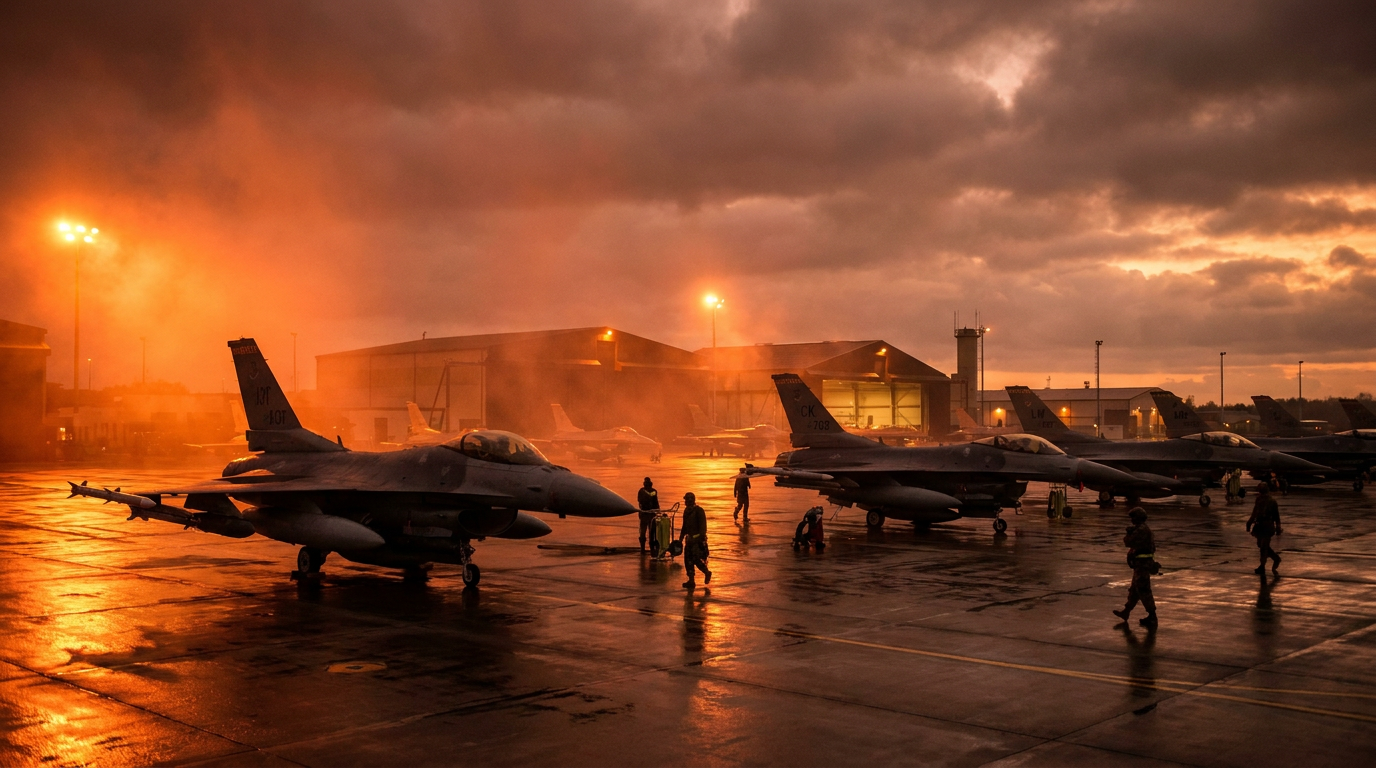
The United States plans to withdraw dozens of fighter jets, reconnaissance aircraft, and naval assets from NATO operations, accelerating a push for Europe to shoulder its own conventional defense.
By Factlen Editorial Team
- U.S. Defense Planners
- The U.S. must rightsize its commitments and force Europe to take primary responsibility for its own security.
- European Security Advocates
- A sudden reduction in U.S. forces creates dangerous vulnerabilities in Europe's deterrence capabilities.
- NATO Leadership
- The alliance is evolving toward a more sustainable, balanced model of shared responsibility.
What's not represented
- · Eastern European Border States
- · Russian Military Command
Why this matters
For decades, European security has relied heavily on American airpower and naval dominance. This rapid drawdown forces European nations to immediately accelerate their own defense spending and fundamentally alters the balance of military power deterring Russian aggression on the continent.
Key points
- The U.S. plans to cut the number of F-16 and F-15E fighter jets committed to NATO from roughly 150 to 100.
- All eight American aerial refueling tankers currently allocated to European operations will be withdrawn.
- Key naval assets, including an aircraft carrier and a missile-carrying submarine, will be reassigned to other regions.
- The drawdown is designed to force European nations to assume primary responsibility for their own conventional defense.
The United States is preparing to significantly reduce the aircraft, warships, and surveillance assets it commits to NATO operations in Europe, marking one of the most substantial shifts in the alliance's defense posture since the end of the Cold War.[4][5]
The planned drawdown, communicated to European allies in early June, will slash the number of F-16 and F-15E fighter jets assigned to NATO missions from roughly 150 down to 100.[2][4]
Maritime reconnaissance aircraft, critical for monitoring submarine activity, will be cut from 26 to 15. Furthermore, all eight aerial refueling tankers currently allocated to European operations will be withdrawn completely.[2][4]

Naval and strategic assets are also being heavily reallocated. The plan calls for the reassignment of a missile-carrying submarine, an aircraft carrier, accompanying warships, and one of two bomber groups previously available for European defense missions.[5][7]
The reductions represent a concrete implementation of the Trump administration's long-standing demand that European nations shoulder the primary burden of their own conventional defense, rather than relying on American military umbrellas.[3][5]
U.S. military officials have framed the move as an effort to "rightsize" contributions to the alliance. U.S. Air Force General Alexus G. Grynkewich, Commander of U.S. European Command, recently noted an "unhealthy co-dependence" on American forces within the NATO Force Model.[9]
military officials have framed the move as an effort to "rightsize" contributions to the alliance.
The redeployment aligns with Washington's broader strategic pivot. As the U.S. focuses increasingly on the Indo-Pacific and the Middle East, defense planners argue that maintaining a massive footprint in Europe is no longer viable or necessary given the economic size of the European Union.[1][8]

The asset cuts follow a broader trend of U.S. disengagement from the continent. The Pentagon recently announced it would withdraw 5,000 troops from Germany and reduce the number of Brigade Combat Teams assigned to Europe from four to three.[3][8]
European officials have expressed concern that the sudden reduction in American airpower, intelligence, and logistics could create immediate vulnerabilities. Analysts note that U.S. assets carry unique weight due to Washington's unmatched military reach and rapid deployment capabilities.[2][6]
The loss of the aerial refueling tankers is particularly acute. Without these specialized aircraft, European fighter jets will have significantly shorter operational ranges, complicating any sustained air campaign or rapid response to incursions on NATO's eastern flank.[2][6]
The cuts will also specifically limit NATO's ability to monitor Russian naval activity and conduct long-range strike operations during a crisis, areas where European militaries currently lack sufficient independent capacity.[1][4]

Despite the alarm in some European capitals, NATO leadership has sought to project stability. NATO Secretary General Mark Rutte stated that the adjustments will unfold gradually and will not undermine the alliance's core defense plans.[8]
"This change strengthens NATO's defense plans by reducing over-dependence on one ally," NATO spokesperson Allison Hart said, framing the shift as a necessary evolution toward long-term sustainability.[1]
How we got here
2022
Russia's full-scale invasion of Ukraine prompts European nations to begin bolstering their defense capacities.
May 2026
The Pentagon announces a reduction in Brigade Combat Teams in Europe and the withdrawal of 5,000 troops from Germany.
Early June 2026
U.S. officials share a document with European allies outlining specific cuts to fighter jets, reconnaissance aircraft, and naval assets.
July 2026
NATO member states are scheduled to meet at a crucial summit to discuss the alliance's new defense posture and burden-sharing.
Viewpoints in depth
U.S. Defense Planners' view
The U.S. must rightsize its commitments and force Europe to take primary responsibility for its own security.
American military leadership argues that the current NATO Force Model relies on an 'unhealthy co-dependence' on U.S. assets. By gradually withdrawing conventional forces, Washington aims to compel European allies to invest more heavily in their own defense industries and military capabilities. This shift also allows the Pentagon to reallocate critical naval and air assets to other strategic theaters, such as the Indo-Pacific, where U.S. planners see more pressing long-term challenges.
European Security Advocates' view
A sudden reduction in U.S. forces creates dangerous vulnerabilities in Europe's deterrence capabilities.
Defense analysts and European officials warn that while the continent has increased military spending since 2022, it still lacks the advanced capabilities the U.S. provides. The complete withdrawal of aerial refueling tankers and the sharp reduction in maritime reconnaissance aircraft are seen as particularly damaging. Without these assets, European militaries will struggle to conduct sustained long-range strikes or effectively monitor Russian submarine activity, potentially emboldening Moscow during a crisis.
NATO Leadership's view
The alliance is evolving toward a more sustainable, balanced model of shared responsibility.
NATO officials have sought to downplay the severity of the American drawdown, framing it as a natural and anticipated evolution of the alliance. Leadership emphasizes that the U.S. is not abandoning Europe, but rather shifting its role as European nations step up. By reducing over-dependence on a single ally, NATO argues it is building a more resilient, multi-polar defense structure that will be better equipped to handle future threats independently.
What we don't know
- Exactly how quickly the Pentagon plans to execute the withdrawal of these specific aircraft and naval assets.
- Whether European defense industries can scale up production fast enough to replace the lost U.S. capabilities.
- How Russia will alter its military posture in response to the reduced American conventional presence in Europe.
Key terms
- NATO Force Model
- The framework under which alliance member countries identify a pool of available military forces that can be activated during a conflict or major crisis.
- Maritime Reconnaissance Aircraft
- Specialized planes equipped with sensors and radar used to patrol oceans, monitor ship movements, and detect submarines.
- Aerial Refueling Tanker
- A specialized aircraft designed to transfer aviation fuel to other military planes mid-flight, significantly extending their operational range.
- Brigade Combat Team (BCT)
- A stand-alone, self-sufficient tactical unit of the U.S. Army that trains and deploys together, typically consisting of around 4,000 soldiers.
Frequently asked
Why is the U.S. withdrawing these military assets?
The U.S. is aiming to shift the primary responsibility for Europe's conventional defense onto European nations, while also pivoting American military resources toward other global regions like the Indo-Pacific.
Which specific aircraft are being removed?
The U.S. is cutting its committed F-16 and F-15E fighter jets from 150 to 100, reducing maritime reconnaissance planes from 26 to 15, and completely withdrawing all eight of its aerial refueling tankers.
Will this leave Europe undefended?
NATO leadership insists the changes will happen gradually and that the U.S. remains committed to the alliance, including its nuclear umbrella, while European nations build up their own military capacities.
Sources
Source coverage
9 outlets
3 viewpoints surfaced








[1]Al JazeeraNATO Leadership
US to cut air and naval assets deployed for NATO operations in Europe
Read on Al Jazeera →[2]NewsweekEuropean Security Advocates
The Four Biggest US Military Cuts That Could Hit NATO
Read on Newsweek →[3]Defense NewsU.S. Defense Planners
US plans to shrink forces available to NATO during crises, sources say
Read on Defense News →[4]The Straits TimesEuropean Security Advocates
US plans major cut to fighter jets, warships for NATO operations in Europe, NYT reports
Read on The Straits Times →[5]Gulf NewsNATO Leadership
US plans major NATO drawdown as Trump shifts focus from Europe
Read on Gulf News →[6]Modern DiplomacyEuropean Security Advocates
US Plans NATO Force Cuts in Europe
Read on Modern Diplomacy →[7]The Times of IsraelNATO Leadership
US planning to significantly cut fighter jets, warships for NATO operations in Europe — report
Read on The Times of Israel →[8]TIMENATO Leadership
NATO Chief Says U.S. Troop Withdrawal Won't Impact Defense Plans
Read on TIME →[9]Open MagazineU.S. Defense Planners
US to Slash Key NATO Military Assets in Europe, Cut Jets, Ships and Surveillance in Major Drawdown: Report
Read on Open Magazine →


Every angle. Every day.
Get news politics stories with full source coverage and perspective breakdowns delivered to your inbox.