
Tokenized Treasury Market Surpasses $10 Billion as Blockchain Offers Global Inflation Shield
The market for blockchain-based U.S. government debt has crossed a historic milestone, providing everyday investors in emerging economies unprecedented access to stable yields. The boom in real-world asset tokenization is transforming how global citizens protect their savings against local currency devaluation.

The digital asset industry has quietly crossed a threshold that has nothing to do with speculative meme coins or volatile trading. As of this week, the total market capitalization of tokenized U.S. Treasury bills on public blockchains surpassed $10 billion, marking a historic maturation point for the sector. This milestone underscores a massive shift in how traditional financial institutions and everyday global citizens are utilizing decentralized networks.[1]
Tokenization involves creating a digital representation of a real-world asset—in this case, short-term U.S. government debt—on a blockchain. Instead of requiring a traditional brokerage account, minimum balances, and U.S. banking infrastructure, these tokens can be held in digital wallets and transferred globally in seconds. The underlying assets are held securely by regulated custodians, while the blockchain acts as an immutable ledger tracking ownership.[3][5]
The surge to $10 billion has been largely driven by traditional finance heavyweights. Firms like BlackRock and Franklin Templeton have aggressively expanded their blockchain-based funds, offering institutional-grade security combined with the 24/7 liquidity of crypto networks. These funds have attracted billions from decentralized autonomous organizations (DAOs), corporate treasuries, and retail-facing fintech platforms looking for a safe place to park capital while earning a steady yield.[4]
But the most profound impact of this financial plumbing upgrade is being felt far from Wall Street. In emerging markets battling severe currency devaluation, tokenized Treasuries are emerging as a vital economic lifeline. Citizens in countries like Argentina, Turkey, and Nigeria are increasingly using these digital instruments to protect their life savings from double-digit inflation.[2]
Historically, accessing U.S. debt from the Global South required navigating prohibitive capital controls, exorbitant banking fees, and high minimum investment thresholds. Today, a freelance graphic designer in Buenos Aires can convert their local currency into a dollar-pegged stablecoin, and then use a decentralized application to purchase fractional shares of a tokenized Treasury fund for as little as $5.[3]
This frictionless access allows them to earn a relatively risk-free 4.5% yield on their savings, a financial shield that was previously reserved for the wealthy or institutional class. Analysts note that this represents one of the first times blockchain technology has delivered on its original promise of democratizing global finance at scale.[2]
The technological backbone supporting this $10 billion ecosystem relies heavily on public networks like Ethereum, Polygon, and Stellar. These blockchains process the transactions, while smart contracts automatically calculate and distribute the daily yield to token holders. By eliminating intermediaries like clearinghouses and correspondent banks, the system drastically reduces operational friction and settlement times.[1][5]
Regulatory clarity has also played a crucial role in this boom. Unlike the legal gray areas surrounding many cryptocurrencies, tokenized Treasuries are explicitly structured as securities. The underlying funds are registered with the U.S. Securities and Exchange Commission (SEC), and the issuers enforce strict Know Your Customer (KYC) and Anti-Money Laundering (AML) checks before allowing users to mint or redeem the tokens.[1][3]
However, this regulatory compliance has sparked a philosophical debate within the crypto community. Because issuers maintain the ability to freeze or seize tokens to comply with law enforcement, decentralized finance (DeFi) purists argue that these assets violate the core ethos of permissionless, censorship-resistant money. They caution that relying on centralized custodians introduces the very counterparty risks that blockchain was invented to solve.[6]
Despite these ideological clashes, the market has spoken clearly in favor of utility and yield. The integration of KYC-gated tokens into broader decentralized finance protocols has created a hybrid ecosystem where traditional compliance meets next-generation infrastructure. Users are increasingly willing to undergo identity verification in exchange for the stability of U.S. government-backed returns.[4][6]
Wall Street executives view the $10 billion Treasury market as merely a proof of concept. The operational efficiencies gained—such as instant atomic settlement and automated compliance via smart contracts—are driving institutions to explore tokenizing more complex asset classes. Private credit, commercial real estate, and corporate bonds are already being piloted on public ledgers.[4]
For the broader public, the success of tokenized real-world assets signals a maturation of the digital economy. The narrative is shifting away from volatile speculation toward tangible financial inclusion. As the infrastructure becomes more invisible and user-friendly, the ability to access the world's safest financial instruments is slowly becoming a standard feature of the global internet.[2][3]
Key points
- The market for tokenized U.S. Treasuries has surpassed $10 billion, driven by traditional finance giants like BlackRock.
- These digital assets allow global users to earn stable, dollar-denominated yields directly from digital wallets.
- Citizens in high-inflation countries are increasingly using these tokens to protect their savings from currency devaluation.
- The underlying funds are regulated by the SEC, requiring strict identity verification for investors.
What we don’t know
- How local governments in emerging markets will react if tokenized U.S. assets begin draining significant capital from their domestic banking systems.
- Whether the SEC will eventually allow these yield-bearing tokens to be used seamlessly as collateral across the broader, unregulated decentralized finance ecosystem.
How we got here
2021
Early experimental protocols begin tokenizing small amounts of U.S. debt on public blockchains.
April 2023
Franklin Templeton launches the first U.S.-registered mutual fund to use a public blockchain to process transactions.
March 2024
BlackRock launches its BUIDL fund on the Ethereum network, rapidly attracting institutional capital.
June 2026
The total market capitalization of tokenized U.S. Treasuries crosses the $10 billion milestone.
- Traditional Finance Institutions
- View tokenization as a massive upgrade to market infrastructure that reduces settlement times and operational costs.
- Emerging Market Consumers
- See tokenized assets as a vital tool for financial inclusion and a shield against local currency devaluation.
- Decentralization Advocates
- Remain skeptical of permissioned smart contracts and centralized custodians, preferring purely trustless systems.
- Financial Regulators
- Support the innovation but prioritize strict KYC/AML compliance and investor protection frameworks.
Perspectives this story doesn't cover
- Local commercial banks in emerging markets losing deposits
- U.S. Treasury Department debt managers
Sources
Source coverage
6 outlets
4 viewpoints surfaced






- [1]ReutersFinancial Regulators
Tokenized US Treasury market eclipses $10 billion milestone
Read on Reuters → - [2]BloombergEmerging Market Consumers
How blockchain bonds became the ultimate inflation hedge in emerging markets
Read on Bloomberg → - [3]Financial TimesFinancial Regulators
The quiet revolution of crypto: Yield-bearing tokens democratize access to US debt
Read on Financial Times → - [4]CNBCTraditional Finance Institutions
The AI trade cooled and oil sank. A closer look at Wall Street's volatile week
Read on CNBC → - [5]TechCrunch
From Fortnite to robots: General Intuition raises $2.3B on bet that video games can train AI agents for the real world
Read on TechCrunch → - [6]The DefiantDecentralization Advocates
DeFi purists clash with TradFi giants over the soul of RWA tokenization
Read on The Defiant →
More in Finance
See all →Crypto Regulation
The Mechanics of Asset Liquidation: How South Korea's New Rules Govern Crypto Seizure for Civil Debt Enforcement
5 sources

Crypto Regulation
The Mechanics of Regulatory Clarity: How the CLARITY Act Will Redefine SEC and CFTC Jurisdiction Over Digital Assets
3 sources
Tokenized Equities
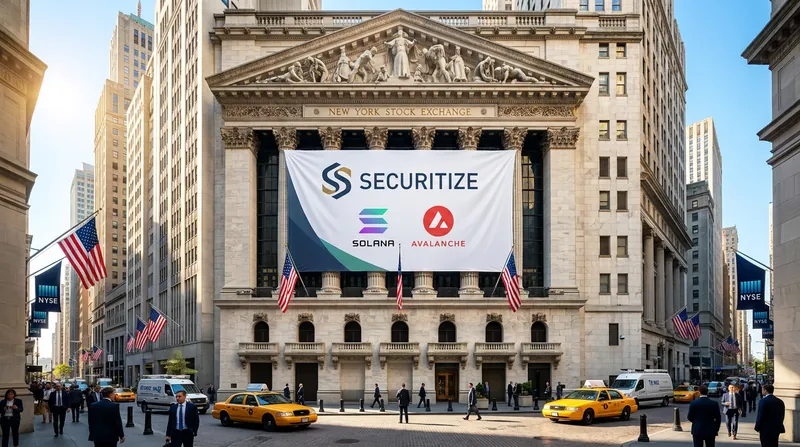
Securitize Debuts on NYSE Alongside Concurrent Tokenized Stock Listings on Solana and Avalanche
5 sources
Tokenized Assets
The Mechanics of Retail Integration: How Robinhood's New Blockchain and Tokenized Stock Platform Reshapes Consumer Crypto Finance
6 sources

Comments
Every angle. Every day.
Get Finance stories with full source coverage and perspective breakdowns, free every day.