
The Space Economy Arrives on Wall Street: Rocket Lab Joins Nasdaq 100 as SpaceX Launches Historic IPO
In a landmark week for the aerospace sector, Rocket Lab has been added to the prestigious Nasdaq-100 index just as SpaceX executes a record-shattering $75 billion public listing. The dual milestones signal the space economy's official transition into a mainstream, benchmarked asset class.
By Factlen Editorial Team

- Institutional Investors
- Focused on the mechanics of index inclusion, passive capital flows, and the stabilization of space stocks as mainstream assets.
- Wall Street Underwriters
- Focused on the massive fee generation, the revival of the mega-IPO market, and providing exclusive access to high-net-worth clients.
- Space Industry Advocates
- Focused on the unlocking of massive capital to fund next-generation launch vehicles, AI compute, and orbital infrastructure.
- Retail Investors
- Focused on democratized access to the space boom and finding value in adjacent aerospace stocks beyond the massive SpaceX listing.
What's not represented
- · Traditional Aerospace Primes
- · Space Regulatory Agencies
Why this matters
The integration of major aerospace companies into benchmark indices means everyday investors now hold a direct financial stake in the space economy. As orbital infrastructure becomes a standard asset class, retirement accounts and mutual funds will increasingly benefit from the financial upside of space exploration and satellite technology.
Key points
- Rocket Lab will join the prestigious Nasdaq-100 index on June 22, reflecting its growth into a $69 billion aerospace leader.
- SpaceX executed the largest IPO in history, raising $75 billion and targeting a valuation of up to $1.8 trillion.
- Inclusion in major indices forces passive funds to purchase aerospace stocks, stabilizing the sector with institutional capital.
- Wall Street banks are earning massive underwriting fees while aggressively marketing space investments to high-net-worth clients.
- The momentum has created a halo effect, boosting the stock prices of other publicly traded space companies like Planet Labs and AST SpaceMobile.
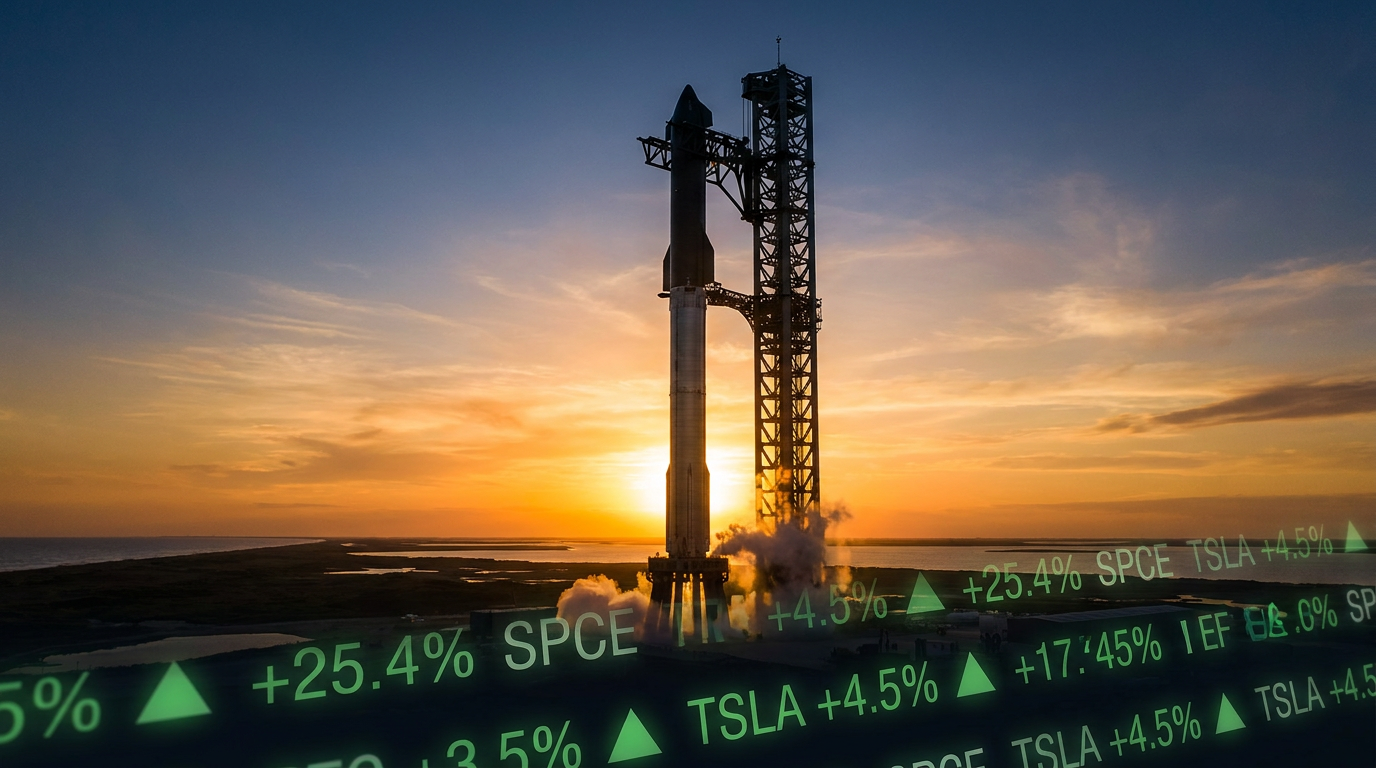
The commercial space race has officially docked at Wall Street, marking a profound structural shift in how global equities value the cosmos. In a landmark week for the aerospace sector, Rocket Lab has been tapped to join the prestigious Nasdaq-100 index, just as SpaceX executes the largest initial public offering in financial history.[1][8]
These dual milestones signal that the "space economy" is no longer viewed as a speculative fringe sector reserved for venture capitalists and government agencies. Instead, it has rapidly matured into a foundational pillar of mainstream investment portfolios, offering quantifiable revenue streams and massive infrastructure growth.[8]
The immediate catalyst for the sector's mainstreaming is Rocket Lab's inclusion in the Nasdaq-100, which will take effect prior to the market open on June 22. The index tracks the 100 largest non-financial companies listed on the exchange, and its quarterly rebalances dictate the flow of massive amounts of passive capital.[2][7]
Rocket Lab, which went public in 2021, has grown from a niche small-satellite launcher into a roughly $69 billion aerospace heavyweight. The company has completed over 80 successful launches and deployed more than 250 satellites to orbit.[2][8]

Inclusion in the Nasdaq-100 is a highly coveted rite of passage that forces index-tracking funds—which manage over $800 billion globally—to automatically purchase the stock. This hands the company a permanent base of institutional buyers that it did not have to win over purely on day-to-day fundamentals.[1][2][8]
Shares of Rocket Lab surged 11% following the announcement, reflecting the immediate impact of this new financial gravity. The company is actively utilizing its capital to develop its medium-class Neutron rocket, aiming to compete for larger national security and commercial constellation contracts.[2][8]
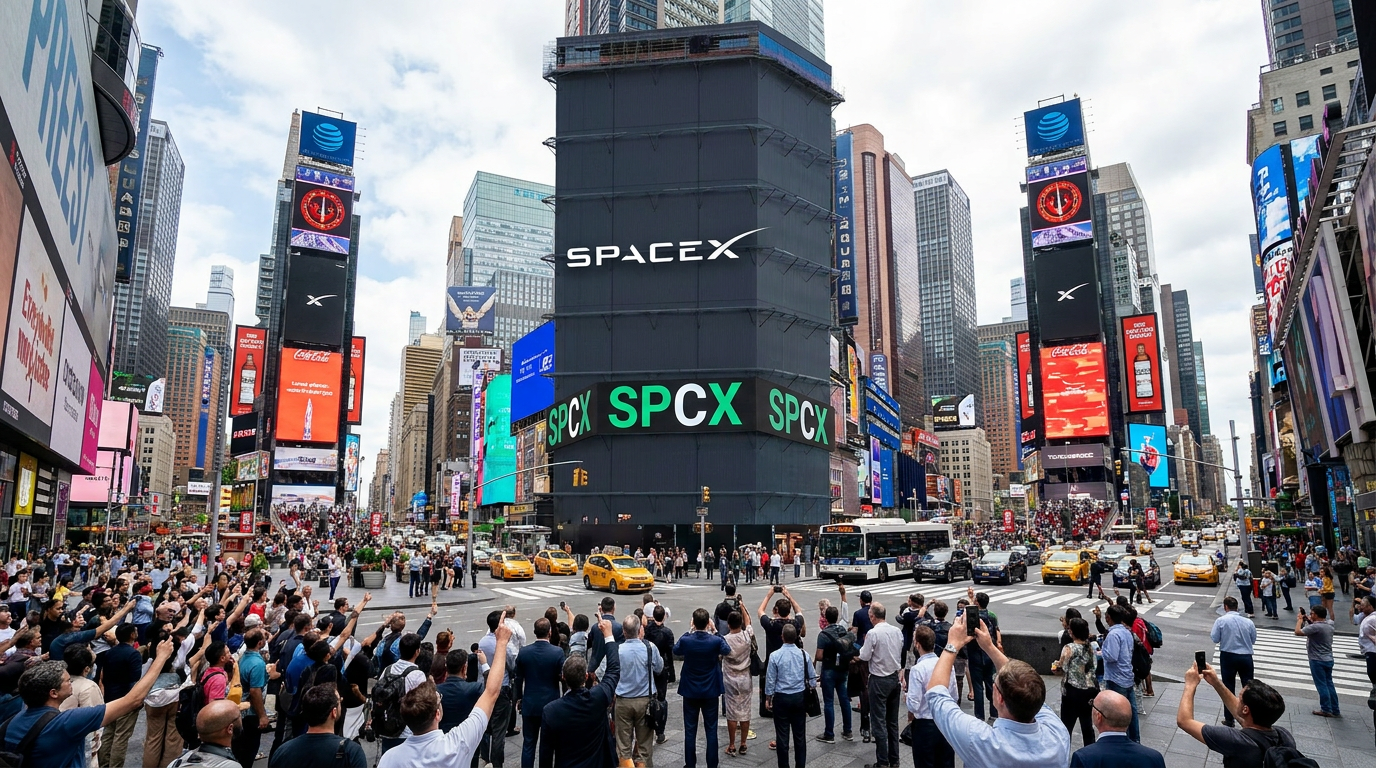
But Rocket Lab's elevation is sharing the financial spotlight with an even larger gravitational event: SpaceX's historic public market debut. Elon Musk's aerospace giant priced its shares at $135 on June 11, raising an unprecedented $75 billion from eager investors.[1][4][5]
But Rocket Lab's elevation is sharing the financial spotlight with an even larger gravitational event: SpaceX's historic public market debut.
This massive offering easily dwarfs the previous record holder, Saudi Aramco's $25.6 billion IPO in 2019, effectively rewriting the rulebook for mega-cap public listings. The listing values SpaceX at roughly $1.75 trillion to $1.8 trillion, instantly catapulting it into the ranks of the ten most valuable publicly traded companies in the United States.[4][5][6]
The sheer scale of the capital raise underscores the market's voracious appetite for next-generation infrastructure. SpaceX's SEC filings indicate the proceeds will fund massive expansions in AI compute capabilities, launch vehicle enhancements, and the rapid scaling of its global satellite networks.[4]

Behind the scenes, Wall Street banks are reaping massive windfalls from the transaction while aggressively marketing the space boom to their clients. A sprawling syndicate of 23 banks, led by Goldman Sachs and Morgan Stanley, shepherded the complex deal to market.[5][6]
Total underwriting fees for the syndicate could potentially reach $1 billion, providing a massive revenue boost to the financial sector's biggest players. The promotional efforts have been highly unusual for a standard IPO, reflecting the cultural weight of the company.[5]
JPMorgan Chase, acting as a joint bookrunner, took the unprecedented step of hosting a virtual simulcast for 2,500 high-net-worth clients across 90 branches, featuring a direct address from Musk. JPMorgan CEO Jamie Dimon personally championed the event, framing the massive retail and wealth-management push around the "democratization of finance."[4][5]
The rising tide generated by these twin milestones is lifting other space-focused equities across the board. Companies like Planet Labs, AST SpaceMobile, and Firefly Aerospace have seen their shares rally significantly as retail and institutional investors look for alternative, perhaps more accessible, entry points into the orbital economy.[3]

Market analysts note that the enthusiasm surrounding the SpaceX IPO has created a "halo effect" for the entire sector. This halo effect validates the business models of smaller firms that provide specialized services, from Earth-imaging to direct-to-smartphone satellite broadband.[3]
Furthermore, index providers are already adapting to the new landscape. Under revised Nasdaq methodology that shortens the waiting period for large new listings, SpaceX itself could qualify for inclusion in the Nasdaq-100 in as little as 15 trading days.[1][8]
For everyday investors, the week's events represent a turning point where orbital logistics, satellite constellations, and interplanetary ambitions become tradable assets. Space exploration is no longer solely the domain of government agencies or private billionaires; it is now a quantifiable asset class anchoring standard retirement accounts and mutual funds worldwide.[3][8]
How we got here
2021
Rocket Lab officially goes public on the Nasdaq, beginning its transition from a small startup to a major aerospace player.
March 2026
Nasdaq revises its methodology, paving the way to fast-track massive new listings like SpaceX into its premier indices.
June 11, 2026
SpaceX prices its historic initial public offering at $135 per share, raising an unprecedented $75 billion.
June 22, 2026
Rocket Lab is officially added to the Nasdaq-100 index prior to the market open, cementing its status among the world's largest non-financial companies.
Viewpoints in depth
Institutional Investors
Index funds and passive capital managers view the space sector's maturation as a necessary evolution of tech benchmarks.
For institutional managers, Rocket Lab's entry into the Nasdaq-100 and SpaceX's massive public float represent a shift from venture-style speculation to quantifiable, benchmarked growth. Index-tracking funds, which manage hundreds of billions of dollars, are bound by strict eligibility rules. The fact that space companies now meet these stringent liquidity and market-cap requirements means portfolio managers can confidently allocate capital to orbital infrastructure just as they would to cloud computing or semiconductor manufacturing.
Wall Street Underwriters
Investment banks see the aerospace boom as a historic revenue generator and a tool for client acquisition.
The financial sector's enthusiasm is driven by unprecedented deal scale. A $75 billion IPO generates staggering underwriting fees, providing a much-needed boost to investment banking divisions. Beyond the immediate financial windfall, banks like JPMorgan and Goldman Sachs are using access to the SpaceX listing as a powerful marketing tool to woo ultra-high-net-worth clients, framing participation in the space economy as a prestige investment opportunity.
Space Industry Advocates
Aerospace engineers and industry leaders view the public market embrace as the fuel needed for interplanetary ambitions.
For the builders of the space economy, Wall Street's capital is the critical missing link for scaling operations. The billions raised are earmarked for tangible infrastructure: expanding AI compute capabilities, finalizing medium- and heavy-lift rockets like Neutron and Starship, and deploying thousands of broadband satellites. Industry advocates argue that public market funding will accelerate the timeline for lunar bases and Mars missions by removing the bottlenecks of private venture funding.
Retail Investors
Everyday traders are seeking accessible entry points into a sector previously dominated by billionaires.
While institutional clients secure early allocations of SpaceX shares, retail investors are actively hunting for value in the broader aerospace ecosystem. Analysts note a surge of interest in publicly traded companies like Planet Labs and AST SpaceMobile, as everyday traders look to capitalize on the 'halo effect' of the mega-IPO. For these investors, the democratization of space finance means they can finally build diversified portfolios around the final frontier.
What we don't know
- It remains to be seen exactly when Nasdaq will officially fast-track SpaceX into the Nasdaq-100 index.
- The long-term performance of SpaceX shares in the retail market following the initial institutional allocation is still uncertain.
- It is unclear how traditional aerospace prime contractors will adjust their market strategies in response to the massive capitalization of newer space firms.
Key terms
- Nasdaq-100
- A stock market index made up of 100 of the largest and most actively traded non-financial companies listed on the Nasdaq stock exchange.
- Initial Public Offering (IPO)
- The process by which a private company offers shares of its stock to the public for the first time, allowing it to raise capital from everyday investors.
- Index-Tracking Fund
- A mutual fund or ETF designed to follow certain preset rules so that the fund can replicate the performance of a specific financial market index.
- Underwriting Fees
- The compensation that investment banks receive for managing a company's IPO, assessing regulatory risks, and selling the initial shares to investors.
Frequently asked
What does it mean for a company to join the Nasdaq-100?
Joining the Nasdaq-100 means a company is recognized as one of the 100 largest non-financial firms on the exchange. It forces index-tracking funds to automatically buy the stock, providing a stable base of institutional investors.
How large is the SpaceX IPO compared to previous records?
SpaceX raised $75 billion, which is nearly triple the size of the previous record holder, Saudi Aramco, which raised $25.6 billion in 2019.
Why did Rocket Lab's stock price jump after the announcement?
The stock surged 11% because mutual funds and ETFs that track the Nasdaq-100 must now purchase Rocket Lab shares to accurately reflect the index's new composition.
Will SpaceX also join the Nasdaq-100?
Under newly revised Nasdaq rules, SpaceX could be fast-tracked into the index in as little as 15 trading days after its listing, rather than waiting the traditional several months.
Sources
Source coverage
8 outlets
4 viewpoints surfaced








[1]MarketWatchInstitutional Investors
Rocket Lab and these four stocks are joining the Nasdaq 100, with SpaceX waiting in the wings
Read on MarketWatch →[2]Investing.comSpace Industry Advocates
Rocket Lab to join Nasdaq-100 index
Read on Investing.com →[3]The Motley FoolRetail Investors
If you're like me, by now you're a bit tired of the massive hype surrounding this week's SpaceX initial public offering
Read on The Motley Fool →[4]PYMNTSWall Street Underwriters
JPMorgan Chase Simulcast Woos Wealthy Investors for Record SpaceX IPO
Read on PYMNTS →[5]CryptoBriefingWall Street Underwriters
JPMorgan Highlights Potential Gains for Banks from SpaceX's $75B IPO
Read on CryptoBriefing →[6]AsiaEWall Street Underwriters
Wall Street's Special Mission: Launching SpaceX
Read on AsiaE →[7]NasdaqInstitutional Investors
Nasdaq Announces Mid-Quarter Rebalance of the Nasdaq-100 Index
Read on Nasdaq →[8]EBC Financial GroupInstitutional Investors
Rocket Lab Enters the Nasdaq-100 With a $69 Billion Valuation to Justify
Read on EBC Financial Group →
Every angle. Every day.
Get finance stories with full source coverage and perspective breakdowns delivered to your inbox.