
The Science of Zone-Based Organization: Why 'Micro-Decluttering' is Replacing the Weekend Purge
Environmental psychologists and professional organizers are shifting away from massive decluttering marathons in favor of 'zone-based' micro-efficiency. By applying industrial spatial design to the home, this method reduces mental load and leverages dopamine to build lasting habits.
By Factlen Editorial Team
- Psychological Organizers
- Focus on the mental and emotional benefits of micro-decluttering, arguing that dopamine-driven habits are the only sustainable cure for disorganization.
- Functional Minimalists
- Focus on the utility of the space, arguing that a home should operate like a well-designed workshop where every item serves a clear purpose.
- Spatial Optimizers
- Focus on maximizing physical footprints in urban environments by creating strict physical boundaries for zones.
What's not represented
- · Interior Designers
- · Neurodivergent Advocates
Why this matters
Traditional decluttering methods often lead to burnout and deeper messes. By adopting micro-habits and spatial zones, you can permanently reduce the mental load of household management without sacrificing your weekends.
Key points
- Zone-based organization groups household items by functional activity rather than overarching category, improving daily efficiency.
- Micro-decluttering replaces exhausting weekend purges with 2- to 15-minute focused tidying bursts.
- Completing small organizational tasks triggers dopamine, building sustainable habits and reducing the stress of large projects.
- The 70% clear zone rule recommends leaving high-traffic surfaces mostly empty to reduce visual clutter and mental load.
- Habit stacking links short decluttering sessions to existing daily routines, making maintenance automatic.
The familiar trap of the weekend purge is a cycle almost everyone has experienced. You wake up on a Saturday highly motivated, pull every piece of clothing out of the closet, and dump it onto the bed. Three hours later, decision fatigue sets in, your energy crashes, and you are left surrounded by a mess significantly larger than the one you started with. Traditional decluttering approaches demand massive, uninterrupted chunks of time and force overwhelming decision-making scenarios. For most busy professionals and parents, these marathon sessions are not just exhausting—they are fundamentally unsustainable, often resulting in half-finished projects that only add to household anxiety.[4]
In response to this widespread burnout, the home organization industry is undergoing a radical shift. Professional organizers and environmental psychologists are increasingly steering clients away from the massive, whole-house events popularized by methods like KonMari. Instead, they are championing a more sustainable, science-backed approach built on two intertwined concepts: Zone-Based Organization and Micro-Decluttering. This new framework treats the home not as a static museum to be perfected, but as an active, living ecosystem that requires continuous, low-friction maintenance.[1][5]
At the core of this movement is Zone-Based Organization, a concept that borrows heavily from industrial spatial design and workplace ergonomics. Rather than categorizing items by their overarching type—such as gathering every book, every pen, or every cleaning supply in the house—this method organizes items strictly by their functional activity. It creates hyper-localized stations where everything needed for a specific task is stored exactly where the task takes place, minimizing the friction of daily routines.[5][7]
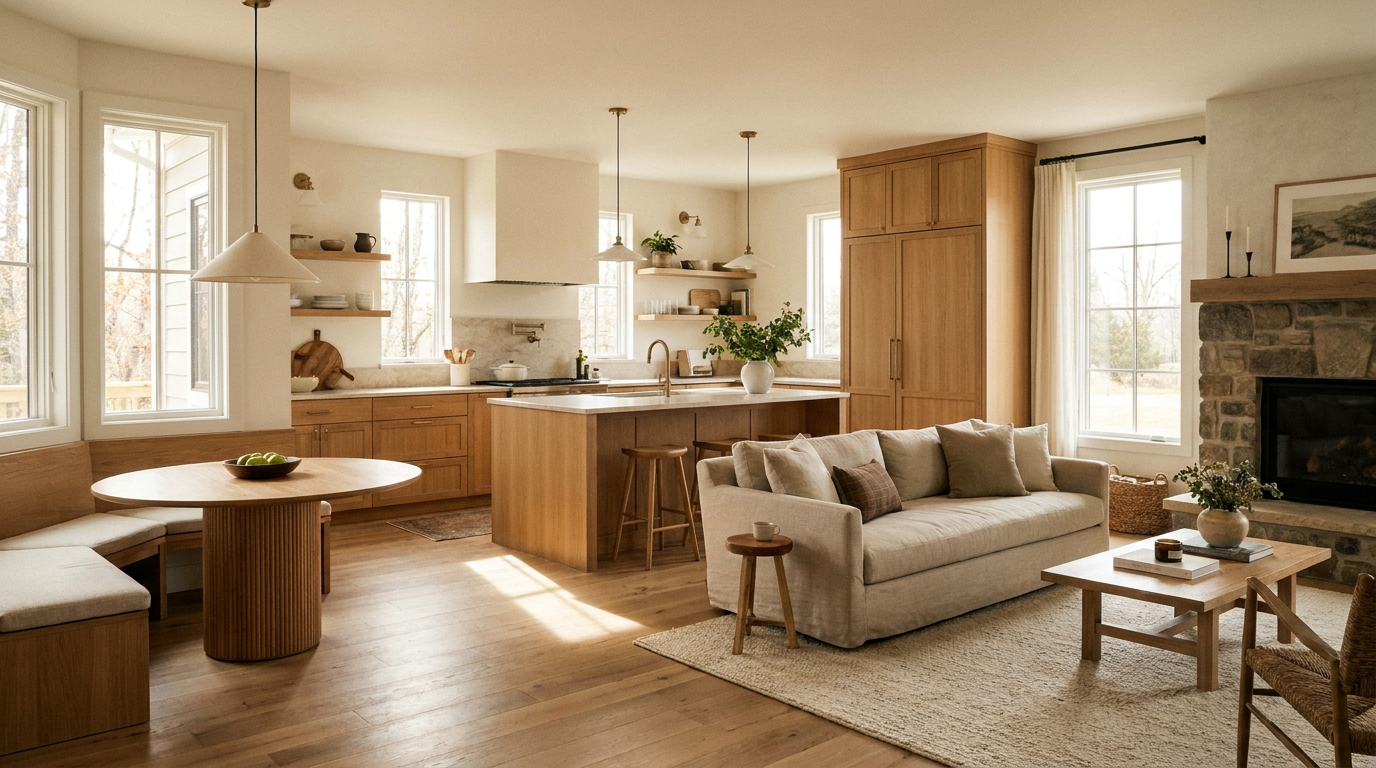
The kitchen provides the clearest and most impactful example of this spatial efficiency in action. In a traditional setup, a homeowner might store all their utensils in one large drawer and all their appliances in a distant pantry. A zone-based kitchen, however, is deliberately divided into distinct functional areas: a prep zone, a cooking zone, a cleaning zone, and a storage zone. This mirrors the workflow of a commercial restaurant kitchen, where movement is optimized for speed and safety.[7]

Within this zoned kitchen framework, the prep zone houses the cutting boards, chef's knives, and mixing bowls, ideally located right next to the primary counter space and trash bin. The cooking zone, centered around the stove, holds the spatulas, wooden spoons, heavy pots, and frequently used spices. By grouping items by their actual use-case rather than their material category, this industrial-style workflow drastically reduces unnecessary steps, saving time and physical energy during every single meal preparation.[7]
The zone method is particularly transformative for small apartments, studios, or open-concept homes where a single large room must serve multiple, often conflicting, purposes. In these compact environments, a zone-based system establishes clear physical and mental boundaries. By designating a specific "work zone," a "dining zone," and a "relaxation zone"—and strictly keeping the items for each activity within those boundaries—residents can prevent their living space from degrading into a chaotic, multi-purpose blur.[6]
However, establishing these highly efficient zones is only half of the equation; maintaining them is where traditional organization methods typically fail. This is where the concept of "micro-decluttering" enters the picture, serving as the daily engine that keeps the zone-based system running. Micro-decluttering is the practice of dedicating short, highly intentional bursts of time—often just two to fifteen minutes—to tidy a single, specific area, rather than attempting to clean an entire room.[1][3]
The psychology behind micro-decluttering is deeply rooted in how the human brain processes motivation, reward, and stress. Large organizational projects naturally trigger a panic response in the brain, spiking cortisol levels as the body anticipates a massive expenditure of physical energy and cognitive load. This stress response is exactly why so many people procrastinate on cleaning out their garage or organizing their home office for months or even years.[2][4]

The psychology behind micro-decluttering is deeply rooted in how the human brain processes motivation, reward, and stress.
Conversely, micro-decluttering leverages dopamine-driven motivation to bypass this stress response entirely. Completing a small, clearly defined task—like clearing a single coffee table, organizing one bathroom drawer, or sorting a stack of mail—triggers the brain's reward pathways. This immediate positive reinforcement provides a sense of accomplishment that naturally encourages the repetition of the behavior, turning a dreaded chore into a rewarding habit.[4]
Professional organizers frequently recommend the "Rule of 5" as a practical entry point into micro-decluttering. This rule involves entering a room and committing to finding just five items to put away, donate, or throw in the trash. Because the threshold for success is so low, it eliminates the paralysis of overwhelm. Each successful micro-session builds confidence, gradually shifting an individual's self-image from someone who is chronically "messy" to someone who is capable of maintaining order.[4]
The guiding principle behind this approach is consistency over intensity. Research in behavioral psychology consistently demonstrates that small, daily actions create far more lasting change than sporadic, intense efforts. By keeping tasks highly achievable and strictly time-boxed, micro-decluttering entirely eliminates the burnout associated with weekend purges, ensuring that the home remains in a constant state of manageable equilibrium.[4]

To make these micro-sessions seamless and automatic, experts advocate for a technique known as "habit stacking." This involves linking a short, two-minute decluttering burst to an existing, deeply ingrained daily rhythm. For example, a person might wipe down the kitchen prep zone while waiting for the microwave to beep, or clear the entryway console while waiting for the shower water to warm up. Over time, the cleaning action becomes as automatic as the trigger itself.[3]
Another critical metric in maintaining zone-based organization is the "Clear Zone" rule, which is particularly vital for high-traffic surfaces. Organizers and spatial designers recommend leaving at least 70 percent of countertops, desks, and tables entirely empty. This negative space is not just an aesthetic choice; it is essential for maintaining a sense of visual calm and ensuring that the surface is actually usable when a task needs to be performed.[7]
Environmental psychology strongly supports the necessity of this empty space. Studies show that physical environments with high levels of visual clutter are directly linked to elevated stress, decreased focus, and a reduced sense of perceived control over one's life. The 70 percent rule ensures that a space feels open and manageable, preventing the visual noise of accumulated objects from constantly demanding the brain's subconscious attention.[2]

Implementing these systems successfully requires confronting the ubiquitous "Just in Case" dilemma—the psychological tendency to keep rarely used items out of fear they might be needed in some hypothetical future scenario. Zone boundaries force a realistic, physical assessment of volume. If the designated "coffee zone" is completely full, a new mug simply cannot enter the space unless an old one is removed, forcing a concrete decision rather than a deferred one.[2]
This natural spatial limitation is commonly referred to as the "One-In, One-Out" rule, and it acts as a built-in defense mechanism against the slow creep of accumulation. It shifts the homeowner's focus away from mindless acquisition and toward intentional curation. By respecting the physical boundaries of each zone, residents ensure that their spaces remain highly functional and uncluttered, regardless of how many new items enter the home.[5]
Ultimately, the goal of zone-based micro-decluttering is not to achieve a sterile, minimalist aesthetic that looks perfect on social media. The true objective is reducing the invisible "mental load" of household management. When everyday decisions—like where to find the scissors, where to put the incoming mail, or how to clear the counter for dinner prep—are simplified and standardized, the entire home runs more smoothly.[3]
By embracing spatial efficiency and time-boxed maintenance, individuals can finally reclaim their weekends from the endless cycle of cleaning and purging. The home transforms from a constant source of labor, guilt, and overwhelming projects into a supportive, functional environment that actually serves the people living in it, allowing them to spend their free time on the things that truly matter.[1][4]
Viewpoints in depth
Psychological Organizers
Focus on the mental and emotional benefits of micro-decluttering.
This camp argues that physical clutter is largely a manifestation of delayed decisions and emotional overwhelm. They emphasize that traditional 'weekend purges' are fundamentally flawed because they demand a massive cognitive load that most people cannot sustain. Instead, they advocate for micro-decluttering as a psychological tool. By leveraging dopamine-driven micro-habits, individuals can bypass the brain's stress response, gradually rewiring their relationship with their possessions and reducing the chronic anxiety associated with a messy home.
Functional Minimalists
Focus on the utility of the space and the reduction of daily friction.
Functional minimalists view the home through the lens of industrial efficiency. They argue that a house should operate like a well-designed workshop, where every item serves a clear purpose and is stored exactly where it is used. For this group, zone-based organization is not about aesthetics, but about minimizing the physical steps and mental calculations required to complete daily tasks like cooking or working. They heavily promote the 'One-In, One-Out' rule to ensure that functional zones never become bogged down by excess inventory.
Spatial Optimizers
Focus on maximizing the physical footprint, particularly in urban environments.
Often working with small apartments or open-concept layouts, spatial optimizers emphasize the importance of creating strict physical boundaries. They argue that without clear zones, multi-use spaces inevitably degrade into chaotic, unusable areas. This perspective champions the use of vertical storage, hidden compartments, and modular furniture to enforce zone boundaries, ensuring that a living room can seamlessly transition from a home office during the day to a relaxation space at night without the items from one activity bleeding into the other.
What we don't know
- Whether the 70% clear zone rule applies universally to neurodivergent individuals, who sometimes rely on visual organization rather than hidden storage.
- Long-term data on whether micro-decluttering permanently alters consumer purchasing habits by enforcing strict spatial boundaries.
Key terms
- Zone-Based Organization
- A spatial planning method that groups household items by their functional activity (e.g., a prep zone) rather than their overarching category.
- Micro-Decluttering
- The practice of tidying spaces in strictly time-boxed, manageable bursts—usually under 15 minutes—to prevent decision fatigue.
- Mental Load
- The invisible, continuous cognitive effort required to manage a household, which is exacerbated by disorganized and inefficient spaces.
- Habit Stacking
- A behavioral psychology technique where a new habit, like a 2-minute decluttering session, is attached to an existing daily routine, such as waiting for coffee to brew.
- Cortisol
- A stress hormone that can spike when individuals are faced with overwhelming visual clutter or massive organizational projects.
Frequently asked
What is zone-based organization?
It is a method of arranging your home based on daily activities rather than item categories. Instead of storing all tools in one place, you store specific items exactly where you use them, such as creating a dedicated 'coffee zone' with mugs, beans, and the brewer.
How is micro-decluttering different from traditional cleaning?
Traditional cleaning often involves hours of deep sorting and purging, which can lead to burnout. Micro-decluttering relies on 2- to 15-minute bursts of highly focused tidying, leveraging small dopamine rewards to build long-term habits.
What is the 70% clear zone rule?
It is a spatial guideline suggesting that at least 70 percent of high-traffic surfaces, like kitchen counters and entry tables, should remain completely empty to reduce visual clutter and mental stress.
How does the 'Rule of 5' work?
The Rule of 5 is a micro-decluttering technique where you commit to finding just five items in a specific room to put away, donate, or throw out. It prevents overwhelm while ensuring consistent daily progress.
Sources
Source coverage
7 outlets
3 viewpoints surfaced







[1]LivingEtcFunctional Minimalists
The micro-decluttering method: our new favorite fast-paced approach
Read on LivingEtc →[2]Home Online TipsPsychological Organizers
Common Decisions and Trade-Offs in Decluttering
Read on Home Online Tips →[3]The Art of DeclutteringPsychological Organizers
Micro-Efficiency and Reducing Mental Load
Read on The Art of Decluttering →[4]Joy of CleaningPsychological Organizers
The Psychology Behind Small Wins Organizing
Read on Joy of Cleaning →[5]Lamu HomeSpatial Optimizers
Understanding Zone-Based Organization
Read on Lamu Home →[6]Assembly SmartSpatial Optimizers
Zone-Based Organization Systems for Small Apartments
Read on Assembly Smart →[7]Incredify KitchensFunctional Minimalists
Adopting a Zone-Based Organization System
Read on Incredify Kitchens →
Every angle. Every day.
Get home stories with full source coverage and perspective breakdowns delivered to your inbox.