
The Science of Superforecasting: How to Train Your Brain to Predict the Future
Decades of research show that accurate forecasting is a learnable skill based on probabilistic thinking. As AI models begin to rival top human forecasters, combining human judgment with machine intelligence is becoming the ultimate cognitive superpower.
By Factlen Editorial Team
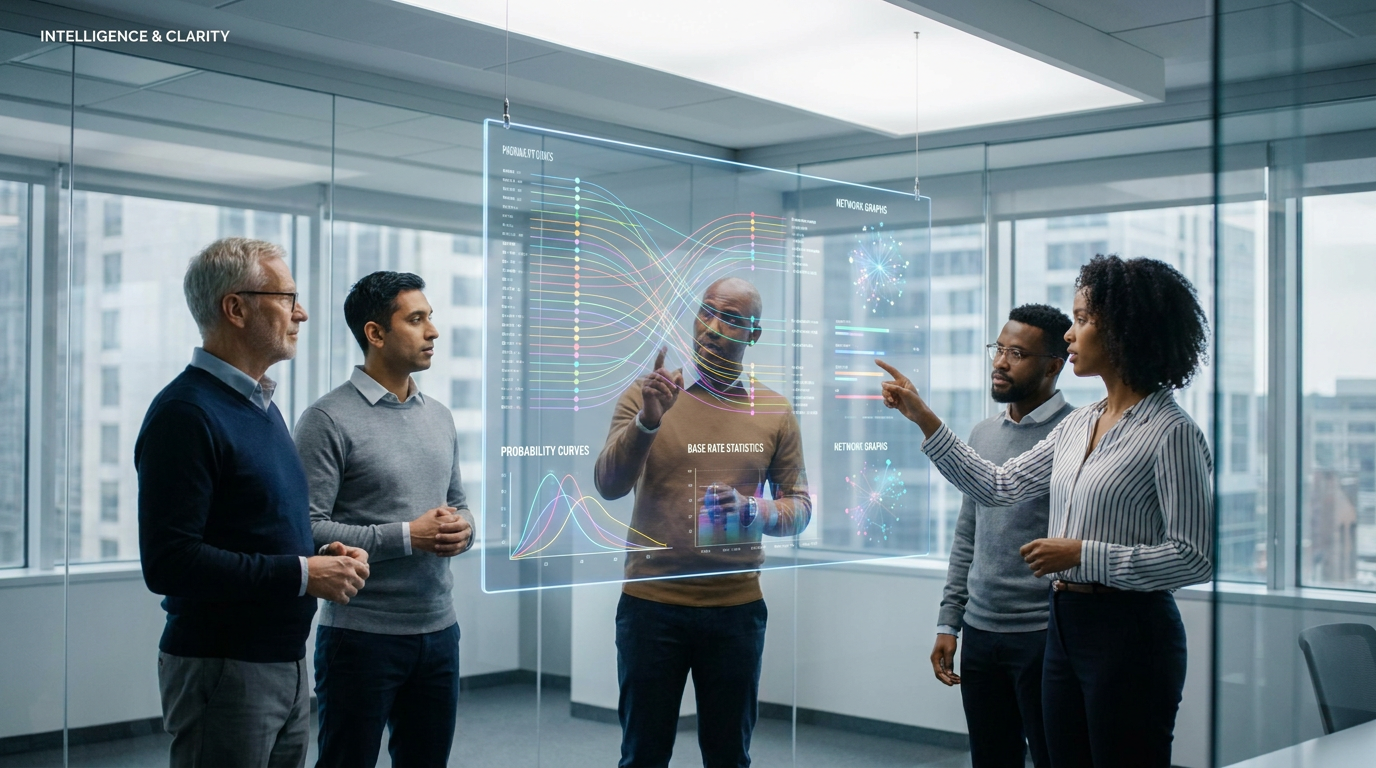
- Behavioral Scientists
- Focus on human cognitive debiasing and structured training to improve judgment.
- Hybrid Forecasters
- Argue the optimal approach is human-AI teaming, combining machine base-rates with human causal reasoning.
- AI Technologists
- Believe agentic LLMs will soon surpass human forecasting entirely through massive data processing.
What's not represented
- · Everyday Retail Investors
- · Corporate Risk Managers
Why this matters
Understanding how to think in probabilities and update beliefs based on evidence doesn't just apply to geopolitics—it fundamentally improves how you make decisions about your career, investments, and personal life.
Key points
- Forecasting is a learnable skill, not an innate talent, based on probabilistic thinking.
- Superforecasters rely on base rates and Bayesian updating rather than gut instinct.
- Just a few hours of cognitive debiasing training can improve prediction accuracy by 14%.
- AI models are now matching human superforecasters on curated prediction benchmarks.
- The future of forecasting relies on hybrid 'centaur' teams combining AI data processing with human causal reasoning.
We make predictions constantly—who to hire, where to invest, how long a project will take, and what the weather will do. Yet, human beings are notoriously bad at forecasting. For decades, the prevailing wisdom in behavioral economics was that predicting the future was a fool's errand, a domain where even highly paid experts performed no better than dart-throwing chimpanzees.[1]
But a quiet revolution in cognitive science has proven that forecasting is not a mystical gift or an innate talent. It is a highly learnable, measurable skill. The discovery of "superforecasters"—ordinary people who consistently outperform intelligence analysts and subject-matter experts—has transformed how organizations approach uncertainty and risk.[2]
The origins of this science trace back to the Good Judgment Project, a massive research initiative launched in 2011 by psychologists Philip Tetlock and Barbara Mellers. Sponsored by the U.S. intelligence community, the project pitted thousands of amateur forecasters against seasoned analysts in a multi-year geopolitical prediction tournament.[1]
The results stunned the intelligence community. A small group of volunteers, eventually dubbed "superforecasters," consistently beat the experts by wide margins. They didn't have access to classified information, nor were they necessarily domain experts in the topics they were predicting. Instead, they possessed a specific set of cognitive habits and problem-solving frameworks that allowed them to see the world more clearly.[2]

The first and most critical habit of a superforecaster is relying on the "outside view," or base rates. When faced with a novel problem, amateurs immediately look at the specific details of the case at hand. Superforecasters, conversely, start by zooming out and asking how often this type of event happens in general.[3]
For example, if predicting the success of a new startup, a superforecaster won't start by evaluating the charismatic founder or the slick pitch deck. They will first anchor their prediction to the statistical reality that roughly 90% of startups fail. Only after establishing this base rate do they adjust their probability up or down based on the specific details of the company.[3]
The second technique is "Fermi-izing," named after the physicist Enrico Fermi. This involves breaking a seemingly impossible, cloud-like question down into smaller, knowable component parts. By flushing ignorance into the open and estimating the variables individually, forecasters can arrive at surprisingly accurate probabilities for complex events.[3]
Superforecasters also treat their beliefs as hypotheses to be tested, rather than treasures to be guarded. They are rigorous Bayesian updaters. When new information emerges, they do not dig in their heels to protect their egos; they incrementally adjust their probabilities. This intellectual humility is a hallmark of the superforecaster mindset.[7]
Superforecasters also treat their beliefs as hypotheses to be tested, rather than treasures to be guarded.
To measure this accuracy, the forecasting community relies on the Brier score—a mathematical metric that evaluates both the accuracy and the calibration of a prediction. A perfect Brier score is 0.0, while a terrible one is 2.0. Keeping a rigorous score forces forecasters to confront their own overconfidence and learn systematically from their failures.[1]

The most empowering finding from this research is that these skills can be taught. Studies have shown that just a few hours of training in probabilistic reasoning and cognitive debiasing can improve an individual's forecasting accuracy by up to 14%. It is a muscle that grows stronger with deliberate practice.[2]
Today, this methodology is being applied to the most complex questions of our time. In early 2026, the Forecasting Research Institute and the Federal Reserve Bank of Chicago published a landmark study using superforecasters to predict the long-term economic impact of artificial intelligence.[4]
The study asked superforecasters, academic economists, and AI experts to project U.S. GDP growth through 2050. Despite the intense hype surrounding AI, the superforecasters anchored their predictions in historical base rates, projecting a median annual GDP growth of 2.5% by 2030—a noticeable but incremental gain over recent baselines, cutting through the noise of techno-utopian extremes.[6]
However, the forecasting landscape is currently undergoing a seismic shift. Artificial intelligence models are no longer just the subject of predictions; they are becoming the forecasters. By 2026, specialized AI agent frameworks have begun to rival human superforecasters on curated prediction benchmarks.[5]
Systems like the AIA Forecaster utilize "Retrieval-Augmented Generation" to scour the internet, synthesize conflicting reports, and output calibrated probabilities. On recent standardized tests like ForecastBench, top AI models achieved a Brier score of 0.0753, statistically tying the human superforecaster average of 0.0740.[5]

Yet, human forecasters still maintain a crucial edge in "Black Swan" events and causal reasoning. While AI models excel at processing vast amounts of historical data to find correlations, they struggle to understand why a historical trend might suddenly break due to novel human behavior or unprecedented geopolitical shifts.[5]
Consequently, the future of prediction is widely expected to be hybrid. The most accurate forecasts of the late 2020s will likely come from "centaur" teams—human superforecasters who use AI agents to rapidly gather base rates and synthesize data, while applying their own causal judgment to the final probability.[8]
For the everyday decision-maker, the lessons of superforecasting offer a profound advantage. Whether evaluating a career change, making a major purchase, or assessing medical risks, adopting a probabilistic mindset reduces anxiety and improves outcomes.[7]
By embracing uncertainty, seeking out base rates, and keeping score of our own predictions, anyone can train their brain to see the future a little more clearly. In an increasingly complex world, good judgment remains the ultimate cognitive superpower.[8]
How we got here
2011
The Good Judgment Project is launched to compete in a U.S. intelligence forecasting tournament.
2015
Philip Tetlock publishes 'Superforecasting', detailing how ordinary citizens consistently beat intelligence analysts.
2020
Superforecasters accurately predict the massive scale of the COVID-19 pandemic months before general consensus.
Late 2025
AI models begin matching human superforecasters on curated prediction benchmarks like ForecastBench.
Early 2026
A landmark Federal Reserve study utilizes superforecasters to project the long-term economic impacts of AI.
Viewpoints in depth
Behavioral Scientists
Focus on human cognitive debiasing and structured training to improve judgment.
Behavioral scientists argue that human intuition is naturally flawed, plagued by recency bias, overconfidence, and a failure to understand probability. However, they emphasize that human judgment can be systematically upgraded. By teaching individuals to seek out base rates, break problems down into smaller components, and keep rigorous score of their predictions, organizations can drastically improve their decision-making without relying entirely on automated systems.
AI Technologists
Believe agentic LLMs will soon surpass human forecasting entirely through massive data processing.
Technologists point to the rapid closing of the Brier score gap between humans and AI as proof that machine forecasting will soon dominate. They argue that AI models can instantly retrieve thousands of historical base rates, synthesize conflicting news reports without emotional bias, and run complex Monte Carlo simulations in seconds. In their view, the human bottleneck in data processing will eventually make unassisted human forecasting obsolete.
Hybrid Forecasters
Argue the optimal approach is human-AI teaming, combining machine base-rates with human causal reasoning.
Proponents of hybrid forecasting believe the future belongs to 'centaur' teams. They note that while AI is exceptional at finding historical correlations and establishing base rates, it struggles with causal reasoning—understanding *why* a trend might break due to a novel geopolitical event or a shift in human psychology. By using AI as a powerful reasoning layer to gather data, human superforecasters can apply their unique causal judgment to produce the most accurate predictions possible.
What we don't know
- Whether AI models will ever develop the causal reasoning necessary to predict unprecedented 'Black Swan' events.
- How financial markets will adapt if AI forecasting agents become widely available to retail investors.
- The exact ceiling of human forecasting accuracy, even with extensive cognitive training.
Key terms
- Base Rate
- The historical average or general frequency of an event occurring, used as a starting point for predictions.
- Fermi-izing
- The practice of breaking a complex, seemingly unanswerable question down into smaller, estimable components.
- Bayesian Updating
- The mathematical and cognitive process of revising a probability estimate as new evidence becomes available.
- Brier Score
- A scoring function that measures the accuracy of probabilistic predictions, rewarding both being right and being appropriately confident.
- Black Swan Event
- A highly improbable, unpredictable event that has a massive impact and is often rationalized in hindsight.
Frequently asked
What is a Brier score?
A Brier score is a mathematical metric used to measure the accuracy of probabilistic predictions. A score of 0.0 is perfect, while 2.0 is entirely inaccurate, forcing forecasters to be both correct and properly confident.
Can anyone become a superforecaster?
Yes. Research shows that while basic numeracy helps, superforecasting is primarily a learnable skill. Training in cognitive debiasing and probabilistic thinking can significantly improve anyone's accuracy.
How do AI forecasters compare to humans?
As of 2026, top AI models can match human superforecasters on standardized benchmarks, but humans still hold an edge in predicting unprecedented 'Black Swan' events that require causal reasoning.
What is the 'outside view'?
The outside view involves looking at the statistical base rate of an event happening in general (e.g., how often startups fail) before analyzing the specific details of the current situation.
Sources
Source coverage
8 outlets
3 viewpoints surfaced








[1]The Decision LabBehavioral Scientists
Superforecasting – How a select few people can accurately forecast future outcomes
Read on The Decision Lab →[2]Leadership ReviewBehavioral Scientists
Learning Good Judgment: How to Improve Forecasting Accuracy
Read on Leadership Review →[3]Farnam StreetHybrid Forecasters
Superforecasting: The Art and Science of Prediction
Read on Farnam Street →[4]Forecasting Research InstituteHybrid Forecasters
Forecasting the Economic Effects of AI
Read on Forecasting Research Institute →[5]Wedbush SecuritiesAI Technologists
The AI Forecasting Laggard Phase is Over
Read on Wedbush Securities →[6]MorningstarHybrid Forecasters
A landmark survey of economists, artificial intelligence insiders, and professional forecasters
Read on Morningstar →[7]Adept EconomicsBehavioral Scientists
Traits of superforecasters and how to improve economic predictions
Read on Adept Economics →[8]Factlen Editorial TeamHybrid Forecasters
Synthesis by Factlen editorial team
Read on Factlen Editorial Team →
More in meta
See all 59 stories →Language Preservation
How Open-Source AI is Empowering Communities to Save Endangered Languages
7 sources
AI Infrastructure
Meta Commits $115M to Trade Jobs and 1GW of Clean Energy in Global AI Infrastructure Push
6 sources
Algorithmic Trust
How Bridging Algorithms Are Replacing Centralized Fact-Checking
7 sources
Frontier Models
Choosing the Right Frontier AI Model in 2026: GPT-5.4 vs. Claude 4.6 vs. Gemini 3.1
7 sources

Every angle. Every day.
Get meta stories with full source coverage and perspective breakdowns delivered to your inbox.