
The Science of Induction Cooking: How Magnets Are Transforming the Modern Kitchen
Induction cooktops use electromagnetic fields to heat pots directly, offering significant upgrades in speed, energy efficiency, and indoor air quality over traditional gas stoves.
By Factlen Editorial Team
- Health & Climate Advocates
- Focuses on the elimination of indoor air pollutants and the transition away from fossil fuels.
- Technology & Efficiency Proponents
- Highlights the superior speed, energy efficiency, and smart features of electromagnetic cooking.
- Culinary Traditionalists
- Values the tactile experience of gas cooking and the ability to use legacy copper or aluminum cookware.
What's not represented
- · Professional Wok Chefs
- · Renters without 240V Outlets
Why this matters
Switching to an induction cooktop can drastically reduce your household energy consumption and eliminate harmful indoor air pollutants, making your kitchen safer and more efficient.
Key points
- Induction cooktops use electromagnetic fields to heat the cookware directly, rather than heating the surface of the stove.
- The technology is roughly 90% energy efficient, compared to 40% for traditional gas stoves.
- Induction eliminates indoor air pollutants like nitrogen dioxide (NO2) associated with burning natural gas.
- The glass cooking surface remains relatively cool, significantly reducing the risk of accidental burns.
- Cookware must contain ferromagnetic materials, like cast iron or magnetic stainless steel, to function.
The American kitchen is undergoing a quiet but profound technological revolution. For decades, the blue flame of a gas stove was considered the gold standard for serious home cooks, while electric coils were viewed as a sluggish, inferior alternative. Today, a third option is rapidly replacing both: the induction cooktop. Driven by a combination of health awareness, environmental concerns, and sheer culinary performance, induction cooking has transitioned from a niche European luxury to a mainstream staple in North American homes. Major appliance manufacturers are now prioritizing induction in their premium lineups, signaling a permanent shift in how we prepare our food.[1][9]
But what exactly is induction, and how does it differ from the stoves we grew up with? Traditional cooking methods—whether gas or electric—rely on thermal conduction. A heat source, such as a flame or a glowing red element, generates thermal energy, which then transfers to the bottom of a pot, and eventually to the food inside. Induction bypasses this middle step entirely. Instead of generating heat on the surface of the appliance, an induction cooktop turns the cookware itself into the heating element, resulting in a fundamentally different cooking experience.[4][9]
The science behind this seemingly magical process is rooted in electromagnetism—the same physical principles that power electric motors and wireless chargers. Beneath the sleek, ceramic-glass surface of an induction cooktop lies a tightly wound coil of copper wire. When the appliance is turned on, an alternating electric current flows through this copper coil. This current does not generate heat; instead, it creates a dynamic, rapidly fluctuating magnetic field directly above the cooking zone.[3][4]
When a compatible pot or pan is placed onto this active cooking zone, the magnetic field penetrates the metal of the cookware. This interaction induces whirling electrical currents—known in physics as 'eddy currents'—deep inside the base of the pan. Because the metal of the cookware has inherent electrical resistance, it fights against these swirling currents. This microscopic tug-of-war creates intense friction at the atomic level, which rapidly generates heat directly within the metal of the pan. Instead of waiting for a burner to heat up and transfer its energy, the cookware itself instantly becomes the heating element, fundamentally changing the thermal dynamics of the cooking process.[3][9]

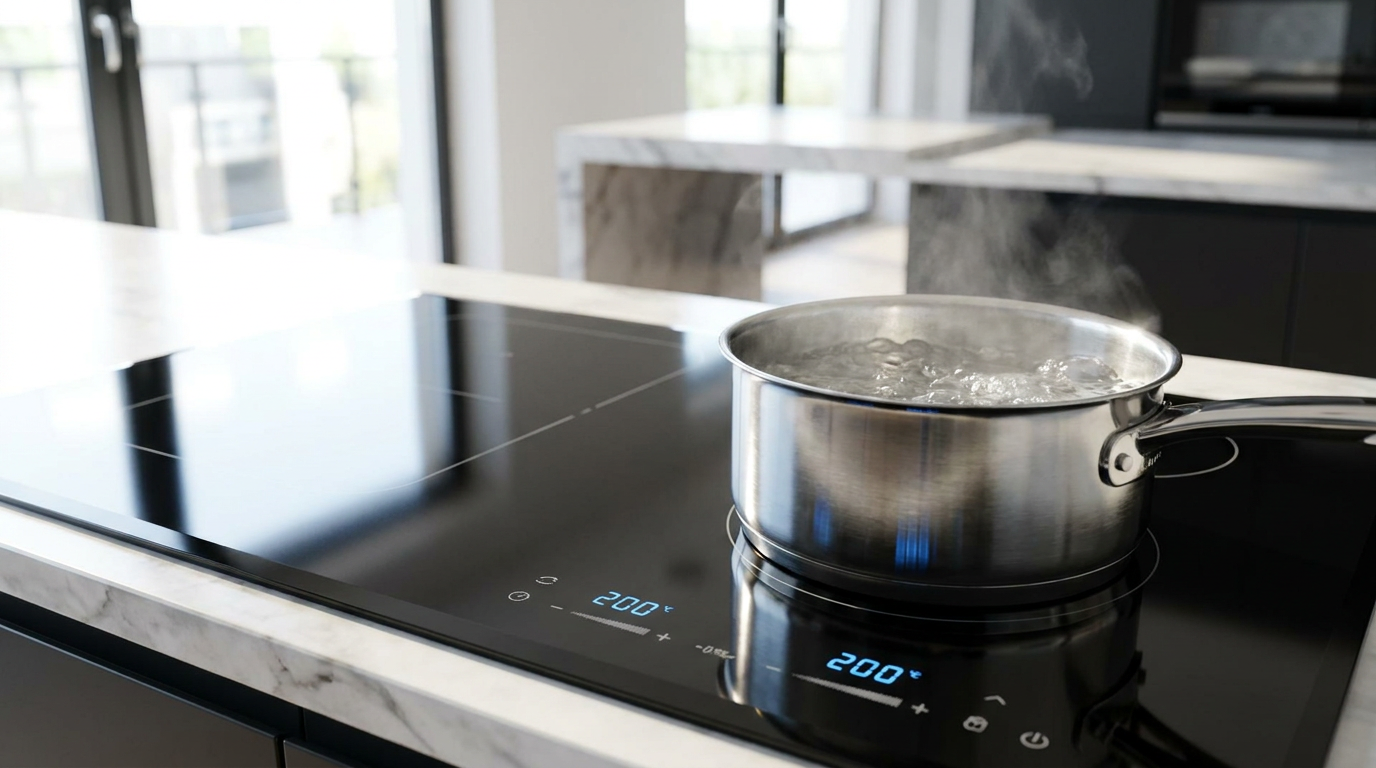
Because the heat is generated inside the cookware rather than on the stove's surface, the energy transfer is incredibly direct and immediate. This explains why induction is famous for its blistering speed. A high-powered induction cooktop can bring a large pot of water to a rolling boil in roughly half the time it takes on a premium gas burner. Furthermore, when a cook adjusts the temperature dial, the magnetic field changes instantly, providing the exact same rapid response that chefs traditionally loved about gas flames.[4][6]
This direct transfer of energy also results in staggering efficiency. According to energy analysts, induction cooktops convert approximately 90 percent of their electrical energy into usable heat for cooking. By contrast, traditional gas stoves operate at roughly 40 percent efficiency. When cooking with gas, the majority of the thermal energy escapes around the sides of the pan, heating the ambient air in the kitchen rather than the food. This wasted heat forces air conditioning systems to work harder during the summer months, driving up household utility bills.[5][9]
This direct transfer of energy also results in staggering efficiency.
Beyond speed and efficiency, a growing body of medical research regarding indoor air quality is accelerating the transition away from gas. Gas stoves rely on the combustion of fossil fuels, which releases a cocktail of indoor air pollutants directly into the kitchen. These emissions include carbon monoxide, particulate matter, and nitrogen dioxide (NO2). Recent studies have linked the NO2 emissions from gas stoves to increased rates of childhood asthma and other respiratory issues, prompting public health advocates to recommend electric alternatives.[5][6]
Because induction cooktops are entirely electric and combustion-free, they produce zero point-of-use emissions. For households prioritizing wellness, eliminating an open indoor flame is one of the most effective ways to instantly improve a home's air quality. Furthermore, as municipal electrical grids increasingly transition toward renewable energy sources like wind and solar, induction cooking offers a pathway to a completely decarbonized, zero-emission kitchen.[5][6]

Safety is another major factor driving consumer adoption, particularly for families with young children or elderly relatives. Because the electromagnetic field only heats the magnetic metal of the pan, the glass cooktop itself does not generate its own heat. While the glass will become warm from the residual heat resting against it, it remains significantly cooler than a traditional electric radiant stove. If a child accidentally touches an empty cooking zone that is turned on, they will not be burned, because human hands are not magnetic.[4][6]
This lack of surface heat also fundamentally changes the kitchen cleanup process. On a traditional gas or radiant electric stove, food splatters and boiling spills immediately hit a scorching hot surface, instantly baking into a stubborn, carbonized mess that requires heavy scrubbing. On an induction cooktop, spills land on a relatively cool glass surface. A damp cloth is usually all that is needed to wipe away a spill, even while the cooktop is still actively cooking a meal.[4][9]
The primary hurdle for consumers transitioning to this technology is cookware compatibility. Because the system relies entirely on magnetic fields, pots and pans must contain a ferromagnetic material—specifically, iron. Cast iron skillets, enameled cast iron Dutch ovens, and most high-quality stainless steel sets work perfectly. However, pure aluminum, copper, and glass cookware will not react to the magnetic field and will remain completely cold on an induction surface.[7][9]
Fortunately, testing an existing cookware collection is incredibly simple and takes only seconds. Consumers only need to take a standard refrigerator magnet and hold it against the bottom of their pots and pans. If the magnet sticks firmly to the base, the cookware is induction-ready and will work perfectly. For those who own expensive copper or aluminum pans they refuse to part with, the industry has developed a workaround. Manufacturers sell 'interface discs'—flat, heavy magnetic steel plates that sit directly on the glass stove and heat up. These discs then transfer their thermal energy to the non-magnetic pan resting above them via traditional conduction, though this method sacrifices much of the system's inherent speed and energy efficiency.[7][9]

As consumer demand surges, the appliance market is responding with rapid innovation. The residential induction cooktop market is projected to reach nearly $24 billion by 2031. Manufacturers are moving beyond basic models, introducing premium features like 'flex zones' that automatically detect the size and shape of a pan, allowing cooks to place cookware anywhere on the surface rather than restricting them to predefined circles. Other innovations include built-in downdraft ventilation systems that pull steam and odors downward, eliminating the need for bulky overhead range hoods.[1][2]
With top ratings from independent testing agencies confirming their superior high-heat and low-heat performance, induction cooktops have proven they are not just a passing trend. By combining the precision of gas with unparalleled safety, speed, and environmental benefits, electromagnetic cooking has firmly established itself as the superior technology for the modern home. As prices continue to fall and adoption grows, the glowing blue flame of the traditional kitchen may soon become a relic of the past.[8][9]
How we got here
1950s
Early induction technology is pioneered, though it remains too expensive for widespread consumer use.
2000s
Induction cooktops gain significant popularity in European and Asian markets due to high energy costs.
2023
Growing medical research on the health impacts of gas stove emissions accelerates interest in induction alternatives.
2025–2026
Induction becomes a mainstream choice in North America, driven by falling prices, smart features, and new environmental regulations.
Viewpoints in depth
Environmental & Health Advocates
Focuses on the immediate health benefits of removing combustion from the kitchen.
Public health researchers and environmental groups view the transition to induction as a critical step for both indoor air quality and broader climate goals. By eliminating the combustion of natural gas indoors, households immediately stop the emission of nitrogen dioxide (NO2) and carbon monoxide, which have been linked to elevated rates of childhood asthma. Furthermore, as electrical grids transition to renewable energy sources, induction cooking allows households to fully decarbonize their daily routines.
Culinary Traditionalists
Values the tactile experience of gas and the ability to use legacy cookware.
Some professional chefs and passionate home cooks remain hesitant to abandon gas stoves. They value the immediate visual feedback of a physical flame and the ability to use specialized techniques, such as charring peppers directly on the burner or tossing food in a round-bottomed wok. Additionally, traditionalists often possess expensive collections of pure copper or aluminum cookware, which are incompatible with magnetic induction without the use of cumbersome interface discs.
Appliance Manufacturers
Focuses on integrating smart technology and expanding market share.
For the appliance industry, induction represents the future of premium kitchen design. Manufacturers are heavily investing in research and development to create 'smart' cooktops with flexible heating zones that automatically detect pan size and placement. By integrating features like AI-assisted temperature control and built-in downdraft ventilation, companies are positioning induction not just as an eco-friendly alternative, but as a definitive technological upgrade over traditional gas ranges.
What we don't know
- How quickly older residential buildings will upgrade their electrical panels to support the 240-volt requirements of full induction ranges.
- Whether the cost of premium induction models will drop enough to achieve total market dominance over budget electric coil stoves.
Key terms
- Electromagnetism
- The physical interaction between electric currents and magnetic fields, used in induction to generate heat.
- Eddy Currents
- Loops of electrical current induced within the metal of the cookware by the alternating magnetic field.
- Ferromagnetic
- Materials, such as iron or certain steel alloys, that are strongly attracted to magnets and are required for induction cooking.
- Interface Disc
- A flat piece of magnetic metal placed between an induction cooktop and a non-magnetic pan to transfer heat via conduction.
Frequently asked
Do I need to buy all new pots and pans?
Not necessarily. Any cookware that a magnet sticks to, such as cast iron or most stainless steel, will work perfectly on an induction stove.
Is induction cooking safe for people with pacemakers?
Yes. Medical reviews confirm that the electromagnetic fields generated by induction cooktops do not interfere with pacemakers under normal use.
Are induction cooktops hard to clean?
No. Because the glass surface itself doesn't get extremely hot, spills and splatters don't bake onto the cooktop, making it very easy to wipe clean with a damp cloth.
Sources
Source coverage
9 outlets
3 viewpoints surfaced









[1]AJ MadisonTechnology & Efficiency Proponents
Induction Cooking Innovations 2025-2026
Read on AJ Madison →[2]SNS InsiderTechnology & Efficiency Proponents
U.S. Induction Cooktops Market Outlook
Read on SNS Insider →[3]Explain That StuffTechnology & Efficiency Proponents
How induction cooking works
Read on Explain That Stuff →[4]Industry KitchensTechnology & Efficiency Proponents
The Science Behind Induction Cooking
Read on Industry Kitchens →[5]Tap EcoHealth & Climate Advocates
Induction vs. Gas Stove: Efficiency and Health
Read on Tap Eco →[6]Bottega del SartoHealth & Climate Advocates
Induction Vs Gas Stove: Which Sparks Your Happiness More
Read on Bottega del Sarto →[7]KaTomCulinary Traditionalists
How Induction Cooking Works
Read on KaTom →[8]House DigestTechnology & Efficiency Proponents
Consumer Reports Ranks Top Induction Cooktops
Read on House Digest →[9]Factlen Editorial TeamTechnology & Efficiency Proponents
Synthesis by Factlen editorial team
Read on Factlen Editorial Team →
Every angle. Every day.
Get home stories with full source coverage and perspective breakdowns delivered to your inbox.