
The Science of Adaptogens: How Herbs Like Ashwagandha Actually Affect the Body's Stress Response
As chronic stress drives a boom in alternative medicine, clinical research is revealing the precise biological mechanisms adaptogenic herbs use to regulate cortisol and the nervous system.
By Factlen Editorial Team
- Clinical Researchers
- Focus on the measurable pharmacological mechanisms, specifically how compounds like withanolides modulate the HPA axis and reduce serum cortisol in randomized trials.
- Integrative Health Advocates
- Emphasize the centuries of traditional use and the holistic ability of these plants to restore homeostasis and balance the nervous system without harsh side effects.
- Medical Skeptics
- Argue that the body's stress response is biologically necessary, warning that suppressing it may not always be beneficial and that supplement quality remains poorly regulated.
What's not represented
- · Traditional Ayurvedic Practitioners
- · Supplement Industry Regulators
Why this matters
Millions of people are turning to unregulated herbal supplements to manage modern burnout. Understanding the actual pharmacology behind these plants allows consumers to separate evidence-based interventions from marketing hype.
Key points
- Adaptogens are non-toxic plants and fungi that help the body resist physical and emotional stress.
- They work primarily by modulating the HPA axis, the body's central stress response system.
- Ashwagandha is the most clinically researched adaptogen, shown to reduce cortisol levels by up to 33%.
- Active compounds called withanolides mimic human hormones, helping to balance the nervous system.
- Medical skeptics warn that suppressing natural stress responses isn't always beneficial and that supplement quality varies wildly.
- Clinical benefits are cumulative and typically require four to eight weeks of consistent use.
The modern world is engineered to keep the human nervous system on high alert. With nearly half of Americans reporting an increase in baseline stress levels since the pandemic, the search for relief has driven a massive resurgence in alternative medicine. At the forefront of this movement are adaptogens—a class of herbs and fungi that promise to buffer the body against the physical and mental toll of chronic stress.[1]
While adaptogens have been foundational to Ayurvedic and Traditional Chinese Medicine for centuries, they are no longer confined to the fringes of wellness culture. Today, they are the subject of rigorous clinical trials, meta-analyses, and pharmacological research. Scientists are working to map exactly how these ancient botanicals interact with human neurochemistry, moving the conversation from mystical energy balancing to measurable receptor binding.[2][6]
The term "adaptogen" was first coined in 1947 by Soviet toxicologist Nikolai Lazarev, who was searching for substances that could increase the endurance of military personnel without the crash associated with stimulants. To qualify as a true adaptogen, a substance must meet three strict criteria: it must be non-toxic at normal doses, it must help the body cope with stress in a non-specific way, and it must actively help the body return to a state of homeostasis, or internal balance.[1][4]
Modern clinical research indicates that adaptogens exert their primary effects by modulating the hypothalamic-pituitary-adrenal (HPA) axis. The HPA axis is the body's central stress response system. When the brain perceives a threat—whether it is a physical injury or an overflowing email inbox—the hypothalamus signals the pituitary gland, which in turn commands the adrenal glands to release cortisol and adrenaline. Adaptogens appear to intercept and regulate this signaling cascade.[1][2]

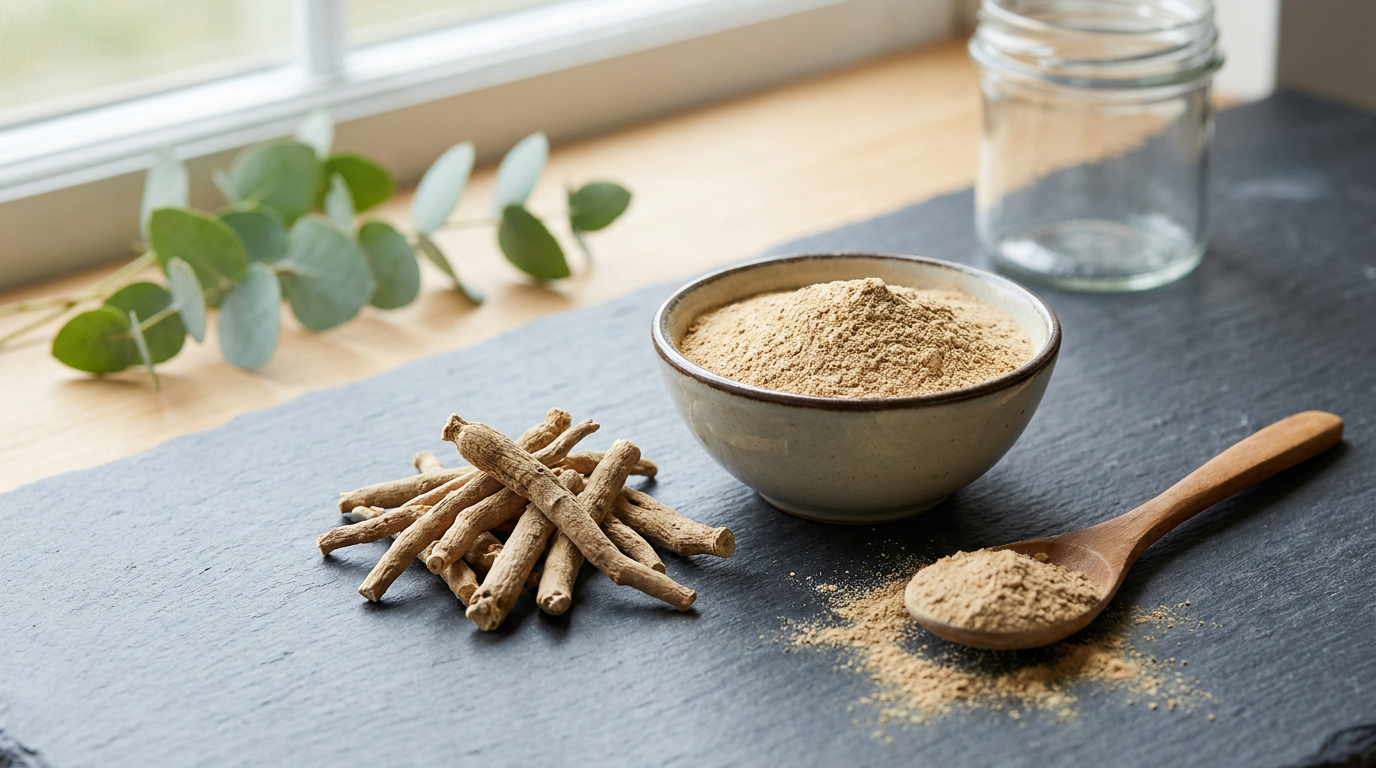
Of all the adaptogens currently under study, Ashwagandha (Withania somnifera) boasts the most robust clinical backing. Native to India and North Africa, the root of this shrub has been shown in multiple double-blind, placebo-controlled trials to significantly alter human stress biomarkers. The secret lies in a group of active compounds called withanolides, which are steroidal lactones that closely resemble human hormones.[2][3]
Because withanolides are structurally similar to human steroids, they can interact directly with the body's hormone receptors. Clinical trials have demonstrated that ashwagandha works as an amphoteric substance—meaning it can bind to receptors to exert a mild effect when natural hormone levels are too low, while blocking those same receptors when stress hormone levels are excessively high. This bidirectional action is the biological definition of an adaptogen.[3]
Because withanolides are structurally similar to human steroids, they can interact directly with the body's hormone receptors.
The results of this receptor modulation are highly measurable. In randomized trials involving chronically stressed adults, researchers have observed serum cortisol levels drop by 23% to 33% over an eight-week period in groups taking standardized ashwagandha root extract, compared to negligible changes in placebo groups. This reduction in the body's primary stress hormone correlates strongly with self-reported decreases in anxiety and fatigue.[2][3]

Beyond the HPA axis, ashwagandha also appears to act directly on the central nervous system. Animal and human studies suggest that the herb's active compounds are gamma-aminobutyric acid (GABA) agonists. GABA is the brain's primary inhibitory neurotransmitter, responsible for calming neuronal excitability. By enhancing GABAergic signaling, ashwagandha induces a calming effect and improves sleep quality without the heavy sedation associated with pharmaceutical tranquilizers.[3]
While ashwagandha dominates the research on anxiety, other adaptogens target different physiological pathways. Rhodiola rosea is heavily studied for its ability to combat physical and mental fatigue, particularly in high-stress environments. Asian ginseng is frequently utilized to boost cognitive function and physical endurance, while medicinal mushrooms like Reishi are investigated for their immunomodulatory properties.[1][4]
Despite the promising data, the medical community maintains a degree of healthy skepticism. Some medical researchers point out that much of the evidence relies on measuring chemicals that cells release in response to stress, operating on the assumption that lowering these chemicals is inherently beneficial. However, the human body evolved its stress response for a reason; acute stress is necessary for cellular defense, immune activation, and physical adaptation.[5]
Skeptics warn that artificially suppressing the body's natural stress-response chemicals could, in theory, hinder the body's ability to defend itself against real physiological threats. Furthermore, while in-vitro (test tube) studies show impressive anti-inflammatory and antioxidant effects, translating those cellular mechanisms into consistent, real-world health outcomes in diverse human populations remains a complex challenge.[5]

The most significant hurdle for consumers is the supplement industry itself. Because adaptogens are classified as dietary supplements rather than pharmaceutical drugs, they bypass the rigorous pre-market testing required by the FDA. This regulatory loophole results in a market flooded with products that are severely under-dosed, contaminated, or lacking the specific active compounds (like withanolides) required to trigger a biological effect.[2][6]
For those looking to integrate adaptogens into their health routine, clinical researchers emphasize the importance of sourcing. Efficacy in clinical trials is almost exclusively tied to standardized extracts—such as KSM-66 for ashwagandha—which guarantee a specific percentage of active compounds. Typical clinical doses range from 250 mg to 600 mg daily, and unlike a cup of coffee, the benefits are cumulative, usually requiring four to eight weeks of consistent use to manifest.[3][6]
Ultimately, adaptogens are not magic pills that can erase the effects of a toxic lifestyle, chronic sleep deprivation, or poor nutrition. However, as the scientific understanding of the HPA axis deepens, these ancient botanicals are proving to be powerful, evidence-based tools that can help a dysregulated nervous system find its way back to baseline.[1][5][6]
Viewpoints in depth
Integrative Health Advocates
Focus on the holistic ability of adaptogens to restore balance to the nervous system.
Integrative medicine practitioners view adaptogens as a vital bridge between ancient healing traditions and modern wellness. They emphasize that these plants—used for centuries in Ayurveda and Traditional Chinese Medicine—do not merely suppress symptoms like a pharmaceutical drug, but rather nourish the adrenal glands and restore systemic homeostasis. For this camp, the appeal of adaptogens lies in their non-toxic, bidirectional nature: they can stimulate a fatigued system or calm a hyperactive one, adapting to what the individual body needs in real-time.
Clinical Researchers
Focus on isolating the specific pharmacological mechanisms and measurable outcomes of botanical extracts.
For clinical researchers and pharmacologists, the "magic" of adaptogens is entirely biological. This camp is focused on isolating active compounds, such as withanolides in ashwagandha or rosavins in Rhodiola, and mapping their exact pathways in the human body. They rely on randomized, double-blind, placebo-controlled trials to prove efficacy, pointing to hard data like 30% reductions in serum cortisol and increased GABA receptor binding. Their primary concern is establishing standardized dosing protocols and proving that these botanicals can perform consistently in a clinical setting.
Medical Skeptics
Warn against the uncritical suppression of stress hormones and highlight the dangers of an unregulated supplement market.
Medical skeptics and traditional allopathic doctors urge caution regarding the adaptogen trend. They argue that the human stress response, including cortisol spikes, evolved for a reason and is necessary for cellular defense and immune function; artificially blunting this response may have unintended long-term consequences. Furthermore, this camp frequently highlights the severe lack of regulation in the dietary supplement industry. Without FDA oversight, they warn that consumers are often purchasing expensive placebos that lack the active compounds necessary to replicate the results seen in clinical trials.
What we don't know
- The long-term physiological effects of artificially suppressing cortisol levels over multiple years.
- How adaptogens interact with complex pharmaceutical regimens, particularly psychiatric medications.
- Whether the cellular benefits observed in test-tube studies consistently translate to disease prevention in humans.
Key terms
- Adaptogen
- A natural substance, typically a plant or mushroom, that helps the body adapt to physical, emotional, or environmental stress without causing toxicity.
- HPA Axis
- The hypothalamic-pituitary-adrenal axis, the body's central stress response system that controls the release of stress hormones.
- Cortisol
- The primary stress hormone produced by the adrenal glands, which regulates metabolism, reduces inflammation, and manages the sleep-wake cycle.
- Withanolides
- The active steroidal compounds found in ashwagandha believed to be responsible for its stress-relieving and adrenal-supporting effects.
- Homeostasis
- The state of steady internal, physical, and chemical conditions maintained by living systems, which adaptogens aim to restore.
- GABA
- Gamma-aminobutyric acid, the primary inhibitory neurotransmitter in the brain that reduces neuronal excitability and promotes calmness.
Frequently asked
Do adaptogens work immediately like caffeine?
No. Unlike stimulants, adaptogens build resilience over time. Clinical trials show that maximum benefits typically appear after four to eight weeks of consistent daily use.
Are adaptogenic herbs safe for everyone?
While generally considered non-toxic, adaptogens can interact with certain medications or affect hormone levels. Medical professionals advise consulting a doctor before starting them, especially for pregnant individuals or those with autoimmune conditions.
Is there scientific proof that adaptogens work?
Yes, though the strength of evidence varies by herb. Ashwagandha has the strongest clinical backing, with multiple randomized controlled trials demonstrating significant reductions in cortisol and self-reported anxiety.
What is the recommended dosage for ashwagandha?
In clinical trials demonstrating stress reduction, participants typically take between 250 mg and 600 mg of a standardized root extract per day.
Sources
Source coverage
6 outlets
3 viewpoints surfaced






[1]UCLA HealthIntegrative Health Advocates
What are adaptogens and should you be taking them?
Read on UCLA Health →[2]News MedicalClinical Researchers
What are adaptogens? How are they believed to work?
Read on News Medical →[3]Restorative MedicineClinical Researchers
Ashwagandha (Withania somnifera) Indications and Mechanism of Action
Read on Restorative Medicine →[4]HealthlineIntegrative Health Advocates
Are adaptogenic herbs beneficial to your health?
Read on Healthline →[5]MSD ManualsMedical Skeptics
What Are Adaptogens? Evidence and Risks
Read on MSD Manuals →[6]Factlen Editorial Team
Synthesis by Factlen editorial team
Read on Factlen Editorial Team →

Every angle. Every day.
Get health stories with full source coverage and perspective breakdowns delivered to your inbox.