
The Science Behind Pilates: How Low-Impact Resistance Reshapes Core Biomechanics
Modern ultrasound and biomechanical research are revealing exactly how Pilates rewires the neuromuscular system, proving that controlled, eccentric movements build profound functional strength.
By Factlen Editorial Team
- Clinical Rehabilitation Specialists
- Focus on the therapeutic application of Pilates for injury recovery and pain management.
- Contemporary Movement Scientists
- Integrate modern biomechanics and progressive overload principles to evolve the Pilates method.
- Classical Pilates Purists
- Advocate for the strict adherence to Joseph Pilates' original, unassisted Mat-based 'Contrology' sequence.
What's not represented
- · Traditional weightlifters comparing core activation to heavy compound lifts
- · Budget-conscious fitness consumers priced out of boutique Reformer classes
Why this matters
Understanding the biomechanics of Pilates allows practitioners to maximize their strength gains and protect their joints, transforming a standard workout into a targeted clinical tool for lifelong mobility and pain prevention.
Key points
- Ultrasound imaging proves Pilates significantly increases the thickness and activation speed of deep core muscles.
- Pilates relies heavily on eccentric contractions, which build strength and flexibility simultaneously while protecting joints.
- Mat Pilates demands 100% internal stabilization, often resulting in higher core activation than spring-assisted Reformer exercises.
- The Reformer allows for progressive overload and precise joint loading, making it highly effective for clinical rehabilitation.
- Clinical trials show Pilates is a frontline intervention for chronic lower back pain and post-viral physical deconditioning.
Pilates has experienced an explosive resurgence, evolving from a niche conditioning secret for professional dancers into a ubiquitous pillar of modern fitness. It is practiced everywhere, from boutique neighborhood studios to advanced physical therapy clinics. But beyond the aesthetic appeal of a "toned" physique, a quiet revolution is happening in how movement scientists and clinicians actually understand the practice.[6]
Joseph Pilates developed his method, originally called "Contrology," nearly a century ago as a way to rehabilitate bedridden patients and strengthen the human body uniformly. Today, modern biomechanics, rehabilitative ultrasound imaging, and fascia research are validating his foundational principles while evolving the practice into a highly precise clinical tool for musculoskeletal health.[5]
At the heart of this scientific validation is a fundamental shift in how we measure and define core strength. For decades, mainstream fitness culture fixated almost exclusively on the rectus abdominis—the superficial "six-pack" muscle that is primarily responsible for forward flexion, such as when performing traditional crunches or sit-ups.[6]
Pilates, however, bypasses the superficial layers to target the deep stabilizing system. A groundbreaking 2025 study published in the medical journal Medicina utilized rehabilitative ultrasound imaging to look directly beneath the skin of practitioners. The researchers found that just six weeks of Pilates-based core stabilization training significantly increased the physical thickness and contraction timing of the transverse abdominis (TrA) and internal obliques.[1]

The transverse abdominis acts like a muscular corset, wrapping horizontally around the spine and pelvis to provide structural integrity before the limbs even begin to move. By improving the contraction ratio of these deep muscles, Pilates effectively rewires the neuromuscular system, teaching the body to stabilize the spine automatically during complex daily activities.[1]
This profound deep-core activation is largely achieved through a specific type of muscle engagement that Pilates heavily relies upon: the eccentric contraction. In a standard concentric contraction, a muscle shortens as it generates force—think of the upward, curling motion of a bicep curl.[2]
An eccentric contraction, by contrast, occurs when a muscle lengthens while remaining under tension, actively resisting the pull of gravity or the mechanical tension of a spring. Research published in Frontiers in Physiology highlights that eccentric muscle work produces highly unique physiological adaptations, building superior strength while simultaneously increasing flexibility.[2]
Because eccentric movements require less cardiovascular effort but generate higher mechanical loads on the muscle fibers, they are incredibly efficient. This lengthening under tension is the exact biomechanical mechanism that gives Pilates its signature ability to build strength without adding bulk, while also fortifying tendons and joints against injury.[2][6]

Because eccentric movements require less cardiovascular effort but generate higher mechanical loads on the muscle fibers, they are incredibly efficient.
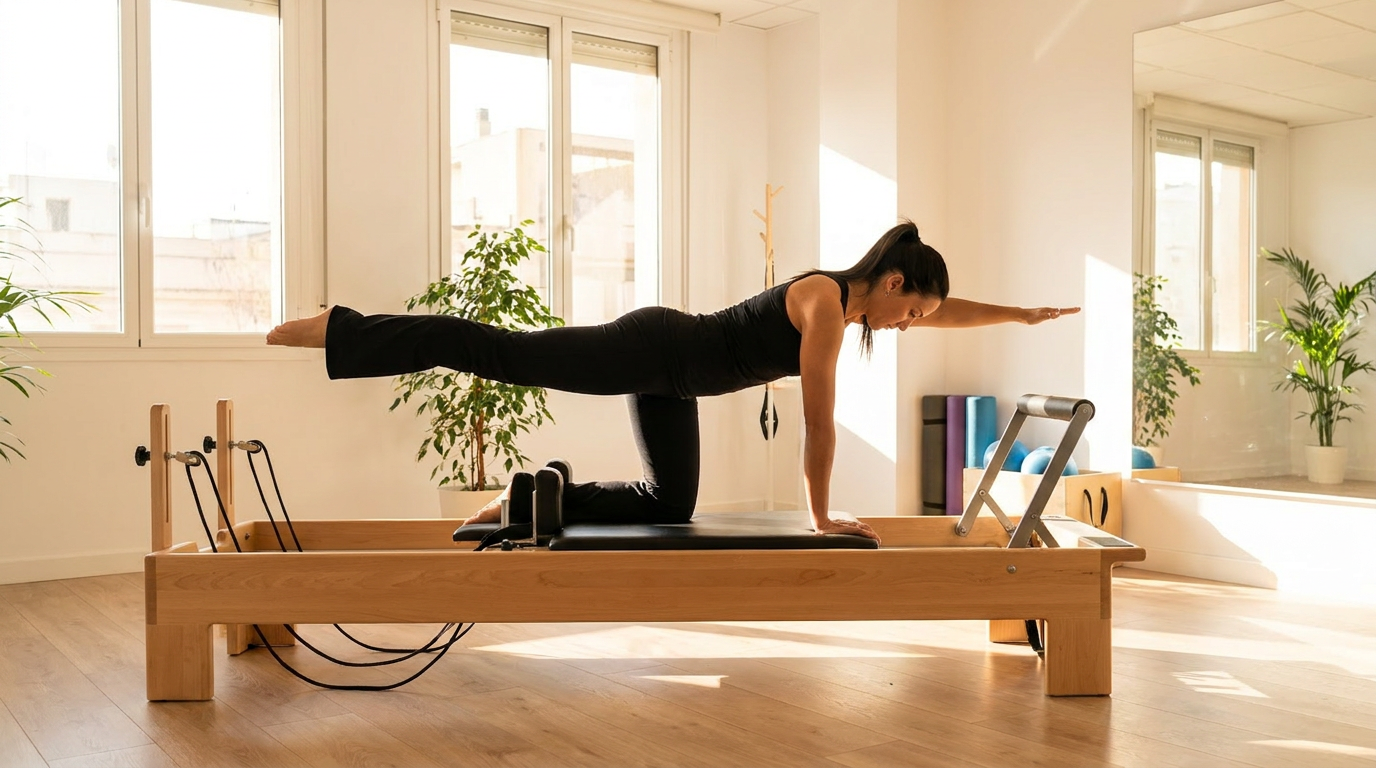
This understanding of muscle activation brings us to the most fiercely debated topic in modern fitness studios: Mat versus Reformer Pilates. To the untrained eye, the Reformer—a bed-like frame equipped with a sliding carriage, ropes, and variable spring resistance—looks like a more intense, advanced version of the floor-based Mat practice.[5]
Biomechanically, the reality is far more nuanced. The Reformer provides constant external feedback. Its springs can be adjusted to either challenge a movement by adding heavy resistance or assist a movement by supporting the body's weight against the downward pull of gravity.[6]
This variable resistance allows for progressive overload, which is essential for building visible muscle mass and increasing bone density over time. It also makes the Reformer an unparalleled tool for clinical rehabilitation, as physical therapists can precisely calibrate the load on a healing joint while the sliding carriage safely supports the patient's spine.[4][6]
Mat Pilates, conversely, strips away all mechanical assistance. Practitioners must rely entirely on internal awareness and gravity. Because there is no carriage guiding the body along a fixed, predictable track, the neuromuscular system must work overtime to stabilize the torso in three dimensions.[6]
Electromyography (EMG) studies have consistently shown that for many foundational exercises, Mat Pilates demands equal or even greater core muscle activation than the Reformer. Without springs to help lift the torso or guide the legs through space, the deep stabilizers must perform 100 percent of the mechanical work.[5][6]

The clinical implications of this deep, three-dimensional stabilization are profound. A 2024 randomized controlled trial published in the Journal of Multidisciplinary Healthcare examined university students recovering from COVID-19, a population often plagued by prolonged fatigue and severe physical deconditioning.[3]
The researchers found that a dedicated Pilates regimen significantly improved both core muscle endurance and static trunk balance in the recovering patients. By rebuilding the foundational strength of the torso, patients experienced a cascading improvement in their overall quality of movement and daily energy levels.[3]
Similarly, systematic reviews of physical therapy interventions have cemented Pilates as a frontline treatment for chronic low back pain. By teaching the nervous system to fire the multifidus—a series of small, intricate muscles attached directly to the spine—Pilates alleviates the compensatory strain that causes chronic aching and stiffness.[4]

Ultimately, the science of Pilates reveals that the method is not defined by the specific equipment you use, but by the biomechanical intention behind the movement. Whether pushing against a heavy steel spring or resisting the simple, relentless downward pull of gravity, the physiological goal remains exactly the same.[5][6]
By prioritizing eccentric control, deep core activation, and precise skeletal alignment, Pilates successfully bridges the gap between athletic conditioning and clinical rehabilitation. It stands as a scientifically validated testament to the idea that intelligent, controlled movement is the most potent medicine for the human body.[6]
How we got here
1920s
Joseph Pilates develops 'Contrology' to rehabilitate bedridden patients and dancers.
1990s
Pilates enters the mainstream fitness market, leading to the proliferation of group Mat classes.
2010s
Clinical physical therapists widely adopt the Reformer for targeted musculoskeletal rehabilitation.
2024–2025
Advanced ultrasound and EMG studies map the precise biomechanical benefits of deep core stabilization.
Viewpoints in depth
Clinical Rehabilitation Specialists
Focus on the therapeutic application of Pilates for injury recovery and pain management.
For physical therapists and clinicians, Pilates is primarily a tool for neuromuscular re-education. They value the Reformer for its ability to provide a closed-kinetic-chain environment, where spring tension can be micro-adjusted to safely load healing joints. By targeting the transverse abdominis and multifidus, clinicians use Pilates to treat chronic lower back pain, correct postural asymmetries, and restore functional movement patterns without risking high-impact joint stress.
Classical Pilates Purists
Advocate for the strict adherence to Joseph Pilates' original 'Contrology' sequence.
Classical practitioners argue that the true power of Pilates lies in its original, unadulterated form. They emphasize that Mat Pilates, which relies entirely on gravity and internal body control, is the ultimate expression of the method. In this view, relying too heavily on the Reformer's springs can become a crutch, preventing the practitioner from developing the profound internal stabilization and mind-body discipline that Joseph Pilates originally intended.
Contemporary Movement Scientists
Integrate modern biomechanics and sports science to evolve the Pilates method.
Movement scientists and contemporary instructors view Pilates as a living, evolving discipline. They incorporate modern research on fascia, neuroplasticity, and progressive overload to modify classical exercises. This camp argues that while the foundational principles of centering and breath remain vital, the choreography must adapt to the biomechanical realities of modern, often sedentary, bodies to maximize athletic conditioning and prevent injury.
What we don't know
- The exact long-term differences in bone density improvements between Mat and Reformer Pilates practitioners.
- How specific genetic variations in fascia elasticity affect an individual's response to eccentric Pilates training.
Key terms
- Transverse Abdominis (TrA)
- The deepest layer of abdominal muscle that wraps around the torso like a corset to stabilize the spine.
- Eccentric Contraction
- A type of muscle activation where the muscle lengthens while under tension, such as slowly lowering a weight.
- Multifidus
- A series of small, deep muscles attached directly to the spine that play a crucial role in postural stability.
- Progressive Overload
- The gradual increase of stress placed upon the body during exercise training to continuously build muscle and strength.
- Proprioception
- The body's subconscious ability to sense its movement, action, and location in space.
Frequently asked
Is Mat or Reformer Pilates better for beginners?
The Reformer is often better for beginners because its springs can assist movements and support the spine, whereas Mat Pilates requires you to stabilize your entire body weight against gravity.
Can Pilates help with chronic lower back pain?
Yes. Clinical studies show that Pilates effectively reduces lower back pain by strengthening the deep stabilizing muscles, like the multifidus, which support the lumbar spine.
Does Pilates build muscle mass?
Pilates builds lean muscle strength primarily through eccentric contractions. While it won't create bulky muscles like heavy weightlifting, it significantly increases muscle density and functional strength.
Sources
Source coverage
6 outlets
3 viewpoints surfaced



[1]MedicinaClinical Rehabilitation Specialists
Effects of Pilates-Based Core Stabilization Training on Deep Stabilizing Muscles
Read on Medicina →Eccentric Muscle Contractions: Risks and Benefits
Read on Frontiers in Physiology →Effects of Pilates Exercises on Core Endurance and Static Balance
Read on Journal of Multidisciplinary Healthcare →Benefits of Pilates: A Systematic Review
Read on European Journal of Investigation in Health, Psychology and Education →[5]Pilates JournalContemporary Movement Scientists
The Science of Pilates: From Classical Roots to Contemporary Practice
Read on Pilates Journal →[6]Factlen Editorial TeamContemporary Movement Scientists
Synthesis by Factlen editorial team
Read on Factlen Editorial Team →

More in fitness
See all 55 stories →Longevity Science
Why Swimming is Emerging as the Ultimate 'Zone 2' Exercise for Longevity
6 sources
Muscle Hypertrophy
The Science of Muscle Hypertrophy: Why Mechanical Tension is the Ultimate Driver of Growth
6 sources

Longevity Science
The Science of Swimming: How Aquatic Exercise Rewires the Brain and Extends Lifespan
6 sources

Zone 2 Science
The Science of Zone 2: Why Running Slower is the Key to Running Faster
7 sources

Every angle. Every day.
Get fitness stories with full source coverage and perspective breakdowns delivered to your inbox.