
The Next-Generation Geothermal Breakthrough, Explained
Advances in drilling technology borrowed from the oil and gas industry are unlocking massive reserves of clean, 24/7 geothermal energy, transforming it from a niche resource into a global powerhouse.
By Factlen Editorial Team
- Geothermal Developers
- Focused on rapid scaling, cost reduction, and providing 24/7 clean baseload power.
- Federal Policymakers
- View advanced geothermal as a critical pillar for national energy security and grid decarbonization.
- Energy Analysts
- Track the economic viability, grid integration, and workforce transition of the technology.
- Climate Advocates
- Prioritize the rapid deployment of firm, carbon-free energy to replace fossil fuels.
What's not represented
- · Local communities living near proposed EGS drilling sites
- · Traditional utility companies managing grid integration
Why this matters
As data centers and artificial intelligence drive up electricity demand, next-generation geothermal offers the holy grail of the energy transition: carbon-free, always-on baseload power that doesn't depend on the sun or wind.
Key points
- Enhanced Geothermal Systems (EGS) use horizontal drilling and hydraulic fracturing to create artificial reservoirs in hot, dry rock.
- The U.S. Department of Energy projects advanced geothermal could increase domestic capacity to 90 GW by 2050.
- Drilling times have dropped by 70 percent over the past two years, drastically improving the technology's economic viability.
- The industry offers a direct transition path for fossil fuel workers, utilizing the same skills and equipment used in oil and gas extraction.
The global energy transition faces a fundamental math problem: the world needs massive amounts of clean electricity to power data centers, artificial intelligence, and electric vehicles, but the grid's primary green engines—wind and solar—are intermittent. When the sun sets and the wind dies down, grid operators are forced to fall back on natural gas or coal to maintain baseline stability. This dynamic has created an urgent hunt for a scalable energy source that can provide firm, reliable power without emitting greenhouse gases.[2][6]
For decades, the holy grail of renewable energy has been a source that is both entirely carbon-free and capable of running 24 hours a day, seven days a week. Traditional geothermal energy fit that description perfectly, but it came with a severe geographic catch. It only worked in rare locations where underground heat, water, and natural rock permeability naturally intersected near the Earth's surface, such as in Iceland, New Zealand, or specific pockets of California and Nevada.[4][6]
Because of these strict geological constraints, conventional geothermal energy currently provides just 0.4 percent of total installed global power. But a technological breakthrough known as Enhanced Geothermal Systems (EGS) is rapidly decoupling geothermal power from its geographic limits, promising to unlock vast reserves of subterranean heat that exist almost everywhere on the planet if you drill deep enough.[5][6]
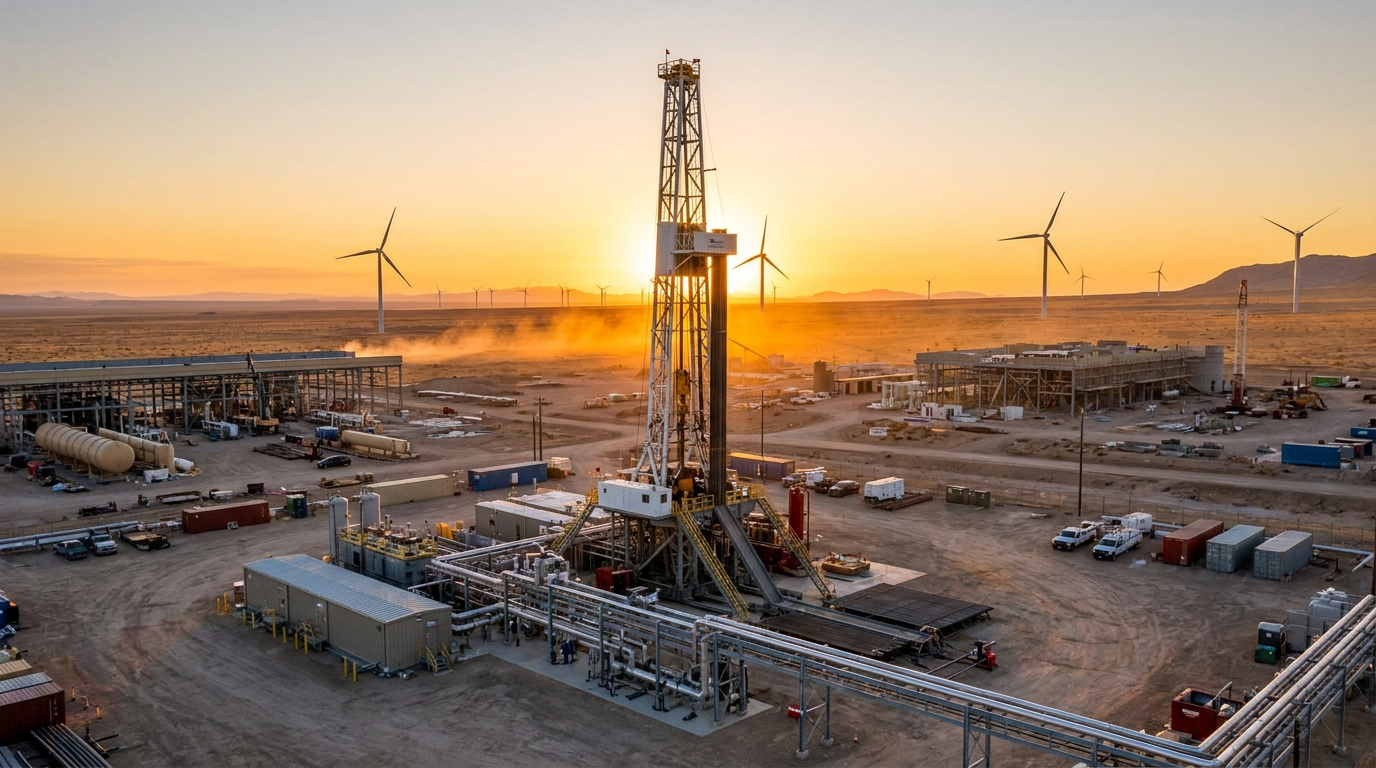
The mechanism behind EGS represents an ironic twist in the history of energy: it relies almost entirely on the drilling innovations pioneered by the fossil fuel industry during the shale oil and gas boom. Instead of hunting for natural underground hot springs, EGS developers drill vertically for up to 10 kilometers to reach hot, dry, crystalline rock that was previously considered useless for power generation.[4][6]

Once the drill reaches the target depth, it turns horizontally. Engineers then use hydraulic stimulation—injecting high-pressure fluid to create a network of millimeter-thin fractures in the rock. Cold water is pumped down an injection well, forced through the newly created artificial reservoir where it absorbs the Earth's intense heat, and is then drawn back up a production well to drive a steam turbine on the surface.[4][8]
This technology has moved rapidly from theoretical models to commercial reality. Fervo Energy, a leading EGS developer, is currently constructing Cape Station in southwest Utah. The facility is slated to begin delivering its first 100 megawatts of continuous power to the grid in 2026, eventually scaling to a 500-megawatt capacity—enough to power hundreds of thousands of homes with zero-emission baseload electricity.[1][8]
The financial markets are signaling strong confidence in the sector's viability. In late 2025, Fervo Energy closed a massive $462 million Series E funding round, positioning the company for a highly anticipated initial public offering in 2026 at a reported valuation of up to $6.5 billion. This influx of capital is allowing developers to transition from pilot projects to utility-scale deployments.[1][2]
The sudden commercial viability of EGS is largely driven by plummeting costs. By adapting oil and gas techniques, developers have slashed drilling times by 70 percent over the past two years. The U.S. Department of Energy projects that as these learning curves continue, the cost of next-generation geothermal will fall below that of nuclear and fossil fuels equipped with carbon capture technology by 2035.[4][6]
The sudden commercial viability of EGS is largely driven by plummeting costs.
In its recent "Pathways to Commercial Liftoff" report, the Department of Energy outlined a roadmap where advanced geothermal technology could increase the United States' geothermal energy production to 90 gigawatts by 2050. This represents a staggering twentyfold increase from today's capacity, transforming geothermal from a niche contributor into a foundational pillar of the national grid.[5][6]

To accelerate this timeline, the federal government is heavily subsidizing early-stage deployments. In early 2026, the Department of Energy announced $171.5 million in new funding to support next-generation geothermal field tests, aiming to de-risk exploration and prove the technology at commercial scale across diverse geological environments.[5]
While EGS is currently leading the commercial charge, other advanced geothermal concepts are also gaining traction. Advanced Geothermal Systems (AGS), often referred to as closed-loop systems, circulate fluid through sealed underground pipes. Because the fluid never directly interacts with the surrounding rock, AGS eliminates the need for hydraulic fracturing and the associated risks of induced seismicity, acting essentially as a massive subterranean radiator.[3][4]
Further out on the technological horizon is Superhot Rock Geothermal (SHR). Companies like MIT spinout Quaise Energy are developing millimeter-wave drilling technology designed to literally vaporize rock, allowing them to reach extreme depths where temperatures exceed 400°C. Tapping into these supercritical fluids could theoretically yield five to ten times the energy output per well compared to standard EGS.[2][4]
Beyond the technological and environmental benefits, next-generation geothermal offers a unique socioeconomic advantage: a seamless transition for the fossil fuel workforce. The International Energy Agency estimates that roughly 75 percent of the technical skills and heavy equipment used in advanced geothermal overlap directly with the oil and gas sector.[4][6]
This overlap means that roughnecks, petroleum engineers, and drilling operators can transition into the clean energy economy without needing to retrain for entirely new industries. The same rigs that once extracted hydrocarbons are now being deployed to harvest carbon-free heat, providing a highly paid lifeline to communities historically dependent on fossil fuel extraction.[4]

The most immediate catalyst for geothermal's rapid rise, however, is the technology sector. The explosion of artificial intelligence has triggered a massive surge in electricity demand for data centers. Tech giants require 24/7 clean power to meet their climate pledges, and they are increasingly looking to co-locate their facilities directly adjacent to new geothermal plants to secure reliable, firm energy without straining local grids.[2][7]
Despite the immense promise, the industry still faces significant headwinds. Permitting timelines for geothermal exploration on federal lands remain notoriously slow, often taking years longer than equivalent permits for oil and gas drilling. Additionally, connecting these new power plants to the broader electrical grid requires massive investments in transmission infrastructure, which is currently lagging behind generation capacity.[3]
There are also localized environmental concerns. Because EGS involves fracturing underground rock, it can induce microseismicity. While these tremors are typically too faint to be felt on the surface, operators must deploy rigorous, continuous seismic monitoring—such as the advanced sensors developed by Lawrence Berkeley National Laboratory—to safely manage fluid injection and prevent larger seismic events.[8]

Ultimately, next-generation geothermal represents a rare convergence of interests. It offers the tech industry the firm power it desperately needs, provides the fossil fuel workforce with a viable future, and gives grid operators a reliable tool to balance intermittent renewables. If the current pace of innovation holds, the heat beneath our feet may soon become the backbone of the clean energy economy.[3][6][7]
How we got here
2023
The Department of Energy launches the 'Pathways to Commercial Liftoff' initiative to accelerate clean energy deployment.
July 2025
Lawrence Berkeley National Laboratory deploys advanced seismic sensors nearly 7,000 feet underground at Fervo's Cape Station.
December 2025
Fervo Energy closes a $462 million Series E funding round, signaling strong market confidence in EGS technology.
February 2026
The DOE announces $171.5 million in new funding to support next-generation geothermal field tests.
2026
Fervo's Cape Station in Utah is slated to begin delivering its first 100 megawatts of continuous commercial power.
Viewpoints in depth
Geothermal Developers
Focused on rapid scaling, cost reduction, and providing 24/7 clean baseload power.
Companies like Fervo Energy and Quaise argue that the technology is already proven and that the primary hurdles are now regulatory and financial, not technical. They emphasize that geothermal is the only clean energy source capable of matching the reliability of natural gas, making it indispensable for powering the AI revolution and stabilizing the grid.
Federal Policymakers
View advanced geothermal as a critical pillar for national energy security and grid decarbonization.
The Department of Energy sees EGS as a massive, untapped domestic resource that can reduce reliance on imported supply chains. By funding field tests and publishing commercial liftoff roadmaps, federal officials aim to de-risk the technology for private investors and accelerate its deployment to meet 2035 and 2050 climate targets.
Fossil Fuel Industry Transitioners
See geothermal as a lifeline that utilizes existing oil and gas drilling expertise for clean energy.
Labor advocates and industry analysts highlight that next-generation geothermal relies on the exact same horizontal drilling and hydraulic fracturing techniques pioneered during the shale boom. This provides a direct, highly paid transition path for fossil fuel workers, allowing them to apply their existing skills to carbon-free energy production without geographic displacement.
Environmental Watchdogs
Support the clean energy output but urge caution regarding water usage and induced seismicity.
While recognizing the necessity of baseload clean power, conservation groups point out that EGS requires significant water inputs for hydraulic stimulation and reservoir circulation. They also emphasize the need for strict regulatory oversight and continuous seismic monitoring to ensure that artificial fracturing does not induce damaging earthquakes or contaminate local groundwater.
What we don't know
- How quickly the electrical grid can be upgraded with new transmission lines to connect remote geothermal plants to major population centers.
- Whether the cost of Superhot Rock Geothermal (SHR) drilling technologies can be brought down enough to achieve commercial viability.
- How local regulatory bodies will streamline the currently sluggish permitting process for geothermal exploration on public lands.
Key terms
- Enhanced Geothermal Systems (EGS)
- A technology that creates artificial underground reservoirs by injecting fluid into hot, dry rock to extract heat for electricity.
- Baseload Power
- The minimum amount of electric power needed to be supplied to the electrical grid at any given time, requiring 24/7 reliability.
- Hydraulic Stimulation
- The process of injecting high-pressure fluid into underground rock to create fractures, allowing water to circulate and absorb heat.
- Microseismicity
- Very faint earth tremors, often too small to be felt on the surface, which can be induced by injecting fluids into underground rock formations.
- Closed-Loop Geothermal
- A system that circulates fluid through sealed underground pipes to absorb heat, acting like a massive subterranean radiator without exchanging fluids with the rock.
Frequently asked
How is next-generation geothermal different from traditional geothermal?
Traditional geothermal relies on naturally occurring underground hot water reservoirs. Next-generation systems use advanced drilling to create artificial reservoirs in hot, dry rock, meaning plants can be built almost anywhere.
Does geothermal energy cause earthquakes?
Enhanced geothermal systems can cause microseismicity—tiny tremors usually undetectable on the surface. Operators use continuous seismic monitoring to manage fluid injection and prevent larger events.
Why is the oil and gas industry involved in geothermal?
The core technologies of next-generation geothermal—horizontal drilling and hydraulic fracturing—were pioneered by the shale oil industry. This allows fossil fuel workers and equipment to transition directly into clean energy.
Can geothermal replace solar and wind?
It is designed to complement them. While solar and wind are cheaper, they only generate power when the weather permits. Geothermal provides the constant, 24/7 baseload power needed to stabilize the grid when renewables drop off.
Sources
Source coverage
8 outlets
4 viewpoints surfaced








[1]AxiosGeothermal Developers
Geothermal unicorn Fervo closes $462M Series E
Read on Axios →[2]TechFundingNewsGeothermal Developers
Critical Energy designs modular geothermal turbines
Read on TechFundingNews →[3]ThinkGeoEnergyEnergy Analysts
2025 did not become the global geothermal breakthrough year that some promised
Read on ThinkGeoEnergy →[4]Information Technology and Innovation FoundationEnergy Analysts
Advanced Geothermal Technologies: EGS, AGS, and SHR
Read on Information Technology and Innovation Foundation →[5]U.S. Department of EnergyFederal Policymakers
Next-Generation Geothermal Energy Field Tests
Read on U.S. Department of Energy →[6]Clean Air Task ForceClimate Advocates
Next-generation geothermal is within reach
Read on Clean Air Task Force →[7]Fervo EnergyGeothermal Developers
A year of execution, scale, and momentum
Read on Fervo Energy →[8]Lawrence Berkeley National LaboratoryFederal Policymakers
Scaling enhanced geothermal systems with continuous monitoring
Read on Lawrence Berkeley National Laboratory →

More in guides
See all 5 stories →


Every angle. Every day.
Get guides stories with full source coverage and perspective breakdowns delivered to your inbox.