
The Most-Favored-Nation Principle That Defines the Baseline of Global Trade
The Most-Favored-Nation principle requires World Trade Organization members to treat all trading partners equally, establishing the baseline tariff rates for the global economy. Originally a tool for bilateral alliances, it now functions as the structural ceiling for international trade costs.
By Madison Lane

- Reciprocity Advocates
- Argue that MFN must be updated to require reciprocal market access to prevent free-riding.
- Multilateral Traditionalists
- Defend unconditional MFN as the necessary baseline to prevent discriminatory trade wars.
- Legal & Historical Analysts
- Focus on the evolution of MFN from a bilateral privilege to a multilateral requirement.
Perspectives this story doesn't cover
- Small and medium-sized export businesses that rely on stable MFN rates to forecast international shipping costs.
- Customs brokers and logistics providers who navigate the complex overlap between MFN baselines and free-trade exemptions.
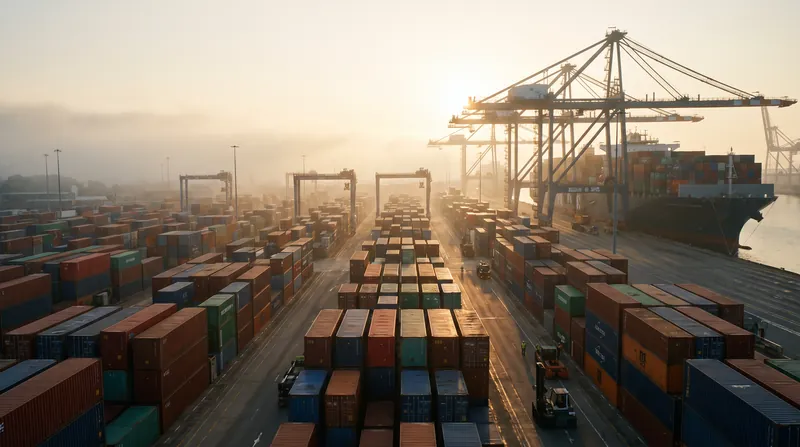
The moment a cargo container clears a port terminal and a customs officer processes its Harmonized System code is the exact step where the Most-Favored-Nation principle dictates the economic outcome of global trade. This classification event determines the baseline tariff rate applied to the goods, establishing the foundational cost of international commerce before any domestic taxes, logistics fees, or retail markups are added. It is the single regulatory checkpoint that decides whether a product can compete in a foreign market or if it will be priced out by import duties.[1][5]
Despite its name, the Most-Favored-Nation (MFN) designation does not mean a country receives a special, exclusive deal. Instead, it operates as a strict non-discrimination guarantee. If a World Trade Organization member lowers a tariff for one nation, it must lower that same tariff for all 164 members. The principle ensures that a country cannot be treated any worse than the most favored trading partner, effectively turning the MFN rate into the ceiling for standard trade costs.[2][5]
This unconditional application is enshrined in Article I of the General Agreement on Tariffs and Trade, established in 1947. The legal text mandates that "any advantage, favor, privilege or immunity granted by any contracting party to any product... shall be accorded immediately and unconditionally to the like product" originating from all other members. The United Nations Office of Legal Affairs notes that this clause forms the structural backbone of modern multilateral trade.[1][2]
The economic mechanics of this rule transformed global commerce. A 2017 paper presented at the American Economic Association by Vanderbilt University economist Wisarut Suwanprasert explains the mechanism: "The basic idea of the MFN principle is that countries must not discriminate between trading partners; favorable treatment a country grants to its trading partner must also be granted to all other WTO members." This multiplies the benefits of any single trade concession across the entire network.[2]
However, the principle has historical roots that operated very differently. In the 18th century, MFN status was conditional and bilateral. During the 1667 Treaty of Madrid, Spain granted England MFN trading status as an exclusive reciprocal privilege, not a universal right. The United States followed a similar conditional approach, beginning with a 1778 trade treaty with France.[5]
The shift from conditional bilateral agreements to unconditional multilateral requirements created a structural dynamic that economists identify as the free-rider problem. Because tariff reductions must be extended to all WTO members regardless of whether they offer reciprocal cuts, outside countries can receive welfare gains without reducing their own trade barriers.[2]
This dynamic systematically shifts the burden of trade liberalization onto developed nations. As capital accumulates in the export sectors of emerging economies, the cost of unconditional MFN compliance for developed nations rises relative to the benefits they receive in return.[2]
This dynamic systematically shifts the burden of trade liberalization onto developed nations.
Consequently, the very success of the MFN principle in promoting comparative advantage causes developed nations to switch from being net beneficiaries to net losers over time. This structural bottleneck disincentivizes further bilateral tariff reductions, as major economies become reluctant to grant concessions that will automatically benefit competitors who refuse to open their own markets.[2]
To bypass these constraints, countries increasingly rely on the explicit exceptions built into the WTO framework. The rules allow for preferential treatment through regional free trade areas and customs unions, provided they cover substantially all trade between the partners.[3][5]
This loophole has led to a proliferation of bilateral and regional agreements, fragmenting the global trading system. The MFN rate, once the aspirational goal of trade negotiations, is now increasingly viewed as the default penalty rate applied to countries left out of preferential blocs. In the United States, the terminology itself was altered; Section 5003 of the Internal Revenue Service Restructuring and Reform Act of 1998 officially changed the designation from MFN to "Normal Trade Relations" to better reflect its baseline status.[5]
The tension over the future of the MFN principle is currently fracturing the WTO. During a September 24, 2026, meeting on WTO reform, sharp divides emerged over the "level playing field" concept and the push by developed nations to demand stricter reciprocity.[4]
According to the Third World Network, a five-page proposal submitted by China severely criticized calls for "re-balancing rights and obligations" based on predetermined outcomes. The document reasserted the core principles of "multilateralism, non-discrimination, predictability and transparency."[4]
China specifically criticized "some members" for attempting to make MFN treatment conditional, cautioning against reviving "power-based trade relations in the name of reciprocity." The debate highlights the core vulnerability of the MFN principle: it relies entirely on the consensus of its largest participants.[4]
If major economies abandon unconditional MFN in favor of reciprocal, conditional tariffs, the foundational baseline of global trade costs will collapse. The outcome of these ongoing reform negotiations will determine whether the MFN principle remains the bedrock of international commerce or whether the system fractures back into the exclusive bilateral alliances of the 18th century.[4][6]
What to know
- The Most-Favored-Nation principle requires WTO members to extend the same tariff rates to all 164 member nations unconditionally.
- Despite its name, MFN establishes a baseline standard of non-discrimination rather than granting an exclusive or special trade advantage.
- The unconditional nature of MFN creates a free-rider problem, allowing countries to benefit from tariff cuts without reducing their own barriers.
- Developed nations increasingly argue that the principle must be updated to require reciprocal market access to remain economically sustainable.
- Developing economies view unconditional MFN as an essential shield against power-based trade relations and bilateral coercion.
Key terms
- Most-Favored-Nation (MFN) Principle
- A WTO rule requiring members to extend the same tariff rates and trade conditions granted to any one trading partner to all other members.
- Harmonized System (HS) Code
- An internationally standardized system of names and numbers used to classify traded products and determine their applicable tariff rates at customs.
- Free-Rider Problem
- An economic dynamic where a country benefits from the tariff reductions of other nations under MFN rules without having to lower its own trade barriers.
- General Agreement on Tariffs and Trade (GATT)
- A 1947 legal agreement between many countries that established the foundational rules for international trade, later succeeded by the WTO.
Sources
Source coverage
6 outlets
3 viewpoints surfaced




- [1]UN Office of Legal AffairsMultilateral Traditionalists
MOST-FAVOURED-NATION CLAUSE: Report of the Working Group
Read on UN Office of Legal Affairs → - [2]American Economic AssociationReciprocity Advocates
The Role of the Most Favored Nation Principle of the GATT/WTO in the New Trade Model
Read on American Economic Association → - [3]Law Research JournalLegal & Historical Analysts
The Evolution and Impact of the Most Favored Nation Clause in (WTO) Jurisprudence: A Pillar of International Trade
Read on Law Research Journal → - [4]Third World NetworkMultilateral Traditionalists
WTO: Sharp divides over "level playing field", reform proposals
Read on Third World Network → - [5]WikipediaLegal & Historical Analysts
Most favoured nation
Read on Wikipedia → - [6]Factlen Editorial TeamLegal & Historical Analysts
Synthesis by Factlen editorial team
Read on Factlen Editorial Team →
Comments

More in Business
See all →Bilateral Trade
US and China Finalize $60 Billion Reciprocal Tariff Reduction and Extend Trade Truce
5 sources
Global Expansion
The Four International Market Entry Strategies and Their Risk-Control Trade-Offs
6 sources
Health Tech Regulation
Digital Health Startups Face a Dual Regulatory Reset as Telehealth and AI Rules Tighten
2 sources

AI Infrastructure
Nvidia Invests $1 Billion in AI Startup Poolside Alongside $6 Billion Software Licensing Deal
3 sources

Every angle. Every day.
Get Business stories with full source coverage and perspective breakdowns delivered to your inbox.