
The Grid, Not the GPU: How AI's Unprecedented Power Demand Is Forcing a Global Energy Infrastructure Reckoning
As AI data centers project to consume over 1,000 terawatt-hours by 2026, the tech industry's primary bottleneck has shifted from silicon supply to electrical grid capacity. In response, hyperscalers are bypassing decade-long interconnection queues by pouring over $1 trillion into next-generation nuclear, geothermal, and private energy infrastructure.

Share this story
The defining bottleneck of the artificial intelligence boom has officially shifted. In 2023 and 2024, the technology sector was consumed by a desperate scramble for silicon, with companies waiting months for advanced GPUs. Today, the chips are flowing freely from fabrication plants, but a much older, slower technology has become the ultimate speed limit: the electrical grid.
The transition from training AI models to deploying them globally for continuous inference has triggered a step-change in energy consumption. The International Energy Agency projects that global data center electricity demand will surpass 1,000 terawatt-hours (TWh) in 2026. To put that staggering figure in perspective, this single digital sector now consumes more electricity than the entire nation of Japan.[2][3]
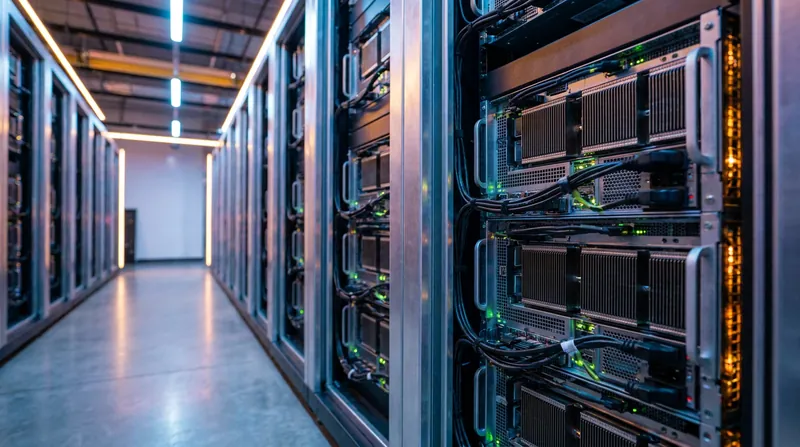
This is not merely a scaling problem; it is a fundamental physics and infrastructure collision. Traditional enterprise server racks draw between 10 and 15 kilowatts of power. In stark contrast, the latest AI-optimized racks, such as those housing next-generation GPU architectures, demand up to 140 kilowatts each.[3]
This extreme rack density translates directly to unprecedented facility-level demand. A standard data center built a decade ago might have required 20 megawatts of continuous power. Today, hyperscale AI campuses are being designed to draw between 300 megawatts and a full gigawatt—the equivalent power consumption of a mid-sized city.[3]
The public electrical grid was never designed to accommodate gigawatt-scale requests arriving simultaneously. In major data center hubs like Northern Virginia and Texas, regional grid operators are overwhelmed. The queue to secure a new high-voltage grid interconnection now stretches five to seven years.[1]
Data centers can be financed and built in a matter of months, but the grids meant to power them often take a decade or more to expand. This severe timing mismatch has made "time-to-firm-power" the most critical metric in the technology industry, forcing a radical strategic pivot among the world's largest companies.[1]
Rather than waiting in a half-decade queue for public grid access, hyperscalers are effectively becoming utility companies. They are bypassing the traditional grid entirely by directly funding and building their own dedicated power generation assets on-site.[1]
This pivot is inadvertently triggering a long-awaited renaissance in next-generation clean energy. Because AI workloads require 24/7 baseload power—a continuous profile that intermittent solar and wind cannot satisfy alone—technology giants are pouring billions into nuclear and geothermal energy.[1]
The most symbolic moment of this shift occurred when Microsoft signed a 20-year agreement to purchase all the power from a restarted nuclear reactor at Three Mile Island. Meanwhile, Amazon has acquired a nuclear-adjacent campus and invested heavily in Small Modular Reactors (SMRs), and Google has partnered with advanced geothermal startups to power its Nevada facilities.[1]
Morgan Stanley Research estimates that large technology companies will commit more than $1 trillion to energy infrastructure between 2025 and 2026. This massive influx of private capital is doing what decades of government subsidies struggled to achieve: commercializing advanced, firm, carbon-free energy technologies at scale.
However, the transition is not entirely green. The sheer urgency of AI deployment has also led to a surge in natural gas commitments. Meta recently locked in a 20-year natural gas supply deal for its southern US campuses, highlighting the tension between immediate power needs and long-term climate goals.[1]
Inside the data centers, the power crunch is forcing a complete redesign of cooling and efficiency metrics. The industry standard metric, Power Usage Effectiveness (PUE), is being replaced by a more holistic measure: "Tokens per Watt." This tracks how much actual AI computational output is generated per unit of energy consumed.[3]
To maximize Tokens per Watt, operators are abandoning traditional air cooling. The heat generated by 140-kilowatt racks physically cannot be moved by fans. Instead, direct-to-chip liquid cooling—where specialized fluids circulate directly over the GPUs—has become mandatory, reducing cooling energy overhead by up to 30%.[3]
The geopolitical implications of this energy reallocation are profound. AI deployment now depends as much on generation rights and sovereign energy policy as it does on software engineering. Regions that can deliver permitted, dispatchable power within a 24-month window are capturing the economic windfall of the AI boom.[1]
Ultimately, the AI power bottleneck is forcing a necessary reckoning for global energy infrastructure. While the short-term strain is immense, the long-term result is a massive, privately funded modernization of the grid and a rapid acceleration of next-generation nuclear and geothermal technologies that will eventually benefit the broader public.
Key points
- The primary bottleneck for AI expansion has shifted from GPU availability to electrical grid capacity.
- Global data center power demand is projected to surpass 1,000 terawatt-hours in 2026, driven by continuous inference workloads.
- With grid interconnection queues stretching up to seven years, tech giants are bypassing public utilities to build private energy campuses.
- Hyperscalers are projected to spend over $1 trillion by 2026, acting as a massive financial catalyst for next-generation nuclear and geothermal energy.
What we don’t know
- How regional grid operators will ultimately allocate the costs of massive transmission upgrades required by AI loads.
- Whether the supply chain for Small Modular Reactors (SMRs) can scale quickly enough to meet the tech industry's aggressive 2030 deployment targets.
- The long-term environmental impact of the temporary surge in natural gas usage as a stopgap before nuclear and geothermal projects come online.
How we got here
2021–2024
The primary bottleneck for AI expansion is the supply of advanced silicon, specifically NVIDIA GPUs and TSMC packaging capacity.
Late 2024
GPU supply begins to stabilize, but grid operators in major hubs like Virginia and Texas warn of capacity shortfalls.
2025
The shift to continuous AI inference at scale triggers a step-change in power density, pushing rack requirements past 100 kilowatts.
September 2025
Microsoft signs a landmark 20-year agreement to purchase power from a restarted nuclear reactor at Three Mile Island.
Mid-2026
Grid interconnection queues stretch to 5–7 years, forcing hyperscalers to commit over $1 trillion to private energy infrastructure.
- Hyperscale Cloud Providers
- Argue that securing independent, firm power generation is an existential requirement to maintain AI leadership amid grid delays.
- Energy Market Analysts
- Focus on the unprecedented capital flowing into nuclear and grid modernization, viewing AI as a catalyst for infrastructure renewal.
- Public Grid Operators
- Emphasize the need to protect grid stability and residential ratepayers from the massive, sudden load demands of gigawatt-scale campuses.
Perspectives this story doesn't cover
- Local communities hosting gigawatt campuses
- Environmental groups opposing natural gas stopgaps
Sources
Source coverage
3 outlets
3 viewpoints surfaced



- [1]ForbesHyperscale Cloud Providers
Retail As Critical Infrastructure In Finland’s AI-Era Defense Strategy
Read on Forbes → - [2]International Energy AgencyPublic Grid Operators
Electricity 2026: Global Data Center Demand Projections
Read on International Energy Agency → - [3]TechPlusTrendsHyperscale Cloud Providers
AI Data Center Power Requirements in 2026: The Complete Grid-to-Chip Guide
Read on TechPlusTrends →

More in Content Types
See all →Labor Market
The End of the Non-Compete: How the FTC's Pivot and State Laws Rewired the US Labor Market
3 sources

High Seas Treaty
The High Seas Treaty is Now Law: How the UN's New Agreement Will Govern Two-Thirds of the World's Oceans
3 sources

AI Architecture
How Large Language Models Actually Work: The Explainer
6 sources

Open-Source AI
How Meta's Llama 4 Works: Inside the Architecture Powering 2026's Open-Source AI Boom
5 sources
Comments
Every angle. Every day.
Get Content Types stories with full source coverage and perspective breakdowns, free every day.