
The Geopolitical Infrastructure Race: Analyzing the New AI Cold War
As artificial intelligence scales, the global competition has shifted from software algorithms to a physical race for data centers, energy grids, and cooling systems.
By Deniz Kaya

Share this story
In short
- Global investment in AI data centers is projected to reach $3 trillion between 2026 and 2030.
- The U.S. controls 74% of high-end compute capacity, but faces severe electrical grid bottlenecks.
- Up to 40% of the energy consumed by modern AI data centers is used entirely for cooling systems.
The defining geopolitical contest of 2026 is no longer being fought over software code or chatbot benchmarks. It is being waged with concrete, copper wire, and gigawatts of electricity. What began as a race to train the most advanced artificial intelligence models has rapidly transformed into a physical infrastructure boom of unprecedented scale, reshaping global supply chains and energy grids.[1]
To understand the stakes of this new era, one must look at the sheer volume of capital being deployed into the physical foundations of the internet. Analysts project that a staggering $3 trillion will be invested globally into AI data centers between 2026 and 2030. This represents a fundamental shift in the technology sector: artificial intelligence is no longer just a digital product; it has become a heavy industry requiring massive industrial mobilization.[1][3]
In 2026 alone, the world's largest technology companies—often referred to as hyperscalers—are expected to spend approximately $750 billion on capital expenditures related to AI infrastructure. This capital is not flowing into ethereal software, but into land acquisition, power generation, advanced cooling systems, and millions of specialized microchips.[1]
Currently, the United States holds a commanding lead in this physical arms race. American companies and their domestic facilities control an estimated 74% of the world's high-end AI compute capacity. This dominance is anchored by the mature capital markets and deep cloud ecosystems of Silicon Valley, giving the U.S. unparalleled leverage in the deployment of frontier AI systems.[1][2]
However, this overwhelming concentration of compute power is beginning to severely strain the American electrical grid. Projections indicate that U.S. data center power demand will more than double in a remarkably short period, climbing from 31 gigawatts in 2025 to 66 gigawatts by 2027. The physical reality of generating and transmitting that much electricity is becoming the primary bottleneck for further expansion.[1]
The consequences of this energy demand are already acute in places like Northern Virginia, which hosts the world's largest concentration of data centers. These facilities now account for roughly 40% of the state's total electricity consumption, leading to grid instability and rising utility costs that have sparked local political backlash.[2]
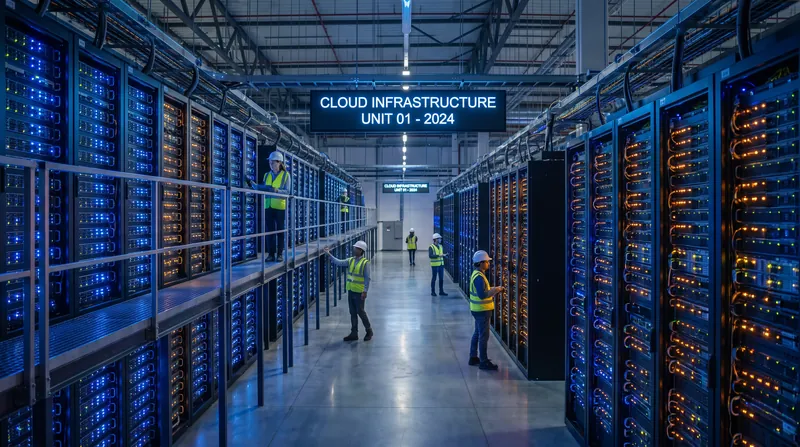
The fundamental challenge is that the bottleneck for artificial intelligence is no longer algorithmic—it is thermodynamic. Over the past five years, AI processors have become exponentially more powerful, but they also run exponentially hotter. A single modern graphics processing unit (GPU) can dissipate 700 watts of heat, creating a massive thermal management crisis when thousands are arrayed side-by-side.[1]
Consequently, keeping the machines from melting has become one of the most resource-intensive aspects of the AI economy. In modern AI data centers, between 35% and 40% of the total energy consumed goes directly to cooling systems rather than computation. This thermodynamic reality is forcing the industry to look beyond traditional tech hubs and seek out regions with abundant, uninterrupted power and favorable climates.[1]
This search for "compute geography" has elevated the Middle East into a critical swing state in the global infrastructure race. Gulf nations are leveraging their immense energy abundance, geographic positioning, and sovereign capital to attract hyperscale development. The region is increasingly viewed not as an edge market, but as a core hub for the next generation of digital infrastructure.[1][4]
In June 2026, the United Arab Emirates formally established the Artificial Intelligence and Data Authority, a move that signals a deliberate strategy to achieve computational sovereignty. The new authority unifies data management and AI strategy at the federal level, treating data centers as strategic national assets on par with oil terminals and naval bases.[4][5]
The scale of Middle Eastern ambition is visible on the ground. Emirati state-backed firms are pouring hundreds of thousands of cubic meters of concrete in Abu Dhabi to build data center campuses the size of small cities, utilizing American technology to deploy region-specific AI models. These greenfield developments allow Gulf states to master-plan digital ecosystems from the ground up, bypassing the legacy grid constraints that plague Western markets.[1]
Meanwhile, China is navigating this infrastructure race under the heavy burden of U.S. export controls, which restrict its access to the most advanced American microchips. In response, Beijing has integrated artificial intelligence into its 15th Five-Year Plan, focusing heavily on building an integrated national compute network and rapidly expanding its domestic semiconductor manufacturing capabilities.[1][2]
China is also countering American hardware dominance through strategic software releases. Chinese laboratories have aggressively published highly capable, open-source AI models—such as the GLM 5.2 system—that are designed to run efficiently on less advanced infrastructure. By making these models freely available, China aims to undercut the massive capital advantages of U.S. hyperscalers and commoditize the model layer of the AI stack.
Beyond the primary superpowers, a broader "Sovereign AI" movement is sweeping the globe as nations realize that relying entirely on foreign compute capacity is a critical strategic vulnerability. Governments across Europe and Asia are now racing to construct their own data centers and power solutions, operated strictly under domestic law.[1]
Japan, for instance, has committed over $65 billion in public support for domestic AI and semiconductor infrastructure through 2030, openly treating the initiative as a necessary catch-up sprint to secure its economic future. Similarly, European policymakers are framing compute capacity as a vital national asset, pushing aggressively for digital sovereignty to protect sensitive data from foreign tech giants.[1]
Ultimately, the next decade of artificial intelligence will not be determined solely by the researchers who write the smartest code, but by the engineers and policymakers who can successfully navigate the physical world. The winners of this new era will be those who can secure the real estate, generate the gigawatts, and cool the machines that will run the global economy.[1]
Definitions
- Hyperscaler
- A large-scale cloud service provider that operates massive networks of data centers to provide computing and storage services globally.
- Compute
- The physical processing power—driven by advanced microchips—required to train and run artificial intelligence models.
- Power Usage Effectiveness (PUE)
- A metric used to determine how energy-efficient a data center is, calculated by dividing the total amount of power entering the facility by the power used to run the IT equipment.
- Sovereign AI
- The strategy of a nation developing and controlling its own artificial intelligence infrastructure, models, and data within its borders.
- Liquid Cooling
- An advanced thermal management technique used in modern data centers where liquid coolants are circulated to absorb the immense heat generated by AI processors.
Questions & answers
What is Sovereign AI?
Sovereign AI refers to a nation's strategy of building and controlling its own artificial intelligence infrastructure, models, and data centers within its borders, rather than relying on foreign technology companies.
Why do AI data centers need so much power?
Modern AI microchips run extremely hot and require massive amounts of electricity both to process complex calculations and to power the advanced cooling systems needed to keep the hardware from melting.
How is the Middle East involved in the AI race?
Countries like the UAE and Saudi Arabia are leveraging their abundant energy grids and sovereign wealth to build massive AI infrastructure hubs, acting as a strategic bridge between Western and Eastern tech ecosystems.
Analysis by camp
U.S. Hyperscalers & Policymakers
Focusing on maintaining American compute dominance and securing domestic power grids while restricting adversary access.
This camp views the AI race as a zero-sum geopolitical contest where maintaining the current 74% market share of high-end compute is a matter of national security. They advocate for massive domestic infrastructure investment and strict export controls on advanced semiconductors to prevent rivals from catching up. However, they are increasingly concerned about the physical limitations of the U.S. electrical grid and the regulatory hurdles of building new power plants.
Sovereign AI Advocates
Prioritizing the construction of localized, state-backed compute clusters to avoid reliance on foreign tech monopolies.
Led by policymakers in Europe, Japan, and the Middle East, this perspective argues that compute capacity is a critical national asset, much like a water supply or highway system. They are deploying billions in public and sovereign wealth funds to build domestic data centers and train region-specific models. Their goal is to ensure that sensitive national data and critical economic infrastructure are not entirely dependent on American or Chinese corporations.
Open-Source Challengers
Leveraging highly efficient, freely available models to undercut the capital advantages of massive proprietary infrastructure.
This community, which includes major Chinese AI labs and global open-source developers, believes that the future of AI does not require trillion-dollar data centers. By releasing highly capable models that require significantly less compute to run, they aim to commoditize the model layer of the AI stack. For Chinese developers specifically, this strategy is a direct countermeasure to U.S. hardware export controls, proving that algorithmic efficiency can partially offset a lack of cutting-edge chips.
Energy & Infrastructure Providers
Viewing the AI boom primarily as a thermodynamic and grid-capacity challenge.
Utility companies, cooling engineers, and real estate developers are less concerned with which country builds the smartest chatbot and more focused on the physical realities of the buildout. They emphasize that the exponential heat generated by modern GPUs requires a complete redesign of data center architecture, pushing the industry toward liquid cooling and nuclear power partnerships. To this group, the AI race is fundamentally an energy race.
- U.S. Hyperscalers & Policymakers
- Focusing on maintaining American compute dominance and securing domestic power grids while restricting adversary access.
- Sovereign AI Advocates
- Prioritizing the construction of localized, state-backed compute clusters to avoid reliance on foreign tech monopolies.
- Open-Source Challengers
- Leveraging highly efficient, freely available models to undercut the capital advantages of massive proprietary infrastructure.
- Energy & Infrastructure Providers
- Viewing the AI boom primarily as a thermodynamic and grid-capacity challenge.
Perspectives this story doesn't cover
- Local communities near hyperscale sites
- Environmental conservation groups
Sources
Source coverage
5 outlets
4 viewpoints surfaced





- [1]Factlen Editorial TeamSovereign AI Advocates
Synthesis by Factlen editorial team
Read on Factlen Editorial Team → - [2]The Washington StandU.S. Hyperscalers & Policymakers
The New AI Cold War: Chips, Energy, and Computing Power
Read on The Washington Stand → - [3]Moody'sEnergy & Infrastructure Providers
Global AI Data Center Capital Expenditure Outlook 2026-2030
Read on Moody's → - [4]International Energy AgencyEnergy & Infrastructure Providers
Energy and AI Special Report: April 2025
Read on International Energy Agency → - [5]UAE CabinetSovereign AI Advocates
Establishment of the UAE Artificial Intelligence and Data Authority
Read on UAE Cabinet →
More in Opinion
See all →AI Governance
Is the US Regulatory Patchwork Stifling AI Innovation More Than the EU AI Act Ever Could?
8 sources

Appliance Engineering
Why Low-Duty Cycling on Induction Stovetops Causes Scorching Without Thermal Mass
4 sources

Automotive Engineering
How Positive Crankcase Ventilation Valves Regulate Blowby Gas Flow Across Shifting Engine Manifold Vacuums
4 sources

Atmospheric Optics
Fried's Atmospheric Coherence Length Limits Ground Telescopes to 20-Centimeter Aperture Resolution Regardless of Mirror Size
4 sources

Comments
Every angle. Every day.
Get Opinion stories with full source coverage and perspective breakdowns, free every day.