
The Evidence on 'Missing Middle' Housing: Does Zoning Reform Actually Lower Rents?
As cities across the globe face acute housing shortages, a growing body of empirical research reveals that large-scale 'upzoning' reforms successfully increase housing supply and moderate rent growth, though results depend heavily on market demand and policy design.
By Factlen Editorial Team
- Supply-Side Economists
- Argue that relaxing zoning restrictions to allow more construction is the primary mechanism for lowering housing costs.
- Housing Equity Advocates
- Emphasize that upzoning must be paired with affordability mandates and subsidies to prevent displacement of low-income residents.
- Property Rights Advocates
- Support missing middle reforms as a restoration of private property rights, allowing homeowners to build on their own land.
What's not represented
- · Local NIMBY homeowner associations
- · Construction trade unions
Why this matters
Housing costs are the single largest expense for most households. Understanding whether zoning reforms actually work empowers voters and local leaders to choose policies backed by data rather than ideology.
Key points
- Strict zoning laws have historically banned medium-density housing in many cities, contributing to severe supply shortages.
- Auckland's 2016 upzoning of 75% of its residential land led to a massive construction boom and significantly slower rent growth.
- Minneapolis eliminated single-family zoning and parking minimums, resulting in a 12% housing stock increase and only 1% rent growth over five years.
- Upzoning is most effective in high-demand areas; neighborhoods with weak housing markets see little new construction even when rules are relaxed.
- Evidence suggests that even market-rate construction helps stabilize overall housing costs by absorbing demand from higher-income renters.
For decades, the residential landscapes of North American and Australasian cities have been defined by a stark duopoly: sprawling neighborhoods of detached single-family homes on one extreme, and dense clusters of high-rise apartment towers on the other. This polarization is not a natural market outcome, but the result of stringent local land-use regulations that effectively outlawed anything in between.[4][6]
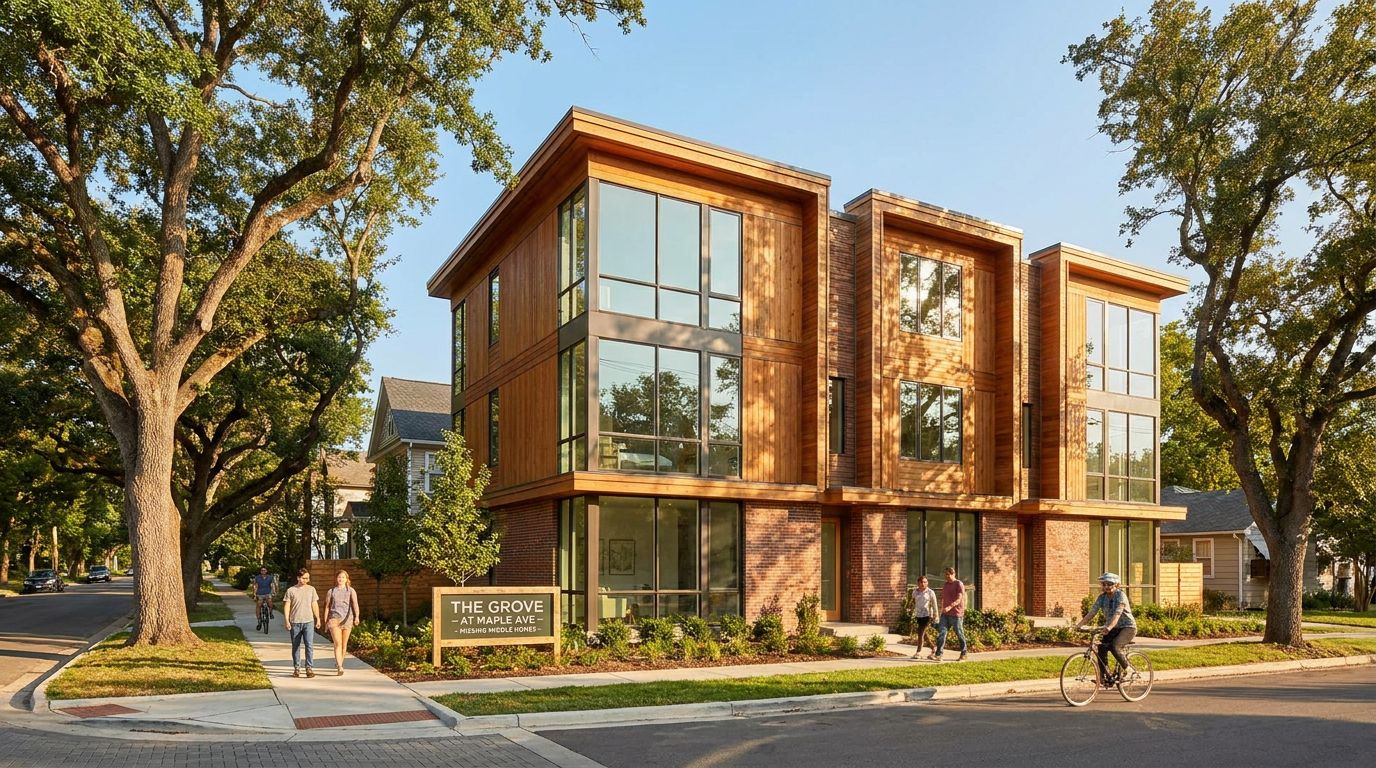
That "in-between" is what urban planners call the "missing middle"—a spectrum of medium-density housing that includes duplexes, triplexes, courtyard apartments, and townhomes. These structures blend seamlessly into traditional residential neighborhoods, offering a modest increase in density without the disruptive scale of a high-rise. For years, advocates have argued that legalizing these structures could alleviate the severe housing shortages driving up rents and home prices.[4][5]
The theory behind this reform, known as "upzoning," is straightforward. If local governments remove caps on the number of homes a developer can build on a single parcel of land, the private market will respond by building more units. A larger housing supply should, in turn, better accommodate population growth and eventually translate to lower, or at least stabilized, housing costs. Until recently, however, this remained largely theoretical.[3][6]
That changed in 2016 when Auckland, New Zealand, launched one of the most sweeping zoning experiments in modern history. Facing a severe housing deficit driven by rapid population growth, the city implemented the Auckland Unitary Plan, which abruptly upzoned approximately 75 percent of its residential land. Overnight, areas previously restricted to single-family homes were opened up to medium- and high-density development.[2]
The empirical results from Auckland have provided urban economists with a robust case study. Researchers at the University of Auckland utilized state-of-the-art econometric models to isolate the effects of the policy, finding a massive surge in construction. Over a five-year period, the city permitted an estimated 21,000 additional dwellings that would not have existed under the old zoning rules, representing a roughly 4 percent increase in the city's total housing stock.[2]

Crucially, this influx of supply had a measurable impact on affordability. While rents in Auckland did not plummet in absolute terms, their growth decelerated dramatically compared to the rest of the country. Between 2016 and 2023, Auckland rents rose by approximately 20 percent, significantly lower than the average increases seen in other major New Zealand cities. Some synthetic control models suggest that without the upzoning, Auckland's rents would have been 28 to 35 percent higher.[2]
Crucially, this influx of supply had a measurable impact on affordability.
A similar success story has unfolded in the American Midwest. In 2018, Minneapolis made national headlines by passing its 2040 Plan, becoming the first major U.S. city to eliminate single-family zoning entirely. The city allowed duplexes and triplexes on all residential lots, eliminated minimum parking requirements for new developments, and permitted larger apartment buildings along commercial and transit corridors.[1]
Data compiled by The Pew Charitable Trusts reveals the profound impact of these changes. From 2017 to 2022, Minneapolis expanded its housing stock by 12 percent. Over that same five-year window, rents in the city grew by a mere 1 percent. By contrast, the rest of Minnesota added only 4 percent to its housing stock, and rents statewide surged by 14 percent. Minneapolis managed to absorb a growing population while effectively freezing rent hikes.[1]

The downstream social benefits of this stabilized housing market have been equally significant. While homelessness rose by 14 percent across the rest of Minnesota during that five-year period, it dropped by 12 percent in Hennepin County, which encompasses Minneapolis. By ensuring a steady pipeline of new apartments, the city reduced displacement risk and preserved affordability for its most vulnerable residents.[1]
However, the evidence also highlights a critical caveat: upzoning is not a magic wand that works equally well in all environments. A comprehensive review by the Urban Institute examined major zoning overhauls in New York City and Philadelphia, finding that the success of upzoning is highly dependent on underlying market demand.[3]
In Philadelphia, a citywide zoning rewrite helped generate up to 4,000 additional housing unit permits per year. Yet, researchers noted that neighborhoods with weak housing markets—those with low pre-existing rents and little developer interest—saw almost no new construction despite the relaxed rules. Upzoning removes the legal barrier to building, but it does not alter the fundamental financial math of construction costs versus expected rental income.[3]
This reality feeds into a persistent debate among housing advocates. Skeptics of upzoning argue that relaxing regulations simply increases the speculative value of land, enriching property owners while resulting in the construction of expensive, market-rate luxury units rather than deeply affordable housing. They caution that without accompanying subsidies or affordability mandates, the "missing middle" will remain out of reach for low-income earners.[4]

Yet, empirical evidence increasingly supports the concept of "filtering." Even when new construction is priced at market rates, it absorbs the demand from higher-income renters who might otherwise bid up the prices of older, existing homes. By building new supply at the top and middle of the market, cities relieve price pressure across the entire housing spectrum, preventing the displacement that occurs when wealthy residents compete for scarce older housing.[1][3]
Ultimately, the data from Auckland, Minneapolis, and beyond points to a clear consensus: while zoning reform alone cannot solve every facet of the housing crisis, it is an indispensable prerequisite. Restoring the "missing middle" empowers cities to grow organically, offering a data-backed blueprint for stabilizing rents and building more inclusive communities.[1][2][6]
How we got here
2016
Auckland passes the Unitary Plan, upzoning approximately 75 percent of its residential land.
2018
Minneapolis passes the 2040 Plan, becoming the first major U.S. city to eliminate single-family zoning.
2021
California passes S.B. 9, allowing duplexes and lot splits on most single-family parcels statewide.
2023
Auckland census data reveals that housing supply has outstripped population growth for the first time in a generation.
Viewpoints in depth
Supply-Side Economists
Argue that relaxing zoning restrictions to allow more construction is the primary mechanism for lowering housing costs.
This camp, supported by research from institutions like the Urban Institute and The Pew Charitable Trusts, views the housing crisis fundamentally as a math problem: population growth has outpaced home construction. They argue that restrictive zoning laws act as an artificial cap on supply. By removing these barriers, the private market can build enough units to meet demand, which naturally stabilizes or lowers prices through competition. They point to the empirical successes in Auckland and Minneapolis as proof that supply-side interventions work.
Housing Equity Advocates
Emphasize that upzoning must be paired with affordability mandates and subsidies to prevent displacement of low-income residents.
While many in this camp support the concept of the missing middle, they caution that the free market alone will not build housing for the lowest-income brackets. They argue that upzoning often increases land values, which can incentivize developers to demolish older, naturally affordable housing to build luxury townhomes. To prevent gentrification and displacement, these advocates push for policies like inclusionary zoning—which requires a percentage of new units to be rented below market rate—and robust government subsidies for non-profit housing developers.
Property Rights Advocates
Support missing middle reforms as a restoration of private property rights, allowing homeowners to build on their own land.
This perspective approaches zoning reform from a libertarian or free-market angle. Organizations like the Reason Foundation argue that single-family zoning is an egregious government overreach that dictates what individuals can do with their own property. They champion missing middle policies, such as the legalization of Accessory Dwelling Units (ADUs) and duplexes, as a way to restore property rights, allowing homeowners to build wealth and adapt their properties to changing family needs without government interference.
What we don't know
- Whether upzoning alone can produce deeply affordable housing for the lowest-income brackets without additional government subsidies.
- The exact timeline required for new market-rate construction to 'filter down' and lower rents in older buildings.
- How long-term shifts in remote work and interest rates will interact with local zoning reforms over the next decade.
Key terms
- Upzoning
- The process of changing local zoning codes to allow for higher-density development, such as permitting apartment buildings in areas previously restricted to single-family homes.
- Missing Middle
- A range of multi-unit or clustered housing types compatible in scale with single-family homes that help meet the growing demand for walkable urban living.
- Filtering
- An economic process where the construction of new, often higher-priced housing frees up older, existing housing stock for lower-income residents as wealthier tenants move into the new units.
- Counterfactual
- In economic research, an estimate of what would have happened in a specific scenario if a policy change (like upzoning) had never been implemented.
Frequently asked
What exactly is 'missing middle' housing?
It refers to medium-density housing types—like duplexes, triplexes, townhomes, and courtyard apartments—that fall between single-family homes and high-rise towers in scale.
Does upzoning lower property values for existing homeowners?
Generally, no. Research indicates that upzoning often increases the value of underlying land because the parcel can now legally accommodate more units, making it more valuable to developers.
Why doesn't upzoning work in every neighborhood?
Upzoning only removes legal barriers to construction. In neighborhoods with weak housing markets and low demand, developers still won't build because the cost of construction exceeds the potential rental income.
Sources
Source coverage
6 outlets
3 viewpoints surfaced






[1]The Pew Charitable TrustsSupply-Side Economists
Minneapolis Land Use Reforms Offer a Blueprint for Housing Affordability
Read on The Pew Charitable Trusts →[2]University of AucklandSupply-Side Economists
Evidence from Auckland's zoning reform
Read on University of Auckland →[3]Urban InstituteSupply-Side Economists
An Examination of Recent Regulatory Reforms on Construction and Permitting in New York City and Philadelphia
Read on Urban Institute →[4]University of Toronto School of CitiesHousing Equity Advocates
Enabling the Missing Middle: Definitions, evidence, barriers and promising practices
Read on University of Toronto School of Cities →[5]Reason FoundationProperty Rights Advocates
Missing middle housing policies balance interests while addressing the affordable housing crisis
Read on Reason Foundation →[6]Factlen Editorial Team
Synthesis by Factlen editorial team
Read on Factlen Editorial Team →
More in real estate
See all 44 stories →iBuyer Market
Selling to an iBuyer vs. a Traditional Agent: Which Strategy Fits You Best?
8 sources

Fractional Ownership
How Fractional Real Estate is Dismantling the Housing Market's Capital Walls
8 sources

Adaptive Reuse
The Evidence Pack: How Empty Offices Are Solving the Housing Crisis
8 sources

Office Conversions
The Evidence Pack: How Empty Offices Are Becoming Affordable Housing in 2026
8 sources
Every angle. Every day.
Get real estate stories with full source coverage and perspective breakdowns delivered to your inbox.