
The European Sleeper Train Renaissance: How Night Rail is Replacing Short-Haul Flights
Driven by climate consciousness and massive new investments, European sleeper trains are experiencing a golden age in 2026 with next-generation cabins and rapidly expanding routes.
By Factlen Editorial Team
- Eco-Conscious Travelers
- Prioritizing sustainability and slow travel over sheer speed.
- Rail Operators & Startups
- Viewing the night train revival as a lucrative but capital-intensive market.
- Infrastructure Critics
- Highlighting the logistical and bureaucratic hurdles holding the network back.
What's not represented
- · Budget Airlines
- · Working-class travelers priced out of premium sleeper cabins
Why this matters
For travelers, the revival of overnight rail offers a practical, highly comfortable way to cross Europe while saving a night's hotel cost and drastically reducing their carbon footprint.
Key points
- European sleeper trains are experiencing a massive revival driven by climate consciousness and a desire for slow travel.
- Austrian operator ÖBB is investing €500 million in 33 next-generation trains featuring private en-suite cabins and solo sleeping pods.
- Private cooperative European Sleeper launched a new Paris-Berlin route in March 2026 and will open a Brussels-Milan route in September.
- Night trains emit roughly one-sixth of the carbon dioxide per kilometer compared to short-haul flights.
- Travelers save the cost of a hotel night and avoid the transit times and security lines associated with airports.
- High track access charges and fragmented national booking systems remain the biggest hurdles to further expansion.
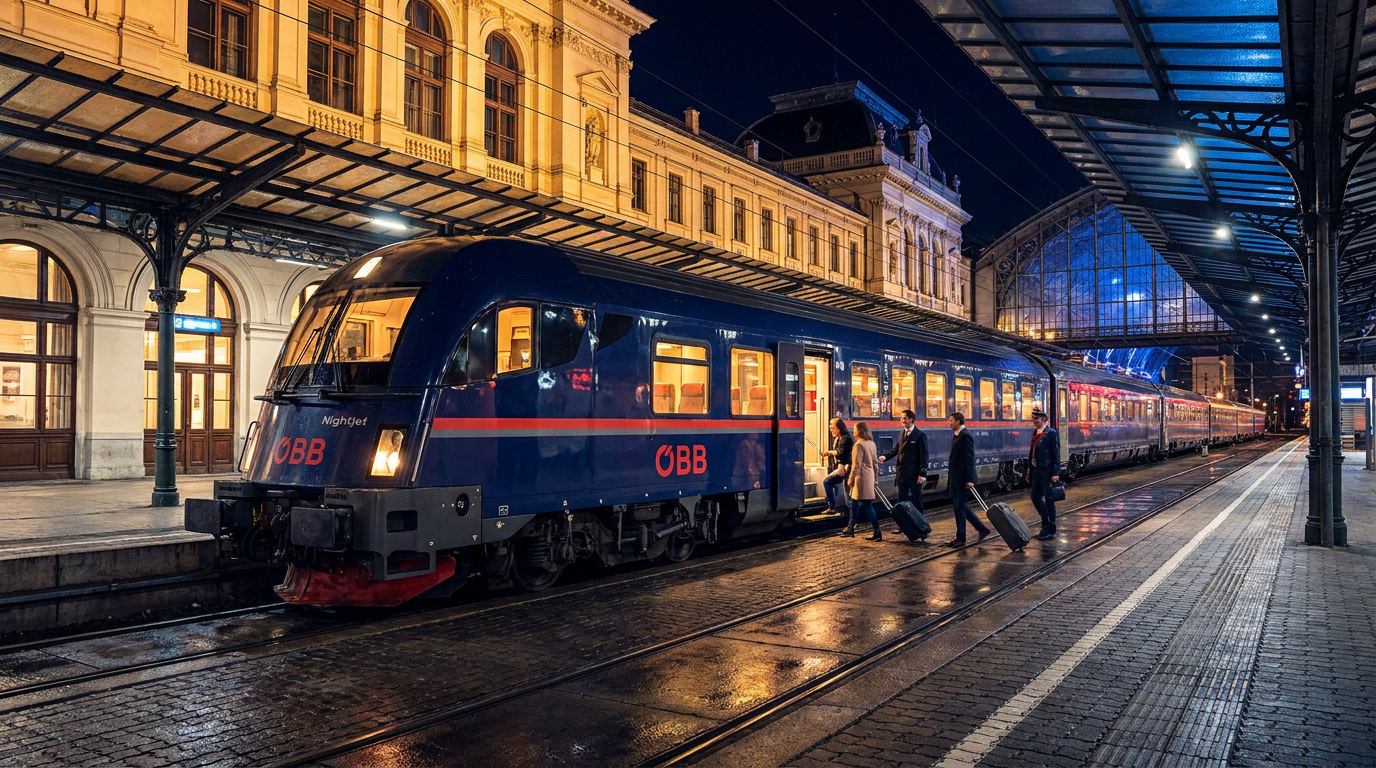
It is 11:00 p.m. at Bologna Centrale, and the platform is buzzing with a distinct kind of traveler. There are no frantic security lines, no restrictive liquid limits, and no chaotic boarding group scrambles. Instead, passengers armed with neck pillows and rolling suitcases are calmly waiting for their hotel to arrive on steel wheels. When the Austrian Federal Railways (ÖBB) Nightjet pulls into the station, the sleepy platform leaps into action. Luggage is hoisted aboard, cabin doors click shut, and within minutes, the train glides into the dark, bound for Vienna while its occupants prepare for a full night's sleep.[1]
Less than a decade ago, this tranquil scene seemed destined for the history books. Across Europe, national rail operators had spent the early 2000s quietly retiring their sleeper cars, convinced the model was dead. They found themselves unable to compete with the rock-bottom fares and rapid transit times offered by budget airlines like Ryanair and EasyJet. The concept of a "hotel on rails" was widely dismissed by transport executives as a romantic but financially unviable relic of a bygone era, too expensive to maintain and too slow for the modern traveler.[1][2]
Today, however, the European night train is experiencing a massive, multi-billion-euro renaissance that is reshaping continental travel. Driven by a sudden surge in climate consciousness, heavy state and private investment, and a post-pandemic desire for "slow travel," overnight rail networks are expanding at a pace unseen since the mid-20th century. In 2026, the continent is more connected by night than it has been in a generation, with operators struggling to keep up with a public hungry for an alternative to the miseries of modern air travel.[2][5]
The primary catalyst for this dramatic revival is environmental. As climate anxiety fundamentally reshapes consumer habits, particularly among younger demographics, the carbon math of short-haul flights has become increasingly difficult to justify. According to data from the International Energy Agency, a passenger on a European train emits roughly 22 grams of CO2 equivalent per kilometer traveled. In stark contrast, a passenger on a short-haul flight emits nearly six times that amount, making aviation one of the most carbon-intensive choices a traveler can make.[3]

This stark environmental contrast gave rise to the Swedish concept of flygskam, or "flight shame," which began actively pushing eco-conscious travelers away from airports and toward the rails. The shift in consumer behavior has been nothing short of dramatic: major ticketing platforms like Trainline have reported that overnight train bookings have surged by nearly 150% compared to pre-pandemic levels. For many modern tourists, swapping a cramped, carbon-heavy flight for a scenic, low-emission train ride has evolved from a niche preference into a definitive lifestyle statement.[2]
But environmental guilt alone could not sustain a continental rail revolution; the product itself had to fundamentally improve. Enter ÖBB, the Austrian state railway that made a contrarian, highly lucrative gamble when others were retreating in defeat. When Germany's Deutsche Bahn abandoned its sleeper network entirely, ÖBB swooped in, bought up the discarded carriages at a discount, refurbished them, and launched the Nightjet brand, proving that a market for overnight travel still existed if managed correctly and marketed to the right demographic of comfort-seeking travelers.[1][2]
That initial gamble paid off so handsomely that ÖBB is now in the midst of rolling out a staggering €500 million fleet of 33 next-generation, seven-car trains built by Siemens. These new Nightjets, which began entering service in late 2023 and are rapidly expanding across premium routes like Zurich-Vienna in mid-2026, look absolutely nothing like the cramped, utilitarian couchettes of the 1990s. They represent a complete reimagining of what overnight rail travel can feel like. The investment signals a long-term commitment to rail as the premier mode of cross-border transport.[2][6]
The new carriages are meticulously designed to rival modern boutique hotels. Premium sleeper cabins now feature en-suite bathrooms with private showers, digital thermostats, and secure keycard entry. For solo travelers on a budget, ÖBB introduced "Mini Cabins"—innovative, Japanese-style sleeping pods that offer a private, lockable space, complete with wireless charging, reading lights, and a sliding door, providing total privacy without the exorbitant cost of booking a full multi-bed compartment. These pods have become wildly popular among backpackers and business travelers alike, frequently selling out months in advance.[5][6]

The new carriages are meticulously designed to rival modern boutique hotels.
While state-backed operators like ÖBB provide the heavy infrastructure and backbone of the network, nimble private startups are aggressively pushing the expansion into new territories. The most prominent of these challengers is European Sleeper, a Belgian-Dutch cooperative that launched in 2023 with a highly successful route connecting Brussels, Amsterdam, Berlin, and Prague. Operating without permanent state subsidies, the cooperative relies on community funding and a passionate customer base to prove that independent rail can thrive. Their success has inspired a wave of new entrants eager to capture a slice of the booming market.[5][8]
In 2026, European Sleeper is aggressively scaling its operations to fill critical gaps left by national carriers. In March 2026, the cooperative launched a highly anticipated Paris-Brussels-Berlin route, running three nights a week. This new service provides a direct, comfortable link between the French and German capitals—a vital economic and cultural corridor that had previously been plagued by cancellations and inconsistent service from traditional state operators. The route's immediate popularity underscores the massive pent-up demand for seamless cross-border connections that bypass congested airports.[4][5][7]
The startup's ambitions extend even further south. On September 9, 2026, European Sleeper will inaugurate a brand-new north-south corridor linking Brussels directly to Milan, routing through Cologne and the Swiss Alps. By December 2026, this ambitious route will expand to include stops in the Dutch cities of Antwerp, Breda, and Eindhoven, officially restoring a direct overnight connection between the Netherlands and northern Italy that has been entirely absent for several years. This expansion effectively creates a new artery for European tourism, linking the low countries to the Mediterranean overnight.[4]

The economic appeal of these expanding routes goes far beyond the baseline ticket price. While a €29 budget seat or a €159 private sleeper might seem roughly comparable to a budget airline fare when booked in advance, the night train fundamentally alters the traveler's financial equation. Passengers save the entire cost of a night's hotel accommodation, which in cities like Paris or Milan can easily exceed the price of the premium train ticket itself. Furthermore, they avoid the hidden costs of aviation, such as exorbitant baggage fees and expensive airport express trains.[5]
"You board in one city center in the evening, sleep, and step off in another city center at breakfast," notes one travel industry analyst. For routes spanning over 400 kilometers, the time saved by traveling while unconscious makes the night train a highly efficient logistical choice, not just a romantic novelty. Travelers reclaim a full day of their itinerary that would otherwise be entirely lost to airport transit, security lines, and baggage claims. This efficiency is particularly attractive to families with young children, who find the freedom to move around a train carriage vastly superior to being strapped into an airplane seat.[5]
Despite the undeniable momentum, the sleeper train renaissance still faces significant structural and political hurdles. Europe's rail network remains a fragmented patchwork of national systems, each operating with its own distinct track gauges, signaling technologies, and bureaucratic fiefdoms. Launching a single international route requires negotiating track access and scheduling with multiple state-owned infrastructure managers, a complex legal and logistical process that can easily take years to finalize. These bottlenecks frequently delay new routes and force operators to build excessive buffer times into their overnight schedules.[3][4]
Furthermore, the rail industry still lacks a unified, user-friendly booking platform. While the aviation sector benefits from seamless global distribution systems that allow travelers to book complex multi-airline itineraries in seconds, booking a cross-border train trip remains stubbornly difficult. It often requires navigating several different national railway websites, each utilizing its own opaque pricing logic, language barriers, and distinct ticket release schedules, frustrating consumers accustomed to one-click booking. Independent platforms are attempting to bridge this gap, but the lack of shared data between national carriers remains a glaring weakness.[3][6]

There is also the persistent, structural challenge of track access charges. Unlike commercial airlines, which benefit from decades-old treaties that exempt aviation fuel from taxation, rail operators must pay hefty, per-kilometer tolls to use national rail infrastructure. Startups and environmental advocates are heavily lobbying the European Union to reduce or eliminate these track fees for night trains, arguing that it is the only way to truly level the playing field against heavily subsidized budget airlines. Until these fees are reformed, sleeper trains will likely remain a slightly premium product rather than a universal budget option.[3]
Yet, despite these challenges, the political winds are blowing firmly in the railways' favor. The European Union has set an ambitious, legally binding target to double high-speed and overnight rail traffic by 2030 as a core pillar of its mandate to drastically cut transport emissions. Several member states, including France, have already instituted outright bans on short-haul domestic flights where a viable rail alternative of under two and a half hours exists. This regulatory pressure ensures that state investment in rail infrastructure will only accelerate in the coming decade.[2][5]
As the 2026 summer travel season approaches, the demand for sleeper berths is vastly outpacing the available supply, with popular routes selling out months in advance. For a rapidly growing demographic of travelers, the journey itself is no longer an obstacle to be minimized, but a restorative, sustainable, and highly anticipated part of the holiday. The golden age of the European sleeper train may not be in the past; it might just be arriving at the platform. With new routes launching every few months and next-generation trains redefining comfort, the future of European transit is looking distinctly nocturnal.[1][5]
How we got here
Early 2000s
National rail operators steadily retire sleeper cars due to budget airline competition.
2016
Austrian railway ÖBB buys discarded German sleeper cars and launches the Nightjet brand.
2023
European Sleeper launches its first route; ÖBB introduces its next-generation Siemens trains.
March 2026
European Sleeper inaugurates the highly anticipated Paris-Brussels-Berlin route.
September 2026
A new north-south corridor linking Brussels to Milan is scheduled to launch.
Viewpoints in depth
Eco-Conscious Travelers
Prioritizing sustainability and slow travel over sheer speed.
For this demographic, the journey is no longer just a means to an end, but a statement of environmental responsibility. Driven by the 'flight shame' movement, these travelers are willing to spend more time—and sometimes more money—to avoid the heavy carbon footprint of short-haul aviation. They view the night train not as an inconvenience, but as a restorative, scenic, and highly ethical way to experience the European continent.
Rail Operators & Startups
Viewing the night train revival as a lucrative but capital-intensive market.
Operators like ÖBB and European Sleeper see massive untapped potential in overnight rail, but they are acutely aware of the financial risks. Building a modern sleeper fleet requires hundreds of millions of euros in upfront capital, and operating cross-border routes involves navigating a maze of track fees and national bureaucracies. They argue that for the renaissance to truly succeed, the European Union must step in to standardize track access charges and reduce the structural advantages currently enjoyed by budget airlines.
Infrastructure Critics
Highlighting the logistical and bureaucratic hurdles holding the network back.
While supportive of the environmental goals, rail experts and infrastructure critics point out that Europe's rail network remains deeply fragmented. They argue that the lack of a unified booking platform, inconsistent track gauges, and the high tolls charged by national infrastructure managers make cross-border rail travel unnecessarily difficult and expensive. Until these systemic issues are resolved, they warn that sleeper trains will remain a premium niche rather than a universal replacement for budget flights.
What we don't know
- Whether the European Union will successfully mandate a unified, cross-border ticketing platform for all rail operators.
- If national governments will agree to lower track access charges to make night trains more competitive with budget airlines.
Key terms
- Couchette
- A basic sleeping compartment on a train, typically featuring four to six bunk beds and shared washroom facilities.
- Track Access Charges
- Tolls paid by train operators to national infrastructure managers for the right to run trains on their rails.
- Flygskam
- A Swedish term translating to 'flight shame,' referring to the cultural movement of avoiding air travel due to its high carbon emissions.
- Mini Cabin
- A modern, capsule-style solo sleeping pod introduced on next-generation European night trains to provide affordable privacy.
Frequently asked
What is a Mini Cabin on a sleeper train?
A Mini Cabin is a modern, Japanese-style solo sleeping pod introduced by ÖBB. It offers a private, lockable space with wireless charging and reading lights for solo travelers on a budget.
How much do European sleeper trains cost?
Prices vary widely by route and comfort level, typically starting around €30 for a basic seat, €50 for a shared couchette bunk, and up to €150 or more for a private premium sleeper cabin.
Are sleeper trains actually better for the environment?
Yes. A passenger on a European train emits roughly 22 grams of CO2 equivalent per kilometer, which is nearly six times less than the emissions of a passenger on a short-haul flight.
Do Eurail passes work on sleeper trains?
Yes, Eurail passes are generally accepted on major sleeper networks like Nightjet and European Sleeper, but passengers must still pay a supplementary reservation fee for their bed or seat.
Sources
Source coverage
8 outlets
3 viewpoints surfaced








[1]CBC NewsInfrastructure Critics
Night train renaissance: For a greener trip, Europe's rolling back to the past
Read on CBC News →[2]VOA NewsEco-Conscious Travelers
Europeans Shunning Airplanes for Overnight Trains
Read on VOA News →[3]DW NewsEco-Conscious Travelers
How about going to sleep in Berlin and waking up in Vienna!
Read on DW News →[4]Railway ProRail Operators & Startups
European Sleeper Milan night train to add Dutch cities
Read on Railway Pro →[5]GoPaxoRail Operators & Startups
The comeback of night trains in Europe (2026 routes & booking guide)
Read on GoPaxo →[6]The Man in Seat 61Infrastructure Critics
Nightjet, the New Generation
Read on The Man in Seat 61 →[7]Time OutInfrastructure Critics
The best European sleeper trains to ride in 2026
Read on Time Out →[8]TravelPulseRail Operators & Startups
European Sleeper's goal is to become one of the most recognizable faces of the European night train renaissance
Read on TravelPulse →

Every angle. Every day.
Get lifestyle stories with full source coverage and perspective breakdowns delivered to your inbox.