
The Era of Disposable Smartphones Ends as Right-to-Repair Mandates Take Global Effect
Sweeping new regulations in the European Union are forcing smartphone manufacturers to provide seven years of spare parts, five years of software updates, and user-replaceable batteries. The rules, which take full effect between 2026 and 2027, are driving a global redesign of consumer electronics.
By Factlen Editorial Team
- Consumer Advocates
- Championing the end of planned obsolescence and emphasizing cost savings and environmental benefits.
- Device Manufacturers
- Adapting to the new compliance landscape while redesigning hardware to balance modularity with premium features.
- Legal & Regulatory Experts
- Focusing on the compliance deadlines, warranty extensions, and the specific legal obligations for spare parts.
What's not represented
- · Independent Repair Shop Owners
- · E-waste Recycling Facilities
Why this matters
For the first time in a decade, consumers will be able to easily and affordably replace their smartphone batteries and screens without relying on expensive official repair centers. This shift will save the average user hundreds of dollars and significantly extend the lifespan of their devices.
Key points
- EU member states must transpose the Right to Repair Directive into national law by July 31, 2026.
- Manufacturers must provide spare parts for at least seven years after a model is discontinued.
- Smartphones are now required to receive free operating system and security updates for five years.
- Consumers who choose to repair a device under warranty receive an automatic 12-month warranty extension.
- By February 2027, all smartphones must feature batteries that users can replace with common tools.
- Software locks designed to block third-party parts or independent repairs are strictly prohibited.
The era of the disposable smartphone is officially drawing to a close. For over a decade, consumers have accepted a frustrating cycle: after two or three years, a device's battery degrades, software updates cease, and the cost of professional repair rivals the price of a brand-new phone. But as of mid-2026, the global smartphone industry is undergoing its most radical architectural redesign since the introduction of the touchscreen, driven by a wave of consumer protection laws that prioritize longevity over planned obsolescence.[1][2]
The primary catalyst for this shift is the European Union’s Right to Repair Directive, a landmark piece of legislation that member states are required to transpose into national law by July 31, 2026. The directive fundamentally rewrites the relationship between tech giants and consumers, mandating that manufacturers offer repairs at reasonable prices and within a reasonable timeframe, even after original warranties have expired.[3][7]
To incentivize consumers to fix their devices rather than discard them, the new legal framework introduces a compelling economic lever. If a user chooses to repair a defective product during its legal guarantee period instead of demanding a full replacement, the manufacturer must automatically extend the device's warranty by an additional 12 months. This shifts the financial math for major brands, making durable, easy-to-repair hardware a business necessity rather than an afterthought.[5][7]
While the July 2026 deadline cements the broader repair ecosystem, strict hardware requirements are already reshaping the devices hitting store shelves today. Under the EU's Ecodesign regulation, which went live in June 2025, smartphone manufacturers are now legally obligated to keep essential spare parts—including batteries, displays, and charging ports—available to consumers for a minimum of seven years after a specific model is discontinued. If a user buys a flagship phone in 2026, replacement components must remain accessible well into the 2030s.[2][6]

Hardware longevity is only half the battle; a phone is useless if its software becomes insecure or obsolete. To address this, the Ecodesign rules also mandate that every smartphone sold in the EU must receive free operating system and security updates for at least five years. For premium devices, long-term support has become increasingly common, but this regulation forces budget and mid-range handsets—which previously topped out at two or three years of support—to meet the same rigorous standard.[2]
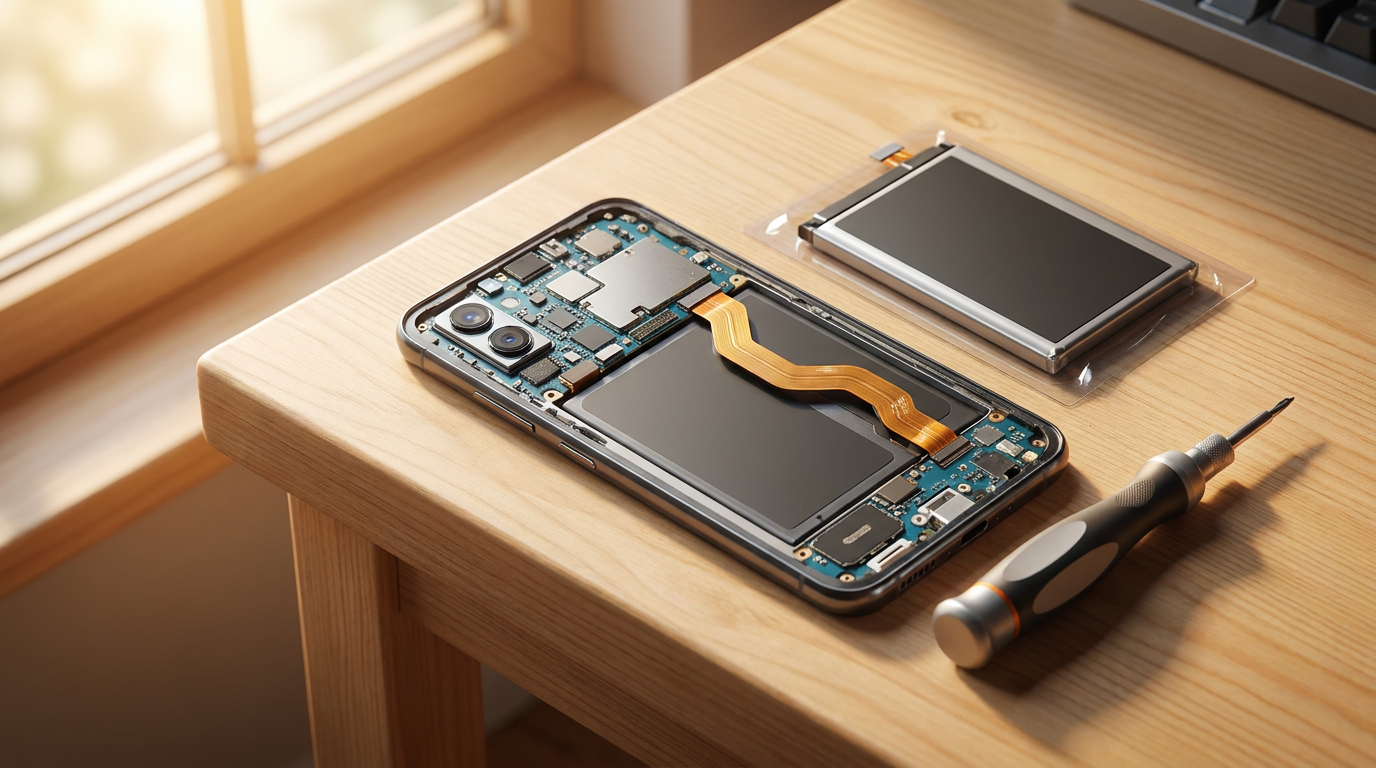
The most anticipated—and heavily debated—change is still on the horizon. Starting in February 2027, the EU Battery Regulation will require all portable electronics, including smartphones and tablets, to feature batteries that end-users can remove and replace using commonly available tools. This effectively bans the industry-standard practice of sealing batteries behind layers of industrial adhesive that require heat guns and specialized solvents to bypass.[1][2]
The most anticipated—and heavily debated—change is still on the horizon.
However, industry analysts are quick to dispel the myth that this mandate will drag smartphone design back to the early 2010s. Consumers should not expect a return to flimsy, snap-off plastic back covers that compromise a device's structural integrity. Instead, manufacturers are developing sophisticated modular architectures that utilize internal clips, pull-tabs, and easily removable screws. These modern designs allow devices to maintain their premium glass-and-metal aesthetics, slim silhouettes, and crucial water-resistance ratings while remaining accessible to a layman with a standard screwdriver.[1][2]
Furthermore, the legislation explicitly prohibits the controversial practice of parts pairing—using software locks to reject third-party components or independent repairs. Historically, some manufacturers programmed their devices to disable features like biometric sensors or battery health indicators if the phone detected a replacement part that wasn't installed by an authorized technician. Under the new rules, these artificial software barriers are strictly forbidden unless justified by legitimate, objective security factors.[3][5][6]

While these sweeping regulations are technically confined to the European market, their impact is undeniably global. The sheer scale and complexity of modern smartphone manufacturing mean that it is economically unviable for tech giants to design, produce, and support two entirely different hardware architectures—one modular design for Europe and a sealed, disposable design for the rest of the world. Consequently, consumers in North America, Asia, and beyond are poised to inherit these repair-friendly devices by default.[1]
The momentum for repairability is also surging outside of Europe. In the United States, the right-to-repair movement has evolved from grassroots advocacy into binding state law. By 2026, five US states—including New York, California, Minnesota, Oregon, and Colorado—have enacted broad consumer electronics repair laws. These state-level victories require manufacturers to provide parts, tools, and repair documentation to both device owners and independent repair shops, creating a patchwork of regulations that further pressures the industry to adopt universal repair standards.[3]
The environmental implications of this industry-wide pivot are staggering. The average consumer currently replaces their smartphone every 2.5 years, with battery degradation cited as the primary catalyst for the upgrade. By empowering users to easily swap a failing battery for a fraction of the cost of a new device, regulators aim to extend the average smartphone lifecycle to four or five years. This extension will drastically reduce the millions of tons of electronic waste generated annually and significantly lower the carbon footprint associated with mining rare earth metals for new devices.[2][6]

The corporate response has been a fascinating study in market adaptation. Companies that spent millions lobbying against right-to-repair legislation just a few years ago are now actively embracing the shift. As the 2026 and 2027 smartphone lineups are finalized, major brands are pivoting their marketing strategies, advertising repairability, modularity, and decade-long lifespans as premium features rather than regulatory burdens.[3][4]
Ultimately, the enforcement of the Right to Repair Directive marks a profound maturation of the mobile technology landscape. After years of prioritizing razor-thin designs and forced upgrade cycles, the industry is being steered toward a more sustainable, consumer-friendly future. For everyday users, the result is clear: smartphones will cost less to maintain, last significantly longer, and remain firmly in the owner's control long after the initial purchase.[2][7]
How we got here
July 2023
The EU Batteries Regulation is officially published, setting the stage for user-replaceable batteries.
June 2025
The EU Ecodesign regulation goes live, mandating seven years of spare parts and five years of software updates.
July 2026
Deadline for all EU member states to transpose the Right to Repair Directive into national law.
February 2027
The mandate requiring all portable electronics to feature user-replaceable batteries takes full effect.
Viewpoints in depth
Consumer Advocates
Advocates view the regulations as a long-overdue victory against planned obsolescence.
Organizations championing the right to repair argue that sealing batteries behind industrial adhesive was always an anti-consumer tactic designed to force premature upgrades. By legally mandating access to parts, tools, and repair manuals, advocates believe consumers will save billions of dollars collectively while drastically reducing the environmental devastation caused by electronic waste.
Device Manufacturers
Manufacturers are focused on balancing modularity with premium consumer expectations.
While tech giants initially resisted these mandates, their focus has shifted to engineering solutions that comply with the law without sacrificing device quality. Manufacturers point out that building a phone that is both easy to open and highly water-resistant requires complex, expensive internal redesigns. They emphasize that the transition involves moving away from chemical adhesives toward precision-engineered mechanical clips and gaskets.
Regulatory Experts
Legal analysts highlight the global ripple effects of the EU's strict compliance deadlines.
Legal and compliance experts note that the July 2026 transposition deadline for the Right to Repair Directive creates a hard pivot point for the industry. Because it is economically inefficient to run separate manufacturing lines for different continents, experts argue that the EU's strict Ecodesign and battery rules are effectively setting a new baseline standard for consumer electronics worldwide.
What we don't know
- It remains unclear exactly how manufacturers will price official spare parts to comply with the 'reasonable price' mandate.
- The specific design mechanisms companies will use to maintain high water-resistance ratings with user-removable backs are still closely guarded secrets.
Key terms
- Planned Obsolescence
- The practice of designing products with a limited useful life so they will become obsolete or non-functional after a certain period, forcing consumers to buy replacements.
- Parts Pairing
- A software restriction used by manufacturers to tie specific hardware components to a device's motherboard, preventing the use of third-party or salvaged parts.
- Ecodesign Regulation
- A set of EU rules aimed at improving the environmental performance of products, including mandates for durability, repairability, and energy efficiency.
- Right to Repair
- A legal and social movement advocating for consumers' ability to repair and modify their own electronic devices, free from manufacturer restrictions.
Frequently asked
Will my next phone have a pop-off plastic back?
No. Manufacturers are designing sophisticated modular architectures that use internal clips and pull-tabs, allowing phones to maintain premium glass-and-metal designs and water resistance while still being accessible with a standard screwdriver.
Do these rules apply outside of Europe?
Legally, no. However, because it is too expensive for tech companies to design and manufacture different hardware for different regions, the repair-friendly designs mandated by the EU will likely become the global standard.
How long will I be able to buy a replacement battery?
Under the new Ecodesign rules, manufacturers must keep essential spare parts, including batteries, available for at least seven years after a specific smartphone model is discontinued.
What happens if I repair my phone under warranty?
If you choose to repair a defective device rather than demand a replacement during the legal guarantee period, the manufacturer must extend your warranty by an additional 12 months.
Sources
Source coverage
7 outlets
3 viewpoints surfaced







[1]TechRadarConsumer Advocates
The EU requires phone makers to fit 'readily removable' batteries from next year
Read on TechRadar →[2]Reviews.orgConsumer Advocates
The EU's Replaceable Battery Law: What It Means for Your Next Phone
Read on Reviews.org →[3]CybernewsLegal & Regulatory Experts
EU Right to Repair directive: what it means for your devices
Read on Cybernews →[4]ForbesDevice Manufacturers
8 Smartphone Trends That Will Shape 2026
Read on Forbes →[5]Taylor WessingLegal & Regulatory Experts
The new EU Right to Repair: What manufacturers need to know
Read on Taylor Wessing →[6]Right to Repair EuropeConsumer Advocates
What should we expect from 2026 for repair and right to repair in Europe?
Read on Right to Repair Europe →[7]ClaimlaneLegal & Regulatory Experts
The EU Right to Repair takes effect July 2026. What ecommerce brands must know
Read on Claimlane →


Every angle. Every day.
Get technology stories with full source coverage and perspective breakdowns delivered to your inbox.