
The End of the Tube-and-Wing: How Blended-Wing Aircraft Are Reshaping Aviation
After 70 years of incremental updates, the aviation industry is accelerating development of blended-wing body aircraft that promise to cut fuel consumption by up to 50%.
By Factlen Editorial Team
- Commercial BWB Developers
- Clean-sheet innovators believe BWB is the only way to achieve the massive efficiency gains required for sustainable aviation.
- Aviation Industry Analysts
- Market observers tracking the financial and operational viability of replacing the global tube-and-wing fleet.
- Legacy Manufacturers
- Established planemakers see BWB as the long-term future but emphasize the decades-long timeline required for transition.
What's not represented
- · Airport Operators
- · Commercial Airline Pilots
- · Passengers with claustrophobia or motion sickness
Why this matters
Commercial aviation is hitting the physical limits of how efficient traditional airplanes can be. Blended-wing designs represent the first fundamental shift in passenger flight architecture since the dawn of the jet age, promising cheaper tickets, vastly lower emissions, and a radically different onboard experience.
Key points
- Blended-wing body (BWB) aircraft merge the fuselage and wings into a single lifting surface, drastically reducing aerodynamic drag.
- Startups like JetZero and Natilus project that BWB designs could cut commercial aviation fuel consumption by 30% to 50%.
- The wide internal volume of BWB aircraft makes them ideal candidates for storing bulky zero-emission hydrogen fuel tanks.
- JetZero recently raised $175 million to accelerate its full-scale demonstrator, targeting a first flight in late 2027.
- Major hurdles remain, including certifying tailless flight dynamics, evacuating wide cabins, and passenger acceptance of windowless interiors.
For more than seven decades, the silhouette of commercial flight has remained stubbornly unchanged. From the dawn of the jet age in the 1950s to the modern Boeing 787 and Airbus A350, the "tube-and-wing" architecture has dominated the skies across the globe. But aerospace engineers and climate scientists are increasingly warning that this classic design has reached the physical limits of its aerodynamic efficiency. Despite the introduction of ultra-lightweight carbon composite materials and highly advanced, massive turbofan engines, the fundamental shape of the airplane is preventing the industry from achieving the drastic emissions reductions required by mid-century climate targets. The aviation sector is now facing a stark reality: incremental updates to a 70-year-old design will not be enough to power the future of sustainable global travel.[6]
The fundamental flaw of the traditional tube-and-wing design lies in its strict division of aerodynamic labor. The cylindrical fuselage is designed solely as a pressure vessel to hold passengers, cargo, and crew, meaning it generates massive aerodynamic drag while contributing absolutely nothing to the aircraft's lift. The wings, therefore, are forced to do all the heavy lifting, requiring massive, fuel-hungry engines to overcome the dead weight and drag of the fuselage. This inherent inefficiency means that a significant portion of the fuel burned on every commercial flight is used simply to push a non-lifting cylinder through the atmosphere. To break this plateau, engineers realized they needed to stop treating the passenger cabin as a drag penalty and start treating it as an aerodynamic asset.[4]
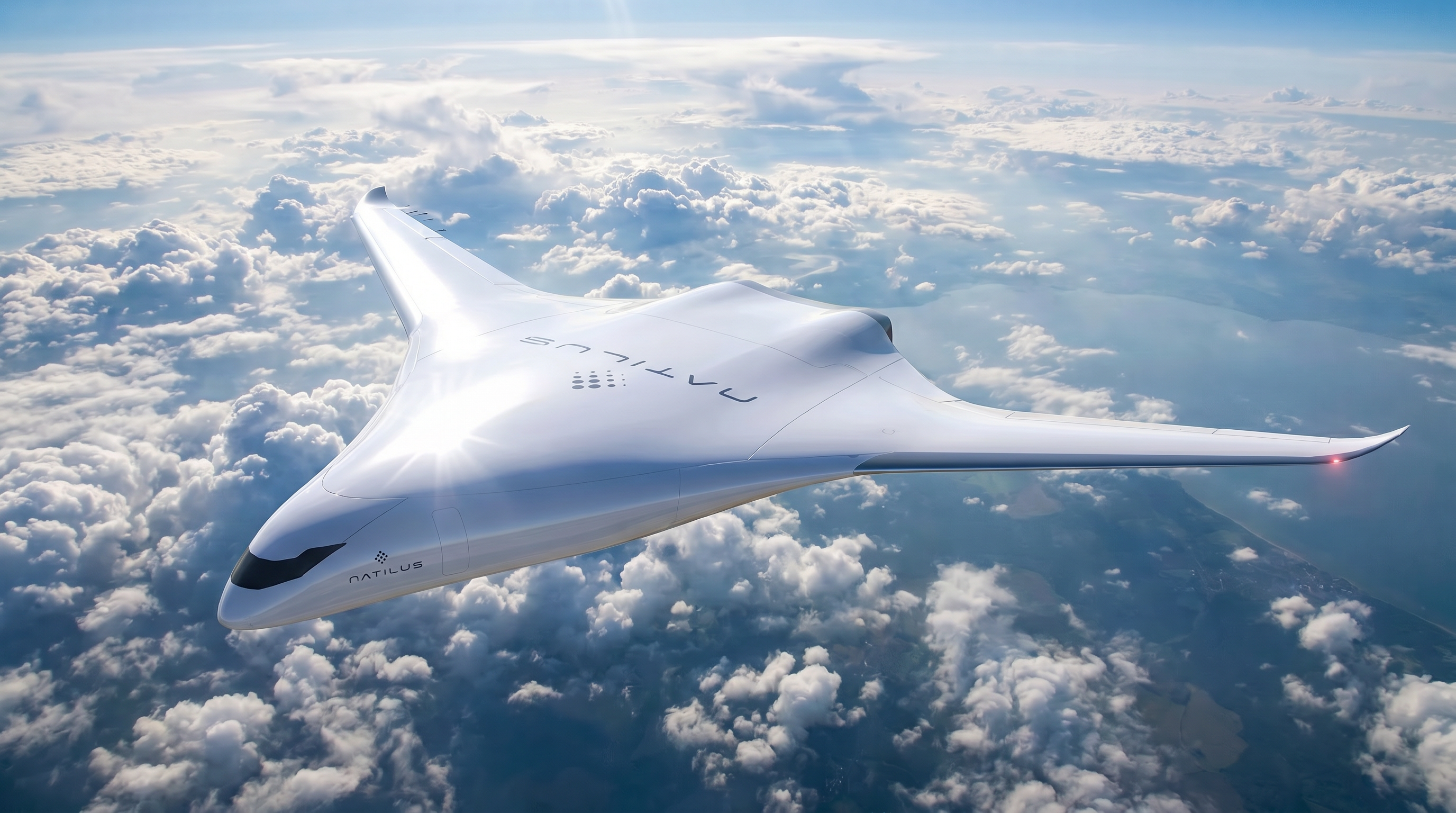
To achieve the next massive leap in fuel efficiency and emissions reduction, the aviation industry is turning its full attention to a radical alternative: the Blended-Wing Body (BWB). In a BWB aircraft, the distinct, sharp lines between the fuselage, the wings, and the tail are completely erased. Instead, the entire airframe is merged into a single, continuous, sweeping lifting surface that resembles a manta ray. By turning the passenger cabin itself into an aerodynamic wing, the BWB design distributes lift across the entire width of the aircraft. This drastically reduces aerodynamic drag and increases overall lift, creating a highly efficient shape that glides through the air with significantly less resistance than a traditional commercial airliner.[4][7]

The efficiency gains promised by this seamless aerodynamic integration are nothing short of massive. Recent wind-tunnel testing and high-fidelity computational fluid dynamics models suggest that a blended-wing configuration could slash fuel consumption by 30% to 50% compared to today's most advanced widebody jets. Because the entire airframe generates lift, the aircraft can maintain cruising altitude using significantly smaller, lighter, and quieter engines. For an airline industry that spends hundreds of billions of dollars annually on jet fuel—and faces mounting pressure to decarbonize its operations—cutting fuel burn in half represents the holy grail of aerospace engineering. This leap in efficiency is why both nimble startups and legacy aerospace titans are racing to bring the concept to life.[5][6]
While the blended-wing concept dates back to the mid-20th century—most famously realized in the military's B-2 Spirit stealth bomber—2026 has marked a definitive turning point for commercial BWB development. In early 2026, the California-based aerospace startup JetZero secured $175 million in Series B financing to accelerate the assembly of its full-scale Z4 demonstrator aircraft. This massive influx of capital, backed by major industry players like United Airlines Ventures and Northrop Grumman, signals that the broader aviation market is finally taking the blended-wing architecture seriously as a near-term commercial reality rather than a distant academic concept.[5][7]
Backed by this fresh capital and a deep roster of aerospace veterans, JetZero is currently assembling the demonstrator's massive composite center section at the Mojave Air & Space Port in California. The company is moving at an aggressive pace, targeting a first flight for the full-scale demonstrator in late 2027. If the flight testing validates the company's aerodynamic models, JetZero has set an ambitious goal of entering commercial airline service in the early 2030s. The company is already planning a massive $4.7 billion production facility in North Carolina, anticipating strong demand from airlines desperate to lower their operating costs and shrink their carbon footprints.[1][7]

JetZero is not the only innovator in the blended-wing race. Natilus, another ambitious aerospace startup, is developing a BWB aircraft dubbed "Horizon," which is specifically designed to replace ubiquitous single-aisle jets like the Boeing 737 and Airbus A320. With critical wind tunnel testing scheduled for mid-2026, Natilus aims to help fill a projected global deficit of over 17,000 commercial aircraft over the next two decades. By targeting the high-volume, middle-of-the-market segment, Natilus hopes to prove that the blended-wing body is not just for massive long-haul widebodies, but can also revolutionize the short-to-medium-haul routes that make up the vast majority of global commercial flights.[3]
Legacy manufacturers are also signaling a profound shift in their long-term strategic thinking. Airbus CEO Guillaume Faury recently stated that over the next 30 to 40 years, planemakers will likely abandon the traditional tube entirely in favor of thick, triangular blended-wing designs. Airbus has already built subscale flight demonstrators, such as the MAVERIC, to gather real-world data on tailless flight dynamics. Furthermore, the European aerospace giant is heavily integrating the blended-wing shape into its ZEROe initiative, which aims to develop the world's first zero-emission commercial aircraft. While Airbus is moving more cautiously than the startups, their commitment to the architecture validates the underlying physics.[2][4]
Legacy manufacturers are also signaling a profound shift in their long-term strategic thinking.
The blended-wing architecture is particularly attractive for the future of zero-emission flight because of its unique internal geometry. If the aviation industry transitions to hydrogen propulsion to eliminate carbon emissions, aircraft will need to store cryogenic liquid hydrogen, which requires roughly four times the volumetric space of traditional kerosene jet fuel. You cannot easily fit these bulky, spherical cryogenic tanks into the slender wings or narrow fuselage of a traditional airliner. However, the vast internal cavity of a blended-wing body provides the perfect real estate for hydrogen storage, allowing the aircraft to carry enough zero-emission fuel for long-haul flights without ruining the plane's external aerodynamics.[4][6]
However, transitioning to a blended-wing design requires entirely rethinking the passenger experience from the ground up. Because the passenger cabin is located deep within the thick central structure of the wing, traditional passenger windows will likely be entirely eliminated. Instead, airlines are exploring the use of massive, high-definition OLED screens to project a live camera feed of the outside view onto the cabin walls. While this technology can create stunning visual environments, aviation psychologists and interior designers warn that the lack of natural light and real windows could trigger claustrophobia or spatial disorientation for some sensitive flyers.[2]

The physical layout of the cabin will also shift dramatically, moving from a long, narrow tube to a wide, theater-style room featuring multiple aisles and unique seating configurations. While this wide-body layout offers the promise of more legroom, larger overhead bins, and significantly faster boarding times, it introduces entirely new physical sensations during flight. Passengers seated on the far outer edges of the wide cabin will be positioned much further from the aircraft's center of gravity. As a result, they will experience more pronounced vertical movement and lateral G-forces when the aircraft banks and rolls during turns, compared to those seated near the centerline.[2][4]
Beyond passenger comfort, regulatory certification presents an incredibly steep climb for these revolutionary aircraft. To fly commercially, every new passenger jet must prove to regulators that a fully loaded cabin can be completely evacuated in 90 seconds or less, using only half of the available exits. Designing emergency evacuation routes for a wide, windowless room where passengers in the center section are seated far away from the outer doors is an unprecedented engineering challenge. Manufacturers will have to invent entirely new egress systems and conduct massive physical trials to satisfy the strict safety mandates of global aviation authorities.[2][7]
Flight dynamics and aerodynamic stability also require rigorous, unprecedented validation. Because blended-wing aircraft lack a traditional vertical tail and rear elevators, they must rely on highly complex fly-by-wire software and wing-mounted control surfaces to manage pitch and yaw. Proving to the Federal Aviation Administration that a tailless commercial aircraft can safely and reliably recover from an aerodynamic stall is a critical hurdle. Regulators will demand thousands of hours of wind tunnel data and test flights to ensure that the aircraft's software can handle extreme weather conditions, crosswind landings, and system failures just as safely as a conventional jet.[3]

To de-risk these radical technologies, the blended-wing body will almost certainly prove itself in military service before it ever carries civilian ticket-holders. The U.S. Air Force has already awarded JetZero a $235 million contract to develop its prototype, viewing the BWB's massive fuel capacity, extreme range, and short-takeoff capabilities as ideal traits for next-generation aerial refueling tankers and military cargo transports. By flying these airframes in demanding military environments first, manufacturers can accumulate the millions of flight hours necessary to prove the structural integrity and software reliability of the design to commercial regulators.[6]
If these early demonstrators succeed in the skies over Mojave over the next two years, the global aviation industry may finally break free from the 70-year-old tube-and-wing paradigm. The transition will not happen overnight; redesigning airport gates, rewriting certification rules, and shifting public perception will take immense capital and time. While widespread commercial adoption may still be a decade or more away, the undeniable physics of the blended-wing body offer the most viable, technologically sound path to keeping the world flying in a carbon-constrained, highly efficient future.
How we got here
1989
The Northrop B-2 Spirit stealth bomber takes its first flight, proving the viability of the tailless 'flying wing' concept for military use.
2007
NASA and Boeing begin flight testing the X-48 subscale demonstrator to explore blended-wing aerodynamics.
2020
Airbus unveils its ZEROe initiative and the MAVERIC subscale demonstrator, signaling legacy interest in the design.
August 2023
The U.S. Air Force awards JetZero a $235 million contract to build a full-scale blended-wing demonstrator.
January 2026
JetZero secures $175 million in private financing to accelerate assembly of its Z4 demonstrator aircraft.
Late 2027
Target date for the first flight of JetZero's full-scale blended-wing demonstrator.
Viewpoints in depth
Commercial BWB Developers
Clean-sheet innovators believe BWB is the only way to achieve the massive efficiency gains required for sustainable aviation.
Companies like JetZero and Natilus argue that the aviation industry has squeezed every drop of efficiency out of the 70-year-old tube-and-wing design. They view the blended-wing body not as a futuristic luxury, but as an immediate necessity to meet 2050 net-zero emissions targets. By building full-scale demonstrators now, these startups aim to force the hand of legacy manufacturers and prove that the aerodynamic physics can translate into viable commercial products within the next decade.
Legacy Manufacturers
Established planemakers see BWB as the long-term future but emphasize the decades-long timeline required for transition.
Aviation giants like Airbus and Boeing acknowledge the superior physics of the blended-wing body, with Airbus CEO Guillaume Faury predicting it will dominate the skies in 30 to 40 years. However, they remain cautious about the near-term viability of the design for passenger travel. Legacy manufacturers point to the immense capital required to retool global supply chains, redesign airport infrastructure, and overcome passenger psychology regarding windowless cabins, suggesting that incremental improvements to existing airframes will bridge the gap.
Aviation Safety Regulators
Safety authorities are focused on the unprecedented challenges of certifying tailless aerodynamics and evacuating wide cabins.
For the Federal Aviation Administration and global regulators, the blended-wing body presents a blank slate of safety questions. Regulators must determine how to certify stall recovery and approach speeds for an aircraft without a traditional tail. Furthermore, the 90-second evacuation rule—a cornerstone of aviation safety—was designed around long, narrow tubes with side doors. Regulators will require extensive physical testing to prove that hundreds of passengers can safely escape a wide, theater-style cabin in an emergency.
What we don't know
- Whether passengers will widely accept windowless cabins and the unique motion sensations of a wide-body flying wing.
- How quickly global aviation regulators will establish new certification frameworks for tailless commercial aircraft.
- Whether existing airport gates and taxiways can accommodate the wingspans of high-capacity BWB airliners without expensive modifications.
Key terms
- Blended-Wing Body (BWB)
- An aircraft design that seamlessly integrates the fuselage and wings into a single lifting surface, eliminating the traditional cylindrical tube.
- Tube-and-Wing
- The conventional aircraft architecture used for the last 70 years, featuring a cylindrical fuselage attached to separate wings and a tail.
- Cryogenic Hydrogen
- Liquid hydrogen stored at extremely low temperatures, considered a future zero-emission aviation fuel that requires large internal storage volumes.
- Aerodynamic Stall
- A dangerous condition where an aircraft loses lift due to an excessive angle of attack, which is traditionally corrected using a rear tail.
Frequently asked
Will blended-wing airplanes have windows?
Most designs eliminate traditional passenger windows because the cabin is located deep within the thick central wing structure. Airlines may use high-definition screens to project the outside view instead.
When will I be able to fly on one?
Startups like JetZero and Natilus are targeting the early 2030s for commercial entry, though legacy manufacturers like Airbus suggest widespread adoption may take 30 to 40 years.
Are blended-wing aircraft safe?
They will have to meet the exact same rigorous safety and evacuation standards as traditional jets, though proving this to regulators without a traditional tail or exit layout is a major engineering hurdle.
Sources
Source coverage
7 outlets
3 viewpoints surfaced







[1]Aviation WeekCommercial BWB Developers
JetZero BWB Demonstrator Assembly Accelerates In Mojave
Read on Aviation Week →[2]Business InsiderLegacy Manufacturers
Airbus CEO Said Future Passenger Jets Could Look Like B-2 Bombers
Read on Business Insider →[3]Flying MagazineAviation Industry Analysts
Natilus Aims to Fill Aircraft Deficit With Blended-Wing Horizon
Read on Flying Magazine →[4]Simple FlyingLegacy Manufacturers
When Will Blended Wing Aircraft Be Ready For Commercial Service?
Read on Simple Flying →[5]Aerospace Global NewsCommercial BWB Developers
JetZero secures $175m to push blended-wing demonstrator toward 2027 flight
Read on Aerospace Global News →[6]Revolution.AeroAviation Industry Analysts
JetZero: The Blended Wing Body Revolution
Read on Revolution.Aero →[7]Air Data NewsCommercial BWB Developers
JetZero raises $175 million for its blended wing body demonstrator
Read on Air Data News →
Every angle. Every day.
Get transportation stories with full source coverage and perspective breakdowns delivered to your inbox.