
Supreme Court Strikes Down Trump's Sweeping Tariffs, Citing Lack of Presidential Authority
The Supreme Court has invalidated the Trump administration's universal baseline tariffs, ruling 7-2 that the executive branch exceeded its constitutional authority by unilaterally imposing taxes on imports without congressional approval.

Share this story
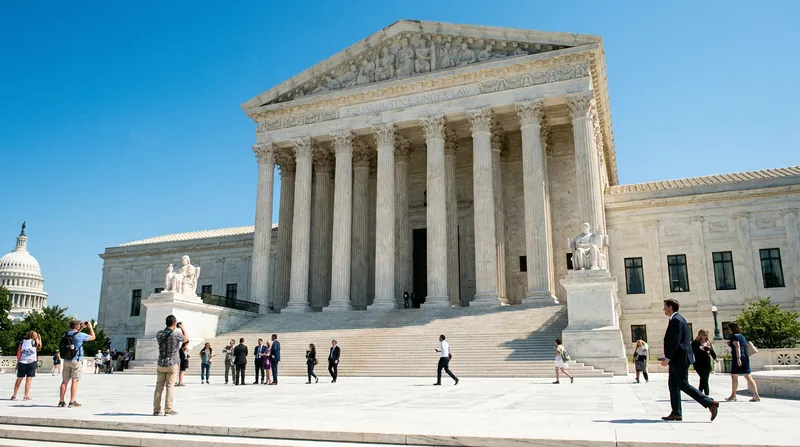
The Supreme Court has delivered a historic rebuke to executive power, striking down the Trump administration's sweeping 20% universal tariff on all imported goods. In a decisive 7-2 ruling issued Monday morning, the justices concluded that the president lacks the constitutional authority to unilaterally impose broad taxes on international trade, returning that power firmly to Congress.[1][5]
The decision immediately halts the collection of the tariffs, which had been implemented via executive order earlier this year under a novel interpretation of the International Emergency Economic Powers Act (IEEPA). Chief Justice John Roberts, writing for the majority, stated that while the president has broad discretion in foreign affairs, the Constitution's Article I explicitly reserves the power to "lay and collect taxes, duties, imposts and excises" for the legislative branch.[5]
"To allow the executive to unilaterally impose a universal tax on all foreign commerce under the guise of an undefined national emergency would effectively render Congress's taxing power a nullity," Roberts wrote. He was joined by the Court's three liberal justices and three fellow conservatives, signaling a broad, cross-ideological consensus on the limits of presidential authority.
The White House reacted with immediate fury. President Trump condemned the ruling as a "disaster for American manufacturing" and accused the Court of stripping the executive branch of its most effective negotiating tool against foreign economic adversaries. Administration officials argued that the tariffs were a necessary measure to protect domestic industries and correct decades of trade imbalances.[3][5]
Conversely, the business community and global financial markets responded with overwhelming relief. U.S. equity markets rallied sharply on the news, with retail, manufacturing, and technology sectors leading the surge. Importers had warned for months that the 20% baseline tariff was severely disrupting supply chains and forcing them to pass higher costs onto American consumers.[2][4][6]
The legal battle began almost immediately after the tariffs were announced, spearheaded by a coalition of the U.S. Chamber of Commerce, major retail associations, and several Democratic-led states. They argued that the administration's use of emergency powers to enact a permanent, universal tax bypassed the legislative process and violated the separation of powers.[2]
During oral arguments, the administration's Solicitor General faced intense skepticism from both conservative and liberal justices. Several conservative justices expressed concern that upholding the tariffs would create a precedent allowing future presidents to bypass Congress on a wide range of domestic economic policies simply by declaring a national emergency.[5]
The ruling has profound implications for the U.S. economy. Economists had projected that the 20% tariff on the roughly $3.8 trillion in annual U.S. imports would significantly accelerate inflation, potentially adding thousands of dollars to the average household's annual expenses. With the tariffs voided, analysts expect a cooling effect on core inflation over the coming months.[4][6]
Internationally, the decision de-escalates a brewing global trade war. Several major U.S. trading partners, including the European Union, China, and Japan, had prepared retaliatory tariffs targeting American agricultural and technological exports. European officials welcomed the ruling on Monday, expressing hope for a return to rules-based trade negotiations.[1][4]
The political fallout shifts the battleground over trade policy back to Capitol Hill. While there is bipartisan appetite in Congress for targeted tariffs on specific countries—particularly China—there is little support for a universal tax on all allies and adversaries alike. Any future broad protectionist measures will now require the administration to build a legislative coalition, a daunting task in a closely divided Congress.[2][3][5]
Viewpoints in depth
Constitutional Originalists
Focus on Article I and the strict separation of powers between branches.
Legal scholars and conservative jurists who supported the ruling argue that the Founders explicitly designed the Constitution to prevent the executive branch from wielding unilateral taxation power. By placing the authority to levy tariffs squarely in Article I, the framers intended for trade policy to be debated and approved by the legislature. Allowing a president to bypass Congress by declaring an economic emergency, they argue, would fundamentally break the separation of powers.
Economic Protectionists
Argue the executive needs agility to fight modern trade wars.
Supporters of the administration's tariff policy argue that the modern global economy moves too quickly for the traditional legislative process. They contend that the president requires broad, unilateral authority to rapidly counter foreign economic threats, currency manipulation, and unfair trade practices. From this perspective, the Court's ruling strips the United States of its most potent negotiating leverage and leaves domestic manufacturing vulnerable to foreign competition.
Free Trade Advocates
Express relief over avoided inflation and supply chain chaos.
The business community, importers, and free-trade economists view universal tariffs as a highly regressive tax that ultimately falls on American consumers. They argue that the 20% baseline tariff was already causing severe disruptions to global supply chains and threatening to spike core inflation. For this camp, the Supreme Court's decision averts an economic disaster and prevents a retaliatory global trade war that would have devastated American exporters.
Key points
- The Supreme Court ruled 7-2 that the president cannot unilaterally impose universal tariffs.
- The decision strikes down the administration's 20% baseline tax on all imported goods.
- Chief Justice Roberts wrote that the Constitution reserves the power to tax exclusively for Congress.
- Global markets rallied on the news, as the ruling averts a potential global trade war.
What we don’t know
- Whether the administration will attempt to impose narrower, targeted tariffs under different statutory authorities.
- How Congress will respond to the administration's demands for new legislative trade protections.
- The exact timeline for U.S. Customs and Border Protection to halt the collection of the invalidated duties and process refunds.
How we got here
Early 2026
The Trump administration announces a 20% universal baseline tariff on all imports using emergency economic powers.
Spring 2026
A coalition of business groups and states sues to block the tariffs, arguing executive overreach.
May 2026
The Supreme Court agrees to hear the case on an expedited basis.
July 13, 2026
The Supreme Court strikes down the tariffs in a 7-2 decision.
- Free Trade Advocates
- Emphasize that universal tariffs act as a regressive tax on American consumers and disrupt global supply chains.
- Constitutional Originalists
- Argue that the Founders explicitly placed the power of taxation and tariffs in the hands of the legislature to prevent executive overreach.
- Economic Protectionists
- Believe the executive branch requires broad, unilateral authority to rapidly counter foreign economic threats and protect domestic manufacturing.
Perspectives this story doesn't cover
- Foreign trade ministers who had drafted retaliatory measures
- Small business owners reliant on imported raw materials
Sources
Source coverage
6 outlets
3 viewpoints surfaced






- [1]ReutersFree Trade Advocates
U.S. Supreme Court strikes down Trump's broad tariffs, citing congressional tax power
Read on Reuters → - [2]The Wall Street JournalConstitutional Originalists
Justices Invalidate Trump Tariffs, Sending Trade Policy Back to Congress
Read on The Wall Street Journal → - [3]Fox NewsEconomic Protectionists
Trump's bold prediction for historic UFC White House fight revealed in new Fox Nation documentary
Read on Fox News → - [4]Financial TimesFree Trade Advocates
Global markets rally as US Supreme Court dismantles Trump's tariff regime
Read on Financial Times → - [5]The New York TimesFree Trade Advocates
Supreme Court Strikes Down Trump's Universal Tariffs in Historic Separation of Powers Ruling
Read on The New York Times → - [6]BloombergFree Trade Advocates
Importers breathe sigh of relief as Supreme Court voids 20% universal tariff
Read on Bloomberg →
More in News & Politics
See all →Congressional Investigations
Rep. Ilhan Omar Relocates From Washington Residence Following Federal Search
5 sources

Data Privacy
New Mexico Judge Orders Meta to Pay $25 Billion Over Cambridge Analytica Privacy Violations
6 sources

Prison Healthcare
Supreme Court Rejects Trump Administration Bid to Restrict Transgender Inmate Medical Care
5 sources
Immigration Crackdown
State Department Cancels Over 300,000 Visas in Broad Trump Administration Immigration Crackdown
5 sources

Comments
Every angle. Every day.
Get News & Politics stories with full source coverage and perspective breakdowns, free every day.