
Supreme Court Strikes Down EPA's Strict Vehicle Emissions Mandate in 5-4 Ruling
The Supreme Court has ruled that the Environmental Protection Agency exceeded its authority with its 2024 tailpipe emissions standards, fundamentally altering federal climate policy and shifting regulatory power back to Congress.
By Factlen Editorial Team
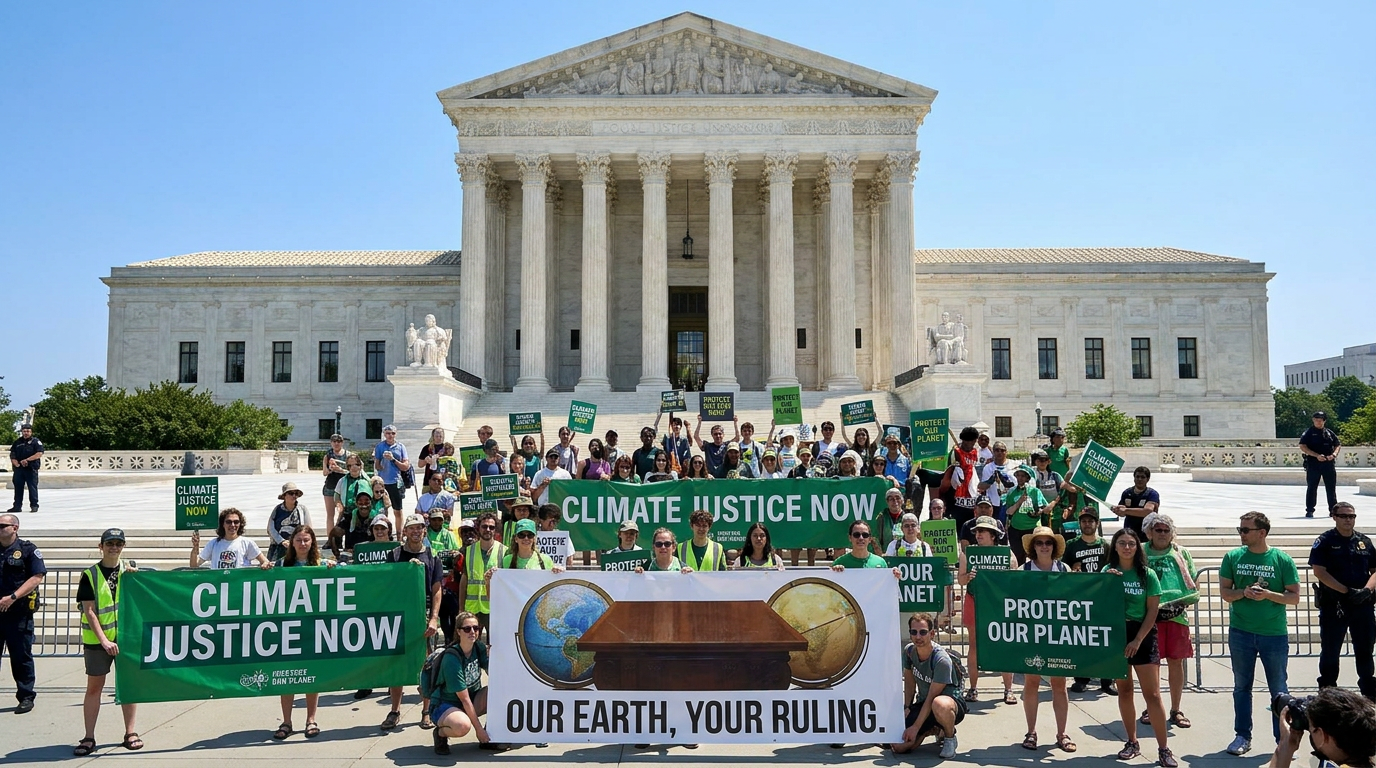
- Deregulation Advocates
- Argues that federal agencies cannot mandate sweeping economic transformations without explicit congressional approval, prioritizing free-market consumer choice.
- Climate Action Advocates
- Argues that the Clean Air Act already empowers the EPA to regulate greenhouse gases and warns that stripping this authority dooms US climate goals.
- Industry & Market Analysts
- Focuses on the logistical nightmare of a fractured auto market, where companies must navigate conflicting state-level regulations without federal certainty.
What's not represented
- · Low-income communities disproportionately affected by highway pollution
- · International climate negotiators relying on US emissions commitments
Why this matters
This ruling strips the executive branch of its primary tool to force a nationwide transition to electric vehicles. It guarantees that any future sweeping climate mandates will require explicit congressional approval, while leaving automakers to navigate a highly fractured landscape of state-level environmental rules.
Key points
- The Supreme Court struck down the EPA's 2024 vehicle emissions standards in a 5-4 decision.
- The conservative majority ruled the EPA lacked explicit congressional authority to mandate a nationwide transition to electric vehicles.
- The decision voids the requirement that 67% of new passenger vehicles sold in the US be all-electric by 2032.
- Automakers now face a fractured market as California and allied states plan to enforce their own strict emissions mandates.
The Supreme Court delivered a historic blow to federal climate policy on Friday, striking down the Environmental Protection Agency’s stringent 2024 vehicle emissions standards in a sharply divided 5-4 decision. The ruling effectively dismantles the Biden administration’s most aggressive regulatory effort to force a nationwide transition from internal combustion engines to electric vehicles. By invalidating the tailpipe rules, the Court has fundamentally altered the trajectory of American environmental policy, declaring that such sweeping economic transformations require explicit authorization from Congress rather than executive agency rulemaking.[1][3]
Writing for the conservative majority, Chief Justice John Roberts invoked the "major questions doctrine," a legal framework that requires federal agencies to have clear congressional backing when implementing regulations of vast economic and political significance. Roberts argued that the Clean Air Act, originally drafted in the 1970s, was never intended to empower the EPA to mandate a wholesale shift in the national automotive market. "The agency has discovered an unheralded power representing a transformative expansion of its regulatory authority," the majority opinion stated, emphasizing that such monumental policy shifts belong exclusively to the legislative branch.[2][4]
The decision immediately voids the EPA's mandate, which had required automakers to ensure that nearly 67 percent of all new passenger vehicles sold in the United States were all-electric by 2032. That rule was the cornerstone of the administration's pledge to halve U.S. greenhouse gas emissions by the end of the decade. Without it, energy analysts project the United States will fall significantly short of its commitments under the Paris Agreement, potentially adding billions of tons of carbon dioxide to the atmosphere over the next two decades as gasoline-powered cars remain on the road longer than previously modeled.[5][6]

In a blistering dissent joined by the Court's liberal wing, Justice Elena Kagan accused the majority of substituting its own policy preferences for scientific expertise and established law. Kagan argued that the Clean Air Act explicitly directs the EPA to regulate harmful air pollutants, a mandate that clearly encompasses greenhouse gases emitted by the transportation sector. She warned that the Court's ruling strips the federal government of the tools necessary to combat the escalating climate crisis, leaving the nation vulnerable to severe environmental and economic consequences while Congress remains paralyzed by partisan gridlock.[3][6]
The immediate fallout for the global auto industry is a complex mix of relief and deep uncertainty. While some legacy automakers and dealership networks had lobbied heavily against the 2024 rules—arguing the EV transition timeline was technologically and economically unfeasible—the sudden removal of a unified federal standard creates a regulatory vacuum. Industry executives are now bracing for a fractured market, as California and over a dozen allied states have vowed to enforce their own strict zero-emission vehicle mandates regardless of the federal rollback.[4][7]
The immediate fallout for the global auto industry is a complex mix of relief and deep uncertainty.
"Automakers are now staring down the barrel of a bifurcated American market," noted one industry analyst following the ruling. Companies will have to decide whether to design vehicles that meet California's stringent standards, which cover roughly a third of the U.S. auto market, or produce different fleets for states with looser environmental regulations. This state-by-state patchwork threatens to disrupt supply chains, increase manufacturing costs, and complicate long-term investment strategies for companies that had already committed billions to battery manufacturing and EV assembly plants across the Midwest and South.[7][8]

Conservative lawmakers and fossil fuel industry groups celebrated the ruling as a vital restoration of constitutional boundaries and consumer choice. Proponents of the lawsuit, which was led by a coalition of Republican attorneys general and oil industry advocates, argued that the EPA's rule was a backdoor attempt to ban gas-powered cars. They maintain that the free market, rather than federal bureaucrats, should dictate the pace of EV adoption, pointing to recent cooling in consumer demand for electric vehicles as evidence that the EPA's targets were detached from economic reality.[2][8]
Conversely, environmental organizations have characterized the decision as a catastrophic setback. Climate advocates warn that transportation remains the largest single source of greenhouse gas emissions in the United States. Without aggressive federal intervention, they argue, the slow, market-driven adoption of EVs will not reduce emissions fast enough to mitigate the worst impacts of global warming. Several prominent environmental groups have already announced plans to pivot their resources toward state-level campaigns and corporate pressure tactics in the wake of the federal defeat.[5][6]
The ruling now places the burden of climate action squarely on a deeply divided Congress, instantly elevating environmental policy as a central flashpoint for the upcoming 2026 midterm elections. The Biden administration has signaled it will explore alternative executive actions to curb emissions, though legal experts warn that any new agency rules will face immediate challenges under the precedent set today. For now, the United States' strategy to decarbonize its transportation sector has been abruptly derailed, leaving states, corporations, and consumers to navigate the fallout.[1][5]

How we got here
April 2024
The EPA finalizes strict new tailpipe emissions standards targeting 2032.
June 2024
A coalition of Republican-led states and oil industry groups file a federal lawsuit challenging the EPA's authority.
October 2025
The Supreme Court agrees to hear the consolidated challenges to the EPA rule.
June 2026
The Supreme Court strikes down the mandate in a 5-4 decision.
Viewpoints in depth
Deregulation Advocates
Supporters of the ruling argue it restores constitutional balance by checking executive overreach.
Conservative legal scholars and industry groups argue that the EPA's 2024 rule was a prime example of an unelected agency bypassing Congress to enact a deeply unpopular economic transformation. By invoking the major questions doctrine, they believe the Supreme Court has rightly forced the legislative branch to take responsibility for climate policy, rather than allowing the executive branch to stretch decades-old statutes like the Clean Air Act beyond their original intent. They also argue this protects consumers from being forced into purchasing expensive electric vehicles before the market and infrastructure are ready.
Climate Action Advocates
Critics of the ruling argue it ignores the existential threat of climate change and misinterprets the Clean Air Act.
Environmental groups and the Court's liberal wing argue that the Clean Air Act was explicitly designed to be flexible enough to address new environmental threats, including greenhouse gases. They view the major questions doctrine as a judicially invented tool used to strike down regulations the conservative majority dislikes. Advocates warn that waiting for a gridlocked Congress to pass comprehensive climate legislation is a death sentence for the Paris Agreement targets, as transportation remains the largest source of US emissions.
The Auto Industry
Automakers are caught in the middle, fearing the logistical nightmare of a fractured regulatory landscape.
While some legacy automakers initially balked at the aggressive timeline of the EPA's 2032 targets, the industry universally dreads the alternative: a patchwork of state-level regulations. With California and over a dozen other states legally permitted to set their own stricter emissions standards, automakers face the prospect of having to design, manufacture, and distribute different types of vehicles for different parts of the country. This bifurcation threatens to drive up manufacturing costs and complicate the billions of dollars already invested in domestic EV supply chains.
What we don't know
- How exactly automakers will adjust their supply chains to handle a bifurcated US market.
- Whether the Biden administration will attempt to issue a scaled-back version of the emissions rule.
- How this ruling will impact the United States' negotiating power at upcoming international climate summits.
Key terms
- Major Questions Doctrine
- A legal principle requiring federal agencies to have explicit congressional authorization before enacting regulations with vast economic or political impact.
- Clean Air Act
- A comprehensive federal law passed in 1970 that regulates air emissions from stationary and mobile sources.
- Tailpipe Emissions Standards
- Regulations that set limits on the amount of pollutants, including greenhouse gases, that can be released by a vehicle's exhaust system.
Frequently asked
Does this ruling ban electric vehicles?
No. The ruling simply prevents the federal government from forcing automakers to meet quotas that would effectively require a massive shift to EVs. Consumers can still buy electric vehicles.
Can the EPA still regulate any vehicle pollution?
Yes. The EPA can still regulate traditional pollutants like smog and soot, but the Court ruled it cannot use those powers to force a wholesale transition of the automotive market.
What happens to state-level EV mandates?
States like California that have their own strict emissions standards and EV mandates are expected to continue enforcing them, likely leading to a fractured US auto market.
Sources
Source coverage
8 outlets
3 viewpoints surfaced








[1]ReutersIndustry & Market Analysts
Supreme Court strikes down EPA vehicle emissions rule in major blow to climate agenda
Read on Reuters →[2]Fox NewsDeregulation Advocates
Supreme Court reins in EPA overreach, striking down Biden's radical EV mandate
Read on Fox News →[3]The New York TimesClimate Action Advocates
In 5-4 Ruling, Supreme Court Severely Limits EPA's Power to Regulate Tailpipe Emissions
Read on The New York Times →[4]The Wall Street JournalDeregulation Advocates
Supreme Court Curbs EPA's Authority on Auto Emissions, Boosting Automakers
Read on The Wall Street Journal →[5]PoliticoIndustry & Market Analysts
What the Supreme Court's EPA ruling means for the future of EVs and climate policy
Read on Politico →[6]The Washington PostClimate Action Advocates
Supreme Court deals devastating blow to US climate goals with EPA ruling
Read on The Washington Post →[7]BloombergIndustry & Market Analysts
Auto Industry Faces Fragmented State Rules After Supreme Court EPA Decision
Read on Bloomberg →[8]E&E NewsIndustry & Market Analysts
Inside the 5-4 decision that rewrote federal climate authority
Read on E&E News →


Every angle. Every day.
Get news politics stories with full source coverage and perspective breakdowns delivered to your inbox.