
Supreme Court Receives First Volley of Briefs in Major AR-15 Ban Challenge
The U.S. Justice Department and gun rights groups have filed dozens of briefs urging the Supreme Court to strike down state and local bans on AR-15 rifles. The filings directly challenge lower court rulings that labeled the popular firearms as unusually dangerous military weapons.

- Second Amendment Advocates
- Argue that AR-15s are in common use for lawful purposes and that categorical bans violate the Constitution by outlawing the nation's most popular rifle.
- Federal & Journalistic Observers
- Highlight the Justice Department's decisive intervention against the bans and track the broader legal implications of the upcoming Supreme Court ruling.
- State & Municipal Defenders
- Maintain that AR-15s are unusually dangerous weapons capable of inflicting mass casualties, justifying local regulations as a matter of public safety.
Perspectives this story doesn't cover
- Gun control advocacy groups
- Medical professionals treating gunshot wounds
Why this matters
The Supreme Court's ruling will determine whether states and municipalities can legally ban the most popular rifle in the United States. A decision striking down the bans would immediately invalidate laws in roughly a dozen states and fundamentally restrict how local governments can regulate modern firearms.
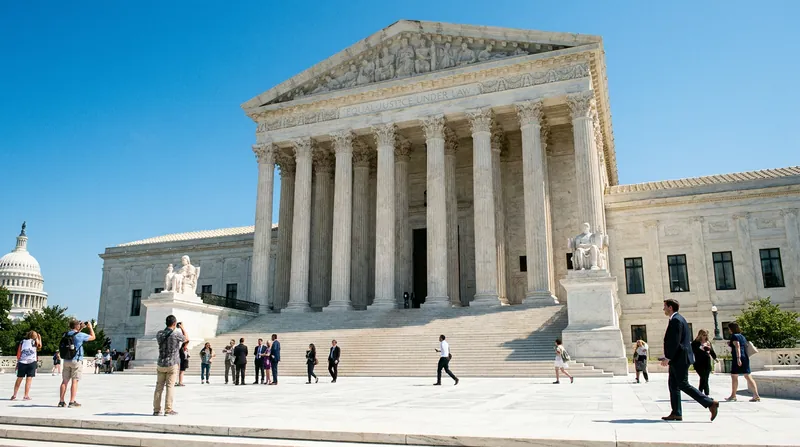
The Seventh and Second Circuit Courts of Appeals upheld bans on AR-15s by declaring the rifles "unusually dangerous" and functionally indistinguishable from military machine guns. But as the U.S. Supreme Court prepares to hear oral arguments on December 2, 2026, in the consolidated case of Viramontes v. Cook County, a massive wave of legal briefs—including a decisive and highly anticipated filing from the U.S. Justice Department—is setting the statistical and mechanical reality of the weapon directly against the lower courts' claims.[3][5]
The consolidated cases, which merge challenges to municipal bans in Cook County, Illinois, and statewide restrictions in Connecticut, represent the most consequential Second Amendment test since the 2022 Bruen decision. At stake is whether states and municipalities can categorically outlaw the possession and sale of specific semiautomatic rifles by labeling them "assault weapons." Gun rights advocates argue that this term is an arbitrary political invention rather than a technical classification, and that the bans criminalize the ownership of the most popular rifle platform in the United States.[2][3][5]
The lower courts relied heavily on the premise that AR-15s represent a dramatic technological change suited primarily for military combat rather than civilian self-defense. In upholding the bans, the Seventh Circuit characterized the AR-15 as a "militaristic weapon" capable of firing "300 rounds a minute," asserting that virtually no difference exists between the civilian semiautomatic rifle and the fully automatic M16 used by the armed forces. The Second Circuit similarly described the banned rifles as capable of "spray firing" and inflicting uniquely severe wounds.[2]
The opening volley of merits briefs, submitted ahead of the Court's September 2026 deadline, attacks those mechanical assertions directly. A coalition of firearms and ballistics experts—including a former FBI ballistics supervisor—filed an amicus brief noting that AR-15s are not machine guns and fire at the exact same rate as common handguns. The experts argue the rifles fire the same bullets at the same velocity as any other non-banned rifle of the same caliber, producing wounds that are generally less severe than those from other common hunting long guns.[2]
The core legal argument hinges on the "common use" standard established in the 2008 District of Columbia v. Heller decision, which protects arms typically possessed by law-abiding citizens for lawful purposes. To prove commonality, the challengers point to Professor William English's 2026 National Firearms Survey. The data shows that approximately 26.4 million American adults currently own at least one AR-15 or similarly styled semiautomatic rifle, with roughly 60 million such rifles in circulation nationwide, making it the paradigmatic American firearm.[2][4]
The core legal argument hinges on the "common use" standard established in the 2008 District of Columbia v.
The U.S. Justice Department has thrown its full weight behind the challengers, a move that significantly alters the political calculus of the case. In a 40-page amicus brief filed by Solicitor General D. John Sauer and Assistant Attorney General Harmeet Dhillon, the federal government argued that categorical bans on such commonly owned rifles violate the Constitution. "A ban on a class of firearms burdens the right to keep and bear arms protected by the Second Amendment's plain text," the Justice Department wrote.[3]
The federal brief dismantles the lower courts' rationale by pointing to the sheer scale of civilian ownership and the lawful applications of the platform. "The AR-15 rifle is unquestionably in common use among law-abiding citizens for lawful purposes," the Justice Department stated, noting that the rifles are currently lawful at the federal level and in 40 states. The government emphasized that the overwhelming majority of owners possess the rifles for self-defense in the home, hunting, and target shooting—activities explicitly protected by the Second Amendment.[3][4]
Gun rights organizations have flooded the Supreme Court docket, filing 45 amicus briefs in support of the petitioners by the first week of September. Groups including the National Association for Gun Rights and the Firearms Policy Coalition highlighted the incongruity of the various bans across different jurisdictions. The Independent Institute's brief pointed out that Cook County bans a semiautomatic rifle if it has no stock, while Connecticut bans the exact same rifle if it does have a stock, illustrating the arbitrary and contradictory nature of the restrictions.[1][2][4]
Defenders of the bans argue that the regulations are critical public safety measures necessary to curb mass casualties in an era of frequent public shootings. The United States Conference of Catholic Bishops logged arguments in favor of keeping the bans, contending that "the adoption of firearm regulations by local authorities—be they municipal or state authorities—is consistent with both traditional principles of federalism and the Church's principle of subsidiarity." Other gun control groups maintain that the lethality of the weapons justifies their restriction.[3]
With oral arguments set for December 2, the Supreme Court's decision, expected by June 2027, will likely dictate the fate of similar bans in roughly a dozen other states. If the justices rule that the "common use" test strictly protects AR-15s based on their widespread ownership, it would severely limit the ability of states to restrict access to modern semiautomatic firearms. Such a ruling would fundamentally alter the landscape of American gun control, forcing state legislatures to abandon categorical bans in favor of alternative regulatory frameworks.[3][5]
Viewpoints in depth
The Challengers' View
Gun rights groups and the DOJ argue that AR-15s are in common use and mechanically identical to other legal rifles.
Advocates for striking down the bans argue that the "assault weapon" label is an arbitrary political invention designed to circumvent the Second Amendment. By pointing to the estimated 60 million AR-15 style rifles in circulation, they contend that the platform easily meets the Supreme Court's "common use" threshold established in Heller. Furthermore, ballistics experts assert that the lower courts fundamentally misunderstood the mechanics of the weapon, noting that it fires at the same rate and velocity as standard hunting rifles and handguns rather than functioning as a military machine gun.
The Regulators' View
State and local governments argue that AR-15s are unusually dangerous weapons suited for military use.
Defenders of the bans, including the lower appellate courts that upheld them, argue that AR-15s represent a dramatic technological shift that makes them uniquely lethal in civilian settings. They maintain that the weapons are capable of inflicting mass casualties rapidly, likening them to military-grade hardware that falls outside the scope of traditional self-defense. Consequently, they argue that categorical bans are a necessary and constitutional exercise of local regulatory power to protect public safety.
Key points
- The Supreme Court will hear oral arguments on December 2 regarding AR-15 bans in Cook County and Connecticut.
- The U.S. Justice Department filed an amicus brief arguing that categorical bans on commonly owned rifles violate the Second Amendment.
- Gun rights groups and ballistics experts filed dozens of briefs challenging lower court claims that AR-15s are unusually dangerous military weapons.
- A 2026 survey estimates that 26.4 million American adults own at least one AR-15 or similarly styled rifle.
- A ruling striking down the bans would likely invalidate similar laws in roughly a dozen other states.
Sources
Source coverage
5 outlets
3 viewpoints surfaced





- [1]National Association for Gun RightsSecond Amendment Advocates
NAGR Files Amicus Brief in Major Supreme Court Fight Over "Assault Weapons" Bans
Read on National Association for Gun Rights → - [2]Independent InstituteSecond Amendment Advocates
First Volley of Briefs Filed in Viramontes: News Article
Read on Independent Institute → - [3]Guns.comFederal & Journalistic Observers
Arguments in Supreme Court 'Assault Weapon Ban' Case Set for December
Read on Guns.com → - [4]Firearms Policy CoalitionSecond Amendment Advocates
FPC Thanks Amici for Support in U.S. Supreme Court Case to End “Assault Weapon” Bans Nationwide
Read on Firearms Policy Coalition → - [5]OyezState & Municipal Defenders
Viramontes v. Cook County, Illinois
Read on Oyez →
Comments
More in Law & Justice
See all →Dispute Resolution
Binding Arbitration vs. Civil Litigation: Comparing the Cost, Speed, and Finality of Dispute Resolution
5 sources

Stare Decisis
The Four Factors That Justify Overruling a Supreme Court Precedent Under the Doctrine of Stare Decisis
6 sources
Fourth Amendment
The Four Criteria That Define a 'Search' Under the Fourth Amendment's Katz Test
6 sources

EPR Legislation
Federal Court Upholds Oregon's Extended Producer Responsibility Packaging Law
7 sources
Every angle. Every day.
Get Law & Justice stories with full source coverage and perspective breakdowns delivered to your inbox.