
SpaceX Shatters IPO Records as the Commercial Space Economy Hits the Public Market
SpaceX's historic $1.77 trillion public debut and Rocket Lab's inclusion in the Nasdaq-100 have officially transformed the orbital economy into a mainstream, liquid asset class.
By Factlen Editorial Team
- Retail & Institutional Bulls
- Focuses on the democratization of the space economy and the massive wealth creation event the IPO represents.
- Ecosystem Investors
- Focuses on the downstream effects, arguing that suppliers and competitors offer better value than a fully-priced SpaceX.
- Market Structurists
- Focuses on index inclusion mechanics and how passive fund flows will force capital into the space sector.
What's not represented
- · Traditional Aerospace Prime Contractors
- · Space Regulatory Agencies
Why this matters
The commercial space industry is officially transitioning from a private playground for billionaires into a public asset class. With SpaceX's record-shattering IPO and competitors like Rocket Lab joining major indices, everyday investors can now directly stake their portfolios on the orbital economy.
Key points
- SpaceX debuted on the Nasdaq at a fixed price of $135 per share, raising $75 billion.
- The IPO valued the aerospace company at $1.77 trillion, making CEO Elon Musk the world's first trillionaire.
- Retail investors placed over $100 billion in orders, aided by brokerages lowering minimum investment thresholds.
- Competitor Rocket Lab will join the Nasdaq-100 on June 22, signaling broader market acceptance of the space sector.
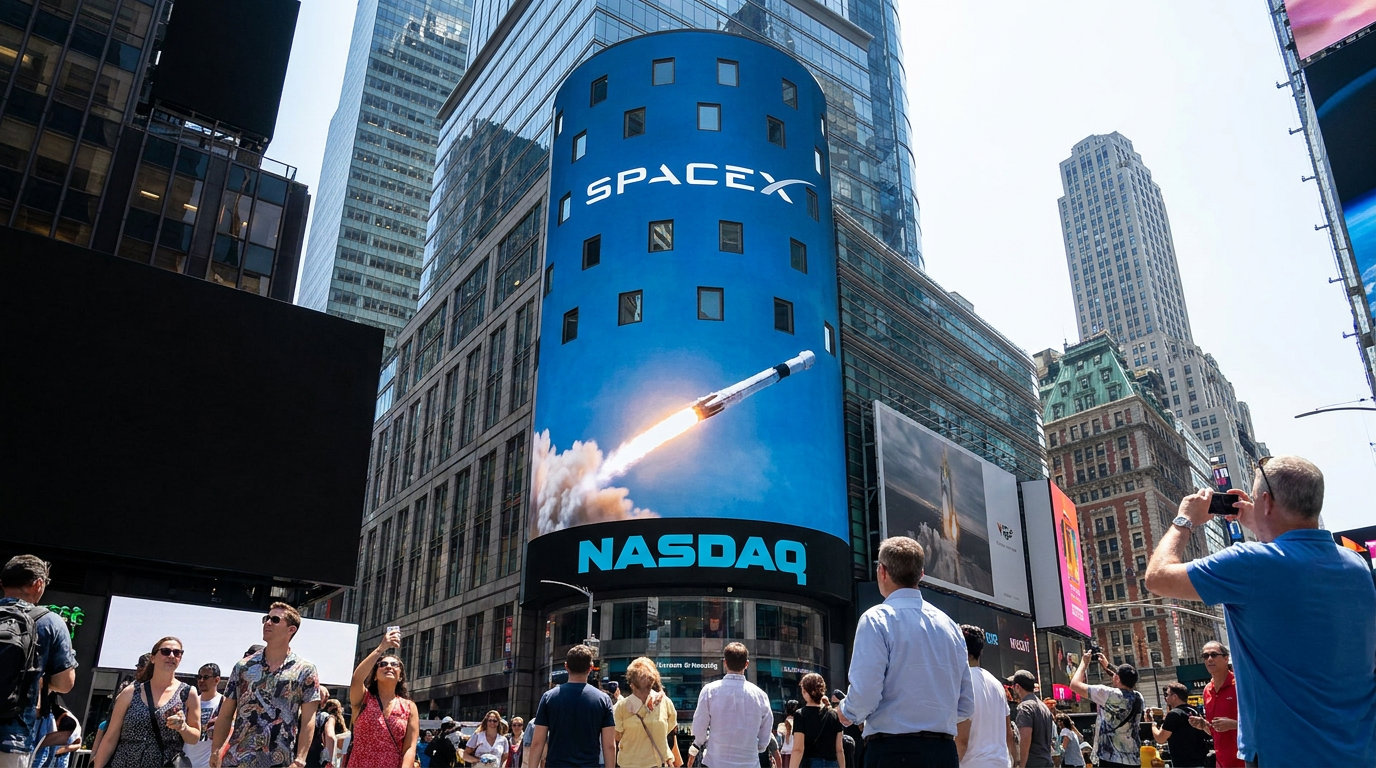
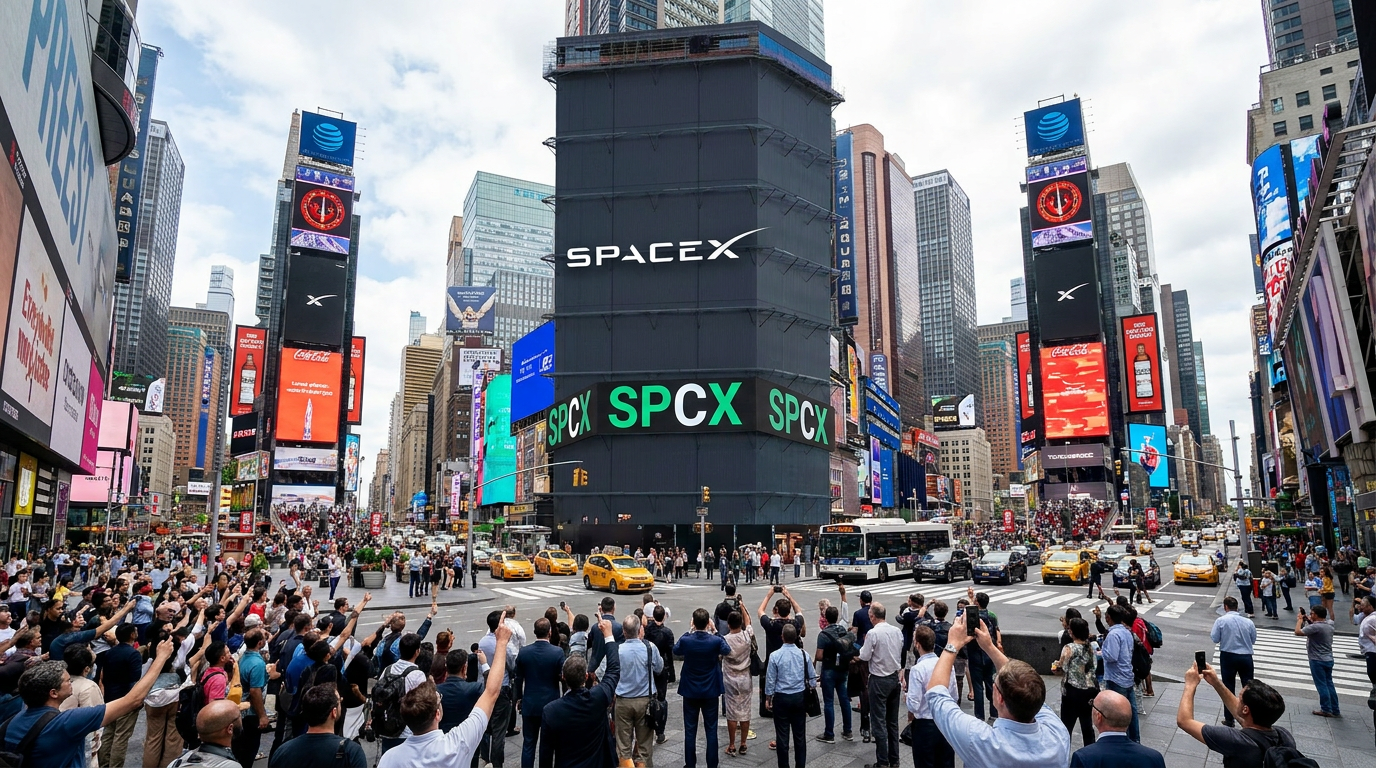
The opening bell at the Nasdaq on Friday didn't just mark the debut of a single company; it signaled the public arrival of the orbital economy. After nearly two and a half decades as a private enterprise, Space Exploration Technologies Corp.—better known as SpaceX—began trading under the ticker SPCX. The stock opened at a fixed price of $135 per share, instantly valuing the rocket manufacturer and satellite internet provider at a staggering $1.77 trillion. The debut shatters previous records, making it the largest initial public offering in history and officially minting CEO Elon Musk as the world's first trillionaire.[1][2]
The mechanics of the offering were as unconventional as the aerospace company itself. Bypassing the traditional Wall Street roadshow and the customary price-discovery range, SpaceX presented the market with a firm, take-it-or-leave-it price of $135 per share. The market overwhelmingly took it. By the time the order book closed, institutional and retail demand had swelled to a staggering $250 billion, oversubscribing the $75 billion offering by nearly four times. Retail investors alone placed orders exceeding $100 billion, demonstrating a massive, pent-up appetite among everyday traders to finally capture a piece of the commercial space race.[2]
To accommodate this unprecedented retail frenzy, major brokerages were forced to adjust their standard IPO playbooks. Fidelity Investments, for instance, significantly lowered its typical access threshold, allowing retail customers with as little as $2,000 in their brokerage accounts to request shares in the offering. SpaceX deliberately structured the deal to reserve up to 30% of the total offering for retail clients. This represents a massive departure from the 5% to 10% typically allocated to non-institutional buyers in mega-cap debuts, ensuring that the wealth-generation event wasn't restricted solely to Wall Street insiders.[3]

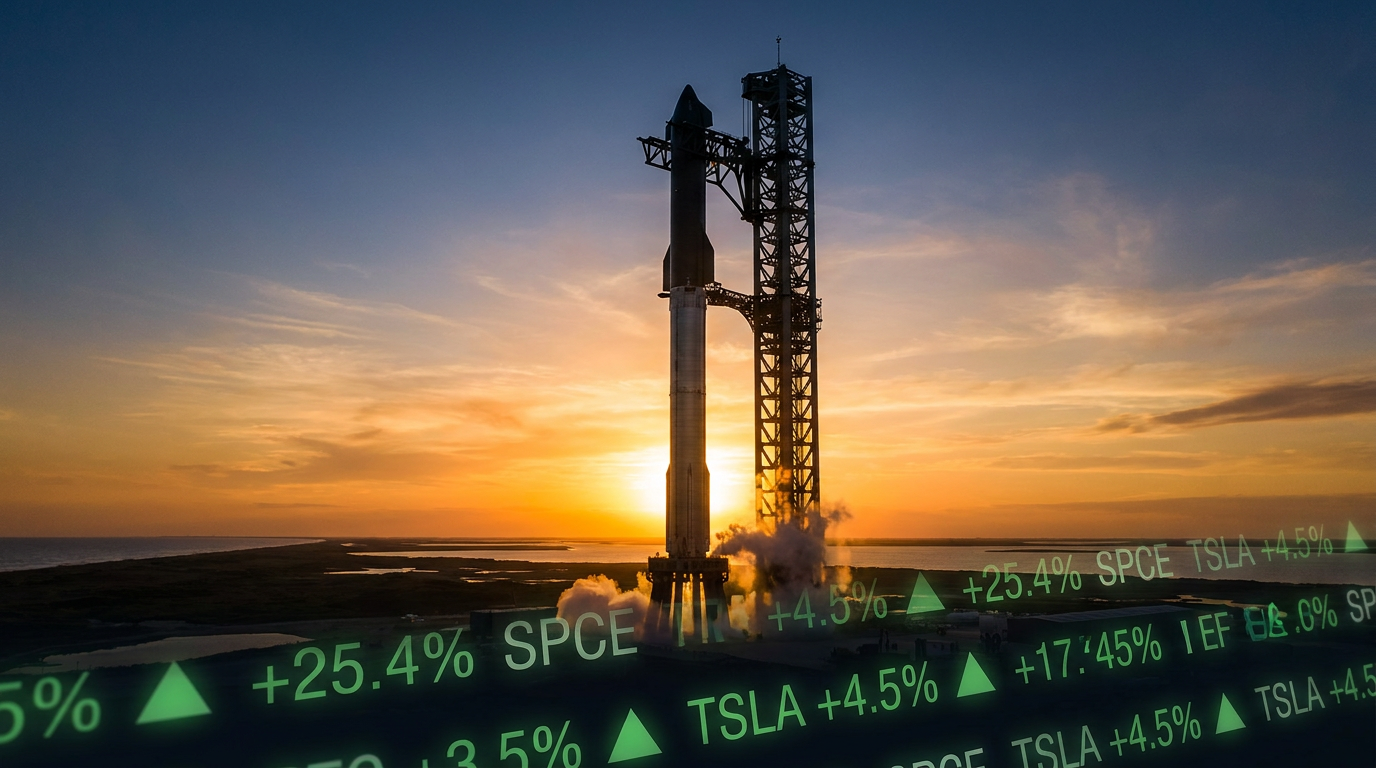
Within thirty minutes of the opening bell, SPCX shares surged past $165, validating the eye-popping valuation and triggering a historic wave of wealth creation. Beyond cementing Musk's status as the world's first trillionaire, the IPO transformed thousands of current and former SpaceX employees into millionaires overnight. Reports indicate that roughly 400 early employees secured stakes worth $100 million or more. The sheer scale of the listing immediately reorients the U.S. stock market, creating a new gravitational center for aerospace and technology portfolios that rivals the influence of artificial intelligence giants.[1]
But the financial milestone extends far beyond a single ticker symbol. SpaceX's public debut is acting as a powerful catalyst for the broader "space economy," pulling a vast constellation of related companies into the mainstream spotlight. Just days before the SPCX listing, Nasdaq announced a major quarterly rebalancing that perfectly captured the industry's momentum. Rocket Lab (RKLB)—SpaceX's most prominent publicly traded competitor in the commercial launch sector—will officially be added to the Nasdaq-100 Index prior to the market open on June 22.[4][5]
But the financial milestone extends far beyond a single ticker symbol.
Rocket Lab's inclusion in the elite index of the 100 largest non-financial companies on the Nasdaq marks a definitive coming-of-age for the broader commercial space sector. The company, which provides critical launch services and manufactures advanced spacecraft components, currently commands a market capitalization of over $66 billion following a remarkable 335% gain over the past twelve months. By joining the Nasdaq-100, Rocket Lab will automatically receive massive capital inflows from the more than $800 billion in passive investment products and mutual funds that are mandated to track the index.[4][5]

Financial analysts note that these dual milestones—SpaceX's record-breaking IPO and Rocket Lab's index inclusion—fundamentally alter how institutional capital interacts with orbital infrastructure. For decades, the space sector was viewed as a high-risk, capital-intensive frontier dominated by sovereign governments and specialized venture capital firms. Now, it has matured into a formalized, highly liquid asset class. Investors who feel they missed the ground floor of the SpaceX phenomenon are aggressively rotating their capital into ecosystem players, searching for the lucrative "picks and shovels" of the new space race.[6][7]
This ecosystem rotation is already lifting a wide variety of specialized aerospace firms that supply the industry's backbone. Companies like Aerojet Rocketdyne, which supplies critical propulsion systems to major contractors, and Intuitive Machines, which is actively developing the cislunar economy following its successful commercial moon landing, are seeing elevated trading volumes. Financial screeners and market analysts are actively pointing retail investors toward these secondary plays, noting that the vast physical infrastructure required to support SpaceX's Mars ambitions and the global Starlink network will generate billions in downstream contracts.[6][7]
The historic week also forces a structural reckoning for passive index funds and everyday retirement accounts. Because of SpaceX's massive $1.77 trillion market capitalization, it will quickly become a mandatory, heavily weighted holding for broad-market mutual funds and S&P tracking ETFs. This means that millions of everyday investors will soon have indirect exposure to the commercial space economy through their 401(k)s and pension plans, permanently tying mainstream retirement security to the success of reusable rockets, satellite internet constellations, and orbital logistics.[1][8]

Despite the market euphoria, financial structurists caution that the aerospace sector remains uniquely volatile compared to traditional enterprise software. Space exploration is inherently risky, characterized by spectacular technological triumphs and equally spectacular hardware failures. A single launch anomaly, payload loss, or regulatory setback can erase billions in market value in a matter of minutes. Furthermore, some analysts warn that the current valuations—particularly Rocket Lab's placement on "most overvalued" lists by several quantitative financial screeners—reflect a speculative premium based on future promises rather than near-term cash flows.[4][8]
Nevertheless, the sentiment on Wall Street remains overwhelmingly focused on the horizon. The $75 billion in fresh capital raised by SpaceX is explicitly earmarked for the continued development of its massive Starship rocket, which is designed to eventually make humanity multiplanetary, and the aggressive global expansion of its highly profitable Starlink communications network. With artificial intelligence rivals like OpenAI and Anthropic also reportedly preparing for their own public debuts, 2026 is shaping up to be a generational realignment of the public markets toward frontier technologies.[1]
Ultimately, the events of this week signify the definitive end of the private space era. The orbital frontier that was once the exclusive, secretive domain of national space agencies and a handful of eccentric billionaires is now trading openly on the public market. Whether investors are buying directly into SpaceX's audacious Mars ambitions or diversifying their portfolios across the specialized suppliers and competitors that make up the broader orbital economy, the space age is finally open to the public.[1][6]
How we got here
April 2026
SpaceX confidentially submits its draft registration statement to the SEC.
May 2026
The SEC publicly discloses SpaceX's S-1 filing, revealing plans for the massive offering.
June 11, 2026
SpaceX finalizes its fixed IPO price at $135 per share, bypassing the traditional roadshow range.
June 12, 2026
SpaceX officially begins trading on the Nasdaq under the ticker SPCX.
June 22, 2026
Rocket Lab is scheduled to join the Nasdaq-100 Index, cementing the space sector's presence in major benchmarks.
Viewpoints in depth
Retail & Institutional Bulls
Focuses on the democratization of the space economy and the massive wealth creation event the IPO represents.
For bullish investors, the SpaceX IPO is a generational wealth event akin to the early days of the internet boom. They argue that by lowering the barrier to entry—with brokerages like Fidelity requiring just $2,000 to participate—the offering democratizes access to what was previously a closed ecosystem. This camp views the $1.77 trillion valuation not as a ceiling, but as a floor, pointing to the monopolistic potential of the Starlink network and the inevitable commercialization of Mars as justifications for the premium.
Ecosystem Investors
Focuses on the downstream effects, arguing that suppliers and competitors offer better value than a fully-priced SpaceX.
Ecosystem investors believe that while SpaceX is the headline, the real value lies in the secondary market. They argue that SpaceX's $1.77 trillion valuation leaves little room for outsized near-term growth, whereas smaller infrastructure players—the "picks and shovels" of the space race—are primed for exponential gains. By targeting companies like Rocket Lab and Intuitive Machines, these investors aim to capture the massive downstream contracts that will inevitably flow from SpaceX's ambitious launch schedule and the broader expansion of the cislunar economy.
Market Structurists
Focuses on index inclusion mechanics and how passive fund flows will force capital into the space sector.
Market structurists analyze the event through the lens of index mechanics rather than technological promise. They point out that the sheer size of SpaceX, combined with Rocket Lab's entry into the Nasdaq-100, forces the hand of passive fund managers. Because trillions of dollars are tied to broad-market indices, these funds must automatically purchase shares in these space companies to maintain their weightings. This structural reality, they argue, guarantees a steady floor of institutional capital for the orbital economy, regardless of quarter-to-quarter launch successes or failures.
What we don't know
- How the extreme volatility of spaceflight hardware failures will translate to daily stock price fluctuations for a $1.77 trillion company.
- Whether secondary space ecosystem stocks can maintain their current valuation premiums once the initial SpaceX IPO euphoria subsides.
Key terms
- Initial Public Offering (IPO)
- The process by which a private company offers its shares to the public for the first time, transitioning to a publicly traded entity.
- Nasdaq-100 Index
- A stock market index made up of 100 of the largest non-financial companies listed on the Nasdaq exchange.
- Orbital Economy
- The commercial industry surrounding space exploration, including rocket launches, satellite networks, and spacecraft manufacturing.
- Oversubscribed
- A situation in an IPO where investor demand for shares exceeds the total number of shares the company is offering.
Frequently asked
What was the starting price for the SpaceX IPO?
SpaceX bypassed the traditional price-discovery range and offered shares at a fixed price of $135.
How much is SpaceX valued at after the IPO?
The initial public offering valued the company at $1.77 trillion, making it one of the largest companies in the world.
When does Rocket Lab join the Nasdaq-100?
Rocket Lab will officially be added to the Nasdaq-100 index prior to the market open on Monday, June 22, 2026.
Can everyday investors buy SpaceX stock?
Yes, shares are now trading publicly on the Nasdaq under the ticker SPCX. Brokerages like Fidelity also lowered their minimums to allow retail investors to participate in the initial allocation.
Sources
Source coverage
8 outlets
3 viewpoints surfaced








[1]The GuardianRetail & Institutional Bulls
SpaceX makes largest ever stock market debut, making Elon Musk world's first trillionaire
Read on The Guardian →[2]ForbesRetail & Institutional Bulls
SpaceX Cements Final IPO Price At $135 As Retail Investor Orders Top $100 Billion
Read on Forbes →[3]Fidelity InvestmentsRetail & Institutional Bulls
SpaceX IPO explained
Read on Fidelity Investments →[4]Investing.comEcosystem Investors
Rocket Lab to join Nasdaq-100 index effective June 22
Read on Investing.com →[5]NasdaqMarket Structurists
Nasdaq-100 Index June 2026 Quarterly Changes
Read on Nasdaq →[6]Simply Wall StEcosystem Investors
If You Believe Space Economy Stocks Are Next Read These Three
Read on Simply Wall St →[7]BingXEcosystem Investors
Top Space Stocks to Buy Ahead of SpaceX IPO
Read on BingX →[8]MarketWatchRetail & Institutional Bulls
Is it too late to buy SpaceX’s stock? Here’s how Tesla’s did after one day — and five years.
Read on MarketWatch →
Every angle. Every day.
Get finance stories with full source coverage and perspective breakdowns delivered to your inbox.