
SpaceX Seeks FCC Approval to Launch 1 Million AI Data Center Satellites
Elon Musk's SpaceX has filed a regulatory request to launch up to one million satellites designed to serve as orbital artificial intelligence data centers. The ambitious proposal aims to harness continuous solar energy for AI computation, but faces intense scrutiny over its estimated $2 trillion cost and potential impact on astronomy.

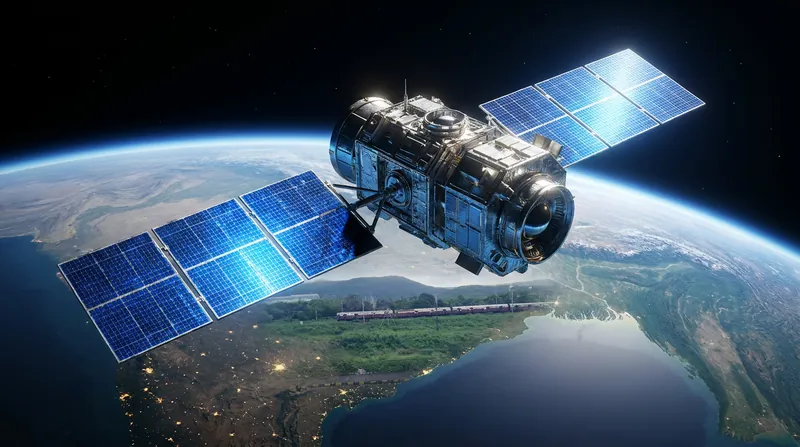
Elon Musk’s SpaceX has formally petitioned the Federal Communications Commission (FCC) for authorization to deploy up to one million satellites designed exclusively to function as orbital artificial intelligence data centers. The unprecedented regulatory filing outlines a sweeping vision to shift the most energy-intensive computational tasks off the planet, leveraging the unique environment of low Earth orbit to power the next generation of artificial general intelligence.
If approved, the constellation would dwarf all existing human infrastructure in space, representing a fundamental shift in how global computing power is generated, stored, and distributed. This move comes as terrestrial power grids face unprecedented strain from the exponential growth of AI facilities.[1][2]
The core engineering rationale behind the proposal hinges on the twin bottlenecks currently constraining AI development on Earth: electricity generation and thermal management. By positioning server farms in orbit, SpaceX argues that these data centers can harvest continuous, unfiltered solar energy without the interruptions of weather or the diurnal cycle.
Furthermore, the ambient temperature of space provides a theoretically limitless heat sink, eliminating the need for the millions of gallons of fresh water currently consumed by terrestrial data centers for cooling purposes. This off-world approach aims to decouple the advancement of AI from Earth's finite ecological resources.[2]
Financial analysts estimate the total capital expenditure required to manufacture, launch, and maintain a million-satellite constellation at roughly $2 trillion over the next decade. This staggering figure exceeds the gross domestic product of many developed nations and represents a massive escalation in capital requirements even for SpaceX, which is currently valued as the world's most prominent private aerospace company. Funding for the initiative is expected to rely heavily on revenue generated by the existing Starlink internet service, alongside massive capital injections from leading AI developers desperate for unconstrained compute capacity.[2]
To achieve the deployment of one million orbital servers, SpaceX will need to scale its launch operations to a cadence previously considered science fiction. The filing indicates that the company plans to utilize its fully reusable Starship launch vehicle, conducting multiple flights per day from spaceports distributed globally.
Even with Starship's massive payload capacity, deploying a million satellites will require tens of thousands of individual launches, testing the limits of aerospace manufacturing, propellant production, and orbital traffic management. The logistics of simply fueling this many rockets will require a massive expansion of liquid oxygen and methane production facilities.[1][3]
Data transmission between the orbital compute nodes and terrestrial users presents another formidable technical challenge. The satellites will reportedly utilize an advanced iteration of SpaceX's optical laser communication network, beaming processed data back to Earth-based receiver stations at terabit-per-second speeds. However, network engineers note that while bandwidth may be vast, the physical distance of the satellites will introduce latency that could make real-time, low-latency AI applications challenging. This limitation may restrict the orbital network to asynchronous training runs and massive batch processing tasks, rather than real-time consumer inference.[3]
The regulatory path forward is fraught with unprecedented legal and geopolitical complexities. The FCC, which coordinates spectrum and orbital slot allocations for US-based companies, has never evaluated a proposal of this magnitude.
Telecommunications policy experts emphasize that approving a million new objects in low Earth orbit will require extensive coordination with international bodies, including the International Telecommunication Union (ITU), to prevent spectrum monopolization and ensure equitable access to space for other nations. Rival nations are likely to view the constellation as a strategic dominance of low Earth orbit by an American corporation.
Immediate and intense backlash has materialized from the global astronomical community, which warns that a million highly reflective objects in orbit could effectively end ground-based optical astronomy. Researchers argue that the resulting light pollution would saturate telescope sensors, ruining long-exposure observations of deep space phenomena and severely compromising planetary defense efforts aimed at tracking near-Earth asteroids. Radio astronomers have similarly voiced alarm over the potential for massive electromagnetic interference generated by millions of high-powered servers operating overhead, which could drown out faint cosmic signals.[3][4]
Beyond observational astronomy, the proposal has reignited urgent debates regarding orbital debris and the carrying capacity of low Earth orbit. Space sustainability advocates warn that adding a million new satellites exponentially increases the risk of Kessler syndrome—a theoretical scenario where cascading collisions generate a debris field so dense that it renders space access impossible for generations.
While SpaceX's filing details automated collision avoidance systems and strict de-orbiting protocols for defunct satellites, critics argue that even a 0.1% failure rate would result in a thousand dead, uncontrollable objects hurtling through crowded orbital planes.[3][4]
The environmental calculus of the proposal presents a complex paradox for policymakers and climate scientists. On one hand, migrating AI training to space could save terrestrial power grids from collapse and drastically reduce the carbon emissions associated with building new natural gas or coal plants to feed data centers. On the other hand, the atmospheric impact of launching tens of thousands of Starship rockets—injecting black carbon, water vapor, and nitrogen oxides into the upper atmosphere—remains poorly understood and could inadvertently accelerate ozone depletion or alter global climate patterns.[2][4]
The FCC has initiated a mandatory public comment period, which is expected to draw record-breaking engagement from tech conglomerates, environmental groups, rival aerospace firms, and international space agencies. As regulators begin the arduous process of evaluating the technical and environmental impact statements, SpaceX is reportedly already constructing prototype 'compute-sats' at its Texas facilities, signaling its intent to move aggressively forward regardless of the mounting terrestrial opposition. The outcome of this regulatory battle will likely define the physical architecture of the AI industry for the next century.[1]
Key points
- SpaceX has asked the FCC for permission to launch up to 1 million AI data center satellites.
- The project aims to utilize continuous solar energy and the natural cooling environment of space.
- Financial analysts estimate the total cost of the constellation at roughly $2 trillion.
- Astronomers warn the sheer number of satellites could severely disrupt ground-based observations.
Unanswered questions
- Whether the FCC possesses the statutory authority to approve a constellation of this unprecedented scale without international consensus.
- How the atmospheric emissions from the tens of thousands of rocket launches required will impact global climate patterns.
- If the latency of space-to-Earth data transmission will make orbital AI training economically viable compared to terrestrial alternatives.
How we got here
2019
SpaceX begins launching the first Starlink internet satellites, proving the viability of mass-produced mega-constellations.
2023-2024
The generative AI boom triggers a massive surge in terrestrial data center construction and unprecedented energy demand.
2025
Tech companies publicly warn of impending power grid bottlenecks that could severely limit the development of advanced AI models.
June 2026
SpaceX files a formal request with the FCC to deploy the 1-million satellite orbital AI constellation.
- Tech & Energy Optimists
- Believe moving AI to space is necessary to prevent terrestrial energy grid collapse.
- Astronomical Community
- Warn that the constellation will blind telescopes and ruin the night sky.
- Regulatory Skeptics
- Question the legality and safety of privatizing low Earth orbit on this scale.
Perspectives this story doesn't cover
- Indigenous groups and cultural heritage organizations whose traditions rely on a pristine, unpolluted night sky.
- Developing nations who may be permanently priced out of utilizing low Earth orbit due to overcrowding by a single private corporation.
Sources
Source coverage
4 outlets
3 viewpoints surfaced




- [1]PCMag
SpaceX Eyes 1 Million Satellites for Orbital Data Center Push
Read on PCMag → - [2]Sky & Telescope
SpaceX Aims to Launch Up to 1 Million AI Data Center Satellites
Read on Sky & Telescope → - [3]Light Reading
SpaceX seeks FCC approval for mega AI data center constellation
Read on Light Reading → - [4]Engadget
The Space Shuttle Endeavour goes on public display later this year
Read on Engadget →

More in Business
See all →Satellite Internet
How Jio Platforms Plans to Build India's First Sovereign Satellite Internet Constellation
4 sources
Advanced Nuclear
US Nuclear Pilot Program Hits Key Milestone as Valar Atomics Advances Small Modular Reactor Tech
3 sources
Geothermal Tech
How the Oil and Gas Playbook is Unlocking 24/7 Geothermal Energy
3 sources

Corporate Accounting
Six Tests Under IAS 38 Separate Expensed Research From Capitalized Development on Corporate Balance Sheets
3 sources

Comments
Every angle. Every day.
Get Business stories with full source coverage and perspective breakdowns, free every day.