
SpaceX’s Record $2.2 Trillion IPO: How It Happened and What It Means for Global Markets
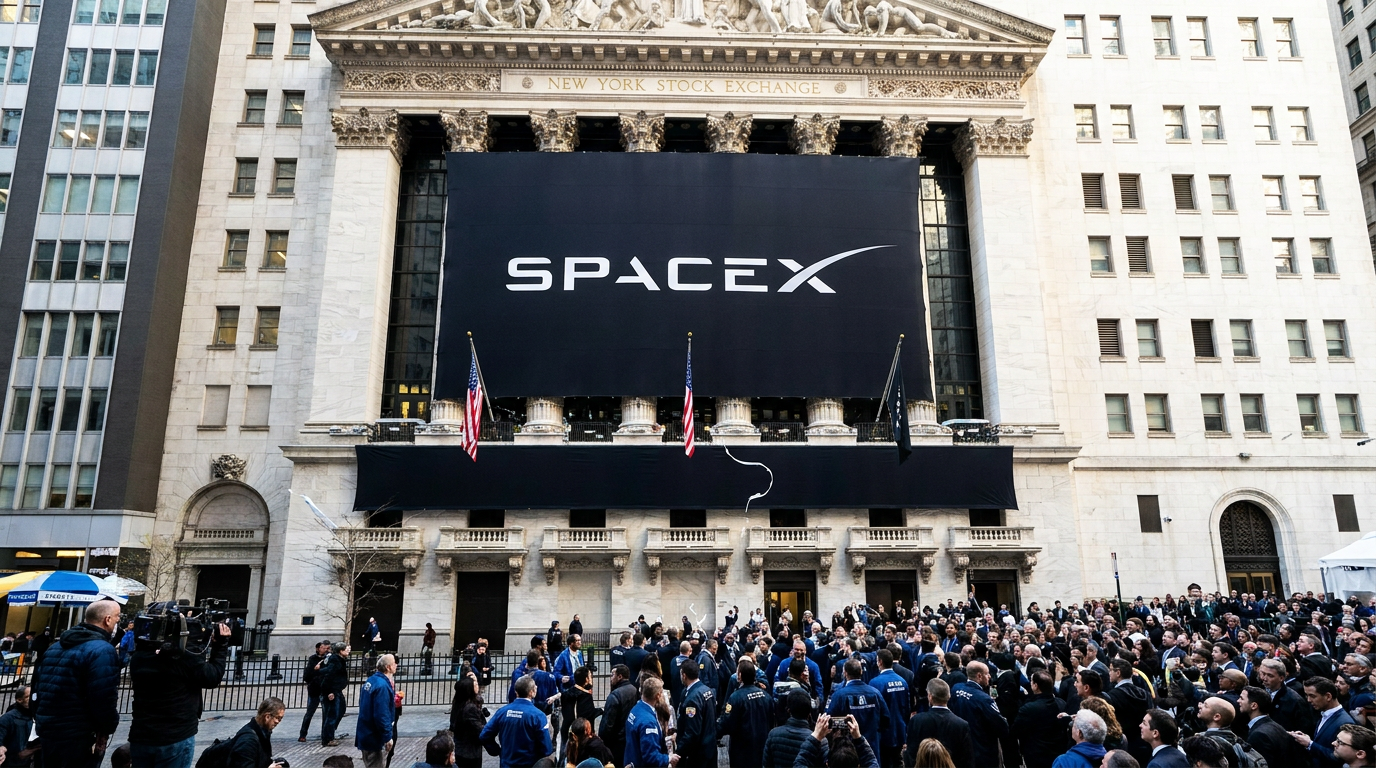
SpaceX executed the largest initial public offering in history, raising $75 billion and reaching a $2.2 trillion market capitalization on its first day of trading. The unprecedented debut has minted the world's first trillionaire and sparked intense debate over corporate governance and index fund inclusion.
By Factlen Editorial Team
- Space Industry Optimists
- View the historic valuation as long-overdue validation of the commercial space economy and a catalyst for further sector investment.
- Institutional Fiduciaries
- Express deep concern over the lack of traditional governance, super-voting shares, and the systemic risks of forced index inclusion.
- Retail Bulls
- See the stock as a generational buy-and-hold opportunity tied to human expansion into space and satellite internet dominance.
What's not represented
- · Competitors in the aerospace sector
- · Regulatory bodies overseeing space launches
Why this matters
Because major index providers are fast-tracking SpaceX into global benchmarks, anyone with a standard retirement account or passive index fund is about to become a SpaceX shareholder, regardless of their appetite for space-industry risk.
Key points
- SpaceX executed the largest IPO in history, raising $75 billion and hitting a $2.2 trillion valuation.
- The surge in valuation made founder Elon Musk the world's first trillionaire.
- Major index providers are bypassing traditional seasoning periods to fast-track SpaceX into global benchmarks.
- Fast-tracking forces passive index funds and retirement accounts to automatically purchase SpaceX shares.
- Institutional watchdogs are raising alarms over the company's lack of independent board oversight and concentrated founder control.
The sheer scale of the event has instantly rewired the global equities landscape. On June 12, 2026, SpaceX executed the largest stock-market debut in financial history, raising $75 billion in its initial public offering. By the close of its first day of trading, the aerospace manufacturer and satellite internet provider had achieved a market capitalization of approximately $2.2 trillion, immediately placing it among the most valuable publicly traded entities on Earth.[1][6]
The immediate financial consequence for the company's founder was historic. The surge in valuation pushed Elon Musk's estimated net worth past the $1 trillion mark, making him the first individual in modern history to reach trillionaire status. This milestone has dominated popular coverage, but the structural implications for the broader financial ecosystem are far more profound.[1][4]
A $2.2 trillion public company cannot simply exist on the periphery of the market; its sheer gravitational pull forces institutional investors to adjust their portfolios. How did a private aerospace company achieve a valuation rivaling established tech giants like Apple and Microsoft? The answer lies in its dual-monopoly structure, which has fundamentally altered the economics of space.[6][7]

SpaceX dominates the global commercial launch market with its reusable Falcon 9 and Falcon Heavy rockets, effectively cornering the market for lifting payloads into orbit. Simultaneously, it operates Starlink, a rapidly expanding satellite internet constellation that generates massive, recurring subscription revenue from both consumer and enterprise clients globally.[1][3]
Heather Pringle, CEO of the Space Foundation, noted that the IPO marks a significant milestone for a maturing space sector. She highlighted that the public listing demonstrates that space is no longer just a realm for government expenditure, but a viable pathway to profitability through communications, launch services, and navigation technologies.[3]
Retail investors have flooded the zone, eager to capture a piece of the space economy. Market commentators, including CNBC's Jim Cramer, have framed the stock as a generational long-term bet on space exploration, urging investors to look past near-term volatility and focus on the company's multi-decade trajectory toward Mars and beyond.[5][8]
Retail investors have flooded the zone, eager to capture a piece of the space economy.
However, the most consequential mechanism of this IPO is its fast-tracked inclusion into major passive indices, such as the MSCI Global Standard and FTSE Russell. Typically, index providers require a "seasoning period" and a proven track record of public earnings before adding a newly listed company to their core benchmarks.[2][7]
Because of SpaceX's unprecedented size, these traditional criteria are being bypassed. This fast-tracking means that passive investment vehicles—including standard 401(k) target-date funds and broad market exchange-traded funds—will automatically be forced to purchase SpaceX shares to match the new index weightings.[2][7]

Millions of everyday investors are now exposed to the company's performance, whether they actively chose to invest in the space sector or not. This forced buying has alarmed institutional watchdogs and governance experts who worry about the precedent being set by index providers bending their own rules.[7][8]
New York City Comptroller Mark Levine has publicly criticized the index inclusion, highlighting SpaceX's unorthodox corporate governance structure. Levine pointed out that the company operates with a single individual holding dominant control, limited shareholder voting rights, and a lack of traditional independent board oversight.[2]
For institutional fiduciaries managing public pension funds, this concentration of power presents a unique risk profile. They argue that bypassing the seasoning period for a company with such concentrated control exposes passive investors to outsized key-man risk without the standard protections expected in public markets.[2][7]

Despite the euphoric debut, significant uncertainties remain regarding the company's operational future. The $2.2 trillion valuation heavily depends on the successful commercialization of Starship, SpaceX's next-generation heavy-lift vehicle, which is essential for deploying the next iteration of Starlink satellites and fulfilling NASA contracts.[1][6]
Furthermore, the space industry is inherently capital-intensive and prone to catastrophic physical risks. A single launch failure, a regulatory grounding by the FAA, or a satellite deployment anomaly could trigger massive swings in a stock that is now a cornerstone of global equities.[3][8]
Ultimately, the SpaceX IPO is more than just a record-breaking capital raise; it represents a structural shift in the global equity market. It tests the limits of founder control in public markets, forces a reevaluation of how emerging industries are valued by Wall Street, and inextricably links the retirement savings of millions to the success of human spaceflight.[1][2][3]
How we got here
2002
SpaceX is founded with the goal of reducing space transportation costs and enabling the colonization of Mars.
2020
SpaceX becomes the first private company to send humans to the International Space Station.
2024
The company successfully completes critical orbital test flights of its next-generation Starship rocket.
June 12, 2026
SpaceX goes public, raising $75 billion in the largest IPO in financial history.
Viewpoints in depth
Space Industry Optimists
View the historic valuation as long-overdue validation of the commercial space economy and a catalyst for further sector investment.
For advocates of the commercial space sector, the $2.2 trillion valuation is not a bubble, but a rational pricing of a dual-monopoly. They point to SpaceX's absolute dominance in the launch market with its reusable Falcon rockets, which have drastically lowered the cost of reaching orbit. Furthermore, the rapid expansion of the Starlink satellite internet constellation provides a massive, recurring revenue stream that traditional aerospace contractors lack. Industry leaders argue that this IPO proves space is a viable, highly profitable sector, which will unlock billions in venture capital for smaller space startups and accelerate human expansion into the solar system.
Institutional Fiduciaries
Express deep concern over the lack of traditional governance, super-voting shares, and the systemic risks of forced index inclusion.
Pension fund managers and corporate governance watchdogs are deeply unsettled by the mechanics of this IPO. Their primary grievance is the fast-tracking of SpaceX into major indices like MSCI and FTSE Russell, which bypasses the traditional 'seasoning period' required to prove a company's public market stability. Because passive funds must buy the stock to match the index, millions of retail investors are forced to take on the risk of a company controlled almost entirely by a single founder. Critics argue that the lack of an independent board and the existence of super-voting shares strip public shareholders of their ability to hold management accountable, introducing unprecedented key-man risk into the bedrock of global retirement portfolios.
Retail Bulls
See the stock as a generational buy-and-hold opportunity tied to human expansion into space and satellite internet dominance.
Retail investors and market commentators have largely embraced the IPO as a rare opportunity to invest in a paradigm-shifting technology company at the ground floor of its public life. Driven by the narrative of colonizing Mars and providing global internet access, this camp views near-term volatility and governance concerns as secondary to the company's long-term trajectory. They argue that traditional valuation metrics and governance structures are ill-suited for a company attempting to fundamentally alter human civilization, and that the premium placed on the stock is justified by its track record of achieving what legacy aerospace companies deemed impossible.
What we don't know
- How the stock will perform once the initial IPO euphoria subsides and the company faces its first public quarterly earnings reports.
- Whether regulatory bodies like the SEC will intervene to enforce stricter governance requirements on mega-cap companies with concentrated founder control.
- How potential delays or failures in the Starship program will impact the company's valuation and the broader market indices it now anchors.
Key terms
- Initial Public Offering (IPO)
- The process by which a private company offers shares to the public for the first time, raising capital and transitioning to a publicly traded entity.
- Market Capitalization
- The total dollar market value of a company's outstanding shares of stock, calculated by multiplying the current stock price by the total number of outstanding shares.
- Index Fund
- A type of mutual fund or ETF with a portfolio constructed to match or track the components of a financial market index, providing broad market exposure.
- Seasoning Period
- A required timeframe during which a newly public company must trade and report earnings before it is eligible to be included in major market indices.
- Fiduciary
- A person or organization that acts on behalf of another person or persons, putting their clients' interest ahead of their own, with a duty to preserve good faith and trust.
Frequently asked
How much did SpaceX raise in its IPO?
SpaceX raised $75 billion in its initial public offering, making it the largest stock-market debut in history.
What is SpaceX's market capitalization?
At the end of its first day of trading, SpaceX reached a market capitalization of approximately $2.2 trillion.
Why are index funds buying SpaceX stock?
Major index providers like MSCI and FTSE Russell are fast-tracking SpaceX into their benchmarks due to its massive size, which forces passive index funds and ETFs to purchase the stock to match the index.
What are the concerns about SpaceX's governance?
Critics, including the NYC Comptroller, point out that SpaceX operates with a single individual holding dominant control and lacks the traditional independent board oversight expected of a $2.2 trillion public company.
Sources
Source coverage
8 outlets
3 viewpoints surfaced






[1]BloombergInstitutional Fiduciaries
What to Know About SpaceX’s Record-Breaking IPO
Read on Bloomberg →NYC Comptroller Raises Concerns Over SpaceX Index Inclusion and Governance Structure
Read on Bloomberg →SpaceX IPO Sparks Surge in Space Industry Investment and Market Optimism
Read on Bloomberg →[4]ForbesSpace Industry Optimists
How Elon Musk Just Became The World's First Trillionaire
Read on Forbes →[5]CNBCRetail Bulls
Jim Cramer says it's not too late to buy SpaceX — under one condition
Read on CNBC →[6]Reuters
SpaceX valuation hits $2.2 trillion in historic market debut
Read on Reuters →[7]Financial TimesInstitutional Fiduciaries
Index providers face pressure over SpaceX fast-track inclusion
Read on Financial Times →[8]The Wall Street JournalRetail Bulls
Retail investors pile into SpaceX following record IPO
Read on The Wall Street Journal →
Every angle. Every day.
Get business stories with full source coverage and perspective breakdowns delivered to your inbox.