
SpaceX's historic $75 billion IPO and the dawn of the trillionaire era, explained
SpaceX shattered market records with a $75 billion Nasdaq debut, pushing its valuation past $2 trillion and cementing Elon Musk as the world's first trillionaire.
By Factlen Editorial Team
- Bullish Growth Investors
- View SpaceX as a foundational infrastructure platform for the future of space and AI, justifying its premium valuation.
- Fundamental Value Analysts
- Argue the company is severely overvalued based on traditional financial metrics and carries significant governance risks.
- Retail Market Participants
- Eager to own a piece of Elon Musk's growth story, driving massive demand regardless of near-term profitability.
What's not represented
- · Competitors in the launch market
- · Environmental groups monitoring launch impacts
Why this matters
This record-breaking public debut not only reshapes global wealth rankings but also opens the commercial space and AI infrastructure sectors to everyday investors. It serves as a massive bellwether for the tech industry, proving that public markets still have an immense appetite for ambitious, capital-intensive innovation.
Key points
- SpaceX raised a record-breaking $75 billion in its Nasdaq debut, pricing shares at $135.
- The stock surged 19% on its first day, pushing the company's valuation past $2 trillion.
- The massive valuation cemented CEO Elon Musk as the world's first trillionaire.
- The company's S-1 filing revealed a three-pillar business model: space launch, Starlink connectivity, and AI infrastructure.
- Despite surging revenues, SpaceX remains unprofitable due to heavy capital expenditures in AI and data centers.
- Analysts are sharply divided, with bulls projecting massive growth and bears warning of severe overvaluation.
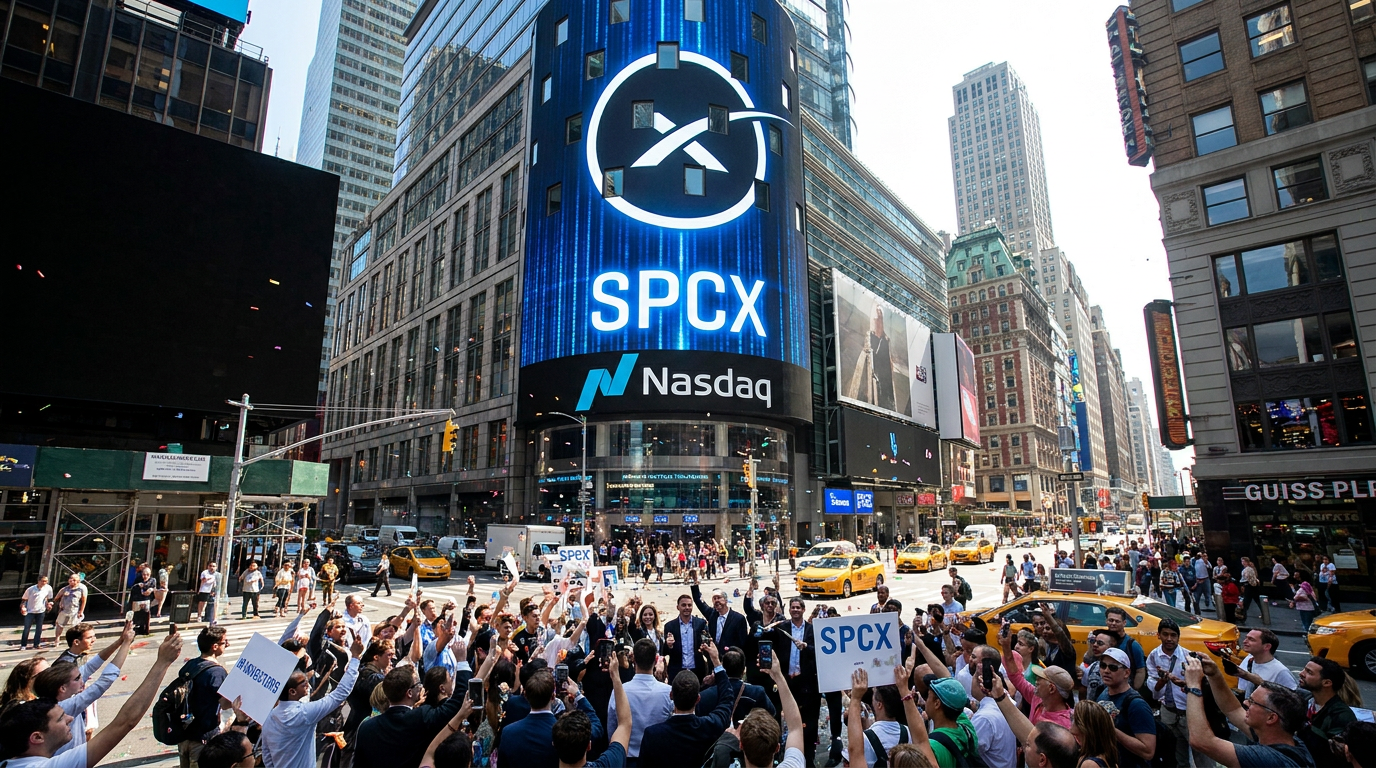
The financial world witnessed history on June 12, 2026, as Space Exploration Technologies Corp. officially transitioned from a private aerospace juggernaut into a publicly traded behemoth. Debuting on the Nasdaq under the ticker symbol SPCX, the company priced its initial public offering at a fixed $135 per share. The offering raised a staggering $75 billion, instantly valuing the company at $1.77 trillion. It was a watershed moment that redefined the scale of modern capital markets, marking the culmination of a decades-long ambition to commercialize the cosmos.[1][8]
The market's appetite for the stock proved insatiable from the opening bell. Shares surged 19% during their first day of trading, closing at approximately $161. This immediate pop pushed SpaceX's market capitalization comfortably past the $2 trillion threshold, placing it among the most valuable corporations on Earth. The trading volume surpassed 500 million shares, testing the limits of the exchange's infrastructure as institutional and retail buyers scrambled for a piece of the newly public entity.[2][5]
To understand the sheer magnitude of the SPCX debut, one must look at the previous records it shattered. Before this week, the largest IPO in global history belonged to Saudi Aramco, which raised $29.4 billion in 2019, followed by Alibaba's $25 billion debut in 2014. SpaceX nearly tripled that high-water mark. Investor demand reportedly exceeded $250 billion for the $75 billion offering, meaning the deal was oversubscribed by more than three times despite its unprecedented size.[1][6]

The most immediate human consequence of the IPO was the rewriting of global wealth rankings. By the time the markets closed on Friday, CEO Elon Musk's personal fortune had crossed a once-unfathomable threshold: he became the world's first trillionaire. Holding roughly 42% of the company alongside millions of exercisable stock options, Musk's net worth swelled to an estimated $1.14 trillion. To put that figure into perspective, his personal wealth now exceeds the annual economic output of all but roughly twenty nations.[2][4][5]
But what exactly did investors buy for $1.77 trillion? The company's S-1 registration statement, filed with the Securities and Exchange Commission, revealed a complex conglomerate rather than a simple rocket manufacturer. The filing officially segmented SpaceX into three distinct pillars: Space, Connectivity, and Artificial Intelligence. This tripartite structure fundamentally altered how Wall Street analysts modeled the company's future cash flows.[3][8]
The foundational pillar remains the Space segment, which has achieved an effective monopoly on commercial access to orbit. In 2025, SpaceX completed a record 165 orbital launches, capturing approximately 82% of the global commercial launch market. This segment is bolstered by deep ties to the federal government, having accumulated more than $22 billion in contracts from NASA and the Department of Defense, including a recent $4.16 billion award for a missile-tracking constellation.[8]
The second pillar, Connectivity, is currently the company's primary economic engine. The Starlink satellite broadband network has grown to encompass over 9 million active users globally. According to the IPO prospectus, Starlink generated the vast majority of SpaceX's $18.67 billion in total revenue for 2025. By providing high-speed internet to rural, maritime, and aviation markets, Starlink transformed SpaceX from a specialized aerospace contractor into a global telecommunications provider.[8]

The second pillar, Connectivity, is currently the company's primary economic engine.
The third and most heavily debated pillar is Artificial Intelligence. In February 2026, SpaceX executed a $1.25 trillion all-stock acquisition of xAI, Musk's generative AI venture. This merger integrated advanced machine learning capabilities and massive data center infrastructure directly into the SpaceX ecosystem. The move explicitly pitched the company to investors not just as a space logistics firm, but as the ultimate AI and orbital data infrastructure play.[3][8]
Despite the staggering top-line growth—revenue jumped 33% year-over-year in 2025—the financial realities beneath the hood reveal a company burning through cash at an astonishing rate. SpaceX remains unprofitable, posting a $4.28 billion net loss in the most recent quarter. This deficit is driven almost entirely by capital expenditures, which more than doubled to $10.1 billion in a single quarter as the company raced to build out AI compute clusters and next-generation Starship hardware.[8]
For bullish investors, these losses are a necessary down payment on an inescapable technological moat. Lead underwriters at Goldman Sachs argue that SpaceX should not be valued on traditional aerospace multiples. Instead, they model the company as a foundational tech platform, projecting that total revenue could scale to $160 billion by 2028. In this view, the AI-related segment alone could be worth hundreds of billions as SpaceX monetizes space-based data processing.[6]
Conversely, fundamental value analysts are sounding alarms over what they view as a severe market dislocation. Researchers at Morningstar published a fair value estimate of just $780 billion—less than half of the IPO target. They caution that buying in at a near-100x price-to-sales ratio requires a belief in decades of flawless execution. Morningstar's models assign heavy probability discounts to the unproven economics of the AI segment, warning of a massive "Musk premium" baked into the stock.[7]

Prominent finance academics have echoed this skepticism. Aswath Damodaran, a valuation expert at New York University, publicly critiqued the $1.8 trillion figure as being detached from financial gravity. He argued that the valuation is driven by an emotional eagerness to own a piece of a futuristic narrative, rather than a sober assessment of discounted cash flows. In his view, the market is pricing in the colonization of Mars rather than the realities of quarterly earnings.[4]
The mechanics of the IPO itself also raised eyebrows across Wall Street. In a highly unusual move for a deal of this size, SpaceX opted for a fixed $135 offer price set before the roadshow, rather than a traditional price range. Analysts estimate that this conservative pricing strategy, combined with the 19% first-day pop, left approximately $20 billion in potential capital on the table—money that accrued to first-day buyers rather than the company's balance sheet.[1]
To mitigate the risk of a massive post-IPO sell-off, SpaceX implemented a unique tiered lockup expiration structure. Rather than the standard 180-day freeze, early investors and employees will be allowed to sell their shares in staggered tranches extending for more than a year. This mechanism is designed to carefully manage the massive influx of liquidity, as roughly 4,400 SpaceX workers became paper millionaires overnight.[6][7]

Beyond the lockup, institutional investors are closely monitoring significant debt and governance risks. The company currently carries a $20 billion bridge loan tied to its AI infrastructure buildout, which matures just 15 months after the IPO. Furthermore, SpaceX maintains a dual-class share structure. Public buyers receive Class A shares with standard voting rights, while Musk and insiders hold Class B shares carrying 10 votes each, granting Musk approximately 85% of total voting control.[7][8]
In a departure from typical mega-IPOs that cater almost exclusively to institutional whales, SpaceX allocated an unusually high 20% of the offering directly to retail investors. This decision democratized access to the space economy, allowing everyday buyers to participate in the debut. It also injected a layer of retail-driven momentum into the stock, drawing comparisons to the fervent community support that has historically buoyed Tesla shares through periods of volatility.[5][6]
Ultimately, the SpaceX IPO serves as a profound bellwether for the broader financial ecosystem. After years of sluggish public listings, the successful $75 billion raise proves that capital markets retain a massive appetite for ambitious, high-growth technology stories. Whether the company can grow into its $2 trillion valuation remains to be seen, but for now, SPCX stands as the undisputed titan of a new era in commercial space and artificial intelligence.[1][6]
How we got here
2002
Elon Musk founds Space Exploration Technologies Corp. with the goal of reducing space transportation costs.
2019
SpaceX begins launching the Starlink satellite constellation to provide global broadband internet.
2025
The company completes a record 165 orbital launches and generates $18.67 billion in full-year revenue.
Feb 2026
SpaceX acquires Musk's artificial intelligence venture, xAI, in a massive $1.25 trillion all-stock merger.
May 2026
The company publicly files its S-1 registration statement with the SEC, detailing its three-pillar business model.
June 12, 2026
SpaceX debuts on the Nasdaq, raising a record $75 billion and pushing Musk's net worth past $1 trillion.
Viewpoints in depth
The Infrastructure Bulls
Investors betting that SpaceX is building the foundational layer for the next century of technology.
Proponents of the $1.77 trillion valuation argue that traditional aerospace metrics fail to capture SpaceX's true addressable market. By combining the world's dominant launch provider, the largest satellite internet constellation, and a massive artificial intelligence operation via xAI, the company is positioning itself as an inescapable utility. Lead underwriters project that revenue could scale to $160 billion by 2028, driven largely by the monetization of orbital data centers and AI compute capabilities that competitors simply cannot replicate.
The Valuation Skeptics
Financial analysts warning that the IPO price bakes in decades of flawless execution.
Fundamental analysts, including researchers at Morningstar and prominent finance academics, caution that a near-100x price-to-sales ratio is mathematically perilous. They peg the company's intrinsic value closer to $780 billion, arguing that the current price reflects a massive 'Musk premium' rather than grounded cash flow projections. Skeptics point to the company's $4.28 billion quarterly net loss, massive capital expenditure requirements, and a $20 billion bridge loan as significant headwinds that retail investors are overlooking in the hype.
The Retail Optimists
Everyday investors treating the stock as a generational buy-and-hold asset.
For retail investors—who received an unusually high 20% allocation of the offering—the fundamentals are secondary to the narrative. Many view SPCX as the ultimate growth stock, akin to buying Amazon in 1997. This camp is less concerned with near-term profitability or lockup expirations, focusing instead on the long-term vision of Mars colonization and artificial general intelligence. Their massive demand, which helped oversubscribe the offering by nearly four times, underscores a willingness to fund visionary tech regardless of traditional valuation models.
What we don't know
- How the unique tiered lockup expiration will impact the stock price when early investors are finally allowed to sell.
- Whether the massive capital expenditures required for xAI's data centers will yield profitable returns in the near term.
- How the company will manage the refinancing of its $20 billion bridge loan maturing 15 months post-IPO.
Key terms
- Initial Public Offering (IPO)
- The process by which a private company offers shares to the public for the first time, allowing it to raise capital from retail and institutional investors.
- Dual-Class Share Structure
- A corporate setup where different classes of shares have different voting rights, often used to keep control of the company in the hands of its founders.
- Price-to-Sales Ratio
- A valuation metric that compares a company's stock price to its revenues, used to evaluate how much investors are willing to pay per dollar of sales.
- Capital Expenditures (CapEx)
- Funds used by a company to acquire, upgrade, and maintain physical assets such as property, industrial buildings, or equipment—in SpaceX's case, rockets and AI data centers.
- Bridge Loan
- A short-term loan used until a person or company secures permanent financing or removes an existing obligation.
Frequently asked
What is SpaceX's stock ticker and where does it trade?
SpaceX trades on the Nasdaq exchange under the ticker symbol SPCX.
How much is SpaceX worth after the IPO?
The IPO priced the company at $1.77 trillion, but a 19% surge on its first day of trading pushed its market capitalization past $2 trillion.
Did SpaceX buy an AI company?
Yes, in February 2026, SpaceX acquired Elon Musk's artificial intelligence venture, xAI, in a $1.25 trillion all-stock deal, integrating AI infrastructure into its core business.
Is SpaceX currently profitable?
No. Despite generating $18.67 billion in revenue in 2025, the company reported a quarterly net loss of $4.28 billion, largely due to massive capital expenditures for AI and data centers.
What is a lockup period?
A lockup period is a timeframe during which early investors and insiders are restricted from selling their shares. SpaceX is using a unique tiered lockup structure that extends for more than a year.
Sources
Source coverage
8 outlets
3 viewpoints surfaced








[1]BloombergFundamental Value Analysts
SpaceX IPO Leaves Billions on the Table Amid High Valuation Concerns
Read on Bloomberg →[2]TechCrunchBullish Growth Investors
SpaceX IPO closes up 19% and delivers the world’s first trillionaire
Read on TechCrunch →[3]Ars TechnicaBullish Growth Investors
SpaceX is now a public company valued for its AI potential, so what comes next?
Read on Ars Technica →[4]The Washington PostFundamental Value Analysts
Elon Musk becomes history's first trillionaire after SpaceX IPO
Read on The Washington Post →[5]CBS NewsRetail Market Participants
Elon Musk becomes world's first trillionaire following SpaceX IPO
Read on CBS News →[6]ForbesBullish Growth Investors
SpaceX IPO: What Retail Investors Need To Know
Read on Forbes →[7]MorningstarFundamental Value Analysts
Morningstar Valuates SpaceX at $780B, Less Than Half of IPO Target
Read on Morningstar →[8]U.S. Securities and Exchange Commission
Form S-1 Registration Statement: Space Exploration Technologies Corp.
Read on U.S. Securities and Exchange Commission →

Every angle. Every day.
Get technology stories with full source coverage and perspective breakdowns delivered to your inbox.