
SpaceX Prices Record $1.77 Trillion IPO, Becoming Largest Public Offering in History
SpaceX has priced its initial public offering at $135 per share, raising $75 billion in a historic market debut that consolidates Elon Musk's aerospace and AI ventures into a single public entity.
By Factlen Editorial Team
- Index and Flow Analysts
- Market structure experts focused on the mechanics of forced buying rather than fundamental valuation.
- Growth Optimists
- Investors who believe the consolidation of space, internet, and AI infrastructure justifies the historic premium.
- Valuation Skeptics
- Analysts warning that the company's cash burn and revenue multiples are disconnected from financial reality.
What's not represented
- · Retail investors locked out of early institutional pricing
- · Competitors in the aerospace and AI sectors facing a newly capitalized giant
Why this matters
The SpaceX IPO is the largest wealth transfer from private to public markets in history, instantly making the company a cornerstone of global index funds. Because major benchmarks fast-tracked its inclusion, anyone with a standard 401(k) or passive retirement account is now a forced investor in a consolidated space, communications, and AI empire.
Key points
- SpaceX priced its IPO at $135 per share, achieving a record-breaking $1.77 trillion valuation.
- The offering raised $75 billion, making it the largest initial public offering in history.
- Following a 2026 merger, the company now includes the xAI division, which is driving massive capital expenditures.
- Major index providers fast-tracked the stock, forcing passive tracker funds to buy billions in shares immediately.
- The company's super-voting structure grants Elon Musk absolute control, prompting protests from major pension funds.
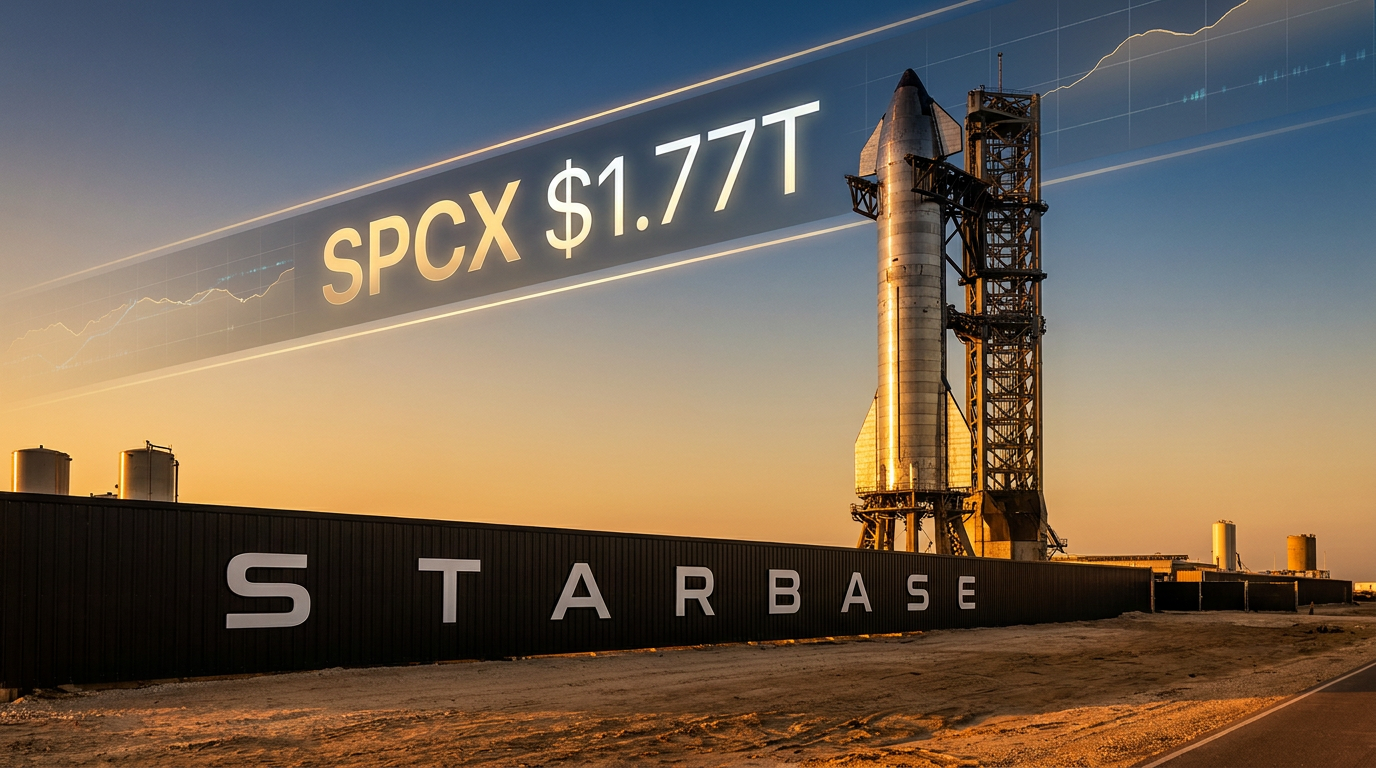
The largest wealth transfer from private to public markets in history is officially underway. On Friday, SpaceX priced its initial public offering at $135 per share, securing a staggering $1.77 trillion valuation as it prepares to debut on the Nasdaq under the ticker SPCX. The offering raised roughly $75 billion, making it the largest IPO ever recorded, dwarfing the $29.4 billion raised by Saudi Aramco in 2019. The sheer scale of the listing has captivated Wall Street, pushing founder Elon Musk to the verge of becoming the world's first trillionaire.[1][2][4][7]
But the company debuting on the public markets today is fundamentally different from the rocket manufacturer of the past decade. Following a sweeping all-stock merger in early 2026, SpaceX absorbed Musk's artificial intelligence venture, xAI, and the social platform X. The result is a sprawling conglomerate that controls an orbital launch monopoly, a global communications network with over 12 million Starlink subscribers, and a frontier AI laboratory. This consolidation of civilizational-scale infrastructure into a single entity is the core driver of the record-breaking valuation.[5][6]
To understand how a company achieves a $1.77 trillion valuation on its first day of trading, one must look at the mechanics of modern equity markets. A critical factor is index inclusion—the process by which a stock is added to major market benchmarks. When a company is added to an index, passive mutual funds and exchange-traded funds that track that benchmark are forced to buy the stock, regardless of its fundamental price.[3][4]

Recognizing the unprecedented size of the offering, index providers MSCI, FTSE Russell, and Nasdaq tweaked their entry criteria to fast-track SpaceX into their benchmarks. This administrative decision guarantees a flood of near-term support, as passive tracker funds are now obligated to absorb roughly 30 percent of the $75 billion deal in the days immediately following the listing. This forced buying creates a structural floor under the stock price, insulating it from immediate downward pressure.[3][4]
However, not all index providers bent their rules. S&P Global refused to fast-track SpaceX into the prestigious S&P 500, dealing a minor setback to the company's efforts to secure blanket institutional demand. The holdout means that funds strictly tracking the S&P 500 will not be forced buyers on day one, creating a divergence in how the broader market digests the massive influx of new equity.[3]
Beyond the mechanics of the listing, the fundamental financial reality of the new SpaceX presents a complex picture. Prior to the 2026 merger, the core aerospace and Starlink divisions had achieved profitability. But the integration of xAI has dramatically altered the company's cash flow profile. The combined entity is now operating at a loss, driven entirely by the staggering capital requirements of training frontier artificial intelligence models.[3][5]
The evidence of this cash burn is stark. Capital expenditures for xAI's data centers and specialized graphics processing units are projected to hit $30.8 billion in 2026 alone—a 142 percent year-over-year increase. Much of the $75 billion raised in the IPO is explicitly earmarked to fund this AI infrastructure build-out, effectively asking public market investors to finance the next generation of compute power.[3][5]

This pivot from a profitable space monopoly to a cash-burning AI conglomerate has sparked fierce debate over the company's valuation. At $1.77 trillion, SpaceX is pricing at roughly 94 times its projected 2025 revenue of $18.7 billion. Traditional fair-value assessments, such as those modeled by Morningstar earlier this month, pegged the company's worth closer to $780 billion. For skeptics, the current multiple represents a dangerous disconnect from financial gravity.[3][5]
This pivot from a profitable space monopoly to a cash-burning AI conglomerate has sparked fierce debate over the company's valuation.
Optimists counter that the $19 billion revenue projection fails to capture the company's true trajectory. Industry analysts point to two recently unveiled mega-contracts with Anthropic and Alphabet that could push SpaceX's run-rate revenues closer to $45 billion. If those contracts materialize as planned, the revenue multiple falls dramatically to a more palatable 39 times sales. The uncertainty lies in whether the AI market can sustain this level of enterprise spending over the long term.[3]
The structure of the order book also introduces unique market dynamics. The IPO was reportedly oversubscribed by nearly four times, with several individual institutional orders exceeding $10 billion. Yet, retail investors—everyday traders—were allocated an unusually high 30 to 40 percent of the total book. This heavy retail participation introduces the potential for extreme volatility, as retail traders are often quicker to flip shares for a quick profit than institutional holders.[3][4]

To mitigate this risk, brokerages have implemented restrictions to discourage retail investors from immediately selling their allocations. Furthermore, insiders and early investors are subject to a lock-up period—a legal restriction preventing them from selling shares for a set time. Musk himself is locked up for 366 days, while other executives will see their shares staggeredly released starting in late 2026.[5][6]
The most contentious aspect of the IPO, however, is the company's corporate governance. SpaceX is going public with a super-voting structure, meaning that certain classes of shares carry multiple votes. This arrangement grants Musk absolute voting control over the company, ensuring that he cannot be removed or overruled by public shareholders, regardless of how much equity they purchase.[4]
This concentration of power has not gone unnoticed. Major pension funds and institutional investors formally protested the governance structure in the weeks leading up to the IPO. Critics argue that handing unaccountable control of orbital logistics, global satellite internet, and frontier AI to a single individual presents a structural risk to the market. Despite the protests, the sheer demand for the stock allowed the company to proceed without altering the voting rights.[4]
Finally, the macroeconomic backdrop adds a layer of friction to the debut. SpaceX is launching into a turbulent environment characterized by inflation running above 4 percent and the Federal Reserve signaling that interest rates will remain higher for longer. The broader AI trade has wobbled in recent days, with roughly $1 trillion erased from chip stocks as the market digests the reality of prolonged high borrowing costs.[4]
The success of the SpaceX IPO will serve as the ultimate test of whether the narrative of artificial intelligence and space dominance can override traditional macroeconomic constraints. If the stock holds its $1.77 trillion valuation, it will validate the market's willingness to fund civilizational-scale ambitions regardless of the cost. If it falters, it may signal the limit of what public markets are willing to bear.[3][4]
How we got here
2002
Elon Musk founds Space Exploration Technologies Corp. (SpaceX) with the goal of reducing space transportation costs.
2019
SpaceX begins launching the first operational satellites for its Starlink global internet constellation.
February 2026
SpaceX executes an all-stock merger with xAI and X, consolidating Musk's aerospace, communications, and AI ventures.
June 11, 2026
The company prices its initial public offering at $135 per share, raising a record $75 billion.
June 12, 2026
SpaceX shares officially begin trading on the Nasdaq under the ticker SPCX.
Viewpoints in depth
Valuation Skeptics
Analysts warning that the company's cash burn and revenue multiples are disconnected from financial reality.
Skeptics argue that a $1.77 trillion valuation—roughly 94 times projected 2025 revenue—is dangerously high for a company that recently pivoted from a profitable aerospace monopoly into a cash-burning AI conglomerate. They point to the $30.8 billion in capital expenditures required by the xAI division this year alone, noting that independent fair-value estimates placed the company closer to $800 billion. From this view, the IPO is priced for absolute perfection in a macroeconomic environment that is increasingly hostile to long-duration tech investments.
Index and Flow Analysts
Market structure experts focused on the mechanics of forced buying rather than fundamental valuation.
This camp views the IPO primarily as a mechanical market event. Because major index providers like MSCI and FTSE Russell fast-tracked the stock's inclusion, passive tracker funds are legally obligated to purchase roughly 30 percent of the $75 billion deal immediately. These analysts argue that this forced institutional buying creates an artificial floor under the stock price, rendering traditional valuation metrics temporarily irrelevant as the sheer weight of passive capital absorbs the available float.
Long-Term Techno-Optimists
Investors who believe the consolidation of space, internet, and AI infrastructure justifies the historic premium.
Optimists view the combined SpaceX entity as an unprecedented civilizational monopoly. They argue that controlling the dominant space launch provider, a global satellite communications network with 12 million subscribers, and a frontier AI lab justifies the $1.77 trillion price tag. This camp points to unannounced mega-contracts with major tech firms that could rapidly double the company's revenue, arguing that the massive capital expenditures are necessary investments to secure dominance in the next era of computing.
What we don't know
- Whether the retail-heavy allocation will lead to extreme price volatility in the weeks following the debut.
- How quickly the xAI division can convert its $30.8 billion infrastructure build-out into profitable enterprise contracts.
- Whether the broader market's shift away from AI stocks due to high interest rates will drag down SpaceX's valuation.
Key terms
- Index inclusion
- The process by which a newly public company is added to major stock market benchmarks, forcing passive mutual funds and ETFs to buy the stock.
- Super-voting structure
- A corporate governance setup where certain shares carry multiple votes, allowing founders to retain absolute control even if they own a minority of the equity.
- Lock-up period
- A predetermined window after an IPO during which insiders and early investors are legally restricted from selling their shares.
- Price-to-sales multiple
- A valuation metric that compares a company's total market capitalization to its annual revenue, often used for fast-growing companies that are not yet profitable.
Frequently asked
Why is SpaceX going public now?
The company requires massive amounts of capital to fund its artificial intelligence subsidiary, xAI, which is projected to spend over $30 billion on data centers and GPUs in 2026 alone.
Will SpaceX be added to the S&P 500?
Not immediately. While Nasdaq and FTSE Russell fast-tracked the stock for their indices, S&P refused to waive its standard entry criteria for the debut.
How much of the company does Elon Musk still control?
Through a super-voting share structure, Musk retains absolute voting control over the company, meaning he cannot be removed or overruled by public shareholders.
Sources
Source coverage
7 outlets
3 viewpoints surfaced






[1]The GuardianIndex and Flow Analysts
Elon Musk on track to become world's first trillionaire today as SpaceX lists on US stock market
Read on The Guardian →[2]BloombergGrowth Optimists
SpaceX Poised to Pop After Record IPO
Read on Bloomberg →[3]ION AnalyticsValuation Skeptics
Record SpaceX IPO frenzy masks uncertain true demand, post-listing trajectory
Read on ION Analytics →[4]BankwatchIndex and Flow Analysts
SpaceX prices largest IPO in history today; trades tomorrow
Read on Bankwatch →[5]BitMEX ResearchValuation Skeptics
SpaceX IPO: Two Ways Traders Can Position for the Largest IPO in History
Read on BitMEX Research →[6]Kasikorn SecuritiesGrowth Optimists
KS: Countdown to SpaceX IPO
Read on Kasikorn Securities →Musk On Verge of Trillionaire Status With SpaceX IPO
Read on Bloomberg Television →
Every angle. Every day.
Get business stories with full source coverage and perspective breakdowns delivered to your inbox.