
SpaceX Prices Historic $75 Billion IPO, Targeting $1.77 Trillion Valuation
Elon Musk's aerospace and AI conglomerate is set to debut on the Nasdaq after executing the largest initial public offering in stock market history. While retail and institutional demand has shattered records, analysts remain sharply divided over the company's unprecedented valuation multiples.
By Factlen Editorial Team
- Retail & Institutional Bulls
- Investors who view SpaceX as a monopolistic space infrastructure and AI play that justifies its premium valuation.
- Valuation Skeptics
- Traditional analysts warning that the stock is priced for absolute perfection and ignores massive capital expenditures.
- Regulatory Watchdogs
- Lawmakers and governance critics raising alarms over the concentration of power and lack of traditional shareholder rights.
What's not represented
- · Competitors in the legacy aerospace sector who may face increased pressure as SpaceX gains access to public capital.
- · Astronomers and environmental groups concerned about the rapid proliferation of Starlink satellites in low Earth orbit.
Why this matters
This IPO reshapes the global stock market, instantly creating one of the world's most valuable public companies. For everyday investors, it offers unprecedented access to the space economy, but it also introduces significant portfolio risks tied to a single, highly volatile tech conglomerate.
Key points
- SpaceX priced its initial public offering at $135 per share, raising a record-breaking $75 billion.
- The offering values the aerospace and communications company at approximately $1.77 trillion.
- Retail investors placed over $100 billion in orders, aided by an unusual 30% retail allocation.
- Analysts are divided on the valuation, noting the company's $4.9 billion net loss in 2025 despite strong Starlink revenues.
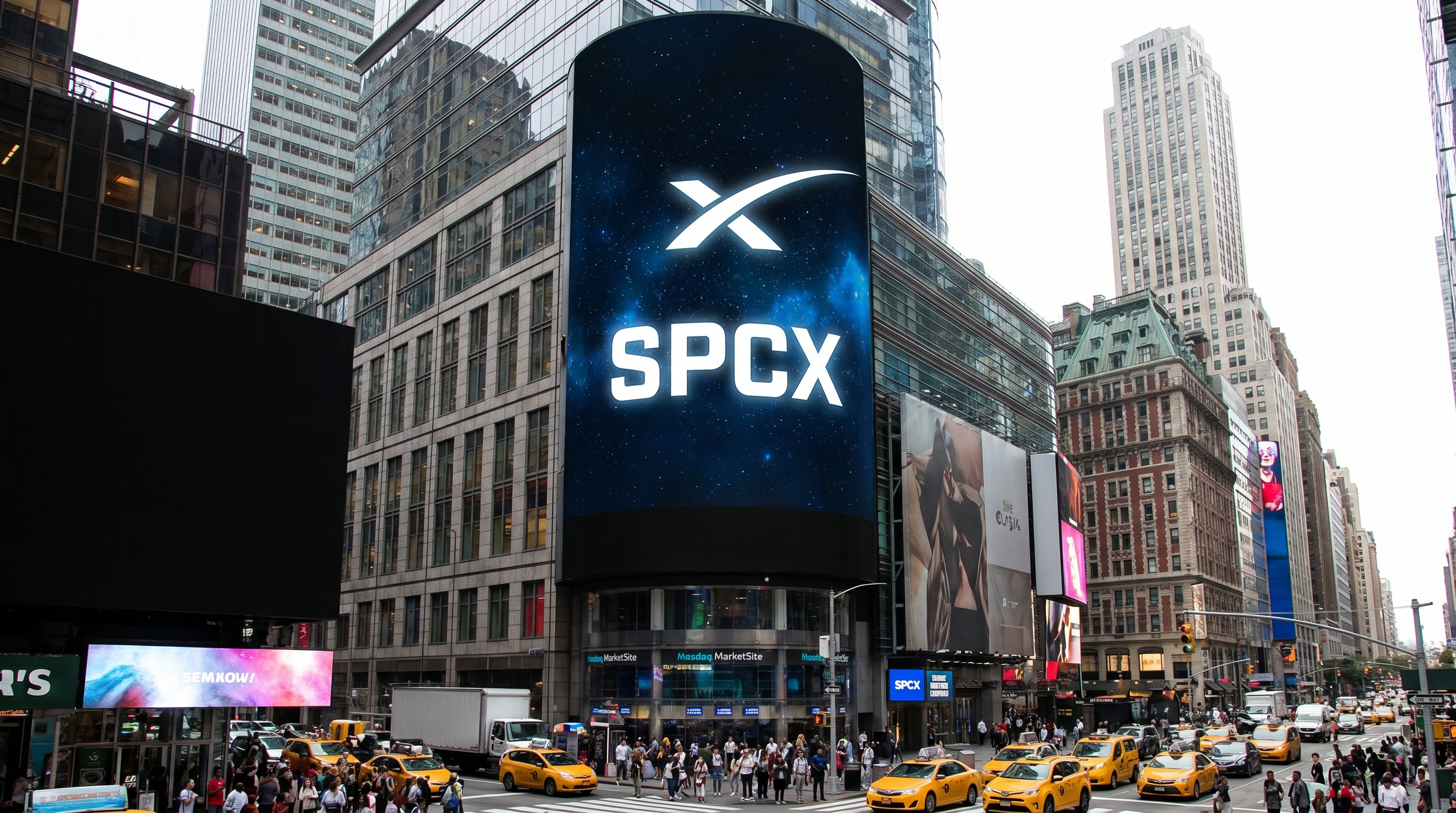
SpaceX is set to rewrite the record books on Friday as it debuts on the Nasdaq under the ticker SPCX, following the largest initial public offering in global market history. Pricing after the bell on Thursday at a fixed $135 per share, the aerospace and communications giant is raising $75 billion.[1][8]
The offering dwarfs the previous global record—Saudi Aramco's $29.4 billion debut in 2019—and values Elon Musk's company at approximately $1.77 trillion. If the stock holds its IPO price in open trading, SpaceX will immediately become one of the most valuable public companies on Earth, trailing only tech behemoths like Apple, Microsoft, and Nvidia.[1][4][8]
The mechanics of the offering were as unconventional as the company itself. Bypassing the traditional Wall Street bookbuilding process where underwriters test a price range over several weeks, SpaceX handed the market a fixed $135 target and moved straight to allocation.[1]

Demand has been staggering. By the time the order book closed, the offering had attracted more than $250 billion in institutional and retail interest, leaving the IPO roughly three-and-a-half times oversubscribed. Retail investors alone placed orders exceeding $100 billion, driven by unprecedented access to the offering.[2]
Historically, retail traders are locked out of mega-cap IPO allocations, which are reserved for institutional clients. However, SpaceX allocated up to 30% of its shares to everyday investors. Brokerages like Fidelity lowered their participation thresholds to just $2,000 in account value to accommodate the surge in interest.[6]
Historically, retail traders are locked out of mega-cap IPO allocations, which are reserved for institutional clients.
The frenzy is fueled by a fundamental shift in SpaceX's business model. While the company is famous for its reusable rockets, the financial engine driving the IPO is Starlink. The satellite internet constellation generated an estimated $11.8 billion in revenue in 2025, crossed the 7-million subscriber mark, and achieved positive cash flow.[4]

Furthermore, the narrative surrounding the stock has expanded beyond the space economy. Following SpaceX's $250 billion acquisition of Musk's artificial intelligence startup xAI in early 2026, institutional investors are increasingly valuing the combined entity as an AI infrastructure play. The integration of xAI's data centers with Starlink's global network has positioned SpaceX at the intersection of two massive growth sectors.[5]
Yet, the astronomical valuation has triggered sharp warnings from traditional financial analysts. Investment research firm Morningstar issued a fair value estimate of just $780 billion—less than half of the IPO pricing—citing a major disconnect between market expectations and underlying fundamentals.[3]
Critics point to the company's bottom line. Despite generating $18.7 billion in total revenue last year, SpaceX posted a net loss of nearly $4.9 billion as it poured capital into its Starship development and AI infrastructure. At $1.77 trillion, the stock is trading at roughly 94 times its trailing sales, a multiple that far exceeds the averages of the largest technology stocks.[1][3][4][5]

Financial advisors are urging caution, particularly for older investors caught up in the hype. Market analysts warn that treating the stock as a guaranteed retirement vehicle ignores the inherent volatility of a company that is priced for absolute perfection and still burning billions in cash annually.[7]
The offering has also drawn scrutiny from Washington. Senator Elizabeth Warren formally requested that the Securities and Exchange Commission delay the IPO, citing concerns over investor protections and governance. Musk will retain 85% of the company's shareholder voting power, an unprecedented level of control for a public entity of this size.[2]
Regardless of the skepticism, the sheer scale of the IPO means passive index funds will eventually be forced to buy the stock, creating a structural floor for demand. As the opening bell approaches on Friday, Wall Street is bracing for a trading session that will test whether the market's appetite for Musk's vision can sustain a nearly two-trillion-dollar reality.[1][4]
How we got here
Dec 2025
SpaceX executes a private tender offer valuing the company at roughly $800 billion.
Feb 2026
SpaceX merges with Elon Musk's artificial intelligence startup xAI in a $250 billion transaction.
May 20, 2026
SpaceX publicly files its S-1 prospectus with the SEC, revealing its financial details.
June 4, 2026
The company launches its investor roadshow with a fixed price target of $135 per share.
June 11, 2026
SpaceX officially prices its IPO, raising $75 billion.
June 12, 2026
Shares debut on the Nasdaq under the ticker SPCX.
Viewpoints in depth
The Bull Case
Investors see SpaceX not just as a rocket company, but as a monopolistic space infrastructure and AI play.
Bulls argue that Starlink's $11.8 billion in revenue proves the viability of a subscription-as-a-service model in space. Combined with the xAI merger, they view the $1.77 trillion valuation as a forward-looking premium for a company that will dominate global connectivity and orbital data centers for decades.
The Valuation Skeptics
Traditional analysts warn that the stock is priced for absolute perfection, ignoring massive capital expenditures.
Skeptics, including Morningstar analysts, point out that a 94x price-to-sales multiple is historically unprecedented for a company of this size. They emphasize that despite top-line growth, SpaceX still posted a nearly $5 billion net loss in 2025, and its valuation relies heavily on the 'Elon Musk premium' rather than standard financial fundamentals.
Corporate Governance Critics
Regulators and corporate watchdogs are raising alarms over the concentration of power and lack of traditional shareholder rights.
With Musk retaining 85% of the voting power, public shareholders will have virtually no say in the company's direction. Lawmakers like Senator Elizabeth Warren argue that this structure, combined with the sheer size of the IPO forcing passive index funds to buy in, strips the market of its usual mechanisms for holding management accountable.
What we don't know
- How the stock will perform in its first hours of open trading, given the massive retail demand and lack of traditional institutional price discovery.
- Whether the SEC will eventually act on lawmakers' requests to review the company's governance structure and Musk's 85% voting control.
- How quickly the xAI integration will yield tangible revenue to justify the combined entity's $1.77 trillion valuation.
Key terms
- Initial Public Offering (IPO)
- The process by which a private company offers shares to the public for the first time, allowing it to raise capital from public investors.
- Bookbuilding
- The traditional process where underwriters determine the price of an IPO by collecting bids from institutional investors over a price range.
- Price-to-Sales Multiple
- A valuation metric that compares a company's stock price to its revenues, used to determine if a stock is overvalued or undervalued.
- Passive Index Funds
- Mutual funds or ETFs designed to track a specific market index, which are often required to buy shares of large new public companies regardless of their individual fundamentals.
Frequently asked
What is the SpaceX IPO price?
SpaceX priced its shares at a fixed $135 each, bypassing the traditional range-finding process.
When does SpaceX start trading?
The stock is scheduled to debut on the Nasdaq exchange on Friday, June 12, 2026, under the ticker symbol SPCX.
Can retail investors buy SpaceX shares?
Yes, SpaceX reserved up to 30% of its offering for retail investors, and brokerages like Fidelity lowered their minimum account requirements to $2,000 to allow broader participation.
Is Starlink a separate stock?
No, Starlink is a subsidiary of SpaceX and is included in the SpaceX IPO. There is currently no standalone Starlink stock.
Sources
Source coverage
8 outlets
3 viewpoints surfaced








[1]ReutersRegulatory Watchdogs
SpaceX targets $1.75 trillion valuation in historic Nasdaq listing
Read on Reuters →[2]ForbesRetail & Institutional Bulls
SpaceX IPO: Regular Investors Reportedly Order $100 Billion In Shares
Read on Forbes →[3]The GuardianValuation Skeptics
SpaceX heads for record $1.78tn float amid fears it is overvalued
Read on The Guardian →[4]Los Angeles TimesRetail & Institutional Bulls
SpaceX is poised to make history with record $75-billion stock IPO
Read on Los Angeles Times →[5]BloombergValuation Skeptics
SpaceX Valuation Is Cheap for Space Peers But Pricey as AI Stock
Read on Bloomberg →[6]Fidelity Investments
SpaceX IPO explained
Read on Fidelity Investments →[7]MarketWatchValuation Skeptics
SpaceX IPO hype is massive — and the FOMO can ruin your retirement
Read on MarketWatch →[8]AxiosRetail & Institutional Bulls
SpaceX raises $75 billion in its IPO
Read on Axios →
Every angle. Every day.
Get finance stories with full source coverage and perspective breakdowns delivered to your inbox.