
SpaceX Prices Historic $75 Billion IPO, Reshaping the Commercial Space Economy
The aerospace giant is set to make its public debut at a $1.77 trillion valuation, bypassing traditional Wall Street mechanics and promising to unlock unprecedented capital for the broader space sector.
By Factlen Editorial Team
- Wall Street Pragmatists
- Institutional bankers and market analysts focused on the unprecedented mechanics and systemic stress of the offering.
- Space Economy Bulls
- Venture capitalists and aerospace startups who view the IPO as a catalyst that will unlock unprecedented growth across the sector.
- Market Skeptics
- Analysts warning about the extreme valuation multiples, cash-burning divisions, and profound key-man risk.
What's not represented
- · Retail investors who are priced out or unable to secure allocations
- · Taxpayers who funded the early NASA contracts that incubated the commercial space sector
Why this matters
The SpaceX IPO marks the transition of the space economy from a government-dominated niche into a mainstream, highly liquid asset class. The $75 billion raised will aggressively accelerate the development of next-generation rockets and satellite networks, directly impacting global telecommunications and the broader technology supply chain.
Key points
- SpaceX is raising $75 billion in the largest initial public offering in history, achieving a valuation of roughly $1.77 trillion.
- The company bypassed traditional Wall Street price discovery, dictating a fixed price of $135 per share for its debut.
- Venture capitalists predict the liquidity event will trigger a 'Netscape moment,' flooding the broader space industry with fresh capital and new startups.
- The offering's immense scale has forced major exchanges and underwriters to rigorously stress-test their systems to prevent technical failures.
- Despite the enthusiasm, skeptics warn of the company's 90x revenue valuation multiple and the profound key-man risk tied to CEO Elon Musk.
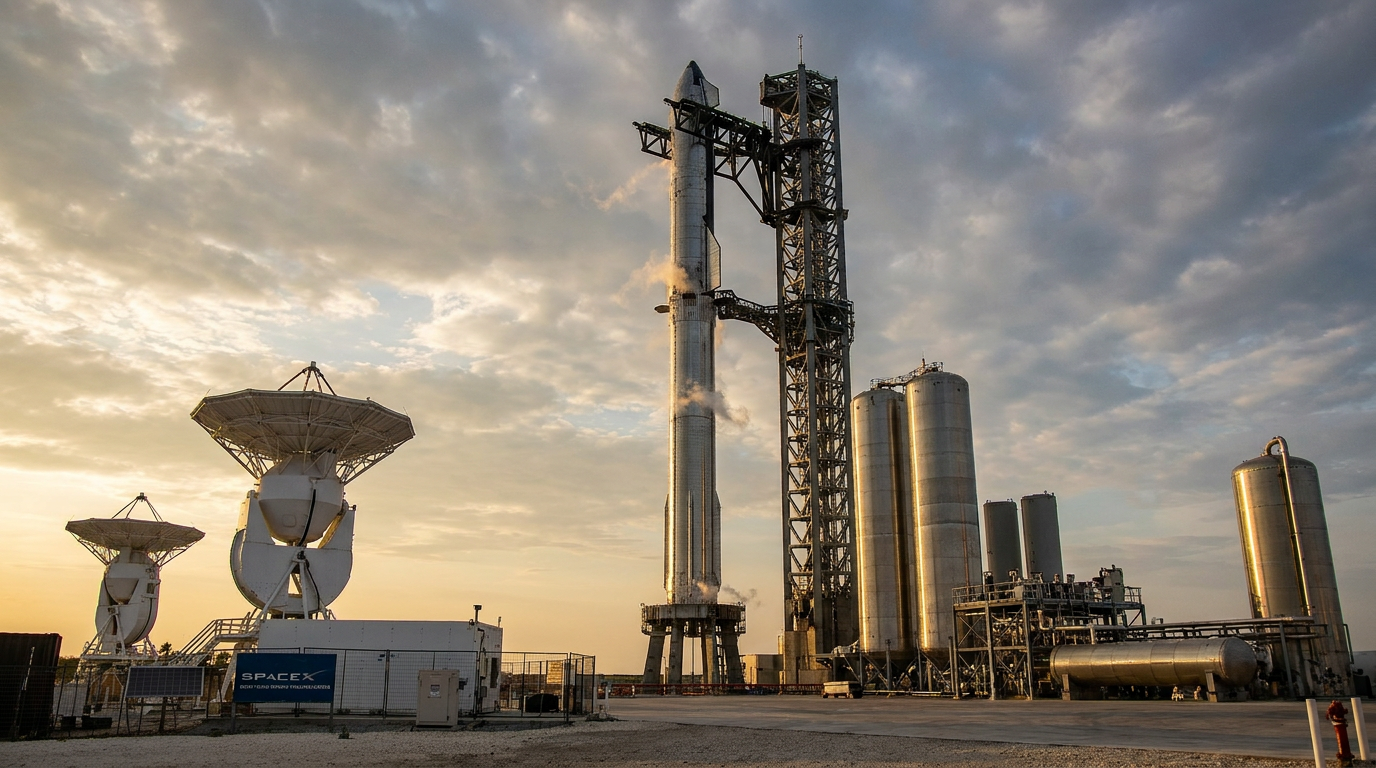
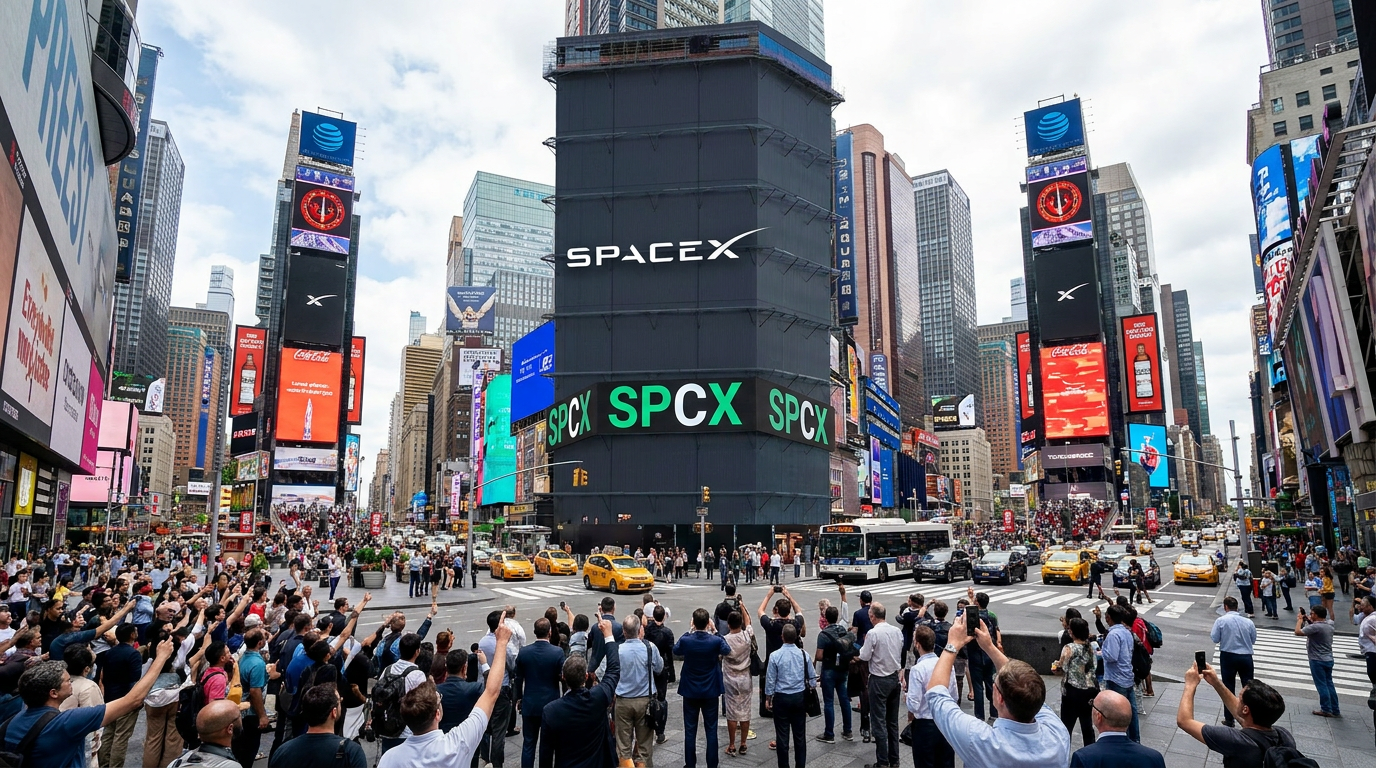
The financial world is bracing for a seismic event that promises to reshape both Wall Street and the cosmos. On Friday, Space Exploration Technologies Corp.—better known as SpaceX—will make its public market debut on the Nasdaq and Nasdaq Texas under the ticker symbol SPCX. The sheer scale of the offering is unprecedented: by selling roughly 555 million shares, the company is raising $75 billion in fresh capital. This eclipses the previous global record of $29.4 billion set by Saudi Aramco in 2019, instantly catapulting SpaceX to a valuation of approximately $1.77 trillion.[1][3]
For the syndicate of 23 investment banks underwriting the deal, led by Goldman Sachs, Morgan Stanley, and Bank of America, the stakes are measured in both historic prestige and systemic risk. Wall Street traders and exchange operators have spent weeks rigorously stress-testing their infrastructure to handle the anticipated surge in retail and institutional volume. The haunting memory of Facebook’s 2012 debut—which was marred by technical glitches that cost market-makers hundreds of millions of dollars—looms large over the proceedings.[3][10]
Yet, the mechanics of this offering defy almost every convention of modern finance. In a traditional initial public offering, underwriters use a "book-building" process, collecting feedback from institutional investors during a roadshow to discover a clearing price based on market demand. SpaceX inverted this dynamic entirely. The company dictated a fixed price of $135 per share, presenting the market with a take-it-or-leave-it proposition that left underwriters with far less flexibility than is typical in a conventional listing.[2][5]

This aggressive posture is made possible by a profound supply-demand imbalance. The offering represents an unusually small "free float"—the portion of shares available to public investors—amounting to less than 5 percent of the company’s total equity. Meanwhile, institutional and retail orders have reportedly exceeded available shares by a factor of three to four. This structure grants the underwriters immense control over the allocation process, but it also leaves the company’s founder, Elon Musk, with an extraordinary degree of unchecked authority over the newly public entity.[2]
Within the venture capital ecosystem, the IPO is being heralded as a watershed moment. Industry veterans are already comparing it to the 1995 Netscape IPO, which proved the commercial viability of the internet and triggered a historic wave of investment. For more than two decades, space technology was viewed as a capital-intensive, high-risk sector largely dependent on government contracts. Today, venture capitalists argue that SpaceX’s debut firmly establishes the cosmos as a mainstream, highly liquid investment category.[4]
Within the venture capital ecosystem, the IPO is being heralded as a watershed moment.
The liquidity event will trigger a massive capital recycling effect. Early backers, including Founders Fund, Sequoia Capital, and Alphabet, are positioned for astronomical returns. More importantly, the IPO is expected to mint thousands of new millionaires among SpaceX’s engineering and operational ranks. Much like the "PayPal Mafia" that seeded the Web2 era, this incoming "SpaceX Mafia" is widely expected to leave the mothership and deploy their newfound wealth and expertise into a new generation of aerospace startups.[4][5]
The ripple effects are already visible across the broader space economy. On the eve of the SpaceX listing, index provider Nasdaq Global Indexes announced that Rocket Lab, a leading provider of medium-class launch services, will be added to the prestigious Nasdaq-100 index on June 22. Rocket Lab’s inclusion alongside mega-cap technology firms underscores how rapidly the commercial space sector is maturing from a speculative fringe into a core component of the modern industrial base.[8]

Downstream startups are also banking heavily on the success of this capital raise. Across aerospace hubs like Seattle and Southern California, a burgeoning ecosystem of satellite manufacturers, orbital logistics firms, and space-data providers have built their business models around the promise of cheap, reliable access to orbit. The $75 billion injection ensures that SpaceX can continue funding the development of Starship, its fully reusable mega-rocket, which promises to lower the cost per kilogram to orbit by an order of magnitude.[9]
The global appetite for the offering has even triggered complex macroeconomic ripples. With foreign investors clamoring for allocations, currency analysts initially speculated that the demand for U.S. dollars to purchase SPCX shares could artificially inflate the greenback. However, foreign exchange experts note that many international funds are likely reallocating existing dollar-denominated assets or selling other U.S. tech stocks to fund their purchases, muting the overall currency impact.[7]
Despite the overwhelming enthusiasm, the offering carries profound risks that are largely obscured by the hype. At a $1.77 trillion valuation, SpaceX is pricing at roughly 90 times its 2025 revenue of $18.7 billion. While its Starlink satellite internet constellation is generating reliable cash flow, the company’s core launch division and its ambitious new artificial intelligence compute initiatives continue to bleed billions of dollars annually.[3][6]

Furthermore, the broader macroeconomic environment is far less forgiving than it was during the zero-interest-rate era. The IPO arrives as the Vix index—Wall Street’s "fear gauge"—is creeping upward amid shifting interest rate expectations and geopolitical friction. Tech stocks have faced waves of volatility in recent weeks, meaning Morgan Stanley, acting as the stabilization agent, may have to aggressively defend the $135 price level if the broader market turns sour.[2][3]
Ultimately, the greatest risk—and the primary engine of the company’s success—is key-man dependency. The entire $1.77 trillion edifice rests on the vision, risk tolerance, and erratic brilliance of Elon Musk. From one perspective, the IPO is a staggering gamble on a single individual. From another, it is a definitive bet that market forces, relentless iterative engineering, and unprecedented capital concentration will succeed in building a self-sustaining interplanetary economy where central planning has historically stalled.[6]
How we got here
2002
Elon Musk founds Space Exploration Technologies Corp. with the ultimate goal of reducing space transportation costs to enable the colonization of Mars.
2012
Facebook goes public in a highly anticipated IPO that is marred by technical glitches, a scenario Wall Street is actively trying to avoid today.
2019
Saudi Aramco raises $29.4 billion in its public debut, setting the previous record for the largest IPO in history.
2025
SpaceX posts a $4.9 billion loss on $18.7 billion in revenue as it scales its Starlink constellation and Starship development.
June 11, 2026
SpaceX officially confirms the pricing of its IPO at a fixed $135 per share.
June 12, 2026
SpaceX shares begin trading on the Nasdaq and Nasdaq Texas under the ticker SPCX.
June 22, 2026
Rocket Lab is scheduled to join the Nasdaq-100 index, reflecting the broader surge in space-tech equities.
Viewpoints in depth
Space Economy Bulls
Venture capitalists and aerospace startups who view the IPO as a catalyst that will unlock unprecedented growth across the sector.
This camp argues that the $75 billion capital injection is just the beginning. By establishing space as a highly liquid, mainstream asset class, the IPO removes the stigma of aerospace being a 'government-only' or overly risky sector. They point to the impending 'SpaceX Mafia'—newly wealthy alumni who will leave to found their own startups—as the engine for a second space age, much like early internet IPOs seeded the modern tech industry.
Wall Street Pragmatists
Institutional bankers and market analysts focused on the unprecedented mechanics and systemic stress of the offering.
For the financial sector, the narrative is dominated by the sheer mechanical difficulty of executing a $75 billion float. Pragmatists are hyper-focused on the fixed $135 price and the unusually small free float, which bypasses traditional price discovery. Their primary concern is ensuring that trading systems do not buckle under the historic retail and institutional demand, prioritizing market stability over aerospace milestones.
Market Skeptics
Analysts warning about the extreme valuation multiples, cash-burning divisions, and profound key-man risk.
Skeptics look past the launchpad triumphs to focus on the balance sheet. They highlight that a $1.77 trillion valuation—roughly 90 times the company's 2025 revenue—leaves zero room for execution errors. Furthermore, they argue that the company's aggressive fixed-price strategy grants Elon Musk an unhealthy level of unchecked control, tying the fate of the world's largest public debut to the erratic decision-making of a single founder.
What we don't know
- How the stock will perform in its opening hours given the unusually small free float and fixed-price structure.
- Whether the influx of capital will be enough to make the cash-intensive Starship and AI compute divisions profitable.
- How much of the newly unlocked wealth will actually flow back into early-stage aerospace startups versus traditional asset classes.
Key terms
- Initial Public Offering (IPO)
- The process of offering shares of a private corporation to the public in a new stock issuance.
- Free Float
- The portion of a company's shares that are in the hands of public investors as opposed to locked-in stock held by promoters or insiders.
- Book-building
- The traditional process where underwriters determine the price of an IPO based on demand from institutional investors.
- Nasdaq-100
- A stock market index made up of 100 of the largest non-financial companies listed on the Nasdaq exchange.
Frequently asked
Why is SpaceX going public now?
The company is raising $75 billion to fund its capital-intensive Starship mega-rocket program and its expanding artificial intelligence data center ambitions.
How does this IPO compare to others?
It is the largest in history by a wide margin, raising more than double the $29.4 billion raised by Saudi Aramco in 2019, and valuing the company at over $1.7 trillion.
Will Elon Musk still control the company?
Yes. Despite selling shares to the public, the offering's fixed-price structure and the small free float leave Musk with an unusual level of control over the public entity.
What does this mean for other space companies?
Industry analysts expect the IPO to legitimize space as a mainstream investment category, freeing up venture capital to flow into newer startups and supply chain partners.
Sources
Source coverage
10 outlets
3 viewpoints surfaced










[1]SpaceXWall Street Pragmatists
SpaceX Announces Pricing of Initial Public Offering
Read on SpaceX →[2]Financial TimesWall Street Pragmatists
SpaceX's bankers are preparing for one of Wall Street's biggest tests
Read on Financial Times →[3]Business InsiderWall Street Pragmatists
Wall Street's investment banks are prepping for the biggest IPO in history
Read on Business Insider →[4]PayloadSpace Economy Bulls
VCs Predict the SpaceX IPO Will Lift the Entire Industry
Read on Payload →[5]Crunchbase NewsSpace Economy Bulls
The SpaceX IPO Filing Looks Nothing Like Those Of The Elite Group Of Tech Giants
Read on Crunchbase News →[6]The Washington PostMarket Skeptics
A $1.77 trillion valuation for SpaceX is a bet on one man's vision
Read on The Washington Post →[7]MarketWatchWall Street Pragmatists
The SpaceX IPO is drawing historic demand from foreign investors. But don’t expect a dollar-buying frenzy.
Read on MarketWatch →[8]Rocket LabSpace Economy Bulls
Rocket Lab to Join the Nasdaq-100 Index
Read on Rocket Lab →[9]GeekWireSpace Economy Bulls
SpaceX IPO is likely to boost the Seattle area's space community
Read on GeekWire →[10]Global Banking & Finance ReviewWall Street Pragmatists
Wall Street buckles up for SpaceX liftoff, hoping for a glitch-free ride
Read on Global Banking & Finance Review →
Every angle. Every day.
Get finance stories with full source coverage and perspective breakdowns delivered to your inbox.