
SpaceX Launches Record $75 Billion IPO in Historic Nasdaq Debut
SpaceX has officially entered the public markets, raising $75 billion in the largest initial public offering in history and pushing its valuation past $1.77 trillion.
By Factlen Editorial Team
- Institutional Bulls
- Investors who view SpaceX's monopoly on heavy launch and satellite broadband as justification for its massive valuation.
- Retail Investors
- Individual traders driven by belief in Elon Musk's long-term vision and the opportunity to invest in a multi-planetary future.
- Valuation Skeptics
- Market analysts concerned by the company's 90x sales multiple, recent net losses, and the execution risks of the Starship program.
- Socioeconomic Critics
- Advocacy groups warning about the societal implications of unprecedented wealth concentration and the creation of the first trillionaire.
What's not represented
- · Traditional aerospace competitors
- · Telecommunications providers losing market share to Starlink
Why this matters
This landmark IPO not only shatters global financial records but also opens public investment access to the world's dominant space infrastructure company. The massive influx of capital will accelerate the development of Starship and orbital computing, potentially reshaping global telecommunications and space exploration.
Key points
- SpaceX raised a record-breaking $75 billion in its Nasdaq debut.
- The $135 fixed share price values the aerospace company at $1.77 trillion.
- Total investor demand exceeded $350 billion, oversubscribing the float nearly four times.
- Retail investors were allocated an unprecedented 20% to 30% of the available shares.
- The massive valuation pushes founder Elon Musk to the brink of becoming the world's first trillionaire.
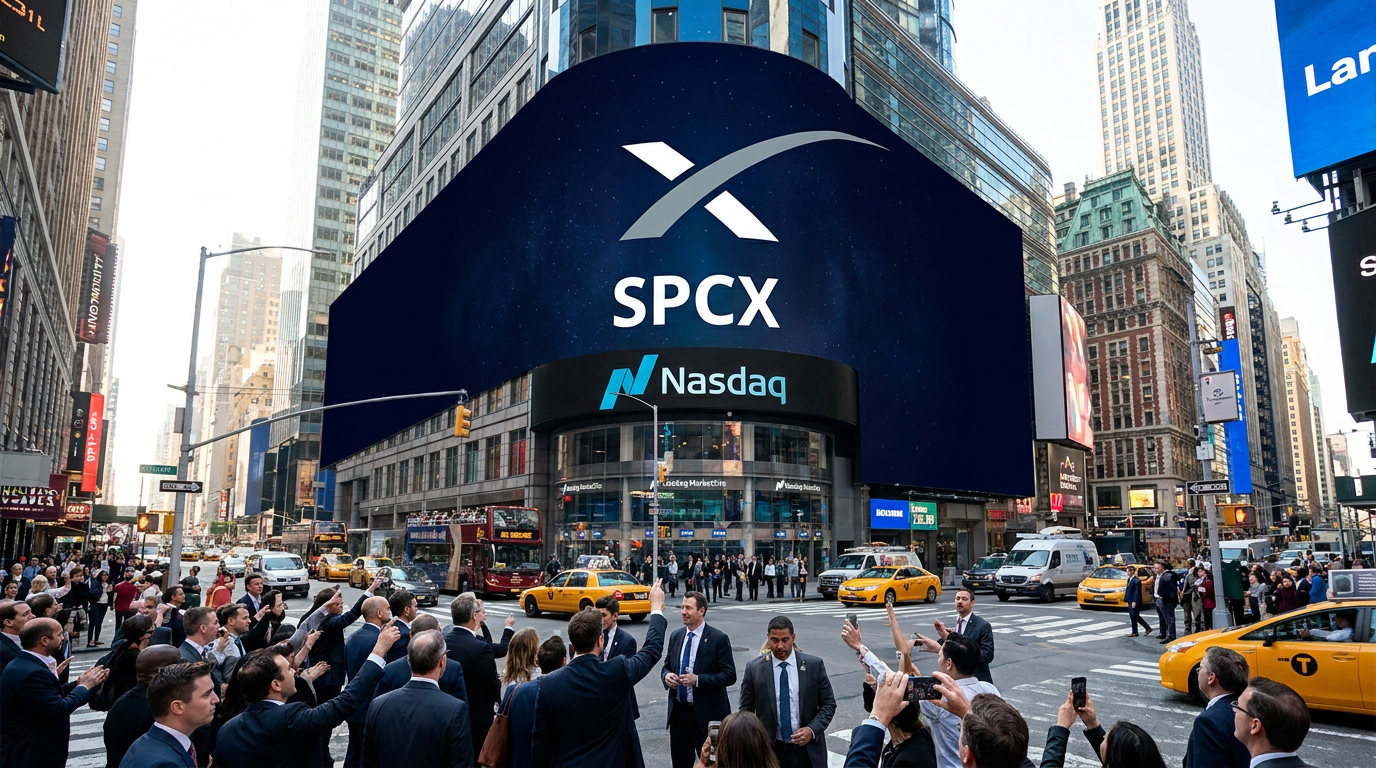
SpaceX officially entered the public markets on Friday morning, executing the largest initial public offering in global financial history and fundamentally reshaping the aerospace and technology sectors. Trading under the ticker symbol SPCX on the Nasdaq, the Elon Musk-led company bypassed traditional book-building conventions to deliver a blockbuster debut that has captivated both Wall Street and retail investors. The highly anticipated listing marks a watershed moment for the commercial space industry, transitioning its most dominant player from a closely guarded private enterprise into a publicly traded behemoth.[1][7]
The sheer scale of the offering rewrites the financial record books. SpaceX raised $75 billion by selling 555.6 million shares at a fixed price of $135 each, instantly granting the rocket and satellite manufacturer an implied valuation of $1.77 trillion. To put the magnitude of the deal into perspective, the capital raise is more than double the size of the previous global record holder, Saudi Aramco, which raised $29.4 billion in its 2019 public debut. The massive influx of capital provides SpaceX with an unprecedented war chest to fund its ambitious Starship program and expand its satellite internet constellation.[1][3]
Demand for the shares reached historic extremes in the days leading up to the debut. Institutional and retail investors placed more than $350 billion in total orders, oversubscribing the available float by nearly four times. Sovereign wealth funds, long-only asset managers, and hedge funds clamored for allocations, creating a fiercely competitive environment for underwriters. The institutional appetite was so voracious that nearly a third of the bidding firms received no stock at all, underscoring the perceived scarcity and long-term value of the equity.[1]

As the opening bell rang, the trading frenzy only intensified. Pre-market auction indicators suggested the stock was poised to open around $175 per share, representing a roughly 30% premium over the initial offering price. If sustained through the close of trading, that opening pop would push SpaceX’s market capitalization past $2.2 trillion. Such a surge would immediately make SpaceX the sixth-largest publicly traded company in the United States, vaulting it ahead of legacy tech giants and financial institutions on its very first day of trading.[2][3]
The celebration spanned half the country, reflecting the company's dual identity as a Wall Street darling and a gritty engineering powerhouse. In New York’s Times Square, SpaceX President and Chief Operating Officer Gwynne Shotwell rang the Nasdaq opening bell, praising the company's 22,000 employees for "keeping a straight spine as the doubters doubt" to achieve historic milestones. Simultaneously, a live feed broadcast Elon Musk addressing a cheering crowd of engineers and technicians at the company’s Starbase facility in South Texas, where the massive Starship rockets are assembled.[4][7]
"A little company that started in a warehouse in El Segundo is now going public with the largest IPO ever," Musk told the Texas crowd, reflecting on the company's 24-year journey from a scrappy startup to an aerospace monopoly. "There are always problems that we want to solve here on Earth... but there also have to be things that get you excited about the future, that make you glad to wake up in the morning because you can't wait to see what happens next."[7]

"There are always problems that we want to solve here on Earth...
A defining feature of the SPCX listing is its unprecedented retail participation. Recognizing Musk's massive and fiercely loyal following among individual traders, the company allocated roughly 20% to 30% of the available shares directly to retail investors. This cohort alone submitted more than $100 billion in orders, cementing their growing influence over mega-cap market dynamics. The decision to bypass standard institutional gatekeeping allowed everyday investors to participate in the debut at the ground floor, a rarity for an offering of this magnitude.[1][5]
Wall Street's voracious appetite is driven by SpaceX's dual dominance in heavy launch infrastructure and global satellite communications. The company's Starlink division is the primary engine of its current valuation, accounting for roughly 60% of its projected $18.7 billion in 2025 revenue. With over 10 million active users globally, Starlink has established a structural moat in broadband internet that terrestrial competitors are struggling to replicate. This recurring subscription revenue provides a reliable and rapidly growing cash flow to subsidize the company's more experimental aerospace ventures, transforming SpaceX from a speculative rocket builder into a highly diversified telecommunications giant.[6]
Investors are also aggressively pricing in the company's expansion into artificial intelligence and advanced computing. Following its early 2026 merger with Musk's xAI, SpaceX is pitching a future of orbital data centers and space-based distributed computing that operates beyond terrestrial constraints. In its prospectus, the company estimated its total addressable market at a staggering $28.5 trillion, framing itself not just as a rocket manufacturer, but as the foundational infrastructure for both the multi-planetary economy and frontier artificial intelligence. This unique "aerospace plus AI" architecture has convinced many institutional buyers that the company's growth trajectory is entirely decoupled from traditional industrial constraints.[3][6]

However, the astronomical valuation has drawn sharp warnings from market skeptics who question the underlying math required to sustain such a premium. At $1.77 trillion, SpaceX is trading at roughly 90 times its 2025 sales, a multiple that leaves zero room for execution errors, launch failures, or delays in its next-generation Starship program. Analysts at Morningstar have called the stock "significantly overvalued," noting that the company posted a $4.28 billion net loss in the first quarter of 2026 alone. These losses are largely driven by heavy capital expenditures in AI infrastructure and launch vehicle development, prompting bears to warn that the company must achieve flawless execution for years to justify its current market capitalization.[1][6]
The historic listing also carries profound implications for global wealth distribution and the personal fortune of its founder. Musk, who retains roughly 38% equity and full voting control through a dual-class share structure, saw his net worth surge to approximately $982 billion at the $135 IPO price. The anticipated 30% opening pop is expected to push his personal fortune well past the 13-figure mark, officially making him the world's first trillionaire. This financial milestone cements his status as the wealthiest individual in modern history, driven by the combined compounding value of his stakes in both SpaceX and Tesla.[4][5]
This unprecedented financial milestone has sparked broader socioeconomic conversations alongside the Wall Street celebrations. Advocacy groups like Oxfam have pointed to the IPO as a stark indicator of widening global wealth gaps, noting the historic nature of a single individual reaching trillionaire status through a combination of commercial success and government contracts. While retail investors and technologists celebrate the breakthroughs in space exploration, the sheer concentration of capital has reignited public debates about wealth distribution, tax policy, and the outsized influence of mega-billionaires on critical global infrastructure like satellite communications.[4]

For the broader financial ecosystem, Friday serves as a massive operational stress test that has kept exchange operators on high alert. Nasdaq executives, market makers, and underwriting banks spent days bracing their trading infrastructure to handle the extraordinary order volumes, desperate to avoid the technical glitches that have occasionally marred highly anticipated tech debuts in the past. The flawless execution of the opening bell ceremonies provided a sigh of relief for exchange operators, but the true test remains managing the unprecedented liquidity event as millions of retail and institutional shares change hands throughout the first trading session.[3]
As the auction process finalizes the first official trades, the market views the SpaceX listing not just as a singular corporate event, but as a critical bellwether for the broader economy. The successful absorption of a $75 billion offering signals robust investor appetite for frontier technology, potentially clearing the runway for highly anticipated future mega-listings from artificial intelligence heavyweights like OpenAI and Anthropic. For now, Wall Street is firmly focused on the stars, betting heavily that SpaceX's multi-planetary ambitions and structural monopolies will continue to deliver astronomical returns for years to come.[3]
How we got here
2002
Elon Musk founds Space Exploration Technologies Corp. with the goal of making life multi-planetary.
2019
SpaceX begins launching the first operational Starlink satellites, laying the groundwork for its broadband empire.
Late 2024
Private market valuation reaches $350 billion amid rapid Starlink growth and Starship development.
Early 2026
SpaceX completes a merger with Musk's xAI, pivoting toward space-based artificial intelligence computing.
June 12, 2026
SpaceX debuts on the Nasdaq, raising a record $75 billion and achieving a $1.77 trillion valuation.
Viewpoints in depth
Institutional Bulls
Investors who see the $1.77 trillion valuation as justified by SpaceX's monopoly on heavy launch and satellite broadband.
Institutional backers argue that SpaceX is no longer just a rocket manufacturer, but the foundational infrastructure for the next century of technological progress. They point to Starlink's 10 million users and 60% revenue share as proof of a structural moat that terrestrial telecommunications companies cannot breach. Furthermore, bulls believe the company's early 2026 merger with xAI positions SpaceX to dominate the emerging market of space-based distributed computing, justifying a valuation that prices in a $28.5 trillion total addressable market.
Retail Enthusiasts
Individual traders driven by belief in Elon Musk's long-term vision and the opportunity to invest in a multi-planetary future.
For the retail cohort, which submitted over $100 billion in orders, the SPCX ticker represents a rare opportunity to own a piece of humanity's expansion into space. These investors are generally less concerned with near-term price-to-sales multiples or quarterly net losses. Instead, they are betting on Musk's track record of disrupting legacy industries and view the IPO as a ground-floor entry into the commercialization of Mars, orbital infrastructure, and frontier artificial intelligence.
Valuation Skeptics
Market analysts pointing out the sheer math required to justify a $2 trillion market capitalization.
Skeptics, including analysts at Morningstar, warn that a $1.77 trillion valuation leaves zero room for error. Trading at roughly 90 times its projected 2025 sales, SpaceX must achieve flawless execution across its Starship, Starlink, and AI divisions for years to come. Bears highlight the company's $4.28 billion net loss in the first quarter of 2026 as evidence that the heavy capital expenditures required for space exploration and AI infrastructure could weigh heavily on public shareholders if growth slows.
What we don't know
- Where the stock price will ultimately settle after the initial retail frenzy subsides.
- How quickly SpaceX can achieve profitability given its massive capital expenditures on Starship and AI infrastructure.
- Whether the company will face increased regulatory scrutiny now that it is a publicly traded entity with a near-monopoly on US space launch.
Key terms
- Initial Public Offering (IPO)
- The process of offering shares of a private corporation to the public in a new stock issuance.
- Float
- The regular shares a company has issued to the public that are available for investors to trade on the open market.
- Total Addressable Market (TAM)
- The overall revenue opportunity that is available to a product or service if 100% market share was achieved.
- Dual-class share structure
- A stock issuance setup where a company has more than one class of shares, typically giving founders significantly more voting power than public shareholders.
- Book-building
- The traditional process by which an underwriter attempts to determine the price at which an IPO will be offered based on institutional demand.
Frequently asked
What is the SpaceX stock ticker symbol?
SpaceX trades on the Nasdaq exchange under the ticker symbol SPCX.
How much did SpaceX raise in its IPO?
The company raised $75 billion, making it the largest initial public offering in global financial history.
Did retail investors get to buy SpaceX stock?
Yes, SpaceX allocated an unusually high 20% to 30% of its available shares directly to retail investors, bypassing traditional institutional gatekeeping.
What is SpaceX's current valuation?
At its $135 IPO price, the company was valued at $1.77 trillion, though early trading demand indicated a push past $2.2 trillion.
Sources
Source coverage
7 outlets
4 viewpoints surfaced







[1]BloombergInstitutional Bulls
SpaceX’s Record IPO Is Said to Draw Over $350 Billion in Demand
Read on Bloomberg →[2]ForbesRetail Investors
SpaceX Could Open At $175—A 30% Surge In Blockbuster Debut
Read on Forbes →[3]ReutersInstitutional Bulls
SpaceX set to surge past $2 trillion valuation in blockbuster Nasdaq debut
Read on Reuters →[4]The GuardianSocioeconomic Critics
SpaceX makes $1.77tn stock market debut with Elon Musk likely to become world's first trillionaire today
Read on The Guardian →[5]Business InsiderRetail Investors
SpaceX IPO live updates: Record-breaking $75 billion market debut is imminent
Read on Business Insider →[6]Investing.comValuation Skeptics
SpaceX stock indicated to open 30% higher from its IPO price
Read on Investing.com →[7]NasdaqRetail Investors
SpaceX (SPCX): Rocket Company Launches Historic IPO
Read on Nasdaq →
Every angle. Every day.
Get business stories with full source coverage and perspective breakdowns delivered to your inbox.