
SpaceX Completes Record-Breaking $75 Billion IPO, Minting World's First Trillionaire
SpaceX has officially entered the public markets with the largest initial public offering in history, valuing the aerospace giant at $1.77 trillion and sending shares surging on their first day of trading.
By Factlen Editorial Team
- Market Optimists
- Investors focused on SpaceX's massive total addressable market and near-monopoly on launch capabilities.
- Valuation Skeptics
- Financial analysts warning that the massive revenue multiple ignores the company's ongoing net losses.
- Governance Critics
- Lawmakers and advocates concerned by the unprecedented wealth concentration and lack of shareholder voting power.
What's not represented
- · Retail Investors
- · Competitor Aerospace Firms
Why this matters
SpaceX's public debut is the largest capital-raising event in history, permanently altering the financial landscape of the commercial space industry. For retail investors and index funds, it offers the first direct public access to the space economy, while simultaneously testing the market's willingness to fund speculative, decades-long engineering projects.
Key points
- SpaceX raised a record-breaking $75 billion in its initial public offering, valuing the company at $1.77 trillion.
- Shares surged on their first day of trading on the Nasdaq under the ticker symbol SPCX.
- The IPO minted CEO Elon Musk as the world's first trillionaire, pushing his net worth to $1.1 trillion.
- Financial analysts warn the stock is trading at a massive 94x revenue multiple despite ongoing net losses.
- The offering has drawn political scrutiny over extreme wealth concentration and corporate governance concerns.
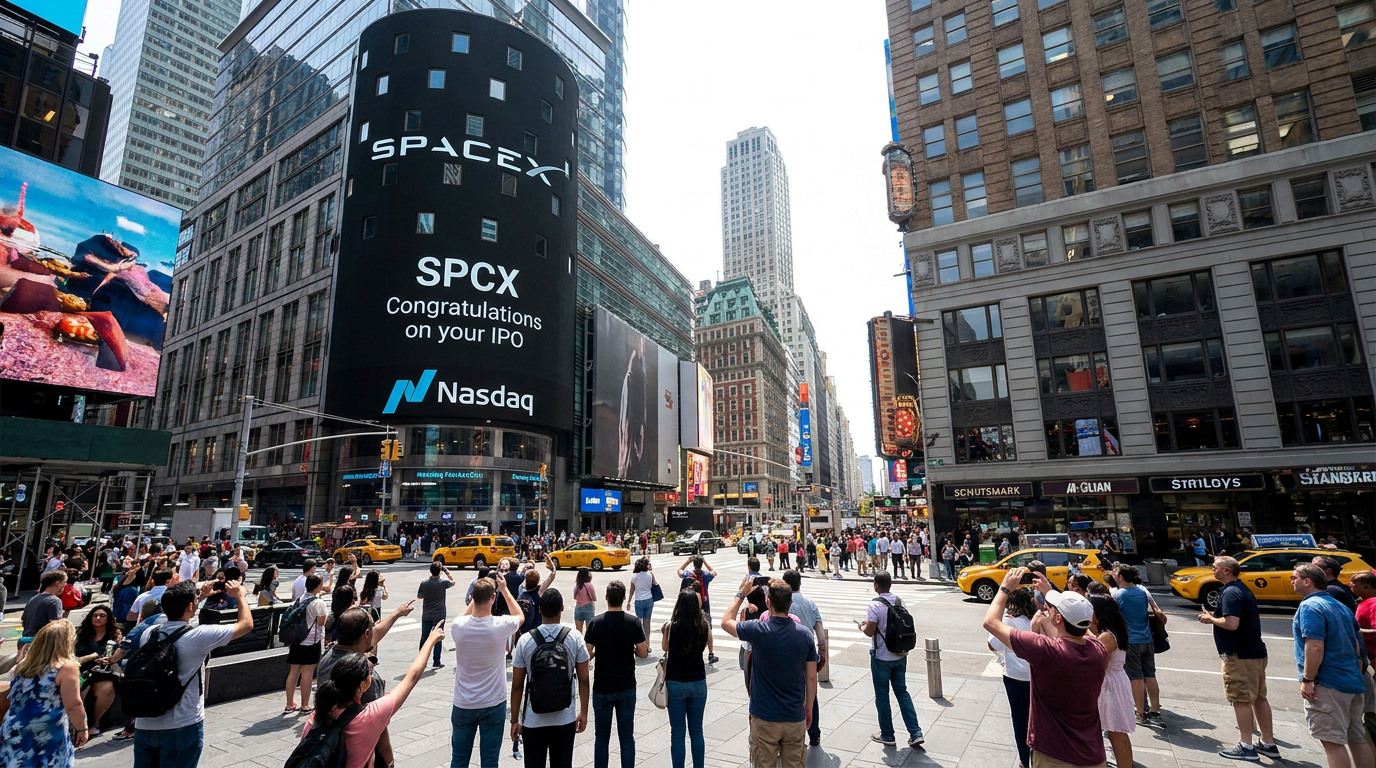
SpaceX officially transitioned from a private aerospace pioneer to a publicly traded juggernaut on Friday, executing the largest initial public offering in global financial history. Trading under the ticker symbol SPCX, the company priced its shares at $135, raising a staggering $75 billion and securing an initial valuation of $1.77 trillion. When the opening bell rang at the Nasdaq Stock Market, retail and institutional demand immediately drove the stock higher, with shares opening at $150 and climbing past $176 in midday trading.[1][7]
The sheer scale of the offering rewrites the record books for global capital markets. SpaceX’s $75 billion raise is nearly three times larger than the previous record holder, Saudi Aramco, which raised $29.4 billion during its 2019 debut. The listing not only cements SpaceX as one of the most valuable companies on Earth—trailing only a handful of tech giants like Apple, Microsoft, and Nvidia—but also marks a watershed moment for the commercial space industry, proving that frontier technologies can command mega-cap public valuations.[6][8]

The financial ripples of the IPO have triggered a historic wealth-creation event, most notably minting CEO Elon Musk as the world’s first trillionaire. Musk retains roughly 42% of the company and over 80% of its voting power, pushing his personal net worth to an estimated $1.1 trillion. Beyond the chief executive, the public listing unlocks massive liquidity for thousands of SpaceX employees who have been granted equity over the company's 24-year private history, instantly creating a new class of aerospace millionaires.[3][4]
Early institutional backers are also reaping unprecedented windfalls. Venture capital firms that anchored SpaceX’s early funding rounds are seeing returns that rank among the most lucrative in Silicon Valley history. Peter Thiel’s Founders Fund, which wrote its first check to the company in 2008 just days before a critical rocket launch, now holds a stake worth tens of billions. Similarly, Valor Equity Partners, led by early Musk backer Antonio Gracias, saw its 3.7% position valued at over $71 billion at the IPO price.[5]
To accommodate the massive influx of capital and signal its shifting geographic center of gravity, SpaceX executed a dual listing. Alongside its primary placement on the Nasdaq in New York, the company simultaneously listed on the newly launched Nasdaq Texas exchange. The move aligns with SpaceX’s expanding physical footprint at its Starbase facility in Boca Chica, Texas, where a secondary bell-ringing ceremony was held to celebrate the company's transition to the public markets.[7]

To accommodate the massive influx of capital and signal its shifting geographic center of gravity, SpaceX executed a dual listing.
The core engine of SpaceX's current revenue is Starlink, the low-Earth orbit satellite constellation that provides high-speed broadband to remote areas globally. With millions of active subscribers and lucrative government defense contracts, Starlink provides the recurring cash flow that traditional rocket launches inherently lack. However, the IPO prospectus revealed that SpaceX views its total addressable market across all divisions at a staggering $28 trillion, signaling ambitions far beyond internet provision.[1][6]
A significant portion of that future growth is pinned to artificial intelligence. Earlier this year, SpaceX formally integrated xAI, Musk's artificial intelligence venture, into its corporate umbrella. The combined entity aims to leverage SpaceX's proprietary Colossus data centers and the Grok AI model to build orbital computing networks. This fusion of space infrastructure and AI processing power is a primary driver of the premium valuation, positioning the company at the intersection of the market's two hottest sectors.[1][7]
Despite the euphoric market reception, traditional financial analysts are grappling with a valuation that defies conventional metrics. SpaceX generated $18.67 billion in revenue in 2025, but still posted a net loss of $4.9 billion. At its $1.77 trillion debut valuation, the company is trading at roughly 94 times its trailing revenue—a multiple that vastly exceeds those of established, highly profitable tech monopolies.[6][7]

Investment research firm Morningstar issued a stark warning to retail investors, calculating the company's fundamental value closer to $63 per share and citing a major disconnect between market expectations and the company's underlying financials. Skeptics point out that the valuation heavily prices in perfect execution of highly speculative future technologies, warning that the current share price leaves no margin of safety for operational setbacks.[6]
Wall Street veterans acknowledge the mathematical disconnect but argue that the stock is trading on a different paradigm. Market analysts note that the unprecedented demand is driven by a calculus based on faith in Musk's track record of disrupting entrenched industries. Investors are effectively paying a premium for the belief that SpaceX will maintain its near-monopoly on global launch capabilities while successfully executing its long-term vision of Mars colonization.[2]

The concentration of wealth and power resulting from the IPO has also drawn sharp political scrutiny. Senator Bernie Sanders publicly criticized the milestone of the world's first trillionaire, framing it as a symptom of extreme economic inequality. Meanwhile, Senator Elizabeth Warren had previously urged the Securities and Exchange Commission to delay the offering, raising concerns over corporate governance and a share structure that heavily insulates Musk from the influence of other public shareholders.[3][4][6]
For the broader aerospace sector, however, the successful float is being hailed as a catalyst for a new era of innovation. Industry analysts predict that the liquidity event will spawn dozens of new commercial space startups, as newly wealthy SpaceX veterans leave to self-fund their own ventures. By proving that public markets will aggressively back capital-intensive space infrastructure, the SPCX listing has permanently altered the financial gravity of the cosmos.[8]
How we got here
2002
Elon Musk founds Space Exploration Technologies Corp. (SpaceX) with the ultimate goal of reducing space transportation costs and colonizing Mars.
2008
SpaceX secures early institutional funding from venture capital firms like Founders Fund, just days before a critical successful rocket launch.
2019
SpaceX begins launching the first batches of its Starlink satellite internet constellation, creating a massive new recurring revenue stream.
February 2026
SpaceX formally integrates Musk's artificial intelligence venture, xAI, into its corporate structure.
June 11, 2026
SpaceX prices its initial public offering at $135 per share, cementing a $1.77 trillion valuation.
June 12, 2026
Shares begin trading on the Nasdaq under the ticker SPCX, surging past $176 in intraday trading.
Viewpoints in depth
Market Optimists
Investors who believe SpaceX's valuation is justified by its monopoly on space launch and its massive future addressable market.
This camp argues that traditional financial metrics like price-to-earnings ratios are insufficient for valuing a company that is fundamentally altering human infrastructure. They point to SpaceX's successful integration of xAI and its dominance in the satellite internet market via Starlink as proof of execution. For these investors, the $1.77 trillion valuation is a 'calculus based on faith' in Elon Musk's ability to achieve unprecedented engineering feats, viewing the company as a hybrid of a defense contractor, a global telecom, and a frontier AI lab.
Valuation Skeptics
Financial analysts who warn that the stock's price is dangerously disconnected from its underlying revenue and profitability.
Skeptics, including research firms like Morningstar, emphasize that SpaceX is trading at nearly 94 times its trailing revenue while still posting multi-billion-dollar annual net losses. They argue that the market is pricing in perfect execution of highly speculative future technologies, such as orbital data centers and Mars colonization, which remain decades away from profitability. This camp advises retail investors to wait for the initial hype to subside, warning that the current share price leaves no margin of safety.
Governance Critics
Lawmakers and advocates concerned about the unprecedented concentration of wealth and voting power.
This perspective focuses on the societal and structural implications of the IPO. Critics highlight that the offering structure grants Elon Musk over 80% of the voting power, effectively insulating him from the accountability typically required by public markets. Furthermore, political figures like Senator Bernie Sanders point to the creation of the world's first trillionaire as a stark indicator of systemic economic inequality, arguing that such massive wealth concentration poses risks to democratic institutions and market integrity.
What we don't know
- How the public markets will react to SpaceX's capital-intensive, high-risk rocket development cycles over the long term.
- Whether the integration of xAI will successfully yield the promised orbital computing networks.
- How regulatory bodies will respond to the unprecedented concentration of wealth and corporate control held by a single individual.
Key terms
- Initial Public Offering (IPO)
- The process by which a private company offers shares of its stock to the public for the first time, transitioning into a publicly traded entity.
- Market Capitalization
- The total dollar market value of a company's outstanding shares of stock, calculated by multiplying the current share price by the total number of shares.
- Trailing Revenue
- The total amount of money brought in by a company's operations over the previous 12 months.
- Dual Listing
- When a company's stock is listed and traded on two different public exchanges simultaneously, in this case, Nasdaq and Nasdaq Texas.
- Price-to-Sales Multiple
- A valuation metric that compares a company's stock price to its revenues, indicating how much investors are willing to pay per dollar of sales.
Frequently asked
What is the ticker symbol for SpaceX?
SpaceX trades on the Nasdaq Stock Market and Nasdaq Texas under the ticker symbol SPCX.
How much money did SpaceX raise in its IPO?
The company raised $75 billion by selling shares at $135 each, making it the largest initial public offering in global history.
Is SpaceX currently profitable?
While SpaceX generated $18.67 billion in revenue in 2025, primarily through its Starlink service, the company still posted a net loss of $4.9 billion for the year.
How much of SpaceX does Elon Musk own?
Following the IPO, Elon Musk retains approximately 42% of the company's outstanding shares and controls over 82% of the voting power.
Sources
Source coverage
8 outlets
3 viewpoints surfaced






[1]BloombergMarket Optimists
SpaceX IPO Whips Musk Fans Into Frenzy
Read on Bloomberg →Record SpaceX IPO 'Calculus Based on Faith' Not Valuation, Says Colas
Read on Bloomberg →[3]The New York TimesValuation Skeptics
SpaceX is structured in a way that appears to benefit Musk at the expense of other shareholders
Read on The New York Times →[4]ForbesGovernance Critics
Bernie Sanders Blasts Musk Becoming World’s First Trillionaire After SpaceX IPO
Read on Forbes →SpaceX IPO Lines Up $230 Billion Windfall For Peter Thiel And Other Musk Backers
Read on Forbes →[6]The GuardianValuation Skeptics
SpaceX heads for record $1.78tn float amid fears it is overvalued
Read on The Guardian →[7]NasdaqMarket Optimists
SpaceX (SPCX): Rocket Company Launches Historic IPO
Read on Nasdaq →[8]Space.comMarket Optimists
SpaceX goes public with a mind-bogglingly historic IPO today. The space industry may never be the same.
Read on Space.com →
Every angle. Every day.
Get business stories with full source coverage and perspective breakdowns delivered to your inbox.