
SpaceX Completes Record $75 Billion IPO, Valuing Aerospace Giant at $1.8 Trillion
SpaceX shares surged in their public market debut following the largest initial public offering in history, fundamentally reshaping index funds and minting CEO Elon Musk as the world's first trillionaire.
By Factlen Editorial Team
- Retail Optimists
- Believe Musk's track record of disruption justifies the premium valuation and view the stock as a generational buy.
- Fundamental Skeptics
- Argue the $1.8 trillion valuation is detached from reality, citing the company's history of net losses and lack of standard governance.
- Passive Investors
- Focus on the mechanical integration of the massive equity into index funds and the unavoidable exposure for everyday retirement accounts.
- Early Backers & Insiders
- View the IPO as the culmination of a two-decade bet on space commercialization, resulting in historic venture capital windfalls.
What's not represented
- · Competitors in the aerospace sector
- · Regulators monitoring market concentration
Why this matters
The $75 billion SpaceX IPO isn't just a milestone for the aerospace industry; it fundamentally rewires the global stock market. Because of its massive $1.8 trillion valuation, the company will quickly be absorbed into major index funds, meaning millions of everyday workers will soon have their 401(k)s and retirement savings tied to the success of reusable rockets and artificial intelligence.
Key points
- SpaceX raised $75 billion in its market debut, shattering the previous global IPO record held by Saudi Aramco.
- The company's shares opened at $150 on the Nasdaq, an 11 percent premium over the initial $135 offering price.
- The surge in valuation propelled CEO Elon Musk's net worth past $1.1 trillion, making him the world's first trillionaire.
- Brokerages allocated up to 30 percent of the offering to retail investors, driving more than $100 billion in retail orders.
- Financial analysts remain divided on the $1.8 trillion valuation, with some estimating the company's fair value at roughly $780 billion.
- Musk retains more than 80 percent of the company's voting power through a dual-class share structure.
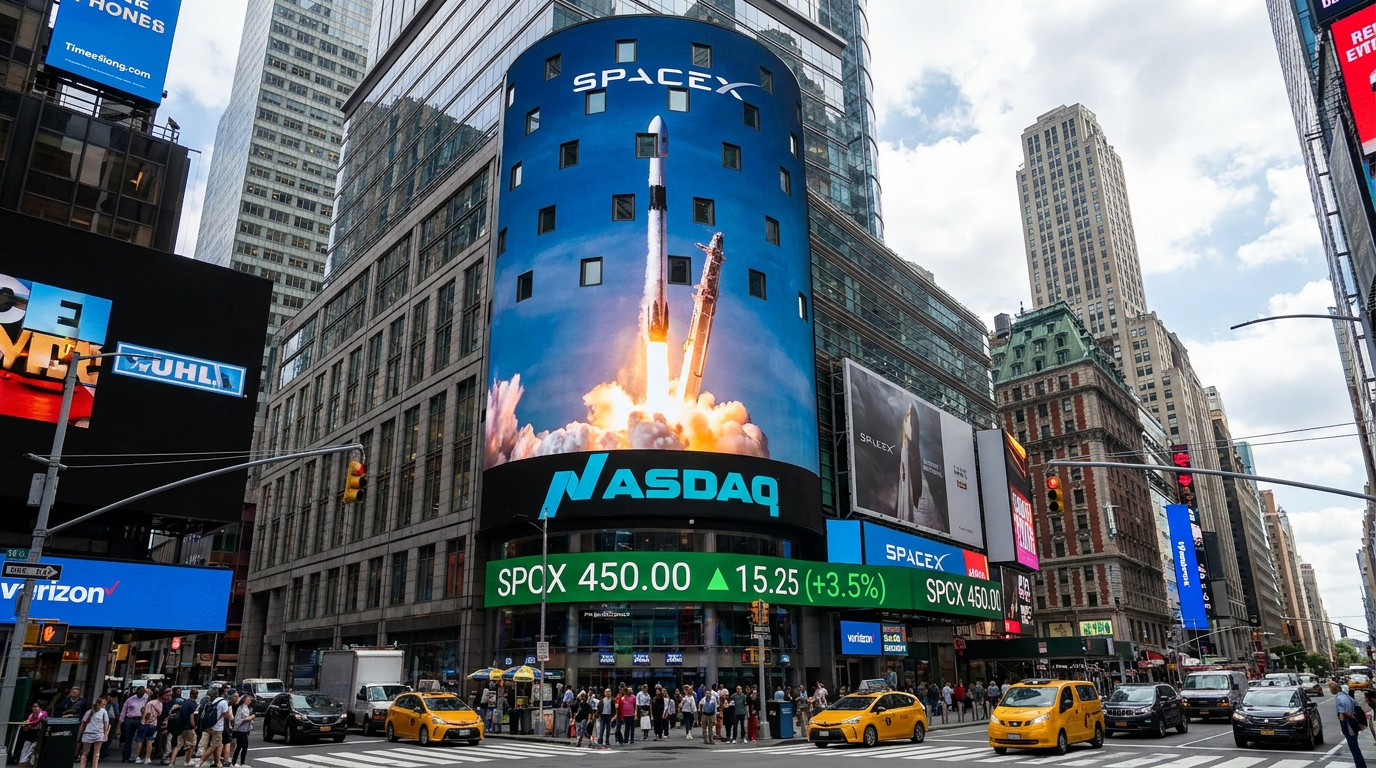
The opening bell on Friday didn't just launch a stock; it fundamentally rewired the global equities market. SpaceX completed the largest initial public offering in history, raising $75 billion and valuing the aerospace giant at roughly $1.8 trillion.[6][10]
The sheer scale of the debut shatters previous financial records. Before Friday, the high-water mark for an IPO was the $26 billion raised by Saudi Aramco in 2019. SpaceX nearly tripled that figure, with shares pricing at $135 on Thursday night before opening at $150 and surging as high as $176.52 in midday trading on the Nasdaq.[6]
The immediate financial consequence of the listing was the minting of a new wealth bracket. The surge in valuation propelled CEO Elon Musk's net worth past the $1.1 trillion mark, making him the world's first trillionaire and drawing immediate political scrutiny over wealth concentration.[4]

But the mechanics of the SpaceX IPO represent a significant departure from traditional Wall Street debuts, particularly in how the company handled retail investors. Historically, individual traders are locked out of the initial pricing, forced to buy on the open market after institutional investors have already secured their allocations and driven up the price.[7][8]
SpaceX flipped that script by allocating up to 30 percent of its offering directly to retail investors. Brokerages lowered their minimum account requirements to just $2,000 to allow broader participation, a move that helped drive more than $100 billion in retail orders alone.[6][7]
For those who didn't actively buy the stock, exposure is coming anyway through the passive investing ecosystem. Because of its massive $1.8 trillion market capitalization, SpaceX will rapidly be integrated into major stock indices.[3][10]
This means that millions of workers with standard 401(k) retirement accounts or broad-market index funds will soon become fractional owners of the space exploration company, tying everyday retirement security to the success of reusable rockets and satellite internet.[3]
Yet beneath the retail enthusiasm lies a fierce debate among financial analysts about the company's fundamental math. Traditional valuation metrics struggle to justify a nearly $2 trillion price tag for a company that explicitly notes in its prospectus that it has a history of net losses and may never achieve consistent profitability.[8]
Yet beneath the retail enthusiasm lies a fierce debate among financial analysts about the company's fundamental math.
Analysts at Morningstar issued a stark warning to investors, estimating the company's fair value at roughly $780 billion—or $63 per share. That represents a 53 percent discount to the IPO price, suggesting the current valuation is detached from the reality of SpaceX's existing launch and satellite business.[8][10]

Market researchers argue that the premium is not based on current revenue, but rather a calculus based on faith. Investors are essentially pricing in Musk's track record of disruption and the belief that the company will monopolize the future space economy, rather than relying on standard price-to-earnings ratios.[1]
A significant portion of that faith is anchored not in rockets, but in artificial intelligence. SpaceX recently absorbed xAI, the developer behind the Grok chatbot. Some financial models attribute up to 90 percent of SpaceX's projected $28 trillion total addressable market to its AI capabilities rather than its aerospace operations.[6]
The corporate governance structure of the newly public entity also defies standard market protections. Through a dual-class share setup, Musk retains more than 80 percent of the company's voting power, effectively granting him unilateral control over operations, strategy, and board appointments.[2][8]

This concentration of power means public shareholders are providing capital without the standard mechanisms to hold management accountable. If the company pivots its strategy—such as prioritizing a Mars colony over near-term profitability—minority investors will have no structural ability to intervene.[2]
For early private backers, however, the governance concerns are overshadowed by historic windfalls. Venture capital firm Founders Fund, which wrote an early check to SpaceX in 2008, saw its stake balloon to $67 billion. Valor Equity Partners, led by Musk associate Antonio Gracias, holds a position worth over $71 billion at the opening price.[9]
Wall Street institutions are also reaping immediate rewards. Investment banks, led by Goldman Sachs, secured massive underwriting fees for orchestrating the complex $75 billion offering, injecting a surge of capital into the financial sector.[5]

The long-term stability of the stock will face its first real test when early investor lock-up periods expire. While Musk and major institutional backers are restricted from selling shares for 366 days, other early investors will be free to liquidate their holdings after the company's second-quarter earnings report, potentially introducing significant downward pressure on the share price.[8]
Ultimately, the SpaceX IPO is more than a single company going public; it is a stress test for the broader market's appetite for mega-cap tech offerings. With AI giants like OpenAI and Anthropic waiting in the wings, Wall Street is watching closely to see if retail faith can sustain a trillion-dollar valuation against the gravity of traditional financial fundamentals.[6][8]
How we got here
2002
Elon Musk founds Space Exploration Technologies Corp. with the goal of reducing space transportation costs.
2008
SpaceX secures its first major institutional venture capital funding from Founders Fund, days before a critical launch.
2020
The company successfully launches its first crewed mission to the International Space Station, cementing its dominance in aerospace.
April 2026
SpaceX files a confidential initial public offering prospectus with the Securities and Exchange Commission.
June 11, 2026
The company prices its shares at $135, officially raising $75 billion in the largest IPO in history.
June 12, 2026
Shares begin trading on the Nasdaq under the ticker SPCX, opening at $150.
Viewpoints in depth
Retail Optimists
Believe Musk's track record of disruption justifies the premium valuation and view the stock as a generational buy.
Retail investors and Musk supporters argue that traditional financial metrics cannot capture SpaceX's potential. They point to the company's success in lowering launch costs, its rapidly expanding Starlink satellite internet monopoly, and the integration of xAI as proof that the company is building a multi-planetary infrastructure. For this camp, the $1.8 trillion valuation is a bargain for a company they believe will eventually dominate a $28 trillion space and AI economy.
Fundamental Skeptics
Argue the $1.8 trillion valuation is detached from reality, citing the company's history of net losses.
Financial analysts and institutional skeptics warn that the IPO is priced for absolute perfection, leaving no room for execution errors. Firms like Morningstar point out that the company's core launch business does not generate the cash flow required to support a nearly $2 trillion market cap. They caution that the current price is driven by a broader market frenzy around artificial intelligence rather than sustainable business fundamentals, making the stock highly vulnerable to a correction once early investor lock-up periods expire.
Passive Investors
Focus on the mechanical integration of the massive equity into index funds and the unavoidable exposure for everyday retirement accounts.
For the passive investing community, the debate over SpaceX's valuation is secondary to the mechanical reality of its size. Because the company is debuting with such a massive market capitalization, index providers will be forced to add it to broad-market benchmarks. This camp emphasizes that millions of workers will automatically become shareholders through their 401(k)s, fundamentally tying the health of everyday retirement portfolios to the high-risk, high-reward aerospace sector.
What we don't know
- How the stock will react when the 366-day lock-up period for major institutional investors and insiders expires.
- Whether the company's integration of the xAI platform will generate the revenue required to justify its massive valuation premium.
- Exactly when major index providers will formally add the $1.8 trillion company to broad-market benchmarks like the S&P 500.
Key terms
- Initial Public Offering (IPO)
- The process by which a private company offers shares to the public for the first time, transitioning to a publicly traded entity.
- Market Capitalization
- The total dollar market value of a company's outstanding shares of stock, calculated by multiplying the stock price by the total number of shares.
- Dual-Class Share Structure
- A corporate setup where different classes of shares have different voting rights, often used by founders to retain control despite owning a minority of the total equity.
- Lock-Up Period
- A predetermined window after an IPO during which company insiders and early investors are legally restricted from selling their shares.
- Index Fund
- A type of mutual fund or exchange-traded fund designed to follow certain preset rules so that the fund can track a specified basket of underlying investments.
Frequently asked
Can I buy SpaceX stock right now?
Yes. SpaceX is now trading publicly on the Nasdaq under the ticker symbol SPCX, meaning anyone with a standard brokerage account can purchase shares at the current market price.
Will this affect my retirement account?
Likely yes. Because of its massive market capitalization, SpaceX will soon be added to major broad-market indices, meaning standard 401(k)s and index funds will automatically purchase the stock.
Why is the company valued so highly?
While critics point to a history of net losses, investors are pricing in the company's dominance in space launch, its Starlink satellite internet business, and its recent acquisition of the artificial intelligence firm xAI.
Does Elon Musk still control the company?
Yes. Despite selling shares to the public, Musk retains over 80 percent of the voting power through a dual-class share structure, giving him ultimate authority over corporate decisions.
Sources
Source coverage
10 outlets
4 viewpoints surfaced








[1]BloombergFundamental Skeptics
Record SpaceX IPO 'Calculus Based on Faith' Not Valuation, Says Colas
Read on Bloomberg →[2]The New York TimesPassive Investors
SpaceX is structured in a way that appears to benefit Musk at the expense of other shareholders.
Read on The New York Times →How Much SpaceX Are You About to Own?
Read on The New York Times →[4]ForbesEarly Backers & Insiders
Bernie Sanders Blasts Musk Becoming World’s First Trillionaire After SpaceX IPO
Read on Forbes →[5]CNBCEarly Backers & Insiders
Goldman nets a big payday for SpaceX IPO.
Read on CNBC →[6]CBS NewsRetail Optimists
SpaceX shares soar following record-breaking $75 billion IPO
Read on CBS News →[7]Fidelity InvestmentsRetail Optimists
SpaceX IPO explained
Read on Fidelity Investments →[8]CBCFundamental Skeptics
SpaceX kicks off wave of monster IPOs: What to know about companies going public
Read on CBC →SpaceX IPO Lines Up $230 Billion Windfall For Peter Thiel And Other Musk Backers
Read on Forbes →[10]CNAFundamental Skeptics
Elon Musk's SpaceX IPO: Is it worth the hype?
Read on CNA →
Every angle. Every day.
Get business stories with full source coverage and perspective breakdowns delivered to your inbox.