
SpaceX Completes Record $75 Billion IPO, Pushing Elon Musk to Trillionaire Status
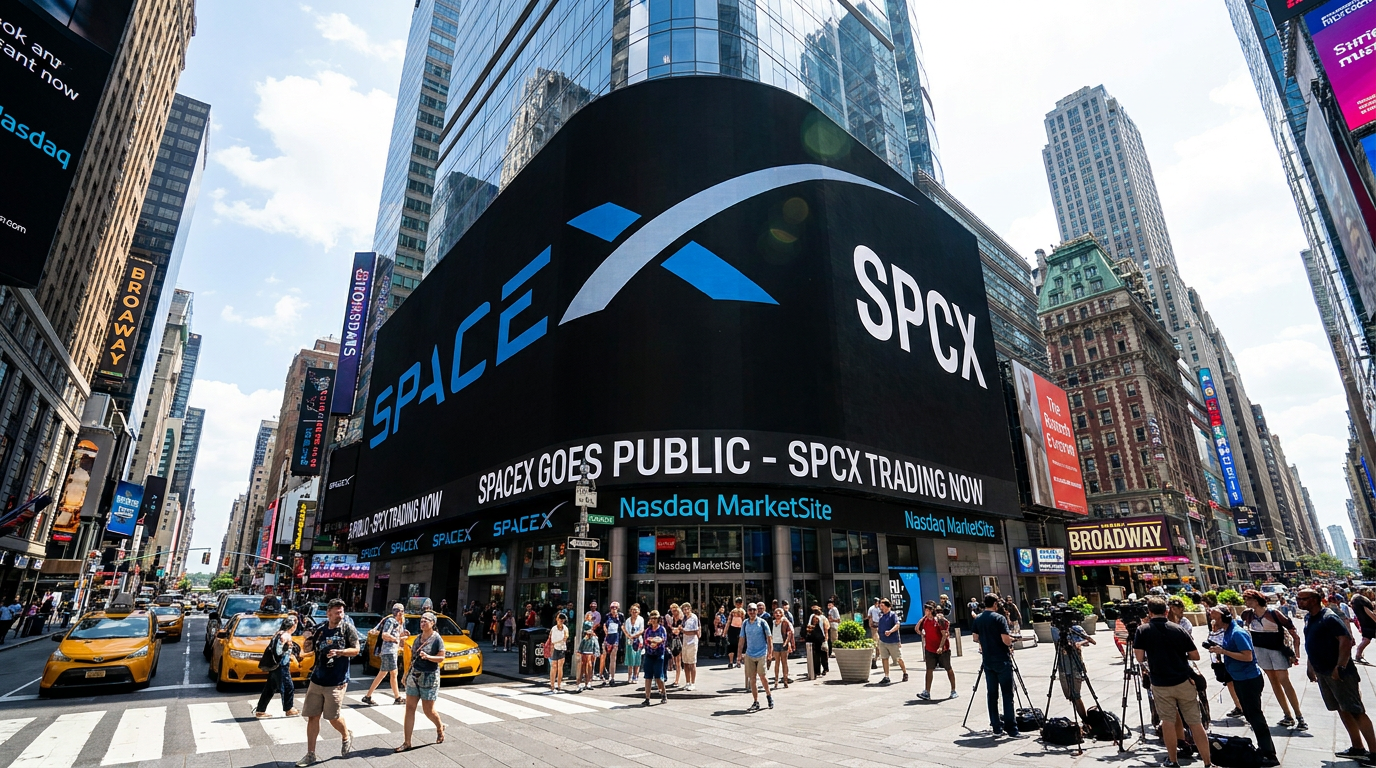
SpaceX debuted on the Nasdaq at a valuation exceeding $2.1 trillion, marking the largest initial public offering in history. The listing's success officially made founder Elon Musk the world's first trillionaire.
By Factlen Editorial Team
- Bullish Tech Investors
- Investors who view SpaceX as a generational monopoly across multiple frontier industries.
- Market Skeptics
- Financial analysts who argue the valuation is detached from the company's underlying fundamentals.
- Corporate Governance Critics
- Regulators and watchdogs concerned about the unprecedented concentration of power in a public company.
What's not represented
- · Early SpaceX employees
- · Competitors in the aerospace sector
Why this matters
SpaceX's debut shatters all previous records for capital formation, opening the commercial space and AI infrastructure sectors to public investors. It also marks a historic wealth milestone, creating the world's first trillionaire and cementing a new era of mega-cap technology monopolies.
Key points
- SpaceX raised $75 billion in its Nasdaq debut, making it the largest initial public offering in history.
- The stock closed its first day of trading at $160.95, giving the company a market capitalization of over $2.1 trillion.
- The massive valuation boosted founder Elon Musk's net worth to approximately $1.14 trillion, making him the world's first trillionaire.
- SpaceX's business model now spans orbital launch services, the Starlink satellite internet network, and artificial intelligence infrastructure.
- Corporate governance critics have raised concerns over Musk retaining 82 percent voting control of the newly public entity.
SpaceX made history on Friday with the largest stock market debut of all time, debuting on the Nasdaq and instantly achieving a valuation exceeding $2.1 trillion. The highly anticipated initial public offering raised a staggering $75 billion, fundamentally reshaping the landscape of public markets and the commercial space industry. The listing's runaway success also pushed SpaceX founder and CEO Elon Musk across a once-unfathomable wealth threshold, officially cementing his status as the world's first trillionaire.[1][2]
Trading under the ticker symbol SPCX, the stock was offered to investors at a fixed price of $135 per share. When the opening bell rang, intense demand immediately drove the price up to $150, and shares ultimately closed their first day of trading at $160.95. This 19 percent jump from the initial offering price reflected a massive appetite from both institutional heavyweights and retail traders, who had reportedly submitted over $100 billion in orders before the stock even went live.[2][7]
The sheer scale of the SpaceX IPO dwarfs any previous public offering. The $75 billion raised is nearly triple the previous global record of $29.4 billion, set by Saudi Aramco in 2019. The capital injection provides SpaceX with an unprecedented war chest to fund its long-term ambitions, which range from establishing a permanent human settlement on Mars to building orbital data centers.[1][5]

For Musk, the IPO represents a historic personal milestone. Because he retains approximately 42 percent ownership of SpaceX, the company's $2.1 trillion market capitalization boosted his personal net worth to an estimated $1.14 trillion. To put that figure into perspective, Musk is now worth more than the next four richest people on Earth combined, and his individual wealth rivals the gross domestic product of nations like the Netherlands.[3][6]
Investors piling into SPCX are buying into a conglomerate that operates three distinct, highly ambitious businesses under a single corporate umbrella. While SpaceX is most famous for its reusable Falcon 9 rockets, the company's financial narrative has evolved far beyond basic aerospace engineering. Today, the firm is equally valued for its global satellite internet network and its recent aggressive pivot into artificial intelligence.[4][5]
In the aerospace sector, SpaceX has established a near-monopoly on commercial launch services. The company's mastery of reusable rocket technology drastically lowered the cost of reaching orbit, allowing SpaceX to conduct more launches annually than every other country combined. This dominance has made the firm the primary launch partner for NASA and a critical contractor for the U.S. Department of Defense.[4]

In the aerospace sector, SpaceX has established a near-monopoly on commercial launch services.
However, the company's most reliable financial engine is Starlink. The low-Earth orbit satellite constellation currently boasts over 9,600 active satellites and serves more than 10.3 million subscribers across 164 countries. Starlink provides high-speed broadband to remote areas, maritime vessels, and commercial airlines, generating the recurring subscription revenue that traditional tech investors crave.[5]
The final, and perhaps most speculative, pillar of SpaceX's valuation is its artificial intelligence infrastructure. In February 2026, SpaceX formally absorbed Musk's AI startup, xAI. This merger brought the Grok chatbot and massive AI compute infrastructure onto SpaceX's balance sheet, positioning the company to build next-generation orbital data centers that combine satellite communications with advanced machine learning.[4][5]
The massive valuation did not catch everyone by surprise. For months leading up to the Nasdaq debut, a shadow market of cryptocurrency traders had been pricing in a massive premium. Perpetual futures contracts tied to SpaceX's eventual listing traded heavily on offshore crypto exchanges like Binance and Hyperliquid, accurately predicting the $2.1 trillion valuation weeks before a single traditional share changed hands.[8]

SpaceX's immediate future on the stock market will be bolstered by mechanical buying from passive index funds. The Nasdaq 100 recently implemented a "fast entry" rule for mega-cap listings, meaning that ETFs and mutual funds tracking the index will be forced to purchase billions of dollars of SPCX stock in the coming weeks to rebalance their portfolios, regardless of the stock's underlying fundamentals.[1][4]
This forced buying has sparked intense debate among corporate governance watchdogs. Lawmakers, including Senator Elizabeth Warren and the New York City Comptroller, have raised alarms about the company's unprecedented power structure. Through special voting shares, Musk retains over 82 percent of the shareholder voting power, giving a single individual unchecked control over a $2 trillion public entity with virtually no independent board oversight.[5]
Traditional financial analysts have also expressed deep skepticism about the company's price tag. NYU finance professor Aswath Damodaran and other valuation experts argue that the $2.1 trillion figure is detached from financial reality, noting that SpaceX posted a net loss of nearly $5 billion in 2025. Skeptics contend that the stock is trading on a "personality premium" driven by Musk's loyal fanbase, rather than standard metrics like price-to-earnings ratios.[3]

Despite the skepticism, Wall Street is celebrating the debut as a massive victory for the broader tech sector. The successful listing is widely viewed as a dress rehearsal for a coming wave of artificial intelligence mega-IPOs, with companies like Anthropic and OpenAI expected to test the public markets later this year. SpaceX has proven that investor appetite for generational, high-risk technology bets remains insatiable.[1]
Twenty-four years after Elon Musk founded the company in a warehouse in El Segundo, California, SpaceX has transformed from a far-out idea into the sixth most valuable publicly traded company in the United States. By opening its doors to everyday investors, the aerospace juggernaut has not only minted the world's first trillionaire but has also ushered in a new era of public market capitalization.[4][6]
How we got here
Feb 2026
SpaceX absorbs Elon Musk's artificial intelligence startup, xAI, expanding its business model into AI infrastructure.
May 20, 2026
SpaceX publicly files its S-1 offering statement with the SEC, detailing its plans to go public.
Jun 11, 2026
The company officially prices its IPO at $135 per share, locking in a $75 billion capital raise.
Jun 12, 2026
SpaceX begins trading on the Nasdaq under the ticker SPCX, with shares surging to close near $161.
Viewpoints in depth
Bullish Tech Investors
Investors who view SpaceX as a generational monopoly across multiple frontier industries.
For venture capitalists and retail traders, SpaceX is not evaluated on traditional price-to-earnings ratios. Backers like Sequoia Capital argue that Elon Musk deserves an 'extreme premium' for consistently calling technology trends early and executing on seemingly impossible engineering feats. They view the company as a three-headed juggernaut: a monopoly in orbital launch, a high-margin global ISP in Starlink, and a massive AI infrastructure play following the absorption of xAI. To these investors, the $2.1 trillion valuation is justified by the sheer scale of the total addressable markets SpaceX is capturing.
Market Skeptics
Financial analysts who argue the valuation is detached from the company's underlying fundamentals.
Traditional valuation experts, such as NYU finance professor Aswath Damodaran, contend that the $2.1 trillion market capitalization is 'made up' and driven by a personality cult rather than financial reality. Skeptics point out that SpaceX posted a loss of nearly $5 billion in 2025 and generates only a fraction of the revenue brought in by similarly valued tech giants like Amazon or Alphabet. They argue that the stock's price reflects an eagerness to own a piece of Musk's futuristic vision—a dynamic that makes the stock highly vulnerable to shifts in sentiment rather than changes in cash flow.
Corporate Governance Critics
Regulators and watchdogs concerned about the unprecedented concentration of power in a public company.
Lawmakers and institutional watchdogs are raising alarms about the structure of the offering. Senator Elizabeth Warren and the New York City Comptroller have both highlighted that Musk retains over 82% of the shareholder voting power, effectively giving him unchecked control over a $2 trillion public entity with no independent board oversight. Furthermore, critics are uneasy about the 'fast entry' rules implemented by major indices like the Nasdaq 100, which will force passive index funds and retirement accounts to mechanically purchase billions of dollars of SpaceX stock regardless of its governance risks or profitability.
What we don't know
- How the stock will perform once the initial retail enthusiasm subsides and early lock-up periods expire.
- Whether the SEC will intervene regarding the company's unprecedented governance structure and index fund inclusion.
- When SpaceX will achieve consistent GAAP profitability, having posted a net loss of nearly $5 billion in 2025.
Key terms
- Initial Public Offering (IPO)
- The process by which a private company offers shares of its stock to the public for the first time, allowing it to raise capital from public investors.
- Market Capitalization
- The total dollar market value of a company's outstanding shares of stock, calculated by multiplying the current stock price by the total number of shares.
- Perpetual Futures
- A type of derivative contract, popular in cryptocurrency markets, that allows traders to speculate on the future price of an asset without an expiration date.
- Index Fund
- A type of mutual fund or ETF designed to follow certain preset rules so that the fund can track a specified basket of underlying investments, like the Nasdaq 100.
- Voting Control
- The power held by a shareholder to influence corporate decisions; in SpaceX's case, special share structures give Elon Musk 82% of this power despite owning a smaller percentage of total equity.
Frequently asked
How much did SpaceX raise in its IPO?
SpaceX raised $75 billion by selling 555.6 million shares, making it the largest initial public offering in history.
What is Elon Musk's net worth after the IPO?
Following the IPO, Elon Musk's net worth surged to approximately $1.14 trillion, making him the world's first trillionaire.
What is the ticker symbol for SpaceX?
SpaceX trades on the Nasdaq under the ticker symbol SPCX.
Is SpaceX profitable?
According to SEC filings, SpaceX is not currently profitable under GAAP standards, having posted a net loss of nearly $5 billion in 2025.
Why did SpaceX acquire xAI?
SpaceX absorbed Musk's artificial intelligence startup xAI in early 2026 to integrate AI compute infrastructure and data centers into its orbital network.
Sources
Source coverage
8 outlets
3 viewpoints surfaced








[1]ReutersBullish Tech Investors
SpaceX vaults over US$2 trillion valuation as stock jumps after record IPO
Read on Reuters →[2]ForbesBullish Tech Investors
SpaceX's IPO Just Made Elon Musk The World's First Trillionaire
Read on Forbes →[3]The Washington PostMarket Skeptics
$1,000,000,000,000. A one with 12 zeroes.
Read on The Washington Post →[4]The GuardianCorporate Governance Critics
SpaceX made the biggest stock market debut in history on Friday
Read on The Guardian →[5]BloombergCorporate Governance Critics
What to Know About SpaceX’s Record-Breaking IPO
Read on Bloomberg →[6]CBS NewsCorporate Governance Critics
Elon Musk has become the first person to cross the trillionaire threshold
Read on CBS News →[7]Anadolu AgencyBullish Tech Investors
SpaceX shares jump over 11% in Nasdaq debut after record $75B IPO
Read on Anadolu Agency →[8]Crypto Valley JournalBullish Tech Investors
Six exchanges, one price signal: how the crypto market prices SpaceX
Read on Crypto Valley Journal →
Every angle. Every day.
Get business stories with full source coverage and perspective breakdowns delivered to your inbox.