
SpaceX Completes Record $75 Billion IPO, Pushing Elon Musk's Net Worth Past $1 Trillion
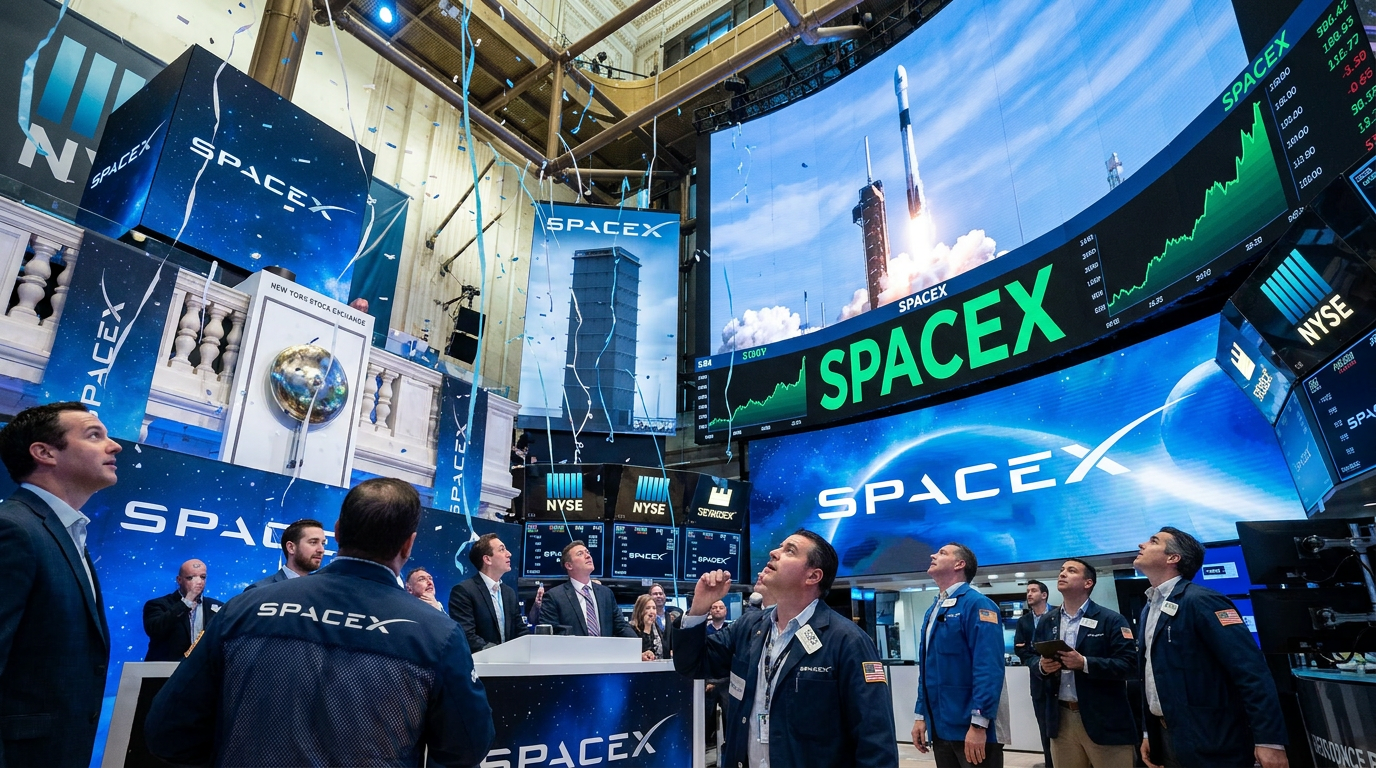
SpaceX has entered the public markets with the largest initial public offering in history, achieving a $2.2 trillion market capitalization on its first day. The milestone has sparked a surge in space industry investment and made founder Elon Musk the world's first trillionaire.
By Factlen Editorial Team
- Space Industry Optimists
- View the IPO as a validation of the commercial space sector and a catalyst for future innovation.
- Institutional Skeptics
- Focus on the risks of poor corporate governance and the dangers of forced index inclusion.
- Historical Analysts
- Contextualize the event through the lens of unprecedented wealth accumulation and market history.
What's not represented
- · Retail investors who were priced out of the initial IPO allocation.
- · Competitors in the aerospace sector facing a newly capitalized giant.
Why this matters
SpaceX's transition to a public company opens the rapidly growing space economy to everyday investors, while its massive $2.2 trillion valuation instantly reshapes global index funds and institutional portfolios.
Key points
- SpaceX raised $75 billion in the largest initial public offering in history.
- The company's market capitalization reached $2.2 trillion by the end of its first trading day.
- The IPO's success pushed founder Elon Musk's net worth past the $1 trillion mark.
- Retail and institutional investors view the listing as a foundational bet on the commercial space economy.
- Governance experts are raising concerns over the company's fast-tracked inclusion in major stock indexes.
SpaceX has officially transitioned from a closely held private juggernaut to a publicly traded behemoth, executing the largest initial public offering in the history of global financial markets. Raising a staggering $75 billion, the aerospace manufacturer and satellite communications company ended its first day of trading with a market capitalization of approximately $2.2 trillion. The highly anticipated debut shattered previous records, handing early IPO buyers a 19% return by the closing bell and fundamentally reshaping the landscape of publicly traded technology companies. For years, Wall Street has eagerly awaited the chance to invest directly in the company that revolutionized orbital logistics.[1][2]
The sheer scale of the offering reflects years of pent-up institutional and retail demand for a pure-play investment in the commercialization of space. For over two decades, SpaceX has dominated the launch sector with its reusable Falcon 9 rockets and built a massive, globally distributed recurring revenue stream through its Starlink satellite internet constellation. Now, public market investors have priced the company not just as a traditional aerospace contractor, but as a foundational infrastructure provider for the orbital economy. Analysts note that this valuation effectively prices in decades of future growth, assuming SpaceX will maintain its near-monopoly on commercial launch services.[1][9]
Beyond the corporate milestone, the IPO has triggered a historic shift in personal wealth, elevating founder and CEO Elon Musk to the unprecedented status of the world’s first trillionaire. Musk’s vast equity stake in the newly public entity, combined with his significant holdings in Tesla, xAI, and other ventures, pushed his net worth decisively across the thirteen-digit threshold. Financial historians and economists are already drawing parallels to the Gilded Age, comparing Musk’s rapid ascension to John D. Rockefeller becoming America’s first billionaire in 1916. The milestone has reignited debates over wealth concentration, even as investors celebrate the technological breakthroughs that enabled it.[3][4]

Market commentators have largely embraced the debut, viewing it as a watershed moment for the broader space sector and a green light for future aerospace investments. CNBC’s Jim Cramer noted that despite the massive day-one valuation and the immediate 19% pop in share price, it is not too late for retail investors to buy into the stock. He emphasized that buyers must view the company as a long-term, multi-decade bet on space exploration and orbital infrastructure rather than a short-term momentum trade. This sentiment underscores a growing consensus that low-Earth orbit is rapidly transitioning from a realm of government-funded research to a highly profitable commercial frontier.[5]
Market commentators have largely embraced the debut, viewing it as a watershed moment for the broader space sector and a green light for future aerospace investments.
The ripple effects of the $2.2 trillion valuation are already being felt across the broader aerospace startup ecosystem, which has historically struggled with high capital requirements and long paths to profitability. Heather Pringle, CEO of the Space Foundation, highlighted that SpaceX’s successful public listing marks a critical maturation point for the entire industry. By demonstrating viable, highly profitable pathways in global communications, launch services, and navigation technologies, SpaceX has effectively validated the business models of dozens of smaller space-tech firms. Venture capitalists are expected to use the SpaceX IPO as a benchmark to justify further investments in next-generation aerospace startups.[6]
However, the unprecedented nature of the IPO has also sparked significant pushback from institutional governance watchdogs and public pension managers. The sheer size of SpaceX’s market capitalization means it is being fast-tracked for inclusion in major global equity indexes, including the MSCI Global Standard and FTSE Russell. This rapid inclusion forces passive index funds and institutional asset managers to purchase the stock automatically, regardless of their internal corporate governance criteria or risk tolerance. For many institutional investors, this dynamic bypasses the traditional scrutiny usually applied to newly public companies.[7][8]

New York City Comptroller Mark Levine has been among the most vocal critics of this fast-tracked index inclusion, raising alarms about the abandonment of traditional seasoning periods and established earnings track records. Levine pointed specifically to SpaceX’s highly unusual corporate governance structure, in which a single individual—Elon Musk—retains dominant super-voting control over the company's direction. The lack of independent board oversight and limited shareholder rights present a unique dilemma for institutional investors who are legally mandated to prioritize strict corporate governance and risk management for their beneficiaries.[7]
Despite these institutional governance concerns, the momentum behind the space economy appears largely unhindered by the regulatory friction. The massive influx of capital raised from the $75 billion offering is expected to accelerate SpaceX’s most ambitious and capital-intensive projects, including the continued development of the Starship launch vehicle and the expansion of the Starlink network to cover commercial aviation and maritime sectors. As the company transitions to life as a public entity, the tension between its rapid-iteration engineering culture and the strict quarterly earnings demands of Wall Street will be closely watched by investors and industry pioneers alike.[1][9]
How we got here
2002
Elon Musk founds SpaceX with the goal of reducing space transportation costs.
2020
SpaceX becomes the first private company to send human astronauts to the International Space Station.
2024
Starlink achieves global coverage and becomes a major recurring revenue driver for the company.
June 12, 2026
SpaceX goes public, raising $75 billion and reaching a $2.2 trillion valuation on its first day of trading.
Viewpoints in depth
Space Industry Optimists
Advocates who see the IPO as a validation of the commercial space sector.
Industry leaders and space advocates view SpaceX's massive valuation as proof that low-Earth orbit is a highly profitable commercial frontier. By demonstrating that satellite communications and reusable launch services can generate massive recurring revenue, they argue SpaceX has permanently lowered the cost of capital for the entire aerospace startup ecosystem, paving the way for further innovation.
Institutional Governance Watchdogs
Financial officials concerned about the lack of traditional corporate oversight.
Public pension managers and corporate governance advocates are alarmed by SpaceX's fast-tracked inclusion into major stock indexes. They argue that forcing passive funds to buy into a $2.2 trillion company where a single founder retains super-voting control and faces minimal independent board oversight sets a dangerous precedent for public market integrity and shareholder rights.
What we don't know
- How SpaceX's rapid-iteration engineering culture will adapt to the quarterly earnings pressure of Wall Street.
- Whether the SEC or other regulatory bodies will intervene regarding the company's super-voting governance structure.
Key terms
- Initial Public Offering (IPO)
- The process of offering shares of a private corporation to the public in a new stock issuance.
- Market Capitalization
- The total value of a publicly traded company's outstanding shares of stock.
- Index Inclusion
- The addition of a company's stock to a major financial index, which often forces passive mutual funds to automatically buy the stock.
- Super-voting Control
- A corporate structure where certain shares, usually held by founders, have significantly more voting power than standard public shares.
Frequently asked
Can anyone buy SpaceX stock now?
Yes, following the IPO, SpaceX shares are available for purchase by retail and institutional investors on the public stock market.
Why is the NYC Comptroller concerned?
The Comptroller is worried that SpaceX's inclusion in major index funds forces public pensions to invest in a company with limited independent board oversight and outsized founder control.
How did Elon Musk become a trillionaire?
Musk's massive equity stake in SpaceX, which is now valued at $2.2 trillion, combined with his holdings in Tesla and other companies, pushed his total net worth over $1 trillion.
Sources
Source coverage
9 outlets
3 viewpoints surfaced






[1]BloombergInstitutional Skeptics
What to Know About SpaceX’s Record-Breaking IPO
Read on Bloomberg →Inside SpaceX and Elon Musk’s $75 billion IPO
Read on Bloomberg →[3]The New York TimesHistorical Analysts
Musk Is the World’s First Trillionaire. Who Was the First Billionaire?
Read on The New York Times →[4]ForbesHistorical Analysts
How Elon Musk Just Became The World's First Trillionaire
Read on Forbes →[5]CNBCSpace Industry Optimists
Jim Cramer says it's not too late to buy SpaceX — under one condition
Read on CNBC →SpaceX IPO Sparks Surge in Space Industry Investment and Market Optimism
Read on Bloomberg →NYC Comptroller Raises Concerns Over SpaceX Index Inclusion and Governance Structure
Read on Bloomberg →[8]MSCIInstitutional Skeptics
MSCI Global Standard Indexes
Read on MSCI →[9]SpaceX OfficialSpace Industry Optimists
SpaceX: Making Humanity Multiplanetary
Read on SpaceX Official →
Every angle. Every day.
Get business stories with full source coverage and perspective breakdowns delivered to your inbox.