
SpaceX Completes Record $75 Billion IPO as Shares Surge in Market Debut
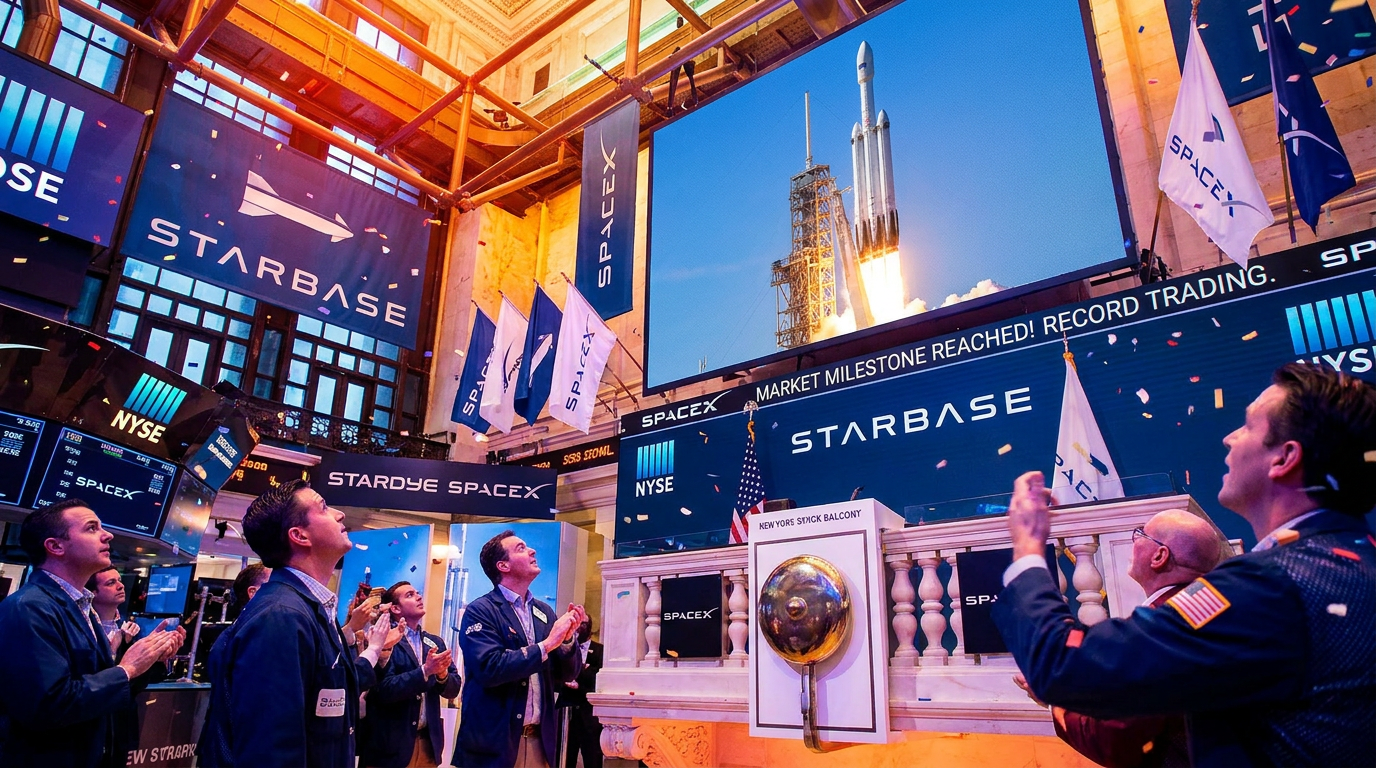
SpaceX has officially gone public in a record-shattering $75 billion initial public offering, drawing massive retail interest and providing the aerospace company with unprecedented capital to accelerate its Mars ambitions.
By Factlen Editorial Team
- Retail Believers
- Investors who view the IPO as a chance to back Elon Musk's track record and the long-term vision of multiplanetary life, regardless of traditional valuation metrics.
- Traditional Analysts
- Financial experts who caution that the $75 billion valuation is based on faith rather than near-term revenue, warning of the risks inherent in such a massive premium.
- Space Economy Optimists
- Industry insiders who celebrate the IPO as a massive capital injection that will accelerate technological breakthroughs like Starship and lift the entire aerospace sector.
What's not represented
- · Legacy aerospace competitors
- · Environmental regulatory bodies
Why this matters
The public debut of SpaceX opens the door for everyday investors to directly fund the commercialization of space. It provides the company with a massive capital injection to accelerate its Starship program, fundamentally altering the timeline for lunar and Martian exploration.
Key points
- SpaceX completed a historic $75 billion initial public offering, shattering previous market records.
- The market debut was driven by massive retail investor demand, betting heavily on Elon Musk's track record.
- Capital from the IPO will accelerate the development of the fully reusable Starship rocket system.
- Analysts note the valuation defies traditional math, describing it as a 'calculus based on faith.'
- The IPO also benefits early backers of xAI, which was folded into SpaceX prior to the public offering.
SpaceX has officially entered the public markets, shattering historical records with a $75 billion initial public offering that sent shockwaves through Wall Street and the global aerospace industry. The highly anticipated debut on Friday saw shares climb immediately, driven by a tidal wave of retail and institutional demand. For years, everyday investors have clamored for a way to buy into Elon Musk's space venture, and the opening bell finally democratized access to the world's most valuable private company.[1][7][8]
The sheer scale of the offering eclipses previous market milestones, cementing a new era for commercial spaceflight. By going public, SpaceX has unlocked an unprecedented war chest of capital. This financial firepower is earmarked for the company's most ambitious projects, primarily the continued development and scaling of the Starship rocket system and the expansion of the Starlink satellite internet constellation.[6][7]
Market analysts have noted that the frenzy surrounding the stock defies traditional valuation metrics. Nick Colas, co-founder of DataTrek Research, described the pricing as a "calculus based on faith" rather than standard revenue multiples. Investors are largely betting on Musk's track record of disrupting entrenched industries and delivering on seemingly impossible technological leaps, rather than modeling near-term quarterly profits.[2][5]

This faith has birthed a new retail-risk complex, with individual investors flocking to the stock in droves. The enthusiasm mirrors the early days of Tesla's meteoric rise, but on a much larger initial scale. Brokerage platforms reported surging activity as fans of the company's mission to make humanity multiplanetary rushed to secure a piece of the equity.[1][2]
While Elon Musk remains the visionary face and driving force behind the company's overarching goals, industry insiders point to President and COO Gwynne Shotwell as the operational anchor. Shotwell's steady hand has been credited with transforming SpaceX from a scrappy startup into a reliable, dominant launch provider that routinely beats legacy aerospace giants for lucrative government and commercial contracts.[3]
The core of SpaceX's near-term profitability lies in its Starlink division. The satellite internet service has grown exponentially, providing a steady stream of recurring revenue that helps offset the massive research and development costs associated with rocketry. Starlink's success has proven that space can be a highly lucrative commercial domain, not just a theater for government exploration.[7][8]
The core of SpaceX's near-term profitability lies in its Starlink division.
However, the ultimate prize remains what Musk calls the "holy grail of space flight": full and rapid reusability. Bloomberg space reporter Loren Grush highlighted that the capital raised in the IPO will heavily subsidize the Starship program. Achieving a fully reusable super-heavy launch vehicle would exponentially lower the cost of putting mass into orbit, fundamentally changing the economics of space exploration.[6]

The IPO has also drawn attention to the complex web of Musk's other ventures. Recently, his artificial intelligence startup, xAI, was folded into the SpaceX corporate umbrella ahead of the public offering. This move allowed early backers of xAI to ride the wave of the SpaceX debut, intertwining the futures of advanced AI and space exploration under a single publicly traded entity.[4]
The financial windfall extends to early private investors and political figures. Disclosures revealed that the family of Republican Representative Lisa McClain invested up to $250,000 in xAI before the merger, positioning them to benefit significantly from Friday's market surge. The broad base of early stakeholders highlights how deeply embedded SpaceX has become in both Silicon Valley and Washington.[4]
Interestingly, not all of Musk's loyal investors participated in the initial rush. Some long-time Tesla shareholders deliberately sat out the SpaceX IPO, speculating that Musk might eventually move to combine his various companies into a massive, unified conglomerate. These investors are betting that holding Tesla stock might eventually offer a backdoor entry into the broader Musk ecosystem.[1]

The transition from a privately held disruptor to a publicly traded behemoth brings new challenges. SpaceX will now face the relentless scrutiny of quarterly earnings reports and the demands of public shareholders. Balancing the long-term, capital-intensive goal of colonizing Mars with the short-term expectations of Wall Street will require a delicate corporate tightrope walk.[3][5]
Despite these looming pressures, the successful IPO marks a triumphant milestone for the commercial space industry. It proves that the market is willing to heavily back ambitious, frontier-pushing technology. As the dust settles on the historic trading day, SpaceX stands not just as a launch provider, but as the vanguard of a new, publicly funded space age.[7][8]
How we got here
2002
Elon Musk founds Space Exploration Technologies Corp. (SpaceX) with the goal of reducing space transportation costs.
2008
Falcon 1 becomes the first privately developed liquid-fueled rocket to reach Earth orbit.
2020
SpaceX successfully launches its first crewed mission to the International Space Station.
2024
The Starship program achieves major orbital milestones, proving the viability of the super-heavy launch system.
June 2026
SpaceX completes a record-breaking $75 billion IPO, opening the company to public investment.
Viewpoints in depth
Retail Investors' View
Viewing the IPO as a long-awaited opportunity to participate in the future of space exploration.
For years, retail investors have watched SpaceX achieve historic milestones from the sidelines, unable to invest directly in the private company. The IPO represents a democratization of the space economy. Many of these investors are less concerned with near-term price-to-earnings ratios and more focused on the multi-decade vision of making humanity multiplanetary. They see their investment as backing Elon Musk's proven ability to disrupt stagnant industries, viewing the stock as a foundational asset for the next century of technological progress.
Financial Analysts' View
Approaching the massive valuation with caution, citing the disconnect between the stock price and traditional financial metrics.
Wall Street traditionalists are grappling with how to model a company whose primary goal is colonizing another planet. Analysts point out that a $75 billion valuation at launch requires a 'calculus based on faith.' While they acknowledge the robust revenue stream generated by Starlink and commercial launch contracts, they warn that the capital-intensive nature of developing Starship presents significant financial risk. For these experts, the stock is currently trading on sentiment and the 'Musk premium' rather than grounded, near-term profitability.
Aerospace Industry's View
Seeing the massive capital influx as a catalyst that will force the entire sector to accelerate innovation.
Within the aerospace sector, the IPO is viewed as a watershed moment that permanently alters the competitive landscape. With billions in fresh capital, SpaceX can aggressively push the boundaries of reusability with Starship, potentially driving launch costs down to levels that legacy providers simply cannot match. Industry insiders believe this will force a reckoning among traditional defense and aerospace contractors, accelerating a shift toward rapid prototyping and commercial agility across the entire space economy.
What we don't know
- How the pressure of quarterly earnings reports will impact SpaceX's long-term, high-risk development timelines.
- Whether the integration of xAI into SpaceX will yield tangible technological synergies or complicate the company's core mission.
- How legacy aerospace competitors will respond to SpaceX's massive new capital advantage.
Key terms
- IPO (Initial Public Offering)
- The process by which a private company offers shares of its stock to the public for the first time, allowing anyone to invest.
- Starship
- SpaceX's next-generation, fully reusable super-heavy launch vehicle designed to carry massive payloads and eventually humans to the Moon and Mars.
- Reusability
- The ability to land and relaunch rocket boosters and spacecraft multiple times, drastically reducing the cost of accessing space.
- Starlink
- A satellite internet constellation operated by SpaceX that provides high-speed broadband coverage across the globe.
Frequently asked
Can anyone buy SpaceX stock now?
Yes, following the IPO, SpaceX shares are now publicly traded on the open market, allowing retail investors to purchase them through standard brokerage accounts.
What will SpaceX do with the IPO money?
The capital is expected to fund the company's most capital-intensive projects, primarily the development of the fully reusable Starship rocket and the expansion of the Starlink satellite internet network.
Does Elon Musk still control the company?
While SpaceX is now public, Musk retains significant influence and remains the visionary leader, though President Gwynne Shotwell continues to handle day-to-day operational control.
Sources
Source coverage
8 outlets
3 viewpoints surfaced





[1]BloombergRetail Believers
SpaceX Mania Powers New Retail-Risk Complex Beyond Wall Street
Read on Bloomberg →SpaceX IPO Whips Musk Fans Into Frenzy
Read on Bloomberg Television →[3]NYTSpace Economy Optimists
The steady hand at SpaceX is not Elon Musk’s.
Read on NYT →[4]CNBC
Top House Republican’s family investment poised to benefit from SpaceX IPO
Read on CNBC →Record SpaceX IPO 'Calculus Based on Faith' Not Valuation, Says Colas
Read on Bloomberg Data →Musk Aiming For 'Holy Grail of Space Flight' in Reusability, Says Loren Grush
Read on Bloomberg Space →[7]Wall Street JournalTraditional Analysts
SpaceX Completes Record $75 Billion IPO
Read on Wall Street Journal →[8]ReutersSpace Economy Optimists
SpaceX shares surge in market debut, cementing Musk's wealth
Read on Reuters →
Every angle. Every day.
Get business stories with full source coverage and perspective breakdowns delivered to your inbox.