
SpaceX Completes Largest IPO in History, Reaching $2 Trillion Valuation
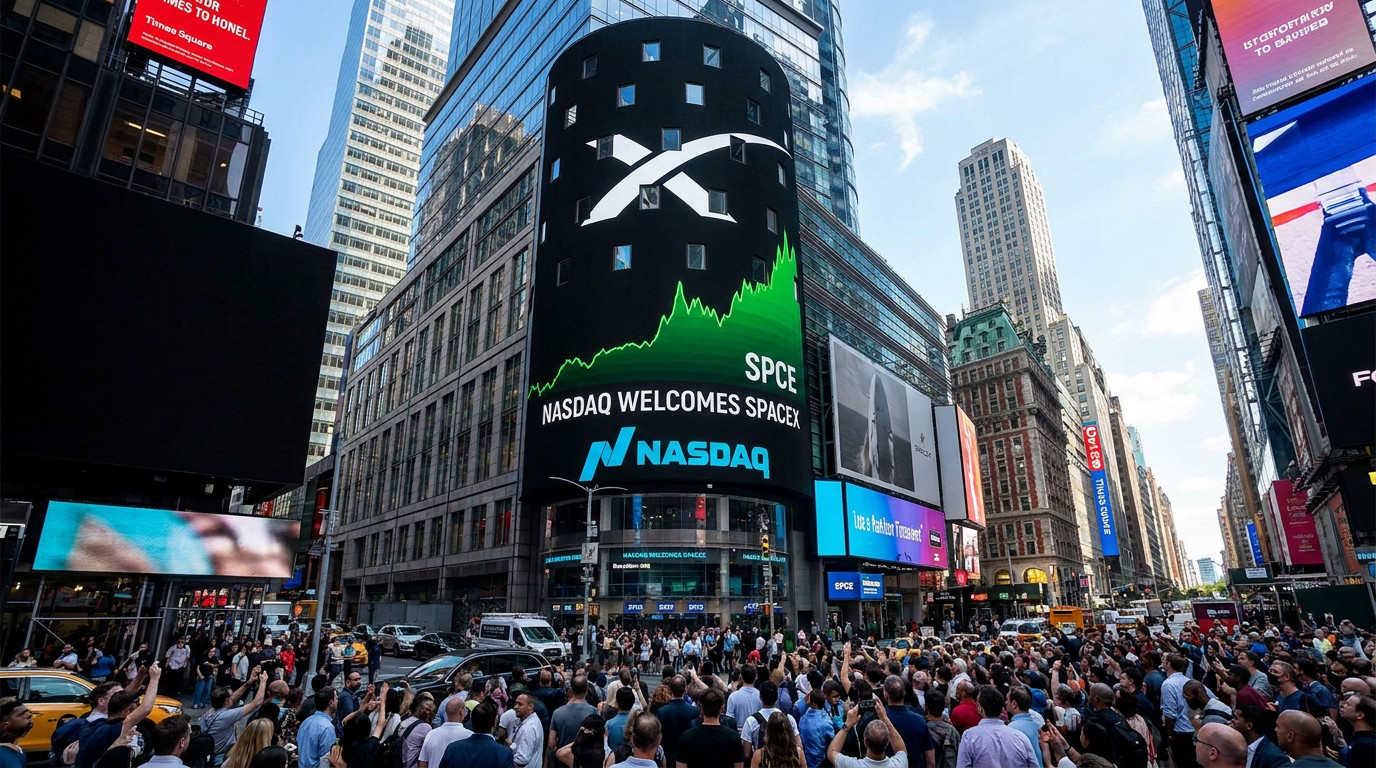
SpaceX shares surged on their first day of Nasdaq trading, cementing the largest initial public offering on record and pushing Elon Musk's net worth past $1 trillion. The landmark debut is reshaping the aerospace sector and setting a new benchmark for upcoming mega-cap tech listings.
By Factlen Editorial Team
- Tech Growth Investors
- View SpaceX as a generational monopoly with software-like margins from Starlink justifying the premium valuation.
- Traditional Value Analysts
- Warn that the $2 trillion valuation is priced for perfection and leaves no room for the inherent risks of spaceflight.
- Legacy Aerospace Sector
- Concerned about the massive capital drain as investors abandon traditional defense contractors for the new market leader.
What's not represented
- · Regulatory bodies overseeing the sudden influx of private capital into orbital infrastructure.
- · Retail investors who were locked out of the initial IPO allocation and must buy at inflated secondary market prices.
Why this matters
The sheer scale of SpaceX's public debut instantly reshapes global equity markets, drawing immense capital away from legacy aerospace firms while establishing a new valuation playbook for impending mega-IPOs. For retail and institutional investors alike, it introduces a massive new heavyweight to major index funds, indirectly affecting millions of retirement portfolios.
Key points
- SpaceX completed the largest IPO in history, reaching an intraday valuation of over $2 trillion.
- Shares surged 21% on the first day of trading on the Nasdaq exchange.
- The massive valuation pushed founder Elon Musk's personal net worth past the $1 trillion mark.
- Rival space and satellite stocks suffered steep selloffs as investors rotated capital into SpaceX.
- The successful listing is expected to pave the way for upcoming mega-IPOs from AI firms like OpenAI.
The opening bell at the Nasdaq on Friday morning marked the culmination of the most anticipated financial event of the decade. SpaceX, the aerospace juggernaut founded by Elon Musk, officially became a publicly traded company in the largest initial public offering in history. Shares surged immediately upon the commencement of trading, leaping 21% in early action and pushing the company's total market capitalization past the $2 trillion threshold.[1][2]
Musk, who rang the opening bell remotely via livestream from the company's Starbase facility in Texas, addressed thousands of employees as the ticker went live. Reflecting on the company's turbulent early days, he noted that he originally gave SpaceX a less than 10% chance of survival. Today, the successful listing not only cements the company's dominance in commercial spaceflight but also pushes Musk's personal net worth into uncharted territory, making him the world's first individual trillionaire.[4][7]
The mechanics of this IPO are as unprecedented as its scale. Priced initially at a valuation of $1.77 trillion before the opening surge, the offering dwarfs previous record-holders like Saudi Aramco and Alibaba. Institutional demand was voracious, heavily oversubscribing the available float. This massive influx of capital provides SpaceX with a liquid currency to fund its most ambitious, capital-intensive projects, including the continued colonization architecture for Mars and the expansion of the Starlink satellite internet constellation.[2][5]

However, the sheer gravity of a $2 trillion aerospace entity entering the public markets has created an immediate vacuum effect across the sector. As institutional portfolio managers scrambled to allocate funds to the new heavyweight, rival space and satellite stocks experienced a sharp selloff. Investors rapidly rotated capital out of legacy defense contractors and smaller, unproven space startups to ensure they had sufficient exposure to the industry's undisputed market leader.[3]
This capital rotation highlights a fundamental shift in how Wall Street values space infrastructure. For years, the sector was viewed through the lens of government contracts and cost-plus defense spending. SpaceX has forced a transition toward a tech-valuation model, where investors are pricing in software-like margins from Starlink and monopolistic dominance in orbital launch cadence. The result is a valuation multiple that traditional aerospace firms simply cannot match.[3][5]

Yet, the astronomical valuation is not without its skeptics. Several prominent institutional investors and market analysts have raised concerns about the $1.77 trillion baseline, describing it as "pie in the sky" pricing that assumes flawless execution for decades to come. To justify a $2 trillion market cap, SpaceX must not only maintain its absolute monopoly on heavy-lift launches but also successfully transition Starlink into a global telecommunications utility that displaces traditional broadband providers.[5]
Yet, the astronomical valuation is not without its skeptics.
The skeptics argue that space remains an inherently risky business, where a single catastrophic failure of the Starship vehicle or a regulatory crackdown on satellite deployments could severely impair the company's growth trajectory. Furthermore, as a public company, SpaceX will now face the relentless quarterly scrutiny of Wall Street, a stark contrast to the patient, long-term capital it enjoyed during its two decades in the private markets.[2][5]
Beyond the corporate implications, the IPO is triggering a massive wealth creation event for SpaceX's early employees and private backers. Thousands of engineers, technicians, and early executives are suddenly holding liquid equity worth millions, prompting a localized economic boom in aerospace hubs like Hawthorne, California, and Boca Chica, Texas. Wealth management firms are reportedly scrambling to adapt, creating bespoke financial products to handle the unique tax and liquidity challenges faced by this new class of "space millionaires."[6]

This sudden influx of liquid wealth is expected to have downstream effects on the broader venture capital ecosystem. Historically, mega-IPOs like Google or Facebook have spawned "mafias" of newly wealthy alumni who go on to fund and found the next generation of startups. Industry watchers anticipate that the SpaceX windfall will similarly catalyze a new wave of deep-tech and hard-science investments, as early employees deploy their capital into nascent ventures.[2][6]
The successful execution of this mega-IPO also serves as a critical icebreaker for the broader technology market. For the past two years, the pipeline for massive public listings has been largely frozen, with late-stage private companies hesitant to test public market waters. SpaceX's triumphant debut provides a clear proof of concept that public investors possess the appetite and the capital to absorb trillion-dollar valuations.[2]
Financial analysts note that this paves the way for a highly anticipated wave of artificial intelligence IPOs. Companies like OpenAI and Anthropic, which have commanded massive private valuations on the back of the generative AI boom, are watching the SpaceX listing closely. The ability of the Nasdaq to smoothly process an offering of this magnitude suggests that the market infrastructure is fully prepared for the next generation of tech titans.[2]

In the immediate term, the focus will shift to the options market. Contracts on SpaceX shares are slated to begin trading on Tuesday, which will introduce new layers of volatility and price discovery. Retail investors, who have long clamored for a way to invest directly in Musk's space ambitions, are expected to drive significant volume in the derivatives market, potentially leading to the kind of dramatic price swings seen in other high-profile tech listings.[1][3]
Ultimately, the SpaceX IPO represents a structural shift in the global equity landscape. A company that builds reusable rockets and satellite constellations is now valued more highly than most sovereign economies and nearly all traditional financial institutions. Whether the company can sustain this valuation under the harsh glare of public markets remains the defining financial question of the year, but its arrival has undeniably altered the center of gravity on Wall Street.[1][5]
How we got here
2002
Elon Musk founds Space Exploration Technologies Corp. with the goal of reducing space transportation costs.
2008
Falcon 1 becomes the first privately developed liquid-fueled rocket to reach orbit, saving the company from bankruptcy.
2020
SpaceX becomes the first private company to send human astronauts to the International Space Station.
June 12, 2026
SpaceX goes public on the Nasdaq in the largest IPO in history, valuing the firm at $2 trillion.
Viewpoints in depth
Tech Growth Investors
Bulls argue the valuation is justified by Starlink's recurring revenue and the total monopoly on orbital launch.
Growth investors view SpaceX not as a traditional aerospace manufacturer, but as a foundational technology platform akin to the early internet. They argue that the $2 trillion valuation is supported by the high-margin, recurring revenue generated by the Starlink satellite internet service, which operates more like a global telecommunications utility than a hardware product. Furthermore, they point to SpaceX's absolute dominance in heavy-lift launch cadence, suggesting that the company essentially owns the toll road to low Earth orbit, allowing it to dictate pricing and pace for the entire industry.
Traditional Value Analysts
Skeptics warn that the $2 trillion valuation is priced for perfection and ignores the inherent risks of spaceflight.
Value-oriented analysts and institutional skeptics caution that pricing a company at $1.77 trillion out of the gate leaves zero margin for error. They argue that this valuation assumes decades of flawless execution, ignoring the historical reality that space exploration is fraught with catastrophic risks. A single failure of the next-generation Starship vehicle, or unforeseen regulatory hurdles regarding space debris and satellite deployment, could severely impair the company's growth narrative. They also note that transitioning from a privately shielded entity to a public company facing quarterly earnings pressure may force SpaceX to compromise on its long-term, high-risk engineering goals.
Legacy Aerospace Sector
Competitors are facing a severe capital drain as investors rotate out of traditional defense contractors.
For legacy aerospace and defense contractors, the SpaceX IPO represents a structural threat to their capital base. As portfolio managers scramble to allocate funds to the new $2 trillion heavyweight, they are actively selling off positions in older, slower-growing space and satellite firms. This capital rotation starves traditional competitors of investment dollars, making it harder for them to fund their own research and development. Industry insiders worry that this dynamic will create a self-fulfilling prophecy, where SpaceX's immense market capitalization allows it to outspend and out-innovate rivals who are simultaneously being abandoned by Wall Street.
What we don't know
- How the stock will stabilize once the initial retail and institutional frenzy subsides.
- Whether SpaceX can maintain its rapid innovation cadence while managing the quarterly earnings pressure of public markets.
- How the sudden liquidity of thousands of early employees will impact retention at the company.
Key terms
- Initial Public Offering (IPO)
- The process of offering shares of a private corporation to the public in a new stock issuance, allowing public investors to buy in.
- Market Capitalization
- The total dollar market value of a company's outstanding shares of stock, calculated by multiplying the stock price by total shares.
- Capital Rotation
- The movement of investment funds from one sector, industry, or specific stock to another in search of better returns or to rebalance a portfolio.
- Float
- The regular shares a company has issued to the public that are available for investors to trade on the open market.
Frequently asked
How much is SpaceX worth after the IPO?
The company priced its IPO at a $1.77 trillion valuation, but early trading surges pushed its market capitalization past $2 trillion on the first day.
Can anyone buy SpaceX stock now?
Yes, as a publicly traded company on the Nasdaq, retail and institutional investors can now buy and sell shares of SpaceX through standard brokerage accounts.
Why did other space stocks drop?
Institutional investors sold off shares in rival aerospace and satellite companies to free up capital to buy into the SpaceX IPO, a process known as capital rotation.
Sources
Source coverage
7 outlets
3 viewpoints surfaced




[1]CNBCTech Growth Investors
SpaceX shares gain 21% as trading begins, valuing Elon Musk's rocket company at more than $2 trillion
Read on CNBC →[2]The New York TimesTraditional Value Analysts
SpaceX Stock Rises 11% in Largest I.P.O. Ever
Read on The New York Times →[3]BloombergLegacy Aerospace Sector
Rival Space Stocks Tumble as Investors Race Toward Musk’s IPO
Read on Bloomberg →[4]ForbesTech Growth Investors
Everything Elon Musk Said As SpaceX Rang Opening Bell For Its Record-Breaking IPO
Read on Forbes →Is SpaceX worth $1.77 trillion? It’s a pie in the sky, some investors say.
Read on The New York Times →New SpaceX millionaires are reinventing the business of managing large wealth
Read on CNBC →Elon Musk Gave SpaceX Less Than 10% Chance of Succeeding
Read on Bloomberg →
Every angle. Every day.
Get business stories with full source coverage and perspective breakdowns delivered to your inbox.