
SpaceX Completes Historic IPO, Reaching $2.2 Trillion Valuation in Market Debut
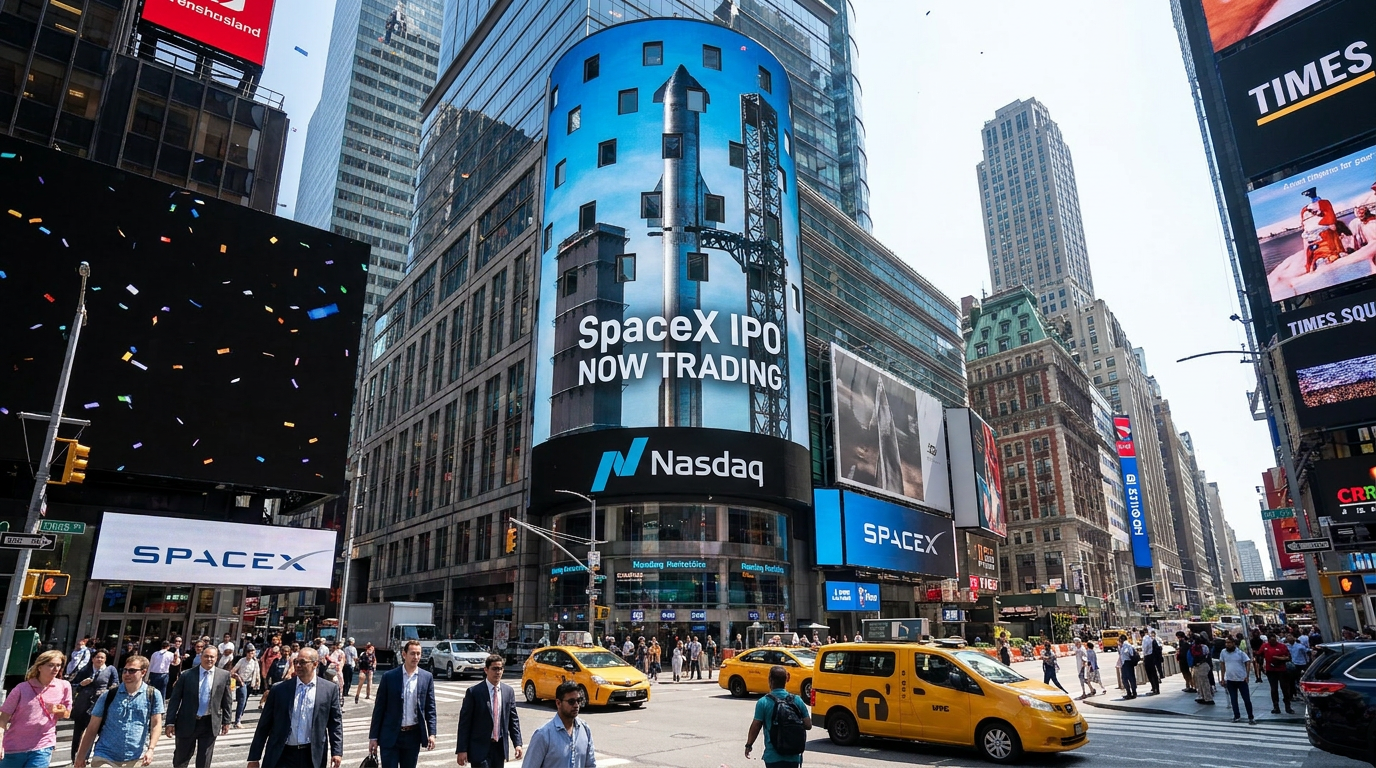
SpaceX shares surged 19% in their Nasdaq debut, valuing the aerospace and artificial intelligence conglomerate at $2.2 trillion and marking the largest public offering in history.
By Factlen Editorial Team
- Retail and Growth Investors
- The IPO represents a generational opportunity to invest in the infrastructure of the future.
- Corporate Governance Advocates
- The company's corporate structure poses unprecedented risks for public markets.
- National Security Voices
- A massively capitalized SpaceX is a vital asset for American technological and geopolitical dominance.
What's not represented
- · Traditional aerospace competitors
- · Environmental advocacy groups monitoring launch impacts
Why this matters
The transition of the world's most valuable private startup into a public company allows retail investors to directly back commercial spaceflight and advanced AI for the first time, while fundamentally reshaping the weighting of major global index funds.
Key points
- SpaceX shares surged 19% in their Nasdaq debut, reaching a historic $2.2 trillion valuation.
- The massive public offering officially made founder Elon Musk the world's first trillionaire.
- The company folded Musk's artificial intelligence startup, xAI, into its corporate structure prior to the IPO.
- SpaceX is being fast-tracked for inclusion in major global indexes, forcing passive funds to buy the stock.
- Corporate governance advocates have raised concerns over Musk's dominant control and the lack of an independent board.
SpaceX officially entered the public markets on Friday in a blockbuster debut that shattered historical records and fundamentally reordered the global technology landscape. Shares of the aerospace and artificial intelligence conglomerate surged 19% by the close of trading on the Nasdaq, pushing the company's total market capitalization to an unprecedented $2.2 trillion.[2][4]
The sheer scale of the offering makes it the largest initial public offering in financial history, instantly cementing SpaceX as one of the most valuable publicly traded entities on Earth. The massive valuation spike also pushed founder and CEO Elon Musk's personal net worth past the thirteen-figure mark, making him the world's first recognized trillionaire.[2][4]
The milestone represents the culmination of an unlikely corporate journey. When the company was founded in 2002, Musk himself famously estimated that SpaceX had less than a 10 percent chance of surviving, let alone succeeding. Over two decades, the firm navigated near-bankruptcy and repeated rocket failures to eventually pioneer the reusable launch vehicles that now dominate the global space economy.[1]

Today, SpaceX's core business operates as a multi-pronged juggernaut. Its Falcon and Starship programs maintain a near-monopoly on commercial heavy-lift launches, while its Starlink division provides high-speed satellite internet to millions of users globally, generating massive recurring revenue that traditional aerospace contractors have never been able to match.[1][7]
A critical catalyst for the $2.2 trillion valuation was the strategic decision to fold Musk's artificial intelligence startup, xAI, into the SpaceX corporate umbrella ahead of the public offering. The consolidation created a dual-threat technology behemoth, merging the capital-intensive infrastructure of space exploration with the explosive growth potential of generative AI.[5][8]
Industry analysts note that the synergy between the two divisions is more than just financial engineering. By integrating xAI's advanced compute capabilities with Starlink's orbital network, SpaceX is positioning itself to offer space-based data processing and autonomous navigation systems that could revolutionize both commercial logistics and defense applications.[8]

Industry analysts note that the synergy between the two divisions is more than just financial engineering.
The historic debut triggered a frenzy among retail investors, who have spent years waiting for an opportunity to buy into Musk's most successful private venture. Trading desks reported overwhelming demand from individual brokerage accounts, fueling what market observers are calling a new "retail-risk complex" that operates largely independently of traditional Wall Street valuation models.[6]
Beyond retail enthusiasm, the sheer size of SpaceX's market capitalization means it is being fast-tracked for inclusion in major institutional benchmarks, including the MSCI Global Standard and FTSE Russell indexes. This inclusion forces passive mutual funds and exchange-traded funds worldwide to automatically purchase billions of dollars in SpaceX stock to match the index weightings.[3]
However, the rapid index inclusion has sparked intense debate over corporate governance. New York City Comptroller Mark Levine and other institutional watchdogs have publicly raised concerns about the company's unprecedented control structure. Because SpaceX bypassed traditional seasoning periods and lacks a conventional independent board of directors, a single individual retains dominant control over a $2.2 trillion public entity.[3]

Despite these structural warnings, the broader market has shown a clear willingness to overlook governance anomalies in exchange for access to the company's growth trajectory. Investors argue that the traditional rules of corporate oversight are ill-suited for a company that has consistently achieved engineering feats previously thought impossible by legacy aerospace firms.[3][7]
From a geopolitical perspective, the massive capitalization of SpaceX is being celebrated as a strategic victory for the United States. Defense analysts and policymakers view the successful IPO as a guarantee that American commercial spaceflight will maintain its dominance over international rivals, providing the deep capital reserves necessary for future lunar bases and crewed missions to Mars.[5][9]
For the broader technology sector, the blockbuster debut signals that the IPO window is violently open for deep-tech and capital-intensive startups. After years of market hesitation, SpaceX's successful transition proves that public markets are willing to aggressively fund ambitious, hardware-focused innovation, potentially paving the way for a new generation of aerospace and AI companies to go public.[1][7]
How we got here
2002
Elon Musk founds Space Exploration Technologies Corp. (SpaceX) with the goal of reducing space transportation costs.
2008
SpaceX successfully launches the Falcon 1, becoming the first privately funded liquid-propellant rocket to reach orbit.
2020
The company successfully launches NASA astronauts to the International Space Station, marking a new era of commercial crewed spaceflight.
Early 2026
SpaceX folds Musk's artificial intelligence startup, xAI, into its corporate structure ahead of a planned public debut.
June 12, 2026
SpaceX debuts on the Nasdaq, surging 19% to reach a historic $2.2 trillion valuation.
Viewpoints in depth
Growth Investors' View
The IPO represents a generational opportunity to invest in the infrastructure of the future.
For retail traders and growth-focused funds, SpaceX is viewed less as a traditional aerospace manufacturer and more as a foundational technology platform. Proponents argue that the combination of Starlink's recurring revenue, the monopoly on heavy-lift launches, and the integration of xAI justifies the astronomical valuation. They largely dismiss governance concerns, pointing to the company's track record of achieving what critics previously deemed impossible.
Governance Advocates' View
The company's corporate structure poses unprecedented risks for public markets.
Institutional watchdogs and corporate governance experts express deep unease over SpaceX's transition to the public markets. Because the company is being fast-tracked into major passive indexes, millions of retirement accounts will automatically purchase shares in a firm where a single individual holds near-absolute control. Critics argue that the lack of an independent board and traditional seasoning periods bypasses the safeguards designed to protect everyday shareholders.
Strategic Policy View
A massively capitalized SpaceX is a vital asset for American technological and geopolitical dominance.
From a national security and policy perspective, the successful IPO is hailed as a strategic victory. Lawmakers and defense analysts view SpaceX's access to deep public capital markets as a guarantee that the United States will maintain its lead over international rivals in both space exploration and artificial intelligence. The financial windfall is seen as fuel for future defense contracts and the eventual goal of crewed missions to Mars.
What we don't know
- How the integration of xAI will practically alter SpaceX's core aerospace operations and revenue models.
- Whether major index providers will eventually demand governance reforms or independent board seats as a condition for long-term inclusion.
- How the company's valuation will hold up once the initial retail trading mania subsides and quarterly earnings reports begin.
Key terms
- Initial Public Offering (IPO)
- The process by which a private company offers shares of its stock to the public for the first time.
- Market Capitalization
- The total dollar market value of a company's outstanding shares of stock, calculated by multiplying the stock price by the total number of shares.
- Index Inclusion
- The addition of a company's stock to major financial benchmarks, which forces mutual funds and ETFs tracking those indexes to automatically buy the stock.
Frequently asked
Why did SpaceX merge with xAI before the IPO?
The merger consolidated Elon Musk's advanced technology ventures, pairing SpaceX's massive capital and infrastructure needs with xAI's artificial intelligence capabilities to create a dual-threat tech conglomerate.
Can anyone buy SpaceX stock now?
Yes, following its Nasdaq debut, SpaceX is a publicly traded company, allowing retail investors to purchase shares through standard brokerage accounts.
Why are some institutional investors concerned?
Critics point to SpaceX's unprecedented governance structure, which grants Elon Musk dominant control with limited shareholder rights and minimal independent board oversight.
Sources
Source coverage
9 outlets
3 viewpoints surfaced








[1]NYTCorporate Governance Advocates
SpaceX’s Unlikely Journey From Far-Out Idea to $2 Trillion Juggernaut
Read on NYT →[2]BBCNational Security Voices
Elon Musk becomes world's first trillionaire as SpaceX soars in stock market debut
Read on BBC →[3]BloombergCorporate Governance Advocates
NYC Comptroller Raises Concerns Over SpaceX Index Inclusion and Governance Structure
Read on Bloomberg →[4]ForbesRetail and Growth Investors
SpaceX Shares Close Up 19% After Historic IPO Makes Musk World’s First Trillionaire
Read on Forbes →[5]CNBCNational Security Voices
Top House Republican’s family investment poised to benefit from SpaceX IPO
Read on CNBC →SpaceX Mania Powers New Retail-Risk Complex Beyond Wall Street
Read on Bloomberg →[7]Wall Street JournalRetail and Growth Investors
SpaceX Goes Public in Landmark $2 Trillion Debut
Read on Wall Street Journal →[8]TechCrunchRetail and Growth Investors
SpaceX and xAI combine in historic public offering
Read on TechCrunch →[9]Fox BusinessNational Security Voices
SpaceX IPO cements American dominance in commercial spaceflight
Read on Fox Business →
Every angle. Every day.
Get business stories with full source coverage and perspective breakdowns delivered to your inbox.