
SpaceX Completes Historic $75 Billion IPO, Pushing Valuation Past $2 Trillion
SpaceX debuted on the public markets in the largest initial public offering in history, raising $75 billion and propelling its market capitalization beyond $2 trillion. The landmark listing cements the company's pivot toward space-based artificial intelligence infrastructure while making founder Elon Musk the world's first trillionaire.
By Factlen Editorial Team
- Space Industry Advocates
- View the IPO as a massive validation of the commercial space sector that will lower the cost of capital for future aerospace innovation.
- Financial Skeptics
- Warn that the $1.77 trillion initial valuation is aggressively priced for perfection, given the company's recent multibillion-dollar operating losses.
- Retail Investors
- Enthusiastic about the unprecedented 30% share allocation, viewing it as a rare opportunity to buy into a generational technology monopoly.
What's not represented
- · Environmental Advocates
- · Legacy Aerospace Competitors
Why this matters
This IPO marks a permanent shift in the commercial space and AI sectors, injecting massive capital into orbital infrastructure. For everyday investors, the unusually high retail allocation offers direct exposure to the space economy, while the sheer scale of the listing reshapes major index funds and global market dynamics.
Key points
- SpaceX raised $75 billion, making it the largest initial public offering in global history.
- Shares closed their first day of trading up nearly 19%, pushing the company's valuation past $2 trillion.
- The listing officially made founder Elon Musk the world's first trillionaire.
- SpaceX bypassed traditional IPO price discovery, setting a fixed $135 price and reserving 30% for retail investors.
- The company plans to use the capital to fund Starship development, Mars missions, and orbital AI data centers.
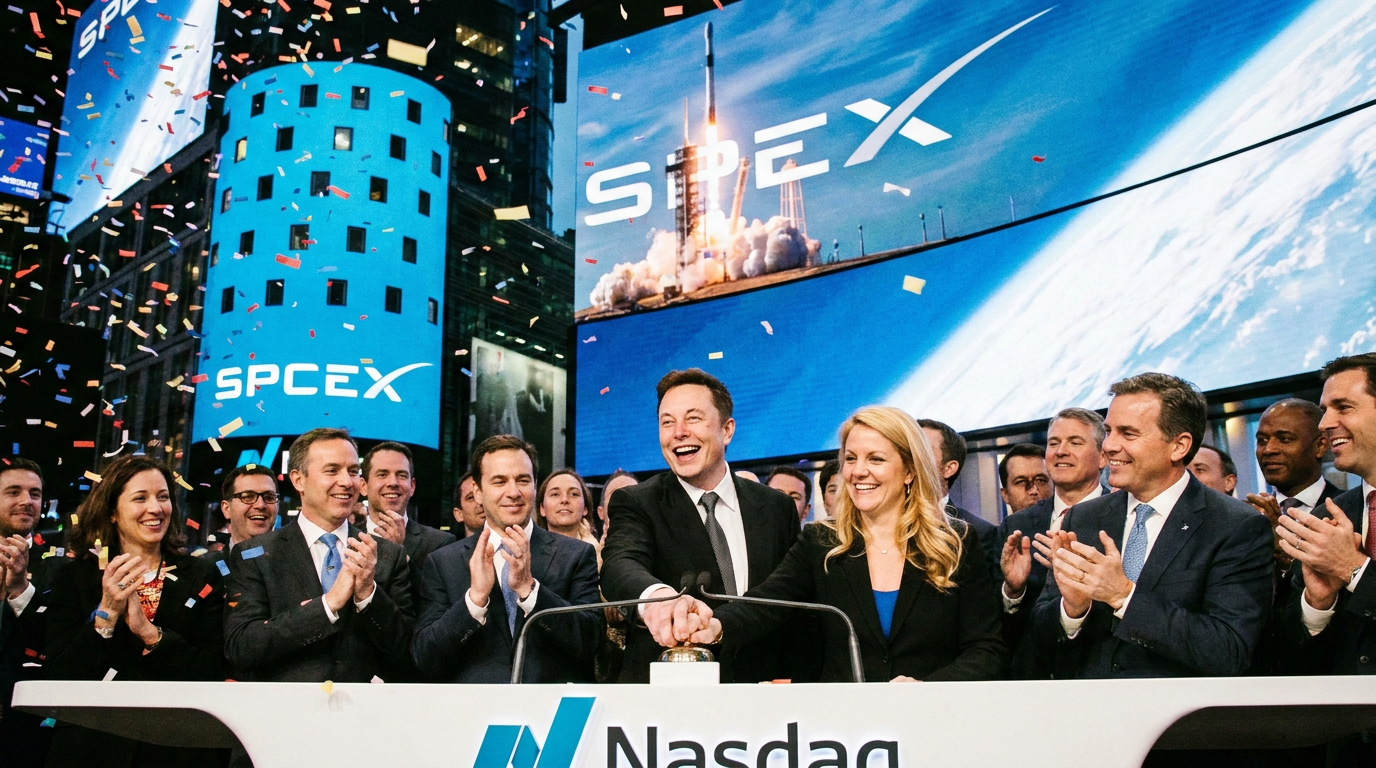
The opening bell at the Nasdaq on Friday didn't just mark the start of trading; it signaled the arrival of the largest public market debut in human history. Space Exploration Technologies Corp., universally known as SpaceX, completed its long-awaited initial public offering, raising a staggering $75 billion. The listing shattered the previous global record set by Saudi Aramco in 2019, injecting unprecedented capital into the commercial space sector and fundamentally altering the landscape of the U.S. stock market. Trading under the ticker symbol SPCX, the company's arrival on the public markets was met with a frenzy of investor demand that pushed its valuation into the stratosphere.[3][4][5]
The sheer scale of the offering reflects the outsized ambitions of a company that has already revolutionized orbital logistics and satellite communications. In a move characteristic of its unorthodox corporate culture, SpaceX bypassed the traditional Wall Street playbook. The company eschewed the customary price-discovery roadshow—where bankers gauge institutional appetite to set a price range—in favor of a fixed, take-it-or-leave-it entry price of $135 per share. When trading officially commenced shortly before noon, the stock opened at $150 and surged as high as $176 in intraday trading. By the time the closing bell rang, shares settled near $161. This robust first-day performance represented a roughly 19% premium over the offering price, cementing a historic market capitalization north of $2 trillion and immediately ranking SpaceX among the most valuable publicly traded entities on Earth.[2][4]
The financial milestone carried an equally historic personal consequence for the company's founder and chief executive. Elon Musk, who seeded SpaceX in 2002 with the proceeds from the sale of PayPal, officially became the world's first trillionaire as the stock surged on Friday afternoon. Holding approximately 42% of the company's outstanding shares—alongside his massive equity stakes in Tesla and his artificial intelligence venture, xAI—Musk's net worth decisively crossed the 13-figure threshold. Yet, it is his ironclad grip on the company's governance that remains a focal point for Wall Street. By retaining 82% of the voting power through a specialized dual-class share structure, Musk exercises near-total control over the $2 trillion behemoth. This unprecedented concentration of corporate power has drawn both awe from his retail loyalists and intense scrutiny from institutional observers who prefer traditional board oversight.[2][4][7]

While SpaceX built its formidable reputation on reusable Falcon 9 rockets and the rapidly expanding Starlink satellite internet constellation, the IPO prospectus revealed a dramatic pivot in the company's long-term thesis. The $75 billion capital injection is not merely destined for rocket fuel; it is heavily earmarked for the artificial intelligence revolution. SpaceX executives have outlined an ambitious roadmap to become the backbone of the AI age, proposing the construction of massive, solar-powered data centers in low Earth orbit. By acquiring Musk's AI startup xAI earlier in the year, the company is positioning itself to capture a significant slice of an estimated $28.5 trillion global AI market, blending orbital infrastructure with next-generation computing.[1][4][5]
This strategic pivot helps explain the astronomical valuation, which some financial analysts argue is entirely disconnected from the company's current balance sheet. Between the start of 2025 and the end of the first quarter of 2026, SpaceX reported billions of dollars in operating losses as it poured capital into the research and development of its next-generation Starship vehicle. Traditional valuation metrics struggle to justify a $2 trillion market cap for a company with such steep near-term deficits. Independent research firms, including Morningstar, had previously valued the core launch and satellite business closer to $780 billion, leading skeptics to warn that the newly minted public stock is priced for absolute perfection and leaves little room for engineering setbacks.[1][5]
This strategic pivot helps explain the astronomical valuation, which some financial analysts argue is entirely disconnected from the company's current balance sheet.
Corporate governance watchdogs and public officials have also sounded the alarm over the unprecedented nature of the listing and its broader market implications. New York City Comptroller Mark Levine publicly criticized the fast-tracking of SpaceX into major passive indices like the MSCI Global Standard and FTSE Russell. Levine highlighted the abandonment of traditional seasoning periods and expressed deep concern over a governance structure that grants a single individual near-total control with virtually no independent board oversight. Senator Elizabeth Warren echoed these sentiments in a formal letter to the Securities and Exchange Commission, requesting that regulators carefully review the offering's investor protections given the sheer magnitude of capital at stake.[6][7]

Despite the institutional hand-wringing, retail investors have embraced the offering with historic fervor. In a highly unusual move for a mega-cap IPO, SpaceX reserved up to 30% of its shares for retail buyers, democratizing access to a stock that has been the holy grail of private markets for a decade. Brokerages reported overwhelming demand, with retail orders reportedly exceeding $100 billion in the days leading up to the debut. This populist allocation strategy aligns directly with Musk's stated goal of allowing everyday supporters to participate in the financial upside of space exploration, effectively bypassing the traditional Wall Street gatekeepers who typically monopolize the most lucrative early-stage allocations.[4][6]
The ripple effects of the IPO are already being felt across the broader aerospace and defense industries. Heather Pringle, CEO of the Space Foundation, noted during a Friday interview that the successful listing provides a massive, undeniable vote of confidence for the maturing space economy. By demonstrating that orbital communications and launch services can command multi-trillion-dollar valuations on the public markets, SpaceX has effectively lowered the cost of capital for an entire ecosystem of aerospace startups. Venture capitalists and private equity firms anticipate a renewed surge in funding for smaller companies pursuing next-generation aviation, lunar logistics, orbital manufacturing, and deep-space navigation technologies, as the pathway to a lucrative public exit has now been proven viable.[8]
The capital raised will immediately accelerate SpaceX's most ambitious engineering projects, chief among them the Starship program. The fully reusable, super-heavy-lift launch vehicle is the linchpin of the company's future, designed to carry unprecedented payloads into orbit at a fraction of current costs. Starship is essential not only for deploying the massive next-generation Starlink satellites required for global broadband dominance but also for fulfilling NASA's Artemis program contracts. The U.S. space agency relies heavily on the success of the Starship human landing system to return American astronauts to the lunar surface later this decade, making the vehicle a cornerstone of national aerospace strategy.[1][3]

Beyond the Moon, the IPO funds the ultimate vision that has driven the company since its inception: the colonization of Mars. During a celebratory address at the company's Starbase facility in South Texas, Musk reiterated his commitment to making humanity a multiplanetary species. The $75 billion war chest provides the financial runway necessary to develop the life-support systems, orbital refueling infrastructure, and mass-manufacturing capabilities required to establish a self-sustaining city on the Red Planet. "Whoever you are watching this, SpaceX wants to be able to take you to the moon, take you to Mars and ultimately beyond," Musk told the cheering crowd.[2][4]
As the dust settles on the most lucrative week in Wall Street history, the true test for SpaceX lies ahead. The company must now navigate the relentless quarterly scrutiny of public markets while executing engineering feats that border on science fiction. Institutional shareholders will demand clear timelines on profitability, closely monitoring the cash burn associated with Starship development and the ambitious orbital data center buildout. If SpaceX can successfully deploy its AI infrastructure and operationalize Starship without catastrophic delays, its $2 trillion valuation may eventually look like a bargain. If technical hurdles delay these promises, the public market's patience will be severely tested.[4][5]
For now, the successful debut of SPCX stands as a watershed moment in modern capitalism. It bridges the gap between the terrestrial tech boom and the final frontier, intertwining the future of artificial intelligence with the expansion of human presence in the solar system. The era of commercial spaceflight has officially graduated from a billionaire's private passion project to a foundational pillar of the global public economy. By inviting millions of everyday investors to buy a literal stake in the cosmos, SpaceX has ensured that its journey to the stars will be funded, scrutinized, and celebrated by the public it aims to carry there.[2][3]
How we got here
2002
Elon Musk founds Space Exploration Technologies Corp. with the ultimate goal of colonizing Mars.
April 2026
SpaceX confidentially submits a draft registration statement to the SEC to begin the IPO process.
May 2026
The SEC publicly discloses SpaceX's S-1 filing, revealing plans for a massive public offering.
June 11, 2026
SpaceX officially prices its shares at a fixed $135, bypassing traditional institutional bookbuilding.
June 12, 2026
Shares debut on the Nasdaq under the ticker SPCX, closing near $161 and pushing the valuation over $2 trillion.
Viewpoints in depth
Space Economy Optimists
Industry leaders view the IPO as a definitive maturation of the commercial space sector.
For advocates of commercial spaceflight, the $75 billion raise is proof that orbital logistics is no longer a niche industry. Organizations like the Space Foundation argue that SpaceX's ability to command a $2 trillion valuation on the public markets validates the economic viability of satellite communications and launch services. This milestone is expected to trigger a downstream investment boom, lowering the cost of capital for smaller startups working on lunar landers, orbital manufacturing, and deep-space navigation.
Corporate Governance Skeptics
Financial watchdogs warn about the unprecedented concentration of power and lack of traditional oversight.
Public officials and institutional investors have raised red flags regarding the mechanics of the IPO and the company's internal structure. Critics point out that Elon Musk's retention of 82% of the voting power effectively neutralizes the ability of public shareholders to influence corporate strategy. Furthermore, the fast-tracking of SpaceX into major passive indices means that millions of retirement accounts will be automatically invested in a company that recently posted multibillion-dollar operating losses and operates with minimal independent board oversight.
Market Analysts
Financial experts caution that the stock is priced for absolute perfection.
While acknowledging the historic scale of the debut, market analysts warn that a $2 trillion valuation leaves no room for error. SpaceX's pivot toward building AI data centers in orbit is technologically unproven, and the company is currently burning through billions of dollars to develop its Starship rocket. Analysts note that while retail enthusiasm drove the first-day pop, institutional investors will eventually demand clear timelines on profitability, making the stock highly vulnerable to any engineering delays or launch failures.
What we don't know
- Whether the ambitious plan to build solar-powered AI data centers in orbit is technologically or economically viable.
- How the stock will perform in the coming weeks as institutional investors digest the company's recent multibillion-dollar operating losses.
Key terms
- Initial Public Offering (IPO)
- The process of offering shares of a private corporation to the public in a new stock issuance, allowing the company to raise capital from public investors.
- Market Capitalization
- The total dollar market value of a company's outstanding shares of stock, calculated by multiplying the current share price by the total number of shares.
- Retail Investor
- Individual, non-professional investors who buy and sell securities for their personal accounts, rather than on behalf of an institution.
- Dual-Class Share Structure
- A corporate structure where a company issues two different classes of shares, typically giving founders or executives significantly more voting power than standard public shareholders.
Frequently asked
How much money did SpaceX raise in its IPO?
SpaceX raised $75 billion, making it the largest initial public offering in global history, surpassing Saudi Aramco's 2019 record.
Why did SpaceX go public?
The company requires massive capital to fund its next-generation Starship rocket program, its plans for Mars colonization, and a new initiative to build solar-powered AI data centers in orbit.
How much control does Elon Musk still have?
Despite selling shares to the public, Musk retains approximately 42% of the company's equity and holds 82% of the voting power through a dual-class share structure.
Sources
Source coverage
8 outlets
3 viewpoints surfaced






[1]The Washington PostFinancial Skeptics
SpaceX IPO extends Elon Musk's influence across AI and the economy
Read on The Washington Post →[2]The GuardianRetail Investors
Initial public offering for aerospace and AI company made Musk the world's first trillionaire
Read on The Guardian →[3]BloombergSpace Industry Advocates
What to Know About SpaceX’s Record-Breaking IPO
Read on Bloomberg →[4]CBS NewsRetail Investors
SpaceX made a blockbuster stock market debut on Friday
Read on CBS News →[5]Los Angeles TimesFinancial Skeptics
SpaceX is set to shatter records with a $75-billion IPO
Read on Los Angeles Times →[6]ForbesRetail Investors
SpaceX Finalizes IPO Price At $135
Read on Forbes →NYC Comptroller Raises Concerns Over SpaceX Index Inclusion and Governance Structure
Read on Bloomberg →SpaceX IPO Sparks Surge in Space Industry Investment and Market Optimism
Read on Bloomberg →
Every angle. Every day.
Get business stories with full source coverage and perspective breakdowns delivered to your inbox.