
SpaceX Completes Historic $75 Billion IPO, Pushing Elon Musk to Trillionaire Status
SpaceX has officially gone public at a record-breaking $1.77 trillion valuation, surging in early trading and opening the door for unprecedented retail investor participation.
By Factlen Editorial Team
- Tech Optimists & Retail Investors
- View the IPO as a historic vindication of disruptive technology and a rare opportunity for everyday investors to build wealth alongside a generational company.
- Market Skeptics & Governance Watchdogs
- Warn that the massive valuation is built on hype rather than consistent profitability, and express concern over Elon Musk's unchecked voting power.
- Passive Market Participants
- Focus on the mechanical impact of the mega-IPO, noting that index funds and 401(k)s will be forced to buy the stock regardless of fundamental analysis.
What's not represented
- · Traditional aerospace competitors
- · Regulatory agencies overseeing space launches
Why this matters
This record-shattering IPO not only reshapes the global wealth landscape by minting the world's first trillionaire, but its unusual 30% retail allocation means everyday investors and 401(k) holders now have a direct financial stake in the commercial space economy.
Key points
- SpaceX priced its initial public offering at $135 per share, raising a record $75 billion.
- The company achieved a $1.77 trillion valuation, surpassing Saudi Aramco as the largest IPO in history.
- Shares surged nearly 20% in early trading on the Nasdaq under the ticker symbol SPCX.
- The successful debut pushed CEO Elon Musk's net worth past $1 trillion, making him the world's first trillionaire.
- SpaceX allocated an unprecedented 30% of its IPO shares to retail investors, democratizing access to the tech giant.
SpaceX has officially entered the public markets, executing the largest initial public offering in global financial history. The aerospace giant priced its highly anticipated IPO at $135 a share late Thursday, raising a staggering $75 billion and achieving a valuation of $1.77 trillion. This monumental debut eclipses the previous record held by state-run oil behemoth Saudi Aramco, cementing SpaceX as one of the most valuable corporations on the planet.[1][2]
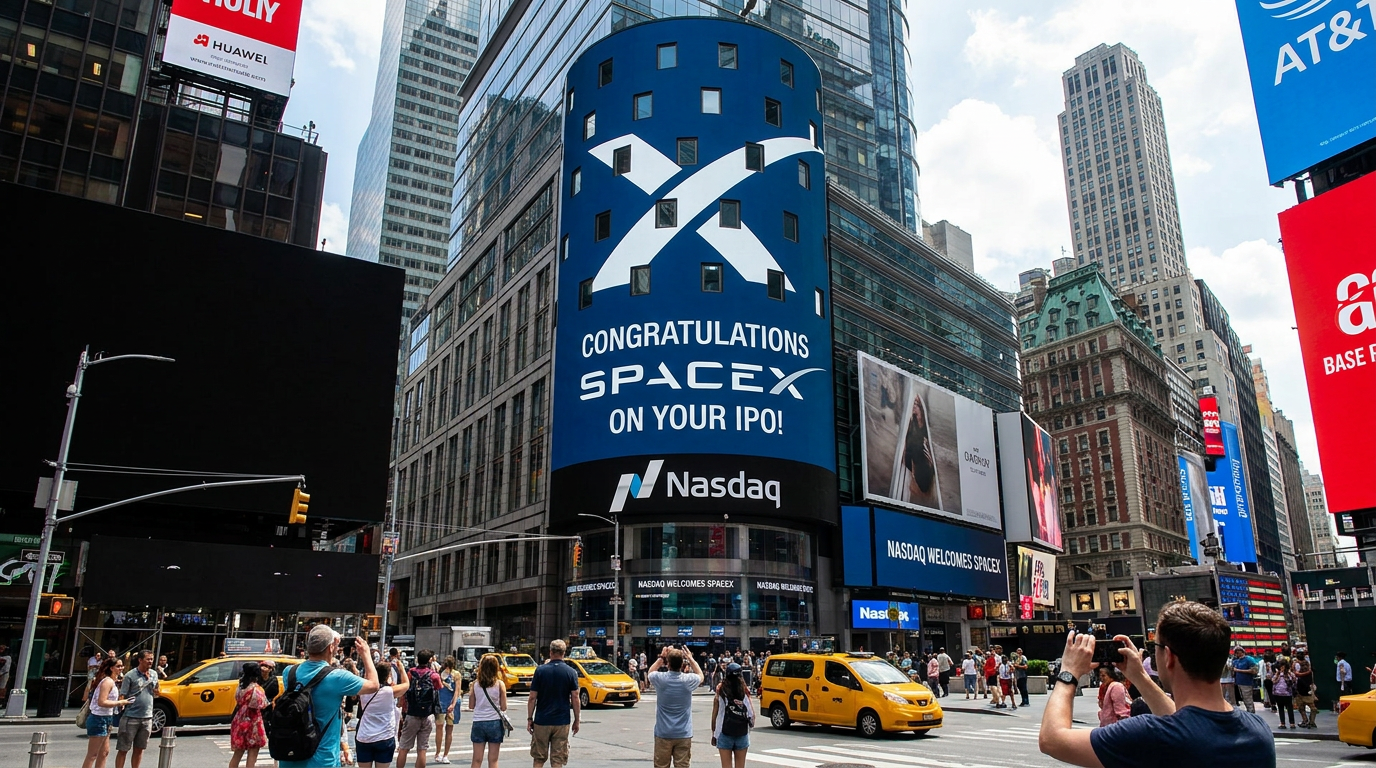
The market's response was immediate and euphoric. Trading under the ticker symbol SPCX, the stock opened on the Nasdaq exchange at $150 and quickly surged nearly 20% in early action, reflecting insatiable investor demand. Company executives celebrated the milestone with a dual bell-ringing ceremony, simultaneously broadcasting from Nasdaq's Times Square headquarters in New York and SpaceX's sprawling Starbase facility in South Texas.[1][7]
The successful debut has triggered a historic wealth creation event, pushing CEO Elon Musk's estimated net worth past the $1 trillion mark and making him the world's first trillionaire. Beyond its founder, the massive liquidity event is expected to mint roughly 20 new billionaires among the company's early investors, venture backers, and long-time employees, fundamentally reshaping the wealth landscape within the technology and aerospace sectors.[3][4]

In a sharp departure from traditional Wall Street practices, SpaceX prioritized everyday traders by allocating an unprecedented 30% of its IPO shares to retail investors. Online brokerages moved quickly to accommodate the surge in interest, with platforms like Wealthsimple and Fidelity opening their doors to clients and lowering minimum account requirements to ensure broader public participation in the historic offering.[6][8]
Even those who did not actively purchase SPCX shares will likely soon own a piece of the space exploration giant. Because of its massive market capitalization, SpaceX is expected to be fast-tracked into major equity indices. This means the stock will automatically become a foundational holding in millions of passive index funds and 401(k) retirement accounts across the globe.[8]
Even those who did not actively purchase SPCX shares will likely soon own a piece of the space exploration giant.
While the company's towering rockets capture the public imagination, the financial engine driving this trillion-dollar valuation is its satellite internet division, Starlink. According to its financial filings, SpaceX generated $18.67 billion in total revenue last year, heavily supported by the recurring subscription model of its global broadband network, which provides a steady cash flow to fund its more capital-intensive deep space ambitions.[7]

Investors are also pricing in SpaceX's rapidly expanding technological footprint. The company recently integrated Musk's artificial intelligence venture, xAI, into its corporate structure. This strategic combination allows SpaceX to pair its unmatched orbital satellite network with proprietary Colossus data centers and the Grok AI model, laying the groundwork for orbit-based AI data center networks.[7]
In a nod to its operational center of gravity, SpaceX executed a dual-listing on both the primary Nasdaq exchange and the newly launched Nasdaq Texas. By pairing its primary listing with the Texas exchange, the company is signaling a broader shift of corporate and financial power toward the Lone Star State's growing innovation economy, where its Starbase headquarters is located.[7]
Despite the market euphoria, some financial analysts are urging caution. Research firm Morningstar recently valued SpaceX at just $63 per share—a steep 53% discount to the final IPO price. Skeptics point to the company's history of net losses and warn that the long-term profitability of its ambitious Mars colonization projects remains entirely unproven.[6]

Veteran short-seller James Chanos has pointed to the mega-IPO as a troubling sign of market exuberance, warning that the sheer scale of the offering could drain liquidity from other sectors. Furthermore, corporate governance experts note that Musk retains more than 80% of the company's voting power, leaving public shareholders with virtually no say in the company's strategic direction or risk management.[5][6]
Nevertheless, SpaceX's successful debut is widely seen as the opening salvo in a new era of "monster IPOs." Artificial intelligence giants OpenAI and Anthropic are reportedly preparing their own public offerings, with valuations expected to approach the $1 trillion mark. The massive demand for these generational tech companies is setting the stage for a historic year on Wall Street.[3][6]
For now, the aerospace giant has successfully navigated its transition from a scrappy startup operating out of an El Segundo warehouse to a publicly traded behemoth. As the dust settles on its record-breaking debut, the market has delivered a resounding vote of confidence in the commercialization of space and the ambitious future SpaceX promises to build.[7]
How we got here
2002
Elon Musk founds Space Exploration Technologies Corp. in an El Segundo warehouse.
2020
SpaceX becomes the first private company to send human astronauts to the International Space Station.
2025
The company generates $18.67 billion in revenue, driven by the rapid expansion of its Starlink network.
June 11, 2026
SpaceX prices its initial public offering at $135 per share, raising a record $75 billion.
June 12, 2026
Shares begin trading on the Nasdaq under the ticker SPCX, surging 20% in early action.
Viewpoints in depth
Retail & Tech Bulls
View this as a democratization of tech wealth and a vindication of disruptive innovation.
For retail investors and technology optimists, the SpaceX IPO represents a rare opportunity to buy into a generational company at the ground floor of its public life. Proponents argue that the company's $18.67 billion in revenue proves its business model is sound, and that its integration with xAI positions it to dominate the future of orbital computing. The unprecedented 30% retail allocation is seen as a deliberate move to democratize wealth creation, allowing everyday traders to benefit from the commercialization of space.
Market Skeptics
Warn of massive overvaluation, lack of profitability, and poor corporate governance.
Financial skeptics and value investors point out that SpaceX's $1.77 trillion valuation is built largely on future promises rather than current net profitability. Research firms like Morningstar argue the stock is severely overvalued, citing the immense capital expenditures required for deep space exploration. Furthermore, governance watchdogs express deep concern over Elon Musk retaining more than 80% of the voting power, which effectively nullifies the ability of public shareholders to influence corporate strategy or hold management accountable.
Index Fund Investors
Passive participants gaining space exposure automatically through broad market indices.
A massive segment of the market will own SpaceX simply by default. Because of its sheer size, the company will be rapidly integrated into major equity indices, forcing passive funds and 401(k) managers to purchase the stock regardless of their fundamental outlook. This mechanical buying pressure provides a massive floor for the stock's price, but also means that millions of retirement savers are now inadvertently exposed to the high-risk, high-reward volatility of the commercial space sector.
What we don't know
- It remains unclear when AI giants OpenAI and Anthropic will officially launch their own highly anticipated public offerings.
- Analysts are uncertain how quickly SpaceX can achieve consistent net profitability given the massive capital requirements of its Mars ambitions.
- The long-term impact of Elon Musk retaining over 80% voting power on public shareholder rights is yet to be tested.
Key terms
- Initial Public Offering (IPO)
- The process by which a private company offers shares of its stock to the public for the first time.
- Market Capitalization
- The total dollar market value of a company's outstanding shares of stock, calculated by multiplying the stock price by the total number of shares.
- Dual Listing
- When a company's stock is listed and traded on more than one public exchange, such as the primary Nasdaq and Nasdaq Texas.
- Voting Power
- The right of a shareholder to vote on matters of corporate policy; in SpaceX's case, Elon Musk retains a supermajority of these rights.
Frequently asked
What is the ticker symbol for SpaceX?
SpaceX trades on the Nasdaq exchange under the ticker symbol SPCX.
Can regular investors buy shares?
Yes. In a rare move, SpaceX allocated up to 30% of its IPO shares to retail investors, and shares are now available to purchase through standard brokerage accounts.
Does this make Elon Musk a trillionaire?
Yes. With the surge in SpaceX's share price following the IPO, Musk's net worth has surpassed the $1 trillion mark, making him the world's first trillionaire.
Sources
Source coverage
8 outlets
3 viewpoints surfaced






[1]ForbesTech Optimists & Retail Investors
SpaceX Opens At $150—Surging 20% After Largest IPO Ever (Live Updates)
Read on Forbes →[2]CNAPassive Market Participants
Musk's SpaceX prices record US$75 billion IPO at US$135 a share
Read on CNA →[3]NYTPassive Market Participants
About 20 New Billionaires Could Be Minted by 3 Mega-I.P.O.s
Read on NYT →[4]BloombergMarket Skeptics & Governance Watchdogs
Elon Musk’s Trillionaire Moment
Read on Bloomberg →SpaceX IPO Is Troubling Sign for Markets, Chanos Says
Read on Bloomberg →[6]CBCMarket Skeptics & Governance Watchdogs
SpaceX kicks off wave of monster IPOs: What to know about companies going public
Read on CBC →[7]NasdaqTech Optimists & Retail Investors
SpaceX (SPCX): Rocket Company Launches Historic IPO
Read on Nasdaq →How Much SpaceX Are You About to Own?
Read on NYT →
Every angle. Every day.
Get business stories with full source coverage and perspective breakdowns delivered to your inbox.