
SpaceX Completes Historic $75 Billion IPO, Minting Elon Musk as the World's First Trillionaire
SpaceX has officially gone public in the largest stock market debut in history, achieving a $1.77 trillion valuation and opening unprecedented access to retail investors.
By Factlen Editorial Team
- Retail Investors & Advocates
- Viewing the 30% retail allocation as a historic democratization of tech wealth.
- Space Economy Optimists
- Focusing on the capital injection as the fuel for humanity's multiplanetary future.
- Institutional Skeptics
- Raising concerns over the massive valuation and concentrated voting power.
What's not represented
- · Traditional aerospace competitors
- · Regulatory bodies overseeing orbital traffic
Why this matters
The SpaceX IPO democratizes access to the space economy, allowing everyday retail investors to own a piece of the world's most dominant aerospace and satellite internet company. It also sets a massive precedent for the valuation of private tech giants, paving the way for upcoming mega-IPOs in the artificial intelligence sector.
Key points
- SpaceX raised $75 billion in the largest initial public offering in history.
- The $1.77 trillion valuation officially made CEO Elon Musk the world's first trillionaire.
- An unprecedented 30% of the IPO shares were allocated to retail investors.
- The company dual-listed on the Nasdaq and Nasdaq Texas under the ticker SPCX.
SpaceX went public on Friday, shattering records to become the largest initial public offering in Wall Street history. Trading under the ticker "SPCX," the aerospace giant priced its shares at $135, raising an unprecedented $75 billion and securing a valuation of $1.77 trillion.[1][4][7]
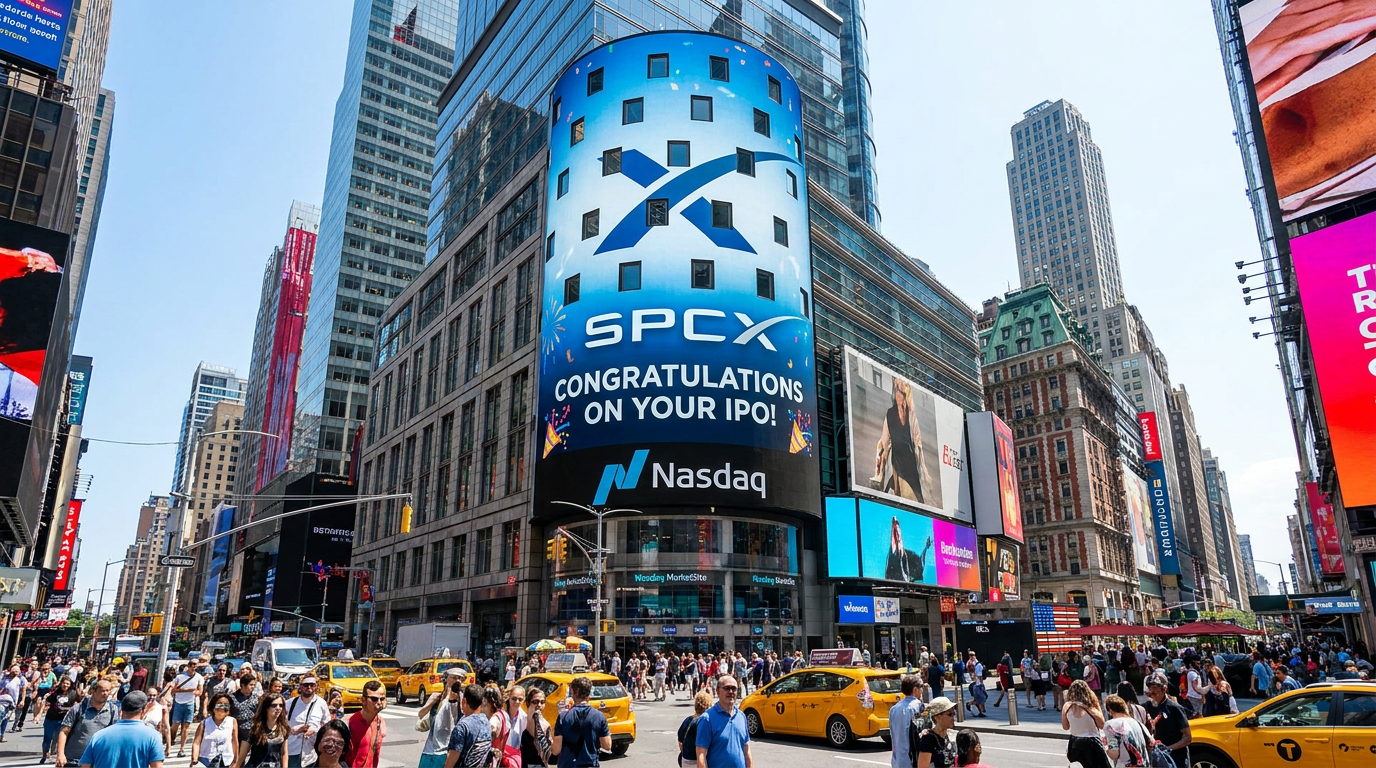
The debut was marked by simultaneous bell-ringing ceremonies at the Nasdaq MarketSite in Times Square and SpaceX's Starbase facility in Texas. As Elton John's "Rocket Man" played on the trading floor, executives celebrated the culmination of a 24-year journey from a scrappy warehouse startup to the world's most dominant launch provider.[1][4]
Market demand was voracious. When public trading commenced around midday, the stock opened at $150 and quickly surged toward $175—a roughly 30% jump from its offering price. The sheer scale of the debut easily eclipsed the previous global IPO record held by Saudi Aramco, which raised $25.6 billion in 2019.[1][7]

The most immediate consequence of the soaring valuation was a historic milestone for SpaceX's founder and CEO. With his massive majority stake in the newly public entity, Elon Musk officially became the world's first trillionaire.[1][2]
The wealth generation extended far beyond the chief executive. The IPO is expected to mint more than 4,400 current and former SpaceX employees as millionaires, with roughly 400 individuals securing windfalls of $100 million or more.[1][8]
Early institutional backers are also reaping historic returns. Peter Thiel's Founders Fund, which wrote the first institutional check to SpaceX in 2008 just days before a critical launch failure, saw its stake balloon to an estimated $67 billion. Valor Equity Partners, another early backer, holds a position worth over $71 billion at the IPO price.[3]
Unlike traditional IPOs that heavily favor institutional giants, SpaceX structured its offering to democratize access. The company allocated an unprecedented 30% of its IPO shares to retail investors—drastically higher than the customary 5% to 10% reserved for the public.[6]

Unlike traditional IPOs that heavily favor institutional giants, SpaceX structured its offering to democratize access.
Brokerages like Fidelity and Wealthsimple facilitated this retail frenzy, allowing customers with as little as $2,000 in their accounts to request shares. This structural decision allowed everyday investors to directly participate in the space economy, rather than waiting to buy on the open market after the initial institutional pop.[5][6]
The financial engine driving this massive valuation is no longer just rocket launches. According to its IPO filings, SpaceX generated $18.67 billion in total revenue in 2025, driven heavily by the recurring subscription model of its Starlink satellite internet constellation.[4]
Furthermore, the company has aggressively positioned itself as an artificial intelligence powerhouse. Earlier this year, SpaceX integrated Musk's AI venture, xAI, pairing its global satellite footprint with proprietary Colossus data centers and the Grok AI model to establish orbit-based computing networks.[4]
The company's geographic footprint is also shifting. Simultaneous to its primary Nasdaq listing, SpaceX executed a dual-listing on Nasdaq Texas. The move signals a deepening connection to the state's business ecosystem, reflecting the company's operational shift toward its Starbase headquarters in Boca Chica.[4]

Despite the overwhelming enthusiasm, some market analysts have urged caution. Research firm Morningstar previously suggested the company was overvalued, citing the inherent risks of spaceflight and the company's history of net losses as it poured capital into research and development.[5]
Corporate governance experts have also highlighted the unusual structure of the newly public entity. Musk retains more than 80% of the company's voting power, meaning public shareholders are effectively betting entirely on his continued leadership and strategic vision without traditional board protections.[5][8]
Nevertheless, the successful debut of SpaceX is already reshaping the broader market landscape. Analysts view the $1.77 trillion listing as the opening salvo in a predicted banner year for mega-IPOs, setting a highly favorable stage for artificial intelligence giants like OpenAI and Anthropic to make their own Wall Street debuts.[1][8]
For the space industry, the capital injection represents a massive acceleration of SpaceX's ultimate goal. As Musk addressed employees at Starbase, he reiterated that the funds will directly support the company's foundational mission: making humanity multiplanetary and establishing a permanent presence on Mars.[1][4]
How we got here
2002
Elon Musk founds Space Exploration Technologies Corp. (SpaceX) with the goal of reducing space transportation costs.
2008
SpaceX secures a critical early investment from Founders Fund just days before a make-or-break rocket launch.
2019
The company begins launching its Starlink satellite internet constellation, creating a massive recurring revenue engine.
March 2026
SpaceX integrates Musk's xAI venture, pairing its satellite network with advanced artificial intelligence capabilities.
June 12, 2026
SpaceX goes public on the Nasdaq, raising $75 billion in the largest IPO in history.
Viewpoints in depth
Retail Investors & Advocates
Viewing the 30% retail allocation as a historic democratization of tech wealth.
For decades, the most lucrative gains in Silicon Valley have been captured by private venture capital firms before a company ever reaches the public market. Retail advocates argue that SpaceX's decision to reserve 30% of its offering for everyday brokerage accounts fundamentally rewrites this playbook. By lowering the barrier to entry to just $2,000, proponents believe the IPO allows the general public to directly benefit from the commercialization of space and the expansion of global satellite internet.
Institutional Skeptics
Raising concerns over the massive valuation and concentrated voting power.
Financial skeptics and corporate governance experts point to the inherent risks of a $1.77 trillion valuation for a company that has historically operated at a net loss to fund its aggressive research and development. Furthermore, they highlight that Elon Musk retains over 80% of the voting power. This structure effectively nullifies the influence of public shareholders and traditional board oversight, meaning investors are placing an unhedged bet on a single founder's decision-making and stability.
Space Economy Optimists
Focusing on the capital injection as the fuel for humanity's multiplanetary future.
Industry analysts and early backers view the IPO not just as a financial exit, but as a massive capital-raising event necessary to fund the next era of aerospace engineering. Optimists argue that the $75 billion raised will accelerate the development of the Starship program, expand the Starlink constellation, and fund the integration of orbital AI data centers. To this camp, the unprecedented valuation is justified by SpaceX's near-monopoly on global launch capacity and its tangible progress toward Mars colonization.
What we don't know
- How the stock will perform in the coming months once the initial lock-up periods for early investors expire.
- Whether the massive influx of capital will significantly accelerate the timeline for crewed missions to Mars.
- How traditional institutional investors will navigate a public company where the founder retains 80% voting control.
Key terms
- Initial Public Offering (IPO)
- The process by which a private company offers shares of its stock to the public for the first time.
- Retail Investor
- An individual, non-professional investor who buys and sells securities for their personal account, rather than on behalf of an institution.
- Dual Listing
- When a company's stock is listed and traded on two different stock exchanges simultaneously, such as the Nasdaq and Nasdaq Texas.
- Voting Power
- The right of a shareholder to vote on matters of corporate policy; in SpaceX's case, structured so the founder retains majority control despite selling shares.
Frequently asked
How much did SpaceX shares cost at the IPO?
SpaceX priced its initial public offering at $135 per share, though the stock quickly surged to around $150 to $175 when public trading began.
Can anyone buy SpaceX stock now?
Yes. Now that the company is publicly traded under the ticker SPCX, anyone with a standard brokerage account can purchase shares on the open market.
How much is SpaceX worth?
At the IPO price of $135 per share, the company was valued at $1.77 trillion, making it one of the most valuable companies in the world.
Did Elon Musk become a trillionaire?
Yes. Because Musk is the majority shareholder of SpaceX, the company's $1.77 trillion valuation officially pushed his personal net worth past the $1 trillion mark.
Sources
Source coverage
8 outlets
3 viewpoints surfaced








[1]The GuardianRetail Investors & Advocates
SpaceX made the biggest stock market debut in history
Read on The Guardian →[2]BloombergSpace Economy Optimists
Elon Musk’s Trillionaire Moment
Read on Bloomberg →[3]ForbesSpace Economy Optimists
SpaceX IPO Lines Up $230 Billion Windfall For Peter Thiel And Other Musk Backers
Read on Forbes →[4]NasdaqSpace Economy Optimists
SpaceX (SPCX): Rocket Company Launches Historic IPO
Read on Nasdaq →[5]CBCInstitutional Skeptics
Is SpaceX's IPO worth the hype?
Read on CBC →[6]FidelityRetail Investors & Advocates
What is the SpaceX initial public offering (IPO)?
Read on Fidelity →[7]Channel News AsiaSpace Economy Optimists
Musk's SpaceX prices record US$75 billion IPO at US$135 a share
Read on Channel News Asia →[8]NYTInstitutional Skeptics
About 20 New Billionaires Could Be Minted by 3 Mega-I.P.O.s
Read on NYT →
Every angle. Every day.
Get business stories with full source coverage and perspective breakdowns delivered to your inbox.