
SpaceX Begins Trading After Record-Shattering $75 Billion IPO
Elon Musk's aerospace and AI company has officially debuted on the Nasdaq, achieving a $1.77 trillion valuation in the largest public offering in history.
By Factlen Editorial Team
- Institutional Optimists
- Wall Street bulls see SpaceX as the foundational infrastructure for the next era of computing and aerospace.
- Retail Believers
- Everyday investors view the IPO as a generational opportunity to back Elon Musk's vision for Mars and AI.
- Governance Skeptics
- Corporate governance advocates warn that the company's structure leaves public shareholders entirely powerless.
What's not represented
- · Competitors in the aerospace and AI sectors who now face a rival armed with $75 billion in fresh public capital.
- · Regulators who must oversee the unprecedented integration of a trillion-dollar, founder-controlled entity into the broader financial system.
Why this matters
SpaceX's $75 billion debut is the largest public offering in history, instantly creating a $1.77 trillion behemoth that will reshape the stock market. Because of its massive size, the stock will soon be automatically added to major index funds, meaning anyone with a standard 401(k) or retirement account will likely become an investor in Elon Musk's aerospace and AI ambitions.
Key points
- SpaceX began trading on the Nasdaq on Friday under the ticker SPCX after pricing its shares at $135.
- The company raised $75 billion, making it the largest IPO in history and valuing the firm at $1.77 trillion.
- Investor demand exceeded $250 billion, with retail investors requesting more than $70 billion in shares.
- The capital will fund a major pivot toward artificial intelligence, including plans for space-based data centers.
- Despite the valuation, SpaceX remains unprofitable, posting a $4.3 billion loss in the first quarter of 2026.
- Elon Musk retains 85% voting control, raising concerns among corporate governance advocates and pension funds.
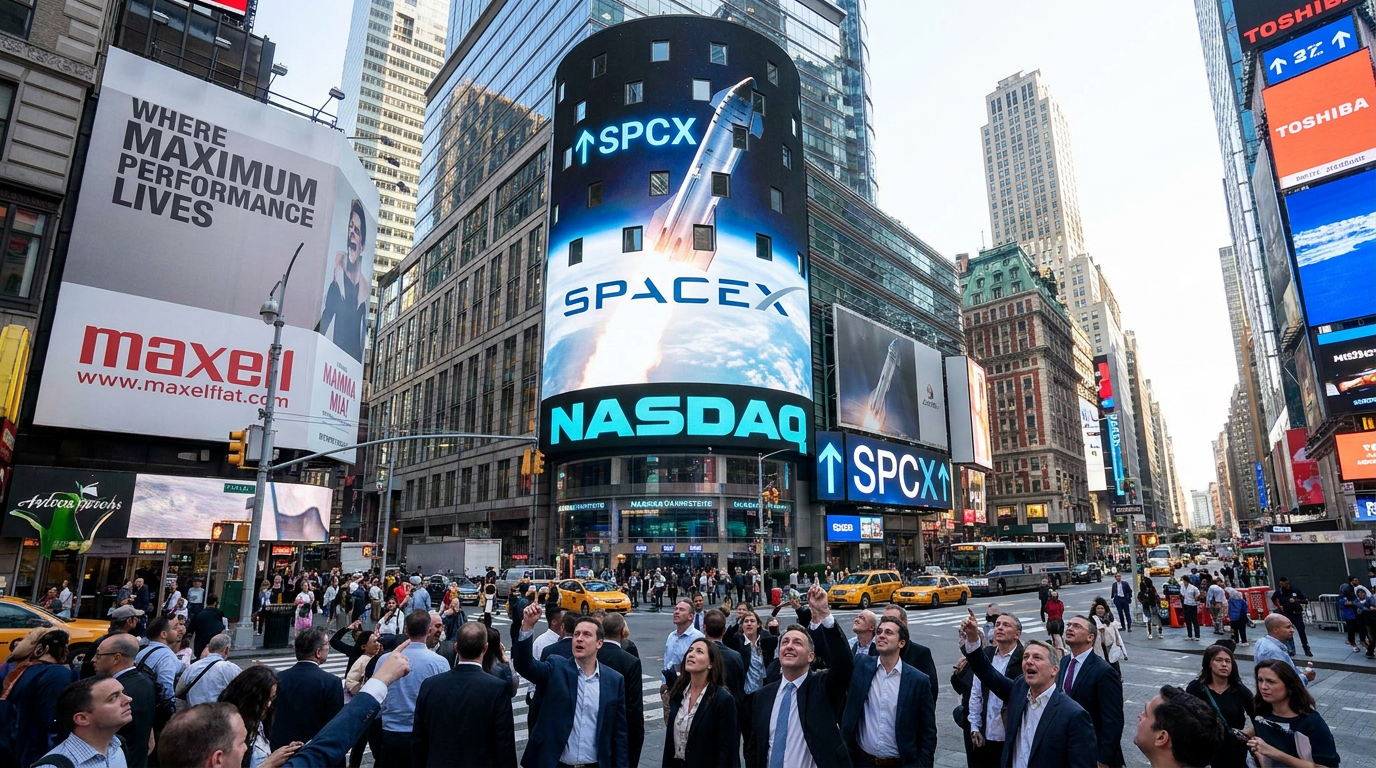
SpaceX is officially a public company. On Friday morning, the aerospace and artificial intelligence behemoth began trading on the Nasdaq under the ticker symbol SPCX, marking the culmination of the most anticipated and largest initial public offering in global financial history. The debut ends more than two decades of private ownership for the Elon Musk-led firm, transforming a company that revolutionized spaceflight into a publicly traded juggernaut. Hundreds of IPO bankers, wealth managers, and institutional investors watched as the opening bell rang, initiating an auction process to determine the stock's first public trades amid a period of broader market volatility. For Wall Street, the listing represents a watershed moment, testing the market's appetite for a company that blends heavy industrial manufacturing with speculative, frontier-defining artificial intelligence ambitions.[2][7]
The sheer scale of the offering has comprehensively rewired Wall Street's record books. Bypassing the traditional book-building process where underwriters market a price range to gauge interest, SpaceX dictated a fixed public offering price of $135 per share. By selling 555.6 million shares of its Class A common stock, the company successfully raised $75 billion in fresh capital. That pricing instantly awarded SpaceX a staggering valuation of $1.77 trillion, catapulting it past titans like Amazon and Alphabet to become one of the most valuable corporations on Earth from its very first minute of trading. The $75 billion raise dwarfs the previous global record—Alibaba's $25 billion debut in 2014—by a multiple of three, fundamentally altering the scale at which private companies can tap public markets.[1][4]
Demand for the shares reached a fever pitch in the days leading up to the bell, underscoring the immense premium investors place on Musk's ventures. Institutional and retail buyers submitted orders exceeding $250 billion, oversubscribing the massive offering by nearly four times. Asset management giant BlackRock alone reportedly requested at least $5 billion in stock, while sovereign wealth funds and family offices scrambled for allocations. Pre-IPO perpetual futures contracts trading on shadow markets and crypto exchanges suggested the stock could surge 20% or more above its $135 listing price once regular trading commenced. The overwhelming demand materialized despite extreme broader market turbulence, including a recent slide in the S&P 500 and a sharp sell-off in the Nasdaq composite earlier in the week.[1][8]

Unlike traditional mega-cap IPOs that heavily favor Wall Street insiders and institutional heavyweights, Musk engineered the SpaceX offering to include an unusually large slice for everyday investors. Up to 30% of the shares were reserved for the retail market, prompting a deluge of activity across brokerage platforms like Fidelity and Robinhood. Individual buyers ultimately submitted requests totaling more than $70 billion. The retail frenzy was fueled by a mix of genuine belief in the company's long-term mission to colonize Mars and a speculative rush to gain exposure to the Musk ecosystem. However, because the offering was so heavily oversubscribed, many retail investors who requested shares are expected to receive only a fraction of their desired allocations, likely driving further buying pressure on the open market.[4][5]
While SpaceX built its reputation on reusable Falcon rockets and the rapidly expanding Starlink satellite internet constellation, the company's IPO prospectus revealed a massive, capital-intensive pivot toward artificial intelligence. The offering effectively serves as a public debut for Musk's broader AI ambitions, following SpaceX's recent absorption of his xAI startup in a $250 billion all-stock merger. The company is pitching investors on a total addressable market that it estimates at nearly $28 trillion, with the vast majority of that value tied to future AI products and services. By merging its launch capabilities with advanced neural networks, SpaceX is positioning itself not just as a logistics provider for low-Earth orbit, but as the foundational infrastructure layer for the next generation of global computing.[3][6]
The $75 billion in newly raised capital is earmarked for an audacious, capital-intensive roadmap that merges these aerospace and computing goals. SpaceX plans to deploy upwards of 100,000 next-generation Starlink satellites, creating a dense orbital mesh network capable of unprecedented data transmission. More critically, the company intends to build massive AI data centers in space, leveraging the vacuum and cold of orbit to cool next-generation server racks while escaping the terrestrial constraints of power grid limitations and land zoning. Musk has argued that deploying AI compute capacity in space is a massive new growth base that requires exactly the kind of unprecedented capital injection this IPO provides, effectively creating a monopoly on off-planet data processing.[1][3]
The $75 billion in newly raised capital is earmarked for an audacious, capital-intensive roadmap that merges these aerospace and computing goals.
Despite the astronomical valuation and the futuristic roadmap, SpaceX remains deeply unprofitable, a reality that introduces significant risk for its new public shareholders. The company's S-1 filing revealed a $4.9 billion net loss last year, followed by a staggering $4.3 billion loss in the first quarter of 2026 alone. These deficits are driven by the immense capital expenditures required to develop the Starship rocket program, manufacture satellites, and build out the Terafab chip complex in Texas alongside Tesla. The prospectus offers no immediate timeline for profitability, asking investors to stomach billions in ongoing cash burn while the company attempts to outpace rivals like OpenAI, Anthropic, and Microsoft in the fiercely competitive artificial intelligence sector.[3][8]

The financial risk is compounded by an unprecedented corporate governance structure that leaves public shareholders with virtually no influence over the company's direction. Through a special class of super-voting shares, Musk retains approximately 85% of the voting power at SpaceX. This structure dictates that the only person who can fire the CEO or alter the company's strategic trajectory is Musk himself. Corporate governance advocates and institutional investors have raised alarms over this dynamic, noting that the prospectus explicitly ties the company's success to Musk as its driving force while simultaneously warning that his loss or distraction could severely damage the business. Furthermore, the IPO mandates arbitration for shareholder claims, severely limiting the ability of investors to file class-action lawsuits.[3][6]
This concentration of power has particularly alarmed pension fund managers and passive investors, who may soon be forced to buy the stock regardless of their governance concerns. Because of its $1.77 trillion valuation, SpaceX is expected to be fast-tracked into major stock indices, including the Nasdaq 100 and eventually the S&P 500. Once included, the trillions of dollars parked in passive index funds and retirement accounts will automatically purchase SPCX shares to mirror the index weightings. Officials from public pension funds in California and New York recently petitioned regulators over this dynamic, arguing that everyday workers' retirement savings will be involuntarily exposed to a highly volatile, founder-controlled company with no clear path to near-term profitability.[3][6]
For Musk personally, the successful listing pushes his net worth into entirely uncharted historical territory. Based on the $135 pricing and his massive equity stake, financial trackers estimate his wealth is now approaching the $1 trillion mark, making him the first individual in modern history to reach that milestone. The IPO also mints thousands of new millionaires among SpaceX's early employees and engineers, who have spent years accepting lower base salaries in exchange for equity in the private firm. The sudden unlocking of this wealth is expected to have ripple effects across the tech industry, potentially funding a new wave of aerospace and AI startups founded by SpaceX alumni.[4][6][7]

As SPCX shares change hands for the first time, the broader financial market is treating the debut as a critical bellwether for the technology sector. A strong sustained performance could pry open the IPO window for other highly valued, AI-adjacent companies that have remained private, such as OpenAI and Anthropic. Conversely, if SpaceX struggles to maintain its $1.77 trillion valuation in the public markets, it could trigger a broader reassessment of the massive premiums currently assigned to artificial intelligence ventures. Ultimately, Wall Street is placing a historic, $75 billion bet on a future where the critical infrastructure of the digital economy moves off-planet, entirely under the control of a single visionary founder.[2][3]
How we got here
May 20, 2026
SpaceX publicly files its S-1 prospectus with the SEC, revealing its financials and AI ambitions.
June 3, 2026
The company bypasses traditional pricing ranges, setting a fixed IPO price of $135 per share.
June 9, 2026
Investor demand surpasses $250 billion, oversubscribing the massive offering by nearly four times.
June 11, 2026
SpaceX officially prices the offering, raising a record-breaking $75 billion.
June 12, 2026
Shares begin trading on the Nasdaq under the ticker symbol SPCX.
Viewpoints in depth
Institutional Optimists
Wall Street bulls see SpaceX as the foundational infrastructure for the next era of computing and aerospace.
For major asset managers and growth-focused funds, SpaceX is no longer just a rocket company—it is the ultimate artificial intelligence play. By merging with xAI and planning to deploy data centers in low-Earth orbit, SpaceX is positioning itself to bypass terrestrial power grid constraints and dominate a total addressable market it estimates at $28 trillion. Optimists argue that the company's absolute monopoly on heavy orbital lift, combined with the cash-generating potential of the Starlink network, makes the $1.77 trillion valuation a reasonable premium for a business with no peer competitors.
Retail Believers
Everyday investors view the IPO as a chance to back a visionary founder and participate in humanity's expansion into space.
The retail frenzy surrounding the SPCX ticker is driven by a deep-seated faith in Elon Musk's track record of disrupting entrenched industries. For these investors, the near-term unprofitability is irrelevant compared to the long-term goals of colonizing Mars and building artificial general intelligence. The unprecedented decision to allocate up to 30% of the IPO shares to retail brokerages has only strengthened this loyalty, framing the public debut as a democratization of wealth creation that allows ordinary people to invest alongside sovereign wealth funds.
Governance Skeptics
Corporate governance advocates warn that the company's structure leaves public shareholders entirely powerless.
Critics point to the stark reality buried in the company's S-1 filing: Elon Musk retains roughly 85% of the voting power, meaning public shareholders have no mechanism to influence strategy, demand dividends, or replace leadership. This concentration of power is particularly alarming to pension fund managers, who note that SpaceX's sheer size will force its inclusion into major passive indices like the Nasdaq 100. Skeptics argue that forcing millions of everyday retirement accounts to absorb the risk of a deeply unprofitable, founder-controlled company sets a dangerous precedent for the public markets.
What we don't know
- How the stock will perform in its first weeks of trading, given the extreme oversubscription and broader market volatility.
- When, or if, SpaceX will achieve profitability as it pours billions into its Starship program and space-based AI data centers.
- How quickly major index providers like the S&P 500 will add SpaceX to their benchmarks, which will trigger massive mandatory buying from passive funds.
Key terms
- Initial Public Offering (IPO)
- The process by which a private company offers shares of its stock to the public for the first time, allowing it to raise capital from public investors.
- Oversubscribed
- A situation in an IPO where the demand for shares from investors exceeds the total number of shares the company is offering.
- Super-voting shares
- A special class of stock that provides its holders with significantly more voting power than regular common stock, often used by founders to maintain control of a public company.
- Passive index fund
- An investment fund designed to automatically track the performance of a specific market index, such as the S&P 500, by purchasing all the stocks within that index.
Frequently asked
How much did SpaceX raise in its IPO?
SpaceX raised $75 billion by selling 555.6 million shares, making it the largest initial public offering in history.
What is the ticker symbol for SpaceX?
SpaceX trades on the Nasdaq exchange under the ticker symbol SPCX.
Is SpaceX a profitable company?
No. According to its public filings, SpaceX reported a $4.9 billion net loss last year and a $4.3 billion loss in the first quarter of 2026 due to heavy capital investments.
How much control does Elon Musk have?
Through a special class of super-voting shares, Elon Musk retains approximately 85% of the voting power, giving him absolute control over the company's decisions.
Sources
Source coverage
8 outlets
3 viewpoints surfaced








[1]ReutersInstitutional Optimists
Musk's SpaceX raises $75 billion in largest IPO ever
Read on Reuters →[2]BloombergInstitutional Optimists
SpaceX to Begin Trading After Record $75 Billion IPO
Read on Bloomberg →[3]The New York TimesGovernance Skeptics
The Consequences of SpaceX’s Trillion-Dollar I.P.O.
Read on The New York Times →[4]ForbesRetail Believers
SpaceX Will Trade Today After Largest IPO Ever
Read on Forbes →[5]CNBCRetail Believers
Small investors scrambled to get in on the SpaceX IPO
Read on CNBC →[6]The GuardianGovernance Skeptics
Elon Musk on track to become world's first trillionaire today as SpaceX lists on US stock market
Read on The Guardian →[7]Business InsiderRetail Believers
SpaceX IPO live updates: Record-breaking $75 billion market debut is imminent
Read on Business Insider →[8]The Wall Street JournalInstitutional Optimists
SpaceX IPO Pricing Sets Valuation at $1.77 Trillion
Read on The Wall Street Journal →
Every angle. Every day.
Get business stories with full source coverage and perspective breakdowns delivered to your inbox.