
Solid-State EV Batteries Are Finally Moving From the Lab to the Factory Floor
After years of delays and hype, major battery developers in the US, Japan, and China have launched pilot production lines for solid-state batteries in 2026. The breakthrough technology promises to double EV range and cut charging times to under 15 minutes.
By Factlen Editorial Team
- Technology Licensors
- Focus on R&D and licensing core battery technology to manufacturing partners.
- Legacy Automakers
- Prioritize vertical integration and securing proprietary supply chains for future EVs.
- Rapid Industrializers
- Focus on aggressive scaling, government-backed standardization, and speed to market.
What's not represented
- · Lithium mining companies facing shifting demand for raw materials.
- · Independent mechanics and right-to-repair advocates assessing the serviceability of solid-state packs.
Why this matters
Solid-state batteries are widely considered the 'holy grail' of electric vehicle technology. By eliminating fire risks and enabling gas-station-like refueling times, they remove the final major hurdles to mass EV adoption.
Key points
- Major battery developers in the US, Japan, and China have launched solid-state pilot production lines in 2026.
- Solid-state technology replaces flammable liquid electrolytes with stable solid materials, eliminating fire risks.
- The new chemistry allows for energy densities exceeding 400 Wh/kg, enabling EV ranges of over 700 miles.
- Fast-charging times can be reduced to under 15 minutes, mimicking the speed of a traditional gas station.
- Initial commercial rollout will likely target luxury vehicles and commercial aerospace before reaching mass-market cars in the 2030s.
For the better part of a decade, solid-state batteries have been the automotive industry's most tantalizing—and elusive—promise. Billed as the "holy grail" of electric vehicle technology, they offered a utopian vision of the future: cars that could travel over 700 miles on a single charge, refuel in the time it takes to buy a cup of coffee, and never catch fire. But year after year, the technology remained trapped in laboratories, plagued by manufacturing hurdles and the sheer difficulty of scaling microscopic chemical breakthroughs into mass-produced automotive components.
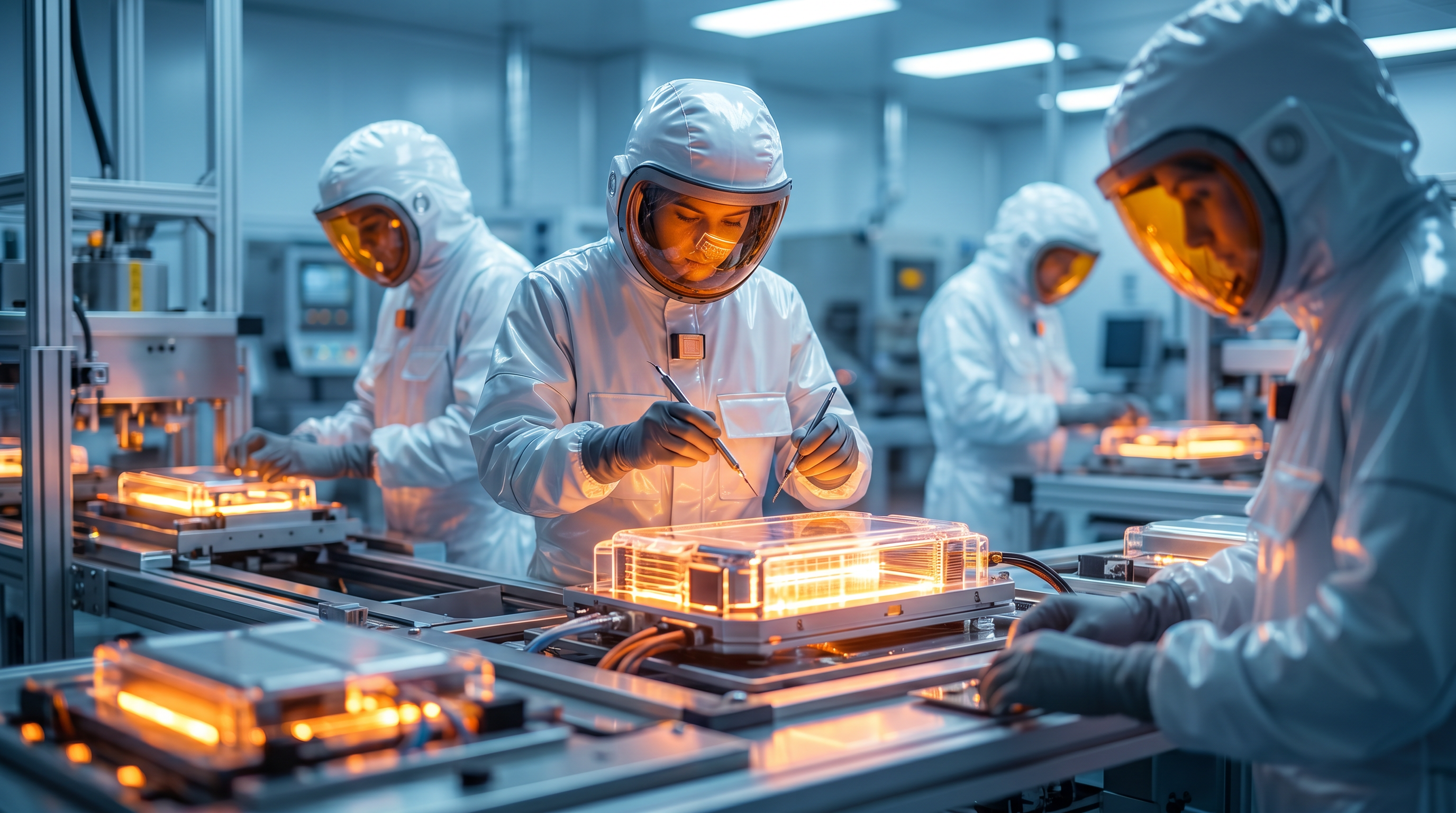
In 2026, that narrative has fundamentally shifted. Across the United States, Japan, and China, the race to commercialize solid-state batteries has moved off the whiteboard and onto the factory floor. Major developers are no longer just publishing peer-reviewed papers about coin-sized prototypes; they are inaugurating pilot production lines, rolling out "A-sample" cells for automaker testing, and breaking ground on massive electrolyte manufacturing facilities.[1][2][3]
To understand why this transition is so critical, it helps to look at the mechanism inside the battery. Traditional lithium-ion batteries—the kind powering everything from smartphones to current electric vehicles—rely on a liquid electrolyte to shuttle ions back and forth between the anode and the cathode. While effective, this liquid is inherently flammable. If the battery is punctured in a crash, or if it overheats during ultra-fast charging, the liquid can ignite, leading to the notoriously difficult-to-extinguish EV fires.
Solid-state batteries replace that volatile liquid with a solid material—typically a ceramic, glass, or sulfide-based compound. Because there is no liquid to boil or ignite, the battery becomes vastly more stable. This inherent safety allows engineers to use more energy-dense materials, such as a pure lithium-metal anode, which would be too dangerous to pair with a liquid electrolyte.

The performance claims resulting from this architectural shift are staggering. By utilizing lithium-metal anodes, solid-state cells can achieve energy densities of 400 Watt-hours per kilogram (Wh/kg) or higher, compared to the 250 to 300 Wh/kg ceiling of today's best lithium-ion cells. In practical terms, this means an automaker can pack significantly more energy into the same physical space, pushing vehicle ranges past the 700-mile mark without adding thousands of pounds of dead weight.[4][5]
Furthermore, the solid electrolyte allows for a much smoother and faster flow of energy during recharging. California-based QuantumScape, one of the leading Western developers, recently demonstrated that its cells can complete 400 consecutive fast-charge cycles—replenishing from 10% to 80% capacity in just 15 minutes—while retaining over 80% of their initial energy. This brings EV charging times remarkably close to the traditional gas station experience.[2][6]

The evidence that these claims are finally materializing can be seen in the flurry of industrial activity this year. In February 2026, QuantumScape inaugurated its "Eagle Line" in San Jose, a highly automated pilot facility designed to prove that its proprietary ceramic separators can be manufactured at scale. Rather than building massive battery plants itself, QuantumScape is adopting a licensing model—akin to the semiconductor industry—partnering with manufacturing giants like Volkswagen's PowerCo, Murata, and Corning to distribute the technology.[2][6]
The evidence that these claims are finally materializing can be seen in the flurry of industrial activity this year.
Meanwhile, in Japan, Toyota is taking a more vertically integrated approach. Long criticized for lagging in the initial EV race, Toyota has quietly positioned itself as a solid-state powerhouse. In early 2026, Toyota's partner, the oil giant Idemitsu Kosan, broke ground on a large-scale pilot plant to produce solid sulfide electrolytes. Toyota aims to launch its first solid-state EVs between 2027 and 2028, targeting a staggering 1,200-kilometer (745-mile) range and a 10-minute charge time.[3]
China is aggressively pushing to maintain its dominance in the global battery supply chain. In April 2026, Greater Bay Technology (GBT), a startup backed by the GAC Group, announced that its first "A-sample" all-solid-state cells had successfully rolled off the production line. GBT reported that the cells passed rigorous safety tests—including needle penetration and thermal shock—without catching fire or exploding. The company is targeting gigawatt-hour-level mass production by the end of the year.[1]
To support this rapid industrialization, the Chinese government is stepping in to organize the market. In 2026, China is preparing to release its first national standard for solid-state EV batteries. This regulatory framework will clarify the often-muddy terminology—distinguishing between "semi-solid," "solid-liquid hybrid," and true "all-solid-state" batteries—while establishing baseline safety and performance testing requirements. Industry experts note that this standardization is a crucial step for scaling up supply chains and reducing confusion among automakers.[4][5]

Despite the palpable momentum, significant uncertainties remain before solid-state batteries become ubiquitous. The primary challenge is manufacturing yield. Producing microscopically flawless solid electrolytes at high speeds is notoriously difficult; even a tiny defect can cause the battery to short-circuit. Transitioning from a pilot line that produces thousands of cells to a gigafactory that produces millions requires unprecedented precision in materials engineering.[2]
Cost is another major hurdle. Initial production runs will be expensive, meaning the first solid-state batteries will almost certainly debut in flagship luxury vehicles, high-end sports cars, or commercial applications where the premium is justified. Widespread adoption in affordable, mass-market commuter cars is generally not expected until the early 2030s, as economies of scale gradually drive down the price per kilowatt-hour.[3][5]
There are also supply chain implications. While solid-state designs often eliminate the need for graphite—a material whose supply chain is heavily concentrated in China—they rely heavily on pure lithium metal and specialized precursors for their ceramic or sulfide electrolytes. Securing reliable, geopolitically stable sources for these new materials will be a critical task for Western automakers over the next decade.[2]
Beyond passenger vehicles, the implications of stable, high-density batteries are vast. Developers are already eyeing applications in sectors where traditional lithium-ion batteries are too heavy or too dangerous. Electric vertical takeoff and landing (eVTOL) aircraft, defense aerospace, robotics, and even AI data center backup power are all prime candidates for solid-state integration once the technology matures.[1][2]
For the everyday consumer, the 2026 milestones represent a turning point. The era of range anxiety and hour-long highway charging stops is visibly drawing to a close. While it may take a few more years for a solid-state EV to land in the average driveway, the foundation for that future is currently being poured in factories across the globe.
How we got here
Early 2020s
Solid-state batteries remain largely confined to laboratory environments, with companies demonstrating coin-sized cell viability.
2024–2025
Developers begin producing multi-layer cells and shipping early prototypes to automotive partners for initial testing.
Early 2026
Companies like QuantumScape and Toyota's partners inaugurate dedicated pilot production lines to prove manufacturing scalability.
Mid 2026
Chinese manufacturers announce the successful production of 'A-sample' cells passing rigorous safety and puncture tests.
2027–2028
Automakers target the first commercial launches of solid-state EVs, likely debuting in flagship luxury models.
Viewpoints in depth
Technology Licensors
Companies focusing on R&D and licensing rather than building massive factories.
Firms like QuantumScape view themselves primarily as technology developers rather than traditional manufacturers. By adopting a licensing model similar to the semiconductor industry (like ARM or TSMC), they aim to perfect the core technology—such as proprietary ceramic separators—and partner with established giants like Volkswagen, Corning, and Murata to handle the capital-intensive scaling. This approach reduces their financial risk while allowing the technology to proliferate across multiple automakers simultaneously.
Legacy Automakers
Established car brands taking a vertically integrated approach to secure their supply chains.
Companies like Toyota are treating solid-state batteries as a proprietary competitive advantage rather than a shared commodity. By partnering directly with materials suppliers like Idemitsu Kosan to build dedicated electrolyte plants, these automakers aim to control the entire vertical stack. For legacy brands that were criticized for moving slowly into the initial EV wave, solid-state technology represents an opportunity to leapfrog the current market leaders by offering vastly superior range and safety.
Regulatory Bodies
Government agencies focused on standardizing the technology and ensuring safety.
As the technology moves toward mass production, regulators are stepping in to prevent a "Wild West" scenario. China's push to establish the first national standard for solid-state batteries in 2026 is designed to clarify marketing terminology—preventing companies from passing off semi-solid hybrids as true solid-state breakthroughs. Regulators are also focused on establishing rigorous new testing protocols for thermal runaway and crash safety, ensuring that the new chemistry delivers on its promises of inherent stability.
What we don't know
- Whether manufacturers can maintain high quality-control yields when scaling from pilot lines to gigafactory volumes.
- The exact price premium solid-state EVs will carry when they first hit dealership lots in 2027-2028.
- How the geopolitical supply chain for pure lithium metal will shift as demand for solid-state components skyrockets.
Key terms
- Solid-State Battery
- A battery technology that uses solid electrodes and a solid electrolyte, instead of the liquid or polymer gel electrolytes found in lithium-ion batteries.
- Electrolyte
- The medium that allows electrical charge (ions) to flow between the cathode and anode inside a battery.
- Energy Density
- The amount of energy a battery can hold relative to its weight, typically measured in Watt-hours per kilogram (Wh/kg).
- Lithium-Metal Anode
- An advanced battery component made of pure lithium that stores significantly more energy than traditional graphite anodes, made possible by the stability of solid electrolytes.
- A-Sample
- A fully functional prototype of a component (like a battery cell) built using intended production processes, provided to automakers for initial validation testing.
Frequently asked
When can I buy a car with a solid-state battery?
The first consumer vehicles equipped with solid-state batteries are expected to launch between 2027 and 2028. However, they will likely debut in high-end luxury models first, with mass-market availability expected in the early 2030s.
Why are solid-state batteries safer?
They replace the flammable liquid electrolyte used in current lithium-ion batteries with a stable solid material, such as ceramic or glass. This eliminates the risk of the battery leaking, boiling, or catching fire if damaged.
Will solid-state batteries charge faster?
Yes. Because the solid electrolyte is more stable and handles heat better, the batteries can accept energy much faster. Developers have demonstrated 10% to 80% charge times of 10 to 15 minutes.
Are solid-state batteries heavier?
No, they are actually lighter for the amount of energy they store. Their higher energy density means automakers can provide the same range with a smaller, lighter battery pack, or double the range using the same physical space.
Sources
Source coverage
6 outlets
3 viewpoints surfaced






[1]ElectrekRapid Industrializers
China ramps up solid-state EV battery production with GBT breakthrough
Read on Electrek →[2]BatteryTech OnlineTechnology Licensors
QuantumScape details commercialization progress, inaugurates Eagle Line
Read on BatteryTech Online →[3]Green Car ReportsLegacy Automakers
Toyota will move ahead with plan to manufacture solid-state batteries in Japan
Read on Green Car Reports →[4]EV Infrastructure NewsRapid Industrializers
China preparing first standard for solid-state EV batteries in 2026
Read on EV Infrastructure News →[5]Search EVRapid Industrializers
China is ramping up its push to get solid-state EV batteries on the road
Read on Search EV →[6]QuantumScapeTechnology Licensors
QuantumScape Celebrates Inauguration of Eagle Line for Solid-State Battery Production
Read on QuantumScape →
Every angle. Every day.
Get transportation stories with full source coverage and perspective breakdowns delivered to your inbox.