
Record-Breaking 43,000 Inscribed Ostraca Found in Egypt, Largest Collection Ever From a Single Site
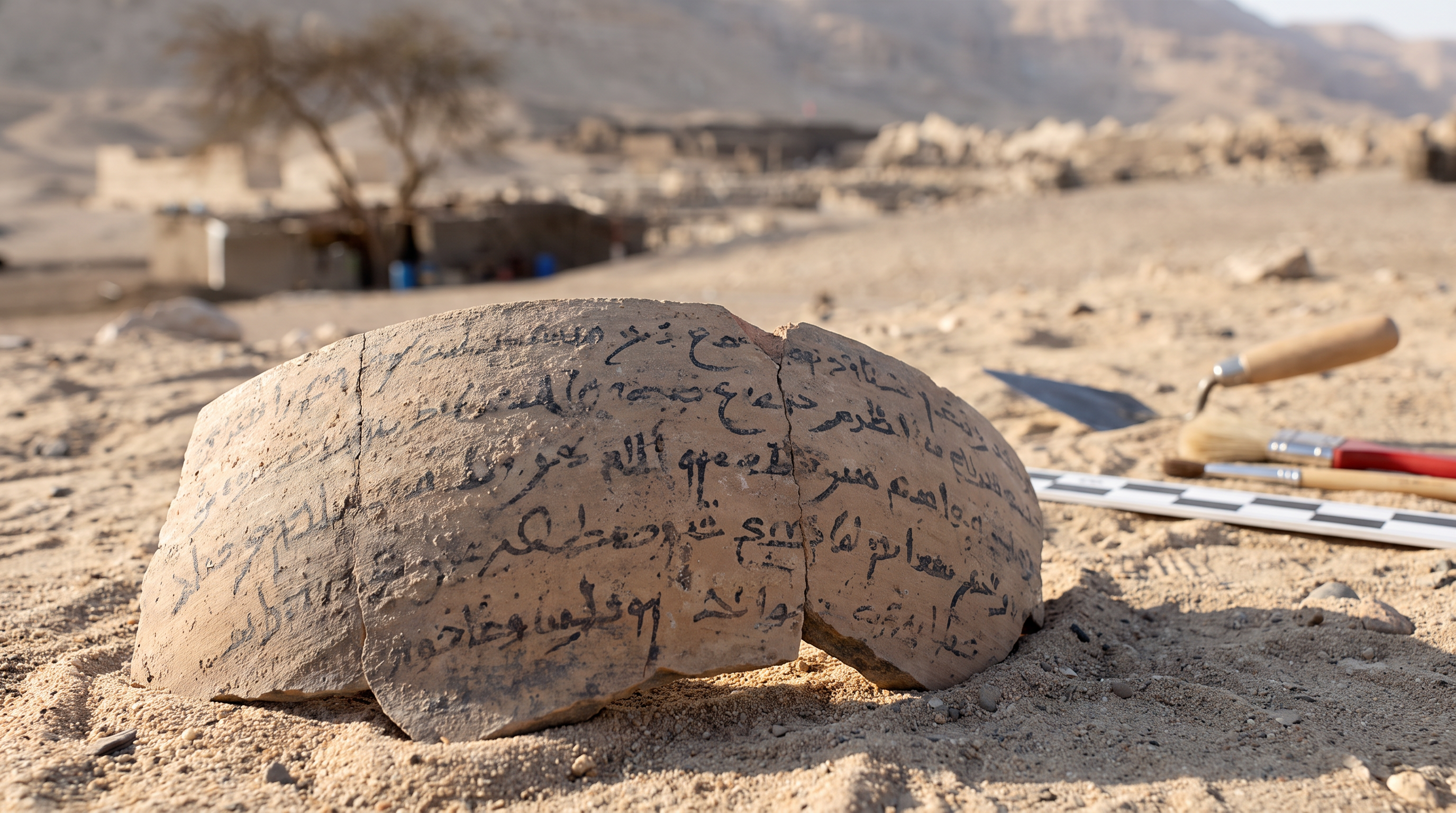
Archaeologists have unearthed 43,000 inscribed pottery fragments at the ancient city of Athribis, revealing the everyday lives, schoolwork, and financial records of ordinary Egyptians over 1,400 years.
By Factlen Editorial Team
- Archaeological Consensus
- Focuses on the unprecedented scale of the discovery and the logistical challenges of preservation.
- Social Historians
- Values the find for its unfiltered window into the daily lives and literacy of non-elite Egyptians.
- Linguists & Philologists
- Emphasizes the linguistic diversity and the evolution of scripts over 1,400 years of continuous occupation.
What's not represented
- · The perspective of the ancient non-elite individuals whose daily lives and struggles are recorded on the ostraca, but whose broader historical voices remain lost.
- · The viewpoint of local Egyptian residents living near the modern Sohag excavation site regarding the cultural heritage being unearthed in their community.
Why this matters
This unprecedented discovery fundamentally rewrites our understanding of ancient Egyptian society by shifting the focus away from pharaohs and monuments. By preserving the grocery lists, schoolwork, and tax receipts of ordinary people, these 43,000 fragments prove that everyday written communication was far more integrated into the lives of the non-elite than previously assumed.
Key points
- Archaeologists have recovered 43,000 inscribed pottery fragments, known as ostraca, at the ancient Egyptian site of Athribis.
- The discovery is the largest collection of everyday written material ever found at a single archaeological site in Egypt.
- The texts span 1,400 years, from the 3rd century BCE to the 11th century CE, documenting the region's linguistic evolution.
- Most of the fragments are written in Demotic and Greek, detailing tax receipts, delivery notes, and financial accounts.
- Hundreds of the ostraca are school exercises, including alphabet lists and repeated punishment lines written by ancient students.
- The cache also includes over 130 horoscopes and numerous doodles, offering an unprecedented look at non-elite daily life.
In what constitutes the largest single-site discovery of everyday ancient texts in Egyptian history, a joint Egyptian-German archaeological mission has recovered approximately 43,000 inscribed pottery fragments, known as ostraca, from the ancient city of Athribis. The sheer volume of the find fundamentally alters the evidentiary baseline for understanding daily life in antiquity. Excavations led by the University of Tübingen and Egypt’s Supreme Council of Antiquities have been ongoing since 2005, but the vast majority of these artifacts—roughly 40,000 pieces—were unearthed in just the last three years near the Temple of Ptolemy XII. These fragments, utilized as the ancient equivalent of scrap paper, offer an unfiltered, granular look at the administrative, educational, and personal lives of ordinary people over a span of more than a millennium.[1][3][6]
The primary evidence consists of ostraca: broken sherds of pottery and flakes of limestone that were repurposed as cheap, accessible writing surfaces. Before the mass production of paper, and because papyrus was often prohibitively expensive for mundane tasks, ancient populations relied on these discarded fragments for temporary records. The Athribis collection provides a stark contrast to the monumental hieroglyphs carved into temple walls, which were designed to project pharaonic power and divine permanence. Instead, these ostraca contain the ephemeral detritus of daily existence—tax receipts, grocery lists, delivery notes, and personal reminders—that were never intended to survive for thousands of years.[2][4]
The scale of the Athribis discovery is unprecedented, officially surpassing the famous workers' village of Deir el-Medina near Luxor, which had long been considered the gold standard for ostraca finds. According to the Supreme Council of Antiquities, the Athribis cache is now the most productive site for ostraca to date. The artifacts were primarily concentrated in a 40-by-40-meter excavation zone west of the main temple complex. The density of the deposit was so high that archaeologists reported unearthing between 50 and 100 inscribed sherds on a daily basis during peak excavation periods, creating a massive logistical challenge for the cataloging teams.[1][3]
Chronologically, the evidence spans an astonishing 1,400 years of continuous human occupation and administrative record-keeping. The earliest texts in the collection date to the third century BCE, during the Ptolemaic period when the descendants of Alexander the Great's generals ruled Egypt. The most recent inscriptions date to the 9th and 11th centuries CE, well into the Islamic period. This unbroken chain of documentation allows historians to track the slow, generational shifts in local administration, taxation, and cultural practices as the region transitioned from Ptolemaic rule to the Roman Empire, through the Byzantine era, and into the Islamic caliphates.[5]

Linguistic analysis of the 43,000 fragments reveals a deeply multicultural and multilingual society. The excavation data indicates that between 60 and 75 percent of the ostraca are written in Demotic, the cursive, everyday administrative script used by Egyptians during the Ptolemaic and Roman periods. This overwhelming prevalence confirms that Demotic remained the primary language of local commerce and daily interaction, even as the ruling elite operated in other languages. The texts provide a massive new corpus for philologists studying the evolution of the Demotic script and its regional variations in Upper Egypt.[2][6]
The secondary linguistic data highlights the profound Hellenistic influence on the region. Approximately 15 to 30 percent of the recovered ostraca feature Greek inscriptions. Following the conquest of Egypt by Alexander the Great, Greek became the language of the upper echelons of government and the broader Mediterranean trade network. The presence of Greek alongside Demotic in everyday transactions at Athribis suggests a bilingual environment where local merchants and administrators had to navigate multiple linguistic systems to conduct business, pay taxes, and interact with state authorities.[3][4]
The secondary linguistic data highlights the profound Hellenistic influence on the region.
Beyond Demotic and Greek, the collection contains a smaller but vital percentage of texts in other scripts, illustrating the long tail of the site's occupation. Researchers have cataloged rare instances of Hieratic (a cursive form of hieroglyphs used primarily by priests), formal Hieroglyphics, Coptic (the final stage of the Egyptian language, written with the Greek alphabet), and early Arabic. The Arabic texts, which include jar labels and administrative notes from the 9th to 11th centuries, are particularly significant as they document the final phases of the site's use before it was eventually abandoned.[5]

The administrative evidence within the cache is highly granular. Thousands of the ostraca function as ancient financial records, detailing the movement of goods, the payment of taxes, and the management of local estates. One notable Demotic inscription serves as a receipt for a delivery from a 'southern vineyard,' providing direct evidence of regional agricultural trade. Other fragments contain lists of names, likely recording employee attendance or the distribution of daily rations. These mundane financial documents are critical for economic historians attempting to reconstruct the inflation rates, trade networks, and taxation burdens of Roman and Ptolemaic Egypt.[1][2]
Perhaps the most humanizing evidence comes from the hundreds of ostraca identified as educational materials. The Athribis site clearly hosted a school, and the pottery sherds served as the ancient equivalent of chalkboards or practice notebooks for students. Archaeologists have recovered fragments featuring alphabet lists, repeated characters, and writing exercises. In a detail that resonates across millennia, several ostraca contain 'punishment' lines, where a student was forced to write the same symbol or word repeatedly across the front and back of the sherd, providing a highly relatable glimpse into ancient pedagogy.[4][5]
The collection also contains a wealth of religious and astrological data. Athribis was the cult center for the lion goddess Repit, and the ostraca reflect the daily operations of her temple. The cache includes priestly certificates verifying the ritual purity of sacrificial animals, as well as hymns and devotional writings. More surprisingly, the site has yielded over 130 demotic-hieratic horoscopes. These astrological charts, which record the positions of stars and planets at specific moments to predict birth outcomes, make Athribis the most important site in the world for the study of ancient Egyptian astronomy and astrology.[3][6]

Artistic expression is also heavily represented in the evidentiary record. Approximately four to five percent of the ostraca feature pictorial or geometric drawings rather than text. These range from formal sketches by trained artisans to casual doodles by students or workers. The subjects include depictions of humans, local gods, and a wide variety of animals, including scorpions, swallows, and shrews. These visual fragments offer art historians a rare look at the informal, unpolished artistic conventions of the era, free from the rigid stylistic rules that governed official temple art.[2]
The sheer volume of the Athribis discovery presents a formidable challenge for the archaeological community. Translating and cataloging 43,000 individual texts is a generational undertaking. To manage the influx of data, the University of Tübingen team has implemented advanced 3D digitization techniques, scanning each sherd to preserve its text before the fragile ink can degrade further upon exposure to the elements. The project is increasingly relying on artificial intelligence and machine learning algorithms to assist in pattern recognition and the preliminary translation of the Demotic and Greek scripts.[1][6]
Despite the overwhelming amount of evidence recovered, significant uncertainties remain. The exact population size of Athribis during its peak remains unknown, making it difficult to determine what percentage of the population was literate. While the presence of a school and thousands of everyday texts suggests a higher degree of functional literacy than previously assumed, historians debate whether these ostraca were written by a specialized class of local scribes on behalf of illiterate citizens, or if basic writing skills were widely distributed among the merchant and artisan classes.[3][4]

Furthermore, the excavation of the Athribis site is far from complete. The 40-by-40-meter area that yielded the massive 40,000-piece cache represents only a fraction of the ancient settlement. The research team expects that further excavations will uncover even more ostraca, potentially shifting the statistical breakdown of the languages and subjects currently cataloged. As the translation work continues over the coming decades, the Athribis ostraca will serve as a foundational primary source, fundamentally rewriting the social and economic history of Upper Egypt.[1][5]
How we got here
4th Century BCE
The city of Athribis is established and the main temple complex is constructed, becoming a cult center for the lion goddess Repit.
3rd Century BCE
The oldest ostraca in the newly discovered cache are written, primarily recording tax receipts in the Demotic script.
30 BCE
The Roman Empire annexes Egypt, but the Athribis site continues to thrive, producing thousands of bilingual Demotic and Greek records.
9th–11th Century CE
The final texts in the collection are written in Arabic, documenting the last phases of the site's occupation before it is abandoned.
2005
The joint Egyptian-German archaeological mission begins formal excavations at the Athribis site.
2018
Archaeologists discover a massive ceramic deposit west of the main temple, prompting an expansion of the excavation zone.
2023–2026
The team unearths an unprecedented 40,000 ostraca in just three years, bringing the site's total to 43,000 and breaking the record for the largest single-site collection in Egypt.
Viewpoints in depth
Archaeological Consensus
Focuses on the unprecedented scale of the discovery and the logistical challenges of preservation.
For the archaeological community, the Athribis find is a generational milestone that redefines the scale of ancient record-keeping. The primary focus is on the sheer volume of the cache—43,000 pieces—which officially surpasses the legendary Deir el-Medina site. The immediate challenge is logistical: protecting the fragile ink from degrading after millennia in the sand. Researchers are prioritizing rapid 3D digitization and the deployment of AI translation models to process the backlog, arguing that the site's true value will only be unlocked once the entire corpus is digitized and cross-referenced.
Social Historians
Values the find for its unfiltered window into the daily lives and literacy of non-elite Egyptians.
Social historians view the ostraca as a vital counterweight to the monumental, state-sponsored history carved into temple walls. Because papyrus was expensive, these repurposed pottery sherds capture the mundane realities of the working and merchant classes—tax burdens, school punishments, and agricultural deliveries. This camp argues that the presence of thousands of everyday texts, particularly school exercises, suggests a higher degree of functional literacy in provincial Egyptian cities than previously estimated, challenging the assumption that writing was exclusively the domain of elite scribes.
Linguists & Philologists
Emphasizes the linguistic diversity and the evolution of scripts over 1,400 years of continuous occupation.
For philologists, the Athribis cache is a treasure trove of linguistic evolution. The texts provide a continuous, 1,400-year written record that tracks the transition of the region's dominant languages. Linguists are particularly focused on the bilingual nature of the society, noting the heavy presence of both Demotic (the local administrative script) and Greek (the language of the Hellenistic elite). The inclusion of transitional scripts like Coptic, alongside early Arabic, allows researchers to map exactly how and when spoken and written languages shifted in Upper Egypt following successive imperial conquests.
What we don't know
- The exact population size of Athribis during its peak, which makes it difficult to calculate the true literacy rate of the city.
- Whether the everyday texts were written by the ordinary citizens themselves, or if they relied on a specialized class of local scribes to document their transactions.
- The full extent of the cache, as the 40-by-40-meter excavation zone represents only a fraction of the ancient settlement, and digging continues.
Key terms
- Ostraca
- Broken fragments of pottery or limestone used in antiquity as a cheap and convenient surface for writing and drawing.
- Demotic
- A cursive script used in ancient Egypt for everyday administrative and legal documents, evolving from earlier hieratic scripts.
- Ptolemaic Period
- The era of Egyptian history (332–30 BCE) when the country was ruled by the Greek Ptolemaic dynasty, beginning after the conquest by Alexander the Great.
- Hieratic
- A cursive writing system used by ancient Egyptian priests and scribes, primarily for religious texts and official documents.
- Coptic
- The final stage of the ancient Egyptian language, written using the Greek alphabet along with a few characters derived from Demotic.
- Philology
- The study of language in oral and written historical sources, focusing on literary texts and written records to establish their authenticity and meaning.
Frequently asked
What exactly is an ostracon?
An ostracon is a piece of broken pottery or a flake of limestone that ancient people used as a cheap, accessible writing surface, much like modern scrap paper or sticky notes.
Why didn't the ancient Egyptians just use papyrus?
Papyrus was relatively expensive and time-consuming to produce, making it too valuable for temporary everyday notes like grocery lists, school exercises, or quick receipts.
How old are the texts found at Athribis?
The texts span roughly 1,400 years, with the oldest dating back to the 3rd century BCE (the Ptolemaic period) and the most recent dating to the 11th century CE (the Islamic period).
What languages are written on the pottery sherds?
The vast majority (60 to 75 percent) are written in Demotic, an ancient Egyptian administrative script, while 15 to 30 percent are in Greek. Smaller numbers feature Hieratic, Hieroglyphic, Coptic, and Arabic.
What do the texts actually say?
They contain mundane daily records, including tax receipts, delivery notes, financial accounts, student writing exercises, horoscopes, and even doodles of animals and gods.
Sources
Source coverage
6 outlets
3 viewpoints surfaced






[1]Smithsonian MagazineSocial Historians
Researchers Discover 43,000 Ancient Egyptian 'To-Do' Lists
Read on Smithsonian Magazine →[2]GizmodoSocial Historians
Archaeologists Find 43,000 Ancient Egyptian Notes and Receipts Scribbled on Pottery Shards
Read on Gizmodo →[3]The History BlogArchaeological Consensus
43,000 ostraca found at Athribis
Read on The History Blog →[4]Biblical Archaeology SocietyLinguists & Philologists
Thousands of ostraca found at Atreps
Read on Biblical Archaeology Society →[5]My Modern MetSocial Historians
Archaeologists Discover 43,000 Ancient Egyptian “To-Do” Lists Offering a Rare Glimpse of Daily Life
Read on My Modern Met →[6]University of TübingenArchaeological Consensus
More than 43,000 pottery sherds document life in ancient Egypt
Read on University of Tübingen →

Every angle. Every day.
Get science stories with full source coverage and perspective breakdowns delivered to your inbox.