
Quantum Entanglement Observed in Centimeter-Scale Crystal, Challenging Classical-Quantum Boundary
Physicists have detected multipartite quantum entanglement in a macroscopic strange metal crystal, proving that collective quantum behavior can survive at the centimeter scale. The discovery bridges solid-state physics and quantum information, opening new pathways for advanced sensors and superconductors.
By Factlen Editorial Team
- Condensed Matter Physicists
- Views the discovery as a key to finally understanding strange metals and engineering room-temperature superconductors.
- Quantum Information Theorists
- Focuses on the successful application of quantum Fisher information to prove entanglement is a fundamental property of bulk matter.
- Experimental Metrologists
- Emphasizes the potential to use these hyper-sensitive entangled clusters for next-generation, ultra-precise quantum sensors.
What's not represented
- · Classical Materials Engineers
- · Commercial Quantum Computing Startups
Why this matters
This breakthrough proves that the bizarre rules of quantum mechanics aren't just confined to isolated microscopic labs—they can dictate how macroscopic materials behave. Understanding this could unlock lossless power grids via high-temperature superconductors and create ultra-precise sensors for medical and technological use.
Key points
- Physicists have detected multipartite quantum entanglement in a centimeter-scale crystal of a strange metal.
- The discovery challenges the traditional boundary between the microscopic quantum realm and the macroscopic classical world.
- Researchers used neutron scattering and a metric called quantum Fisher information to prove the particles were acting collectively.
- The phenomenon is being called a 'Schrödinger's anthill,' where groups of at least nine particles behave as a single entangled entity.
- This breakthrough could help explain high-temperature superconductors and pave the way for ultra-precise quantum sensors.
The boundary between the quantum and classical worlds has long been treated as a strict physical divide. On the microscopic scale, particles can exist in multiple states at once and share instantaneous connections through quantum entanglement. On the macroscopic scale—the world of apples, planets, and humans—these fragile quantum effects are destroyed by environmental noise, a process known as decoherence.
For decades, physicists have assumed that scaling up quantum phenomena requires extreme isolation, typically achieved by trapping single atoms in vacuum chambers at temperatures near absolute zero. But a landmark discovery has just blurred that boundary.
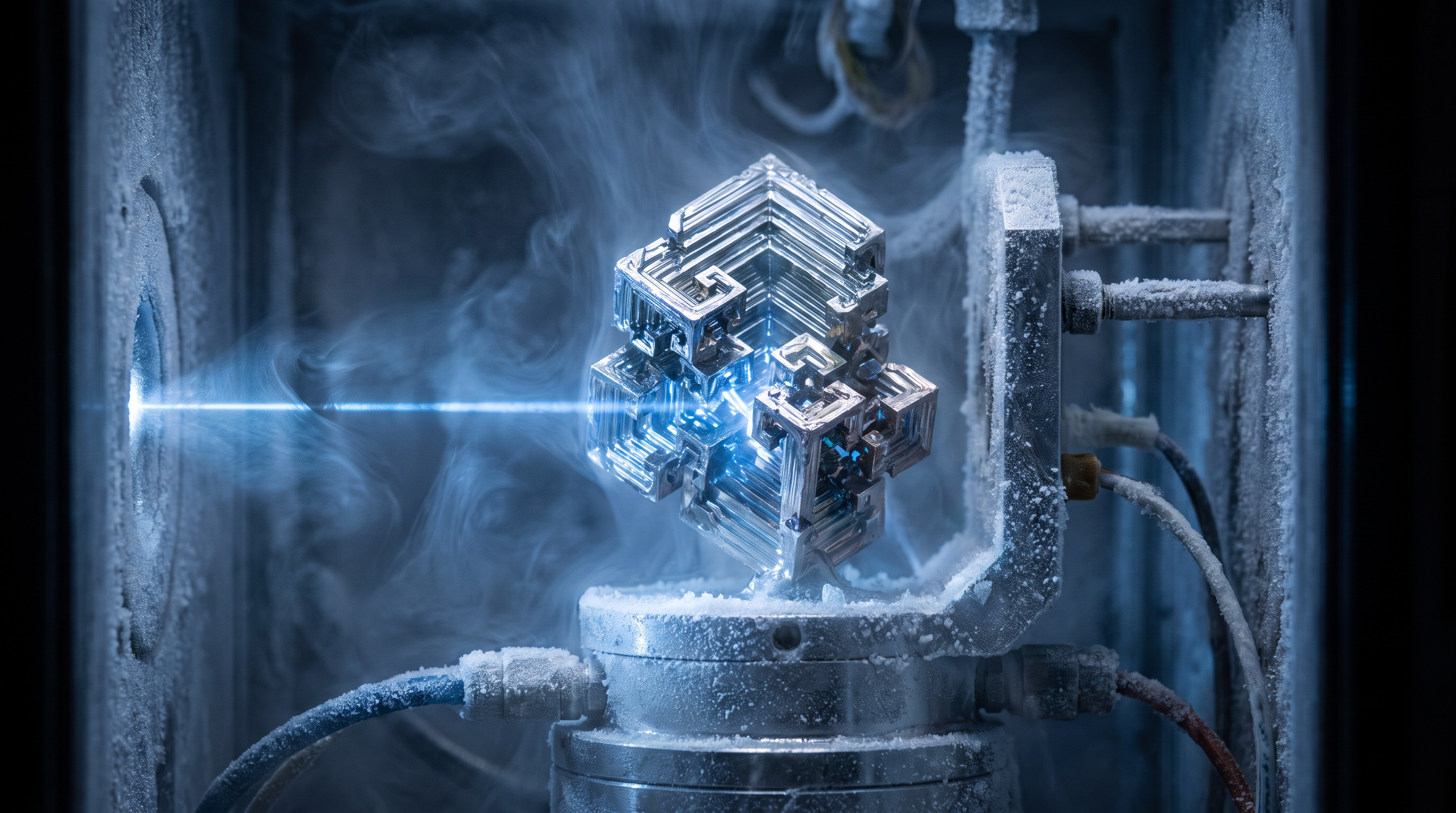
Researchers at the Vienna University of Technology (TU Wien) have successfully detected a high degree of multipartite quantum entanglement within a solid, centimeter-scale crystal. The findings, published in Nature Physics, demonstrate that massive objects made of countless particles can collectively exhibit fundamental quantum effects without being perfectly isolated from their environment.[1][2]
To understand the magnitude of this breakthrough, it helps to look at the material itself. The team did not use a standard block of copper or iron. Instead, they synthesized a crystal of cerium, palladium, and silicon (Ce₃Pd₂₀Si₆), a compound belonging to a mysterious class of materials known as "strange metals."[2]

Strange metals have puzzled condensed matter physicists for nearly forty years. Unlike conventional metals, where electrical resistance arises from electrons bumping into the vibrating atomic lattice, strange metals exhibit resistance that scales perfectly linearly with temperature. This unusual behavior suggested that the electrons were not acting as independent particles, but rather as a highly correlated, quantum-mechanical soup.[3]
Proving that this "soup" was actually entangled, however, required a completely new experimental approach. The TU Wien team, led by experimentalist Silke Bühler-Paschen and theorist Fakher Assaad, turned to neutron scattering.[2]
At the Institut Laue-Langevin (ILL) in France, the researchers bombarded the strange metal crystal with a beam of neutrons. In a normal material, a neutron would transfer its energy to a single, independent particle, scattering in a predictable pattern.[4]
But the Ce₃Pd₂₀Si₆ crystal did not behave normally. The neutron scattering data revealed a collective response that was impossible to explain using conventional, independent-particle models. The crystal was reacting to the disturbance as a coordinated whole.[4]
To quantify this bizarre behavior, the researchers utilized a mathematical framework called "quantum Fisher information." Originally developed by quantum optics pioneer Peter Zoller and his colleagues, this metric measures how sensitively a quantum system responds to an external change.[1][5]

If a system consists of independent particles, its sensitivity is strictly limited, as each particle can only contribute its own isolated reaction. However, if the particles are entangled, the entire system can respond far more strongly than the sum of its individual parts.[5]
If a system consists of independent particles, its sensitivity is strictly limited, as each particle can only contribute its own isolated reaction.
The quantum Fisher information extracted from the neutron scattering data was off the charts. The analysis proved that groups of at least nine quantum entities within the crystal were acting collectively, bound together by multipartite entanglement.[1]
The researchers have dubbed this phenomenon a "Schrödinger's anthill." Rather than attempting to force the entire centimeter-sized crystal into a single, fragile superposition—akin to the famous Schrödinger's cat thought experiment—the material naturally organizes itself into robust, entangled clusters that behave like a coordinated colony of ants.[2]
This discovery represents a massive bridge between two previously distinct fields: solid-state physics and quantum information theory. For years, quantum information scientists have focused on building artificial qubits for computation, while solid-state physicists have studied the natural properties of complex materials.[6]

Now, the tools of quantum information are being used to decode the fundamental nature of matter. The realization that macroscopic crystals can harbor measurable, multipartite entanglement suggests that collective quantum behavior may be a fundamental organizing principle of nature, rather than a delicate laboratory artifact.[6]
The implications for future technology are profound. Strange metals are closely related to high-temperature superconductors—materials that can conduct electricity with zero resistance at relatively warm temperatures. Understanding the entangled nature of strange metals could finally unlock the mechanism behind high-temperature superconductivity, paving the way for lossless power grids and revolutionary magnetic levitation systems.[3]
Furthermore, the extreme sensitivity of these entangled clusters could be harnessed for quantum metrology. Sensors built from strange metal crystals could theoretically detect microscopic fluctuations in magnetic fields or temperature with unprecedented precision, far surpassing the limits of classical instruments.[5]

Despite the excitement, significant uncertainties remain. The entanglement observed in the Ce₃Pd₂₀Si₆ crystal is internal and collective; it cannot yet be easily extracted or manipulated to perform logical operations like a standard qubit.[6]
Decoherence also remains a formidable adversary. While the "anthill" entanglement is surprisingly robust for a macroscopic object, it still relies on the unique quantum critical point of the strange metal, requiring highly specific temperature and magnetic field conditions to survive.[1]
Translating this discovery into practical quantum computers or everyday sensors will require decades of further engineering. Scientists must figure out how to tune and control these entangled clusters without accidentally collapsing their delicate quantum states.
Nevertheless, the philosophical shift is permanent. The observation of quantum entanglement in a crystal large enough to hold in your hand proves that the quantum world is not confined to the microscopic shadows. It is woven into the fabric of the macroscopic world, waiting for the right tools to reveal it.[6]
How we got here
1935
Erwin Schrödinger proposes his famous 'cat' thought experiment to highlight the absurdity of macroscopic quantum states.
1980s
Physicists first discover 'strange metals,' noting their bizarre electrical resistance patterns that defy classical models.
2000s
Theorist Peter Zoller and colleagues develop 'quantum Fisher information' as a mathematical tool to measure entanglement.
June 2026
TU Wien researchers publish findings in Nature Physics, confirming macroscopic entanglement in a centimeter-scale crystal.
Viewpoints in depth
Condensed Matter Physicists
This camp views the discovery as a Rosetta Stone for understanding strange metals and high-temperature superconductors.
By proving that the linear resistance in these materials is driven by macroscopic quantum entanglement, condensed matter physicists believe we can finally model and engineer new superconducting materials. If this collective quantum behavior can be replicated at room temperature, it could revolutionize global energy grids by eliminating electrical resistance entirely.
Quantum Information Theorists
For theorists, the focus is on the successful application of quantum Fisher information to a solid-state system.
This group argues that the experiment validates decades of theoretical math, proving that entanglement isn't just a resource to be artificially manufactured in an isolated quantum computer. Instead, it is a fundamental property of matter that can be measured and quantified in the wild, bridging the gap between abstract quantum theory and tangible materials science.
Experimental Metrologists
This group is focused on the practical applications of the 'Schrödinger's anthill' effect for advanced measurement tools.
Because these entangled clusters are hyper-sensitive to external disturbances, metrologists envision using strange metal crystals as the foundation for next-generation quantum sensors. These devices could theoretically detect microscopic shifts in magnetic fields, temperature, or gravity with unprecedented resolution, far surpassing what classical instruments can achieve.
What we don't know
- Whether this collective entanglement can be isolated and manipulated for use in functional quantum computers.
- If similar macroscopic entanglement exists in more common materials at room temperature.
- The exact mechanism by which the strange metal protects these entangled clusters from immediate decoherence.
Key terms
- Quantum Entanglement
- A phenomenon where particles become linked, such that the state of one instantly influences the state of another, regardless of distance.
- Strange Metal
- A material that exhibits unusual electrical properties, particularly resistance that scales linearly with temperature, defying conventional physics models.
- Quantum Fisher Information
- A mathematical metric used to quantify how sensitively a quantum system responds to external changes, serving as a signature of entanglement.
- Neutron Scattering
- An experimental technique that fires neutrons at a material to measure how they bounce off, revealing the internal atomic and magnetic structure.
- Decoherence
- The process by which a quantum system loses its fragile entangled state due to interaction with its surrounding environment.
Frequently asked
What is a strange metal?
A class of materials that doesn't follow the standard rules of electrical resistance. Instead of resistance changing predictably with the atomic lattice, it scales perfectly linearly with temperature, hinting at deep quantum behavior.
Does this mean the crystal is like Schrödinger's cat?
No. Instead of the entire crystal being in two states at once, groups of particles inside it are entangled and acting collectively—a phenomenon researchers are calling a 'Schrödinger's anthill.'
Can we use this for quantum computers today?
Not immediately. While it proves macroscopic entanglement exists, extracting and controlling these states for computation requires overcoming significant challenges related to environmental noise and decoherence.
Sources
Source coverage
6 outlets
3 viewpoints surfaced






[1]Nature PhysicsCondensed Matter Physicists
Quantum Fisher information in a strange metal
Read on Nature Physics →[2]TU WienExperimental Metrologists
High degree of quantum entanglement detected for first time in centimeter-sized crystal of strange metal
Read on TU Wien →[3]arXivCondensed Matter Physicists
Macroscopic quantum entanglement and strange metal phase transitions
Read on arXiv →[4]Institut Laue-LangevinExperimental Metrologists
Quantum entanglement detected inside a centimetre-sized strange metal
Read on Institut Laue-Langevin →[5]Physical Review LettersQuantum Information Theorists
Quantifying multipartite entanglement via quantum Fisher information
Read on Physical Review Letters →[6]Factlen Editorial TeamQuantum Information Theorists
Synthesis by Factlen editorial team
Read on Factlen Editorial Team →


Every angle. Every day.
Get science stories with full source coverage and perspective breakdowns delivered to your inbox.